| Catalog No | Package | Original Price | Price | Inventory | Quantity | Operating |
|---|---|---|---|---|---|---|
| BP0853-100mg | 100mg | $30.00 | Sign in |
|


Product name: Levodopa
Synonym name: 3,4-Dihydroxy-L-phenylalanine;Bendopa; Brocadopa; Dopar; Larodopa
Catalogue No.: BP0853
Cas No.: 59-92-7
Formula: C9H11NO4
Mol Weight: 197.19
Botanical Source:
Physical Description:
Type of Compound: Phenylpropanoids
Purity: 95%~99%
Analysis Method: HPLC-DAD or/and HPLC-ELSD
Identification Method: Mass, NMR
Packing: Brown vial or HDPE plastic bottle
Storage: Store in a well closed container, protected from air and light. Put into refrigerate or freeze for long term storage.
Whenever possible, you should prepare and use solutions on the same day. However, if you need to make up stock solutions in advance, we recommend that you store the solution as aliquots in tightly sealed vials at -20℃. Generally, these will be useable for up to two weeks.
The product could be supplied from milligrams to grams
Inquire for bulk scale.
Chengdu Biopurify Phytochemicals Ltd. is a leading company in the research, development, manufacture and marketing of High Quality Phytochemicals and Extracts(especially Active Ingredients from Traditional Chinese Medicine,TCM), Natural Active Pharmaceutical Ingredients worldwide.
The main services:
A. Supply active ingredients and reference standards of TCM, from mgs to kgs scale
B. Custom extraction and purification, target Herb Active Ingredients
C. Custom synthesis and semi-synthesis for Natural Active Ingredients
D. CR(contract research), CM(contract manufacture) and PD(process development) services from lab scale, pilot scale to commercial scale(GMP is also available)
E. TCM compounds library for drug screen,more than 3000 compounds available, many of them are rare and unique.
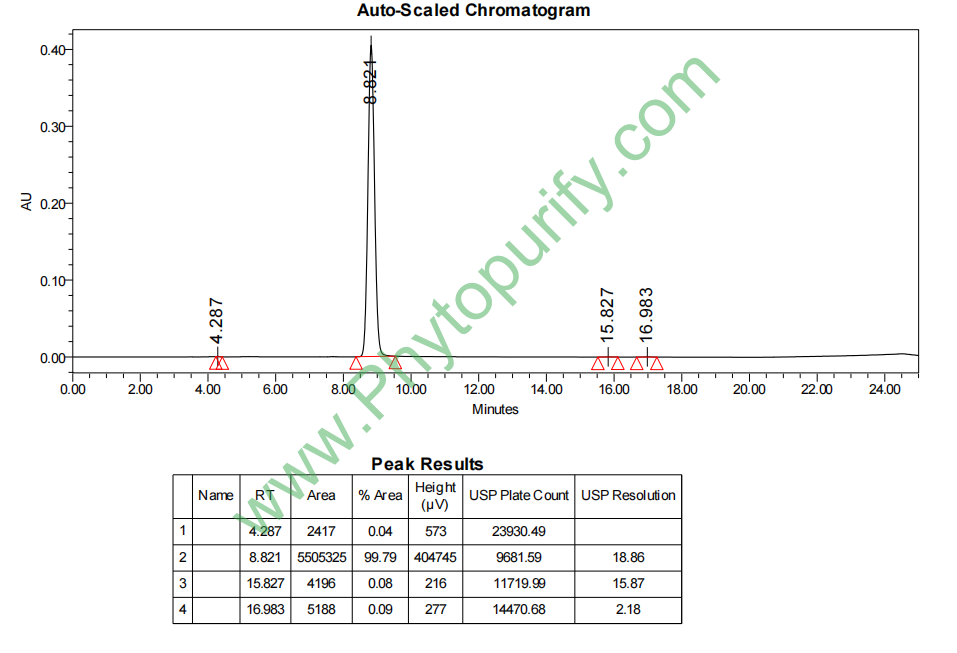
HPLC of Levodopa
Storage conditions:Short-term storage at 2~8℃, long-term storage at -20 ~ -80℃
Levodopa (L-DOPA), as a classic natural derivative drug, has become the gold standard drug for treating Parkinson's Disease (PD) since its introduction into clinical practice in the 1960s. Parkinson's disease is a neurodegenerative disease characterized by progressive loss of dopaminergic neurons in the central nervous system, characterized by symptoms such as bradykinesia, muscle rigidity, tremors, and postural instability. As a precursor of dopamine, levodopa can cross the blood-brain barrier and be converted into dopamine by dopamine decarboxylase in the brain, supplementing the reduced dopamine levels caused by neuronal damage and improving patients' motor symptoms.
Levodopa not only plays an important role in the field of neuropharmacology, but its biosynthesis as a natural product, plant origin, and multi-target mechanism of action have also attracted widespread attention. This article provides a systematic review of the chemical structure and physicochemical properties, plant sources and extraction methods, pharmacological activity and mechanism of action, pharmacological evaluation and pharmacokinetic characteristics of levodopa. Finally, the clinical application prospects of levodopa are discussed, aiming to provide reference for natural product pharmacology and Parkinson's disease treatment research.
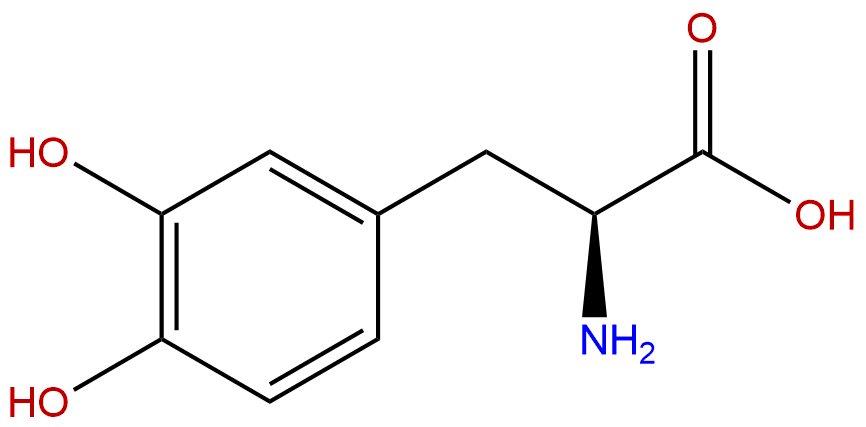
The chemical name of levodopa is (2S) -2-amino-3- (3,4-dihydroxyphenyl) propionic acid, with a molecular formula of C9H11NO4 and a molecular weight of 197.19. Its structural feature is a tyrosine derivative with two adjacent hydroxyl groups connected to the L - α - amino acid backbone via a benzene ring (doba group). L-dopa is an optically active isomer of dopa in the L-configuration, possessing non protein amino acid properties.
In terms of physical and chemical properties, the LogP value of levodopa is -1.7667, indicating its strong hydrophilicity and good water solubility (solubility of about 6.2143 mg/mL), which is beneficial for its absorption and distribution in vivo. Its topological polar surface area (TPSA) is 103.78 Å ², indicating that the molecule has strong polarity and hydrogen bond donor/acceptor ability. Although levodopa itself has low blood-brain barrier permeability, it enters the central nervous system through specific amino acid transporters. The negative result of hERG channel inhibition experiment indicates a low risk of cardiac toxicity; The Ames test result is 0, indicating no significant genetic toxicity.
Levodopa, as a naturally occurring non protein amino acid, is widely distributed in various plants, especially leguminous plants and certain tropical plants. The most famous plant source is the African legume Mucuna pruriens, whose seeds contain abundant amounts of levodopa, ranging from 3% to 6%. In addition, other plants such as Phaseolus vulgaris (beans) and Vicia faba (broad beans) also contain a certain amount of levodopa.
The traditional methods for extracting levodopa mainly include water extraction, alcohol extraction, and acid extraction. The general process is to crush plant seeds, extract them with hot water or acidic solution, then remove solid impurities through filtration and centrifugation, and purify them through activated carbon adsorption, ion exchange column, or high-performance liquid chromatography (HPLC). In recent years, the application of ultrasound assisted extraction, enzymatic extraction, and membrane separation technologies has improved extraction efficiency and purity. During the extraction process, attention should be paid to preventing the oxidative degradation of levodopa, and antioxidants such as ascorbic acid are often added to maintain its stability.
The main pharmacological activity of levodopa is focused on its role as a precursor of dopamine. After entering the body, levodopa is absorbed through the amino acid transport system and subsequently converted into dopamine by aromatic L-amino acid decarboxylase (AADC) in the brain, supplementing the missing neurotransmitters in Parkinson's disease patients and alleviating motor symptoms. In addition, levodopa also exhibits certain antioxidant, anti-inflammatory, and neuroprotective effects.
Experimental studies have shown that levodopa has the activity of a plant growth inhibitor and may exert its effects by interfering with the dopamine metabolic pathway in plants. In animal models, levodopa can significantly improve motor disorders, alleviate tremors and muscle rigidity, and studies on metabolites in mice reveal that its metabolic process involves multiple enzyme systems. In addition, as a hapten and allelochemical, levodopa can regulate immune responses, indicating its potential role in neuroinflammation.
However, long-term use of levodopa may cause motor complications such as dyskinesia and "on-off" phenomenon, indicating its complex pharmacological activity and the need for combination therapy with other drugs to optimize efficacy.
The core mechanism of action of levodopa is to restore dopaminergic neuron function by supplementing dopamine levels in the brain. Its main molecular targets and related signaling pathways include:
Aromatic L-amino acid decarboxylase (AADC)Catalyzing the conversion of levodopa to dopamine is a key enzyme for the pharmacological effects of levodopa.
Dopamine receptor (D1-D5 subtype)Dopamine binds with its receptor to regulate the basal ganglia neural circuit and improve motor control.
AMPK(PRKAA1)As an energy metabolism regulatory enzyme, AMPK is involved in the metabolic homeostasis of neurons, and levodopa may affect neuroprotection by regulating AMPK signaling.
BCL2 Anti apoptotic protein, levodopa may promote neuronal survival by regulating BCL2 expression.
MAOA (monoamine oxidase A)The metabolic enzyme of dopamine affects the degradation rate of dopamine and regulates the balance of neurotransmitters.
PTPN1 (protein tyrosine phosphatase 1)Participate in signal transduction and may affect neuronal function.
BACE1 (β - secretase 1)Related to neurodegenerative diseases, the regulatory effect of levodopa on it is still under study.
APEX1、ALOX15、ALOX5、AKR1B1 Levodopa may exert neuroprotective effects by regulating these targets, which are involved in oxidative stress and inflammatory responses.
In summary, levodopa not only exerts direct effects as a dopamine prodrug, but also may regulate neuronal metabolism, apoptosis, and inflammatory response through multiple targets and pathways, reflecting its complex pharmacological mechanism.
The pharmacological evaluation of levodopa shows that it has good safety and efficacy. The molecular weight is 197.19, and a smaller molecular structure is advantageous for in vivo distribution. Its negative LogP value and high TPSA indicate strong hydrophilicity, making it difficult to passively diffuse and penetrate the blood-brain barrier, but relying on active transport of amino acid transporters into the central nervous system. The low permeability of the blood-brain barrier is a limiting factor in its clinical application, and it is usually used in combination with aromatic L-amino acid decarboxylase inhibitors (such as carbidopa) to reduce peripheral metabolism and increase effective concentration in the brain.
Pharmacokinetic studies have shown that oral levodopa is rapidly absorbed with a short half-life (about 1-2 hours), and its bioavailability is greatly influenced by gastrointestinal factors. Its metabolism mainly occurs in the periphery and brain, and its metabolites include dopamine and its oxidative products. Levodopa does not significantly inhibit hERG channels, has good cardiac safety, and has no significant genetic toxicity, meeting the requirements for long-term medication.
However, long-term use of levodopa may lead to drug efficacy fluctuations and exercise complications, indicating a complex relationship between its pharmacokinetic properties and clinical efficacy, and further optimization of the dosing regimen and dosage form is needed.
As the cornerstone of Parkinson's disease treatment, levodopa has significant therapeutic effects in improving motor symptoms, but its long-term application faces many challenges, such as motor complications, drug efficacy fluctuations, and limited improvement of non motor symptoms. The research directions for future clinical applications mainly include:
Combination therapy strategy Combined with drugs such as dopa decarboxylase inhibitors, MAO-B inhibitors, COMT inhibitors, etc., optimize the pharmacokinetics of levodopa, prolong the duration of efficacy, and reduce side effects.
New drug delivery system Develop sustained-release formulations, controlled release microspheres, nasal inhalers, and direct brain delivery technologies to increase drug concentration in the brain and reduce peripheral side effects.
personalized treatment Based on genetics and metabolomics, develop personalized dosage and administration plans to improve efficacy and safety.
Neuroprotective and Disease Modifying Effects Exploring the potential of levodopa and its derivatives in neuroprotection, antioxidant and anti-inflammatory aspects, combined with novel biomarkers, to promote early disease intervention.
Natural product resource development In depth research on the extraction of levodopa from natural resources such as Mucuna pruriens and the synergistic effects of its complex components, providing new ideas for the development of natural medicines.
In summary, levodopa remains an irreplaceable drug for the treatment of Parkinson's disease, and its clinical application value is expected to be enhanced through interdisciplinary innovation in the future.
As a typical natural derivative drug, levodopa has played an irreplaceable role in the treatment of Parkinson's disease. Its unique chemical structure and physicochemical properties determine its pharmacological activity and pharmacokinetic characteristics. The plant sources are abundant, and the extraction process is constantly optimized to provide guarantees for its large-scale production. The multi-target mechanism of action reveals its complex pharmacological effects, providing a theoretical basis for combination therapy and new drug development. The drug efficacy evaluation shows that it has good safety, but it still needs to overcome the problems of blood-brain barrier penetration and long-term drug side effects. In the future, with the development of biotechnology and drug delivery systems, the clinical application prospects of levodopa are broad, and it is expected to bring more effective and safe treatment options for Parkinson's disease patients.
Through a systematic review of levodopa, it is expected to promote in-depth research in the fields of natural product pharmacology and neurological disease treatment, and to drive innovation and translational applications of natural product drugs.
