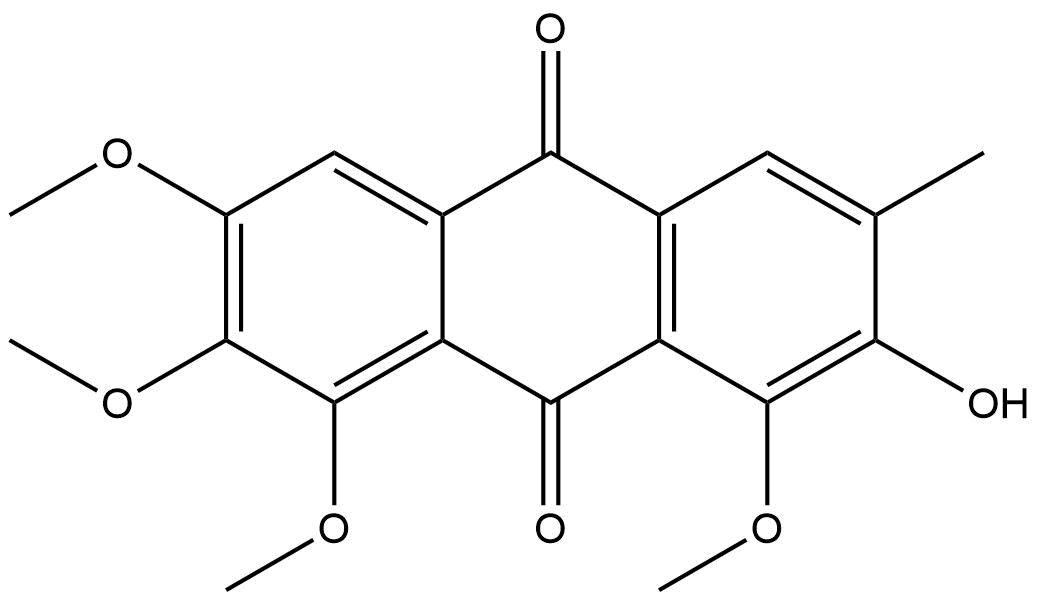


Product name: Chrysoobtusin
Synonym name:
Catalogue No.: BP4038
Cas No.: 70588-06-6
Formula: C19H18O7
Mol Weight: 358.346
Botanical Source: CassiaeSemen
Physical Description:
Type of Compound: Anthraquinones
Purity: 95%~99%
Analysis Method: HPLC-DAD or/and HPLC-ELSD
Identification Method: Mass, NMR
Packing: Brown vial or HDPE plastic bottle
Storage: Store in a well closed container, protected from air and light. Put into refrigerate or freeze for long term storage.
Whenever possible, you should prepare and use solutions on the same day. However, if you need to make up stock solutions in advance, we recommend that you store the solution as aliquots in tightly sealed vials at -20℃. Generally, these will be useable for up to two weeks.
The product could be supplied from milligrams to grams
Inquire for bulk scale.
For Reference Standard and R&D, Not for Human Use Directly.
Storage conditions:Short-term storage at 2~8℃, long-term storage at -20 ~ -80℃
Chrysoobtusin is a natural anthraquinone product isolated from the traditional Chinese medicinal herb Semen Cassiae. Cassia seed, as a widely used medicinal herb in traditional Chinese medicine, has a long history and is mainly used for various functions such as liver protection, vision improvement, and bowel movements. In recent years, with the deepening development of natural product pharmacology, quercetin has received widespread attention due to its unique chemical structure and significant biological activity, especially in the field of antioxidant potential. The core role of antioxidant stress in various chronic diseases and aging processes makes quercetin an important subject for studying natural antioxidants.
This article aims to systematically review the chemical structure and physicochemical properties, plant sources and extraction methods, pharmacological activity and mechanism of action, pharmacological evaluation and pharmacokinetic characteristics of quercetin, and explore its future clinical application prospects, providing theoretical basis and research reference for researchers and drug developers in related fields.
Huangxianmingsu is a typical anthraquinone derivative with a molecular formula of C20H18O6 and a molecular weight of 358.3460. Its structure contains two anthraquinone core units with multiple hydroxyl substitutions, endowing it with strong electron donor ability and free radical scavenging potential. The LogP value of quercetin is 2.8038, indicating that it has moderate lipid solubility, which is beneficial for membrane penetration and in vivo distribution. Its polar surface area (TPSA) is 91.29 Å ², indicating that the molecule has a certain polarity that facilitates binding to biomolecule targets.
The water solubility is low (0.0111 mg/mL), which to some extent limits its oral bioavailability, but its blood-brain barrier permeability is high, indicating that quercetin may play a role in the central nervous system. The hERG channel inhibition experiment showed a negative result, indicating a low risk of cardiac toxicity. The Ames test value is 1.2, indicating that quercetin has no significant mutagenicity and is relatively safe.
The main source of quercetin comes from the mature seeds of plants in the Cassiaceae family, namely Cassia obtusifolia L. and Cassia tora L. Cassia seed is widely used in traditional Chinese medicine, with the effects of clearing the liver, improving vision, moistening the intestines, and promoting bowel movements. Its main active ingredients include anthraquinones, flavonoids, and polysaccharides, among which quercetin, as a representative component of anthraquinones, has attracted much attention for its biological activity, although its content is not as high as total anthraquinones.
The extraction of quercetin is usually carried out by organic solvent extraction method. Using dried and crushed cassia seeds as raw materials, reflux extraction is carried out using ethanol or methanol, followed by separation and purification techniques such as liquid-liquid distribution and column chromatography. In recent years, the application of ultrasound assisted extraction and supercritical fluid extraction technology has improved the extraction efficiency and purity of quercetin. During the purification process, silica gel column chromatography and high-performance liquid chromatography (HPLC) are widely used for separation and quantitative analysis.
The pharmacological activity research of Polygonatum sibiricum mainly focuses on antioxidant, anti-inflammatory, hepatoprotective, and neuroprotective aspects.
Huangxianmingsu exhibits significant antioxidant capacity. In vitro experiments have shown that quercetin can effectively scavenge free radicals such as DPPH and ABTS, reducing oxidative stress damage. Its antioxidant effect is closely related to its polyhydroxyanthraquinone structure, which can neutralize reactive oxygen species (ROS) through electron donor action.
In cell models, quercetin can upregulate the expression of various antioxidant enzymes in cells, such as superoxide dismutase (SOD1, SOD2), catalase (CAT), glutathione peroxidase (GPX1), and heme oxygenase-1 (HMOX1), thereby enhancing the cell's antioxidant defense ability and protecting it from oxidative damage.
Cassia seed and its active ingredient cassia extract have shown good hepatoprotective effects in various liver injury models. Huangxianming Su can alleviate liver cell damage caused by drugs or chemicals, reduce liver oxidative stress levels, inhibit liver inflammation, and promote liver cell repair and regeneration. Related animal experiments have shown that quercetin can significantly reduce serum transaminase levels and alleviate liver tissue fibrosis.
Huangqianmingsu exerts anti-inflammatory effects by regulating oxidative stress-related signaling pathways, inhibiting the production of inflammatory factors. Its high blood-brain barrier permeability suggests its potential protective role in neurological diseases. Preliminary studies have shown that quercetin can alleviate oxidative damage to nerve cells, inhibit neuroinflammatory responses, and has the potential to treat neurodegenerative diseases.
The mechanism of action of quercetin is mainly achieved by regulating the intracellular antioxidant defense system and related signaling pathways. Its key molecular targets include:
NFE2L2/NRF2 signaling pathway Huangqianmingsu can activate nuclear factor E2 related factor 2 (NFE2L2/NRF2), promote its nuclear translocation, enhance the transcriptional expression of antioxidant genes such as SOD1, SOD2, CAT, GPX1, and HMOX1, improve cellular antioxidant capacity, and slow down oxidative stress damage.
Matrix metalloproteinases (MMP1, MMP3)Huangqianmingsu's regulation of MMPs helps to inhibit tissue matrix degradation, alleviate inflammation and fibrosis, and promote tissue repair.
Tyrosinase (TYR)The regulation of TYR by quercetin may affect melanin synthesis, indicating its potential application in skin protection and pigment related diseases.
In addition, Huangxianmingsu exhibits a comprehensive pharmacological effect of multi-target and multi mechanism by clearing free radicals, reducing ROS levels, alleviating cell membrane lipid peroxidation, protecting mitochondrial function, and preventing cell apoptosis and necrosis.
The pharmacological parameters of Huangxianmingsu indicate that it has good development potential. The molecular weight is moderate (358.3460), with a LogP value of around 2.8, which conforms to Lipinski's rule and is beneficial for oral absorption. The TPSA is 91.29, which is suitable for cell membrane penetration. Low water solubility may affect oral bioavailability, but solubility and absorption can be improved through formulation improvements such as nanocarriers and solid dispersions.
The high permeability of the blood-brain barrier suggests its advantages in the treatment of central nervous system diseases. HERG inhibition negative and Ames test low mutagenicity indicate good safety and low risk of cardiac toxicity.
At present, there is limited research on the pharmacokinetics of quercetin. Preliminary animal experiments have shown that it is rapidly absorbed orally and widely distributed in the body. Its metabolism is mainly through the liver enzyme system, and its excretion pathways are mainly bile and urine. Further systematic research is needed in the future to investigate its metabolic kinetics, in vivo stability, and potential drug interactions.
Based on the significant antioxidant, hepatoprotective, and neuroprotective effects of quercetin, it has broad application prospects in the prevention and treatment of various diseases. Specifically, it includes:
liver disease Huangxianmingsu can be used as an adjuvant therapy for diseases such as hepatitis, fatty liver, and liver fibrosis, reducing liver damage and promoting liver function recovery through antioxidant and anti-inflammatory mechanisms.
ophthalmic diseases Cassia seed is traditionally used for improving eyesight, while quercetin may protect retinal cells through antioxidant effects, preventing eye diseases such as macular degeneration and cataracts that are related to oxidative stress.
Neurodegenerative diseases The high blood-brain barrier permeability makes quercetin potentially neuroprotective in neurodegenerative diseases such as Alzheimer's disease and Parkinson's disease.
Skin Diseases and Beauty By regulating TYR and antioxidant mechanisms, quercetin may be applied in fields such as pigmentation and skin aging.
Future research should focus on preclinical safety evaluation, dosage form optimization, and clinical trial design of quercetin, further clarifying its pharmacological and pharmacokinetic characteristics, and promoting its clinical translation.
As an important anthraquinone derivative in Cassia seed, Huangxianmingsu exhibits significant pharmacological potential due to its unique chemical structure and multi-target antioxidant activity. Its research achievements in liver protection, anti-inflammatory, neuroprotection and other aspects provide a solid foundation for the development of new natural medicines. Although the pharmacokinetic and clinical research on it is still in its infancy, its good pharmacokinetic parameters and safety characteristics lay a solid foundation for future drug development.
In summary, as a natural product with a wide range of biological activities, quercetin deserves more attention and in-depth research in the fields of natural medicine research and new drug development, promoting its clinical application and contributing new natural medicine resources to human health.
