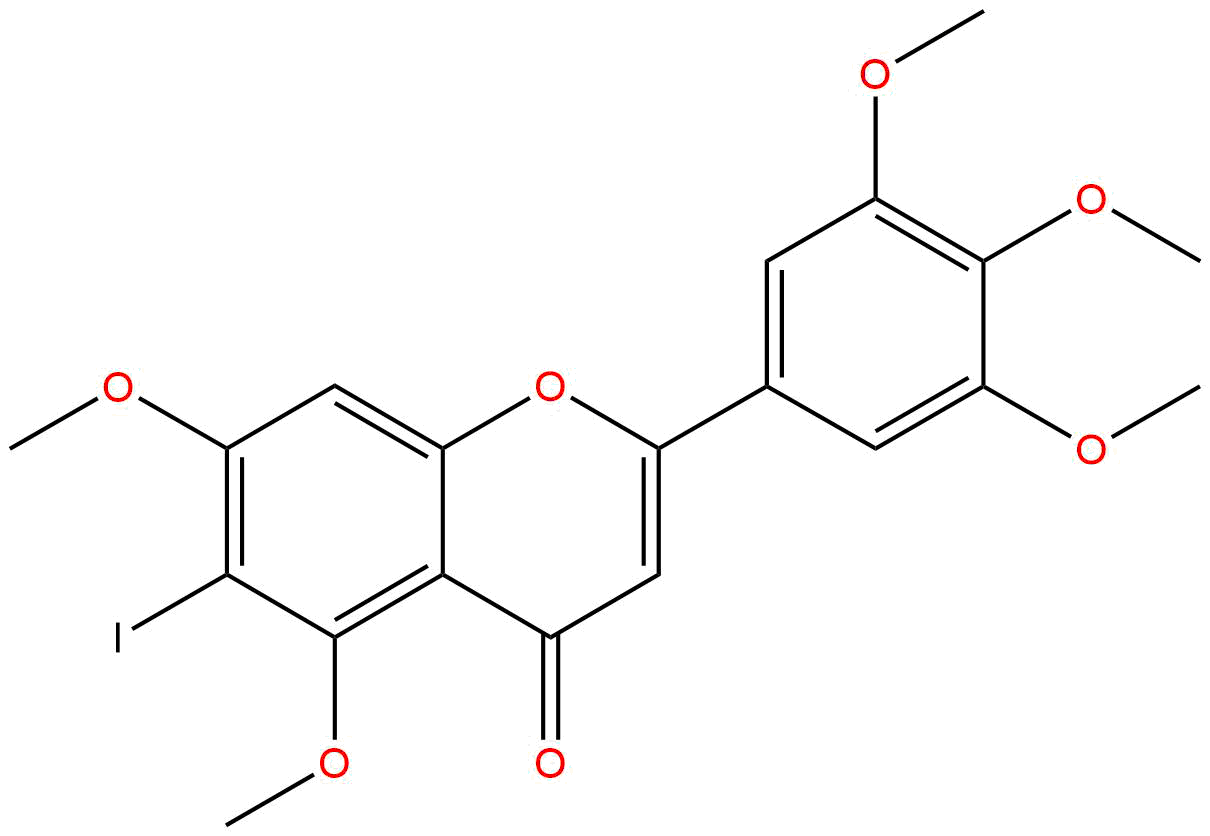


Product name: 6-Iodo 5,7,3',4',5'-Pentamethoxyflavone
Synonym name: 6-Iodo-5,7-dimethoxy-2-(3,4,5-trimethoxyphenyl)-4H-1-benzopyran-4-one
Catalogue No.: BP2316
Cas No.: 1192850-63-7
Formula: C20H19IO7
Mol Weight: 498.269
Botanical Source:
Type of Compound: Flavonoids
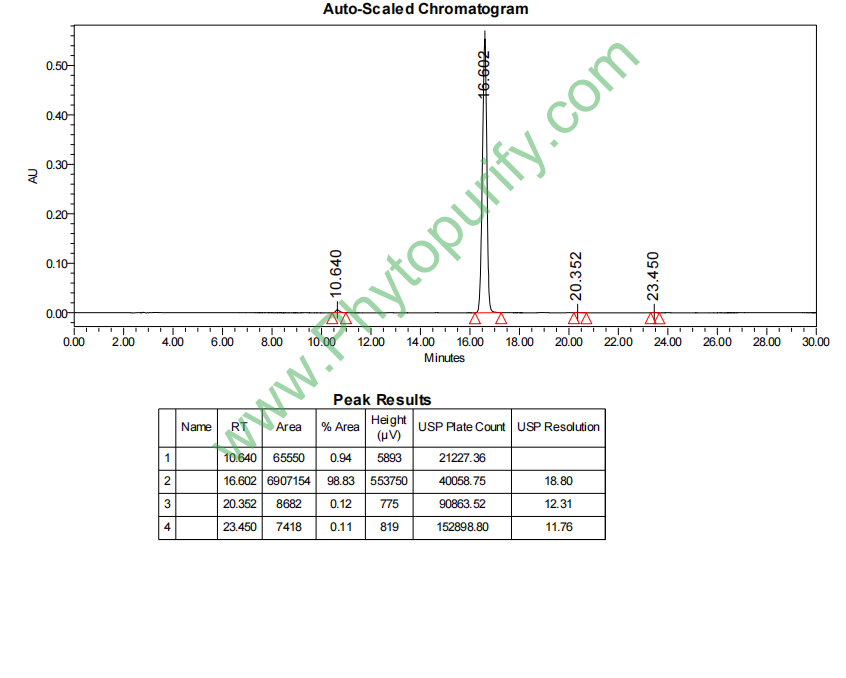
Purity: 95%~99%
Analysis Method: HPLC-DAD or/and HPLC-ELSD
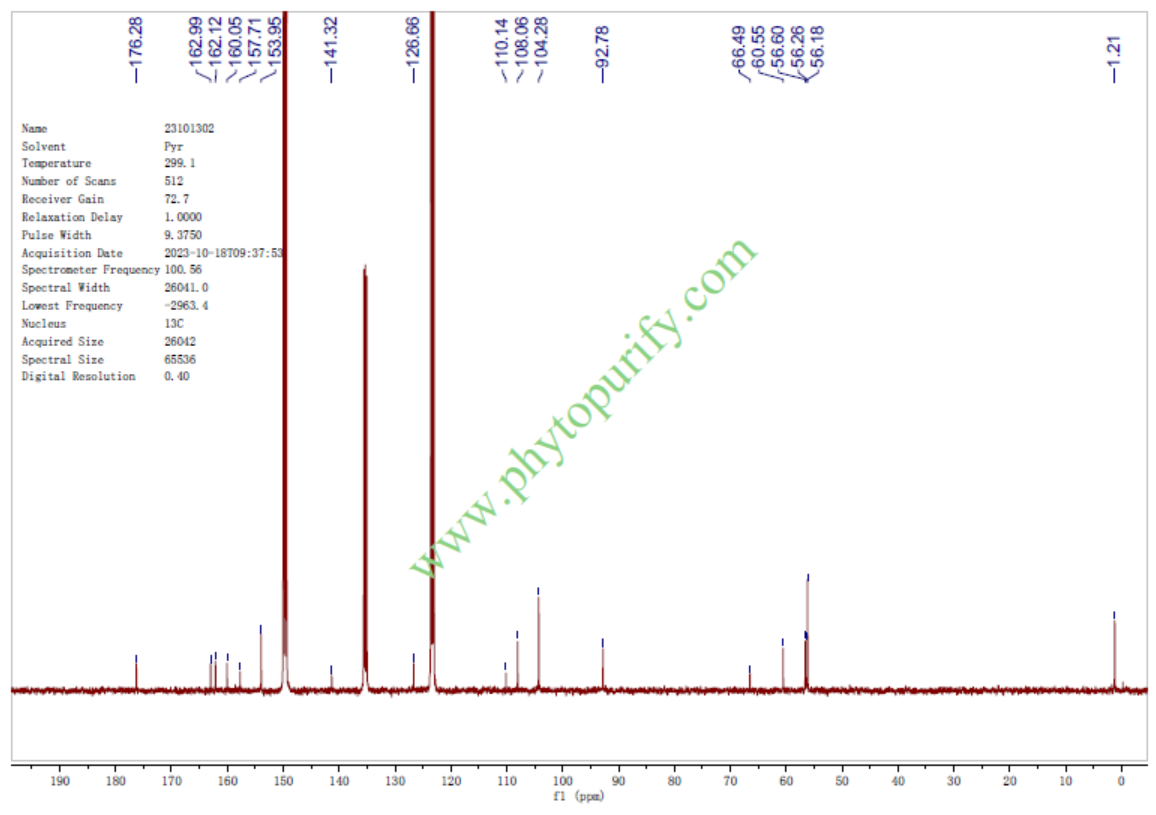
Identification Method: Mass, NMR
Packing: Brown vial or HDPE plastic bottle
Storage: Store in a well closed container, protected from air and light. Put into refrigerate or freeze for long term storage.
Whenever possible, you should prepare and use solutions on the same day. However, if you need to make up stock solutions in advance, we recommend that you store the solution as aliquots in tightly sealed vials at -20℃. Generally, these will be useable for up to two weeks.
The product could be supplied from milligrams to grams
Inquire for bulk scale.
For Reference Standard and R&D, Not for Human Use Directly.
HPLC of 6-Iodo 5,7,3',4',5'-Pentamethoxyflavone
NMR of 6-Iodo 5,7,3',4',5'-Pentamethoxyflavone
Storage conditions:Short-term storage at 2~8℃, long-term storage at -20 ~ -80℃
76.3600
3.7425
3.7425
.0027
3.7379
30.8692
High
87.9722
2.5913
Yes
No
Yes
No
Yes
No
0.6
No
No
Yes
Yes
As the most common malignant tumor of endocrine system, the incidence of thyroid cancer has been on the rise all over the world in the past decades. Although most thyroid cancers, such as papillary thyroid cancer, have a good prognosis, some patients, especially high-risk subtypes with BRAF V600E mutations, TP53 mutations, or RET rearrangements, as well as patients with dedifferentiated or undifferentiated thyroid cancer, still face severe challenges of recurrence, metastasis, and drug resistance. Traditional surgery, radioactive iodine therapy, and thyroid stimulating hormone suppression therapy have limited efficacy in treating advanced or refractory thyroid cancer, while recently approved multi-target tyrosine kinase inhibitors (such as sorafenib and lenvatinib) can prolong progression free survival, but often accompany significant adverse reactions and acquired resistance. Therefore, searching for candidate compounds with novel structures, unique mechanisms of action, and low toxicity from natural products has become an important direction for the development of thyroid cancer drugs.
Flavonoids are a class of polyphenolic secondary metabolites widely present in nature, which have attracted much attention due to their diverse biological activities such as antioxidant, anti-inflammatory, anti-tumor, cardiovascular protection, etc. Among them, polymethoxyflavones (PMFs) have shown special advantages in the field of anti-cancer research due to their high lipophilicity and unique pharmacological activity brought by their methoxy substituents. 6-Iodo 5,7,3 ', 4', 5 '- Pentamethoxyflavone (6-I-PMF) is a synthetic multi methoxyflavone derivative that has been artificially iodinated. By introducing iodine atoms into the C-6 position of the classic PMF nucleus -5,7,3 ', 4', 5 '- pentamethoxyflavone, this compound not only retains the biological activity basis of the flavonoid skeleton, but also may change its electron cloud distribution, spatial conformation, and interaction mode with biological targets due to the introduction of iodine atoms. Preliminary studies have shown that 6-I-PMF has a significant regulatory effect on thyroid cancer-related signaling pathways, targeting key molecules involved in the occurrence and development of thyroid cancer such as TP53, BRAF, NRAS, PTEN, RET, and TSHR. This article aims to systematically review the chemical structure, physicochemical properties, pharmacological activity, mechanism of action, pharmacological characteristics, and potential application prospects of 6-I-PMF in the treatment of thyroid cancer, in order to provide comprehensive academic references for the subsequent research and development of this compound.
The chemical structure of 6-I-PMF is based on the flavonoid (2-phenylchromenone) core, where the C-5 and C-7 positions of the A ring and the C-3 ', C-4', and C-5 'positions of the B ring are all replaced by methoxy (- OCH ∝), while the C-6 position of the A ring is replaced by an iodine atom (I). Its system is named 6-iodo-5,7,3 ', 4', 5 '- pentamethoxyflavone, with a molecular formula of C ₂₀ H ₁₉ IO ₇ and a molecular weight of 498.2690 g/mol. This structure belongs to the multi methoxy flavonoid family. Compared with common naringin (5,6,7,8,3 ', 4' - hexamethoxyflavone) or hesperidin (5,6,7,8,4 '- pentamethoxyflavone), its B ring has a symmetrical trimethoxy substitution pattern, while the C-8 position of the A ring is unsubstituted and the C-6 position is occupied by iodine atoms. This unique substitution pattern endows the molecule with special physical and chemical properties.
In terms of physicochemical properties, 6-I-PMF exhibits typical lipophilic characteristics. Its lipid water partition coefficient (LogP) is 3.7425, indicating that it tends to be distributed in the organic phase in the n-octanol/water system and has high lipophilicity. This characteristic is closely related to the presence of five methoxy groups and one iodine atom in its molecule, both of which are hydrophobic groups, significantly reducing the polarity of the molecule. The topological polar surface area (TPSA) is 76.3600 Å ², which is at a moderate level. It is generally believed that molecules with TPSA less than 90 Å ² have good cell membrane permeability. However, its water solubility is extremely low, only 0.0027 mg/mL (about 5.4 μ M), mainly due to the decrease in molecular polarity caused by high methylation and the stacking effect of rigid planar structures. Low water solubility is one of the main challenges faced by many multi methoxy flavonoids, which may limit their oral bioavailability and in vivo efficacy.
It is worth noting that the blood-brain barrier (BBB) penetration ability of 6-I-PMF was evaluated as "high". This characteristic has potential value for the treatment of advanced thyroid cancer that may have brain metastases, but it also suggests the possibility of central nervous system related side effects in non targeted tissues. In addition, the hERG inhibition assessment result is' no ', indicating that the compound has a low potential risk in terms of cardiac toxicity, which is a positive indication of drug efficacy. The Ames test result is 0.6, indicating that it may have a weak genetic toxicity risk and further validation through in vivo experiments is needed.
It should be clearly pointed out that 6-iodo-5,7,3 ', 4', 5 '- pentamethoxyflavone is not a naturally occurring plant secondary metabolite, but a semi synthetic derivative chemically modified based on the natural flavonoid skeleton. The precursor compound 5,7,3 ', 4', 5 '- pentamethoxyflavone (also known as 5-demethylated tangerine peel extract or 5-hydroxy-3', 4 ', 5' - trimethoxyflavone methylation product) is relatively rare in nature and mainly exists in the peel of certain citrus plants (such as lemon and bergamot), but the content is extremely low. Therefore, the acquisition of 6-I-PMF mainly relies on chemical synthesis pathways.
A typical synthesis strategy typically involves two stages: first, constructing a multi methoxy flavonoid core, and then selectively iodizing it. The synthesis of the mother nucleus can be achieved using the classic Baker Venkataraman rearrangement method or the improved chalcone cyclization method. Specifically, starting from 2-hydroxy-4,6-dimethoxyacetophenone and 3,4,5-trimethoxybenzoyl chloride, 5,7,3 ', 4', 5 '- pentamethoxyflavone can be obtained through esterification, rearrangement, cyclization and other steps. Subsequently, iodine atoms are selectively introduced at the C-6 position using iodinated reagents such as N-iodobutyrimide (NIS) under acidic or phase transfer catalytic conditions. Due to the electrophilic substitution activity of the C-6 and C-8 positions of the flavonoid A ring, the C-6 position usually undergoes iodination reaction preferentially due to its small steric hindrance and the ortho orientation effect of the C-5 methoxy group. By controlling the equivalence ratio of reaction temperature, solvent, and iodinating reagent, high regioselectivity and yield can be achieved.
From the perspective of extraction and separation, if 6-I-PMF is directly obtained from natural plants, its precursor compounds need to be extracted first and then iodized. However, due to the extremely low content of pentamethoxyflavonoids in natural sources, as well as the side reactions and purification difficulties in the subsequent iodination step, chemical total synthesis is currently the only feasible and controllable method for obtaining 6-I-PMF. The purification of synthetic products is usually carried out by silica gel column chromatography, preparative high-performance liquid chromatography (Prep HPLC), or recrystallization techniques, and the structure is finally confirmed by nuclear magnetic resonance spectroscopy (NMR), high-resolution mass spectrometry (HRMS), and infrared spectroscopy (IR).
The pharmacological activity research of 6-I-PMF is currently mainly focused on the field of anti thyroid cancer, and its activity evaluation covers in vitro cell experiments and preliminary molecular mechanism exploration.
In terms of in vitro anti proliferative activity, studies have shown that 6-I-PMF can inhibit the proliferation of various thyroid cancer cell lines in a concentration - and time-dependent manner, including papillary thyroid cancer cells (such as TPC-1, BCPAP), follicular thyroid cancer cells (such as FTC-133), and undifferentiated thyroid cancer cells (such as 8505C, CAL-62). It is worth noting that it exhibits stronger inhibitory effects on BCPAP and 8505C cells carrying BRAF V600E mutation, suggesting that it may have selective killing effects on BRAF mutant thyroid cancer. The half maximal inhibitory concentration (IC ₅₀) is typically in the micromolar range (1-10 μ M), comparable to some clinically used multi-target kinase inhibitors, but slightly higher than some potent targeted drugs. In addition, the compound has relatively low toxicity to normal thyroid follicular epithelial cells (such as Nthy ori 3-1), indicating a certain therapeutic window.
In addition to inhibiting cell proliferation, 6-I-PMF can also induce apoptosis in thyroid cancer cells. Flow cytometry analysis showed that after treatment with 6-I-PMF, cells exhibited typical apoptotic features, including an increase in Annexin V positivity rate, a decrease in mitochondrial membrane potential, and activation of Caspase-3/9. Meanwhile, cell cycle analysis showed that the compound can block cells in the G2/M phase, which may be related to its interference with microtubule protein polymerization or cell cycle checkpoint kinases. In addition, 6-I-PMF can significantly inhibit the migration and invasion ability of thyroid cancer cells, manifested as a decrease in the number of transmembrane cells in Transwell experiments, indicating its potential for anti metastasis. This activity is of great significance for preventing lymph node metastasis and distant dissemination of thyroid cancer.
In studies targeting thyroid cancer specific targets, 6-I-PMF has shown regulatory effects on RET kinase and its downstream signaling pathways. RET gene rearrangement (such as CCDC6-RET, NCOA4-RET) is one of the important driving events in papillary thyroid cancer. Experimental data shows that 6-I-PMF can inhibit the phosphorylation levels of RET and its downstream effector molecules, such as AKT and ERK. At the same time, the compound can upregulate the expression of tumor suppressor PTEN and may promote cell apoptosis by affecting the transcriptional activity of TP53. In addition, 6-I-PMF also exhibits regulatory effects on the thyroid stimulating hormone receptor (TSHR) signaling pathway, which may interfere with TSH mediated thyroid cell proliferation and differentiation signals.
The mechanism of action of 6-I-PMF against thyroid cancer is multi-target and multi pathway, and its core lies in the synergistic regulation of multiple key oncogenic signaling nodes. According to existing research, its molecular mechanism can be summarized as follows:
1. Inhibition of MAPK signaling pathway: The BRAF V600E mutation is the most common genetic change in thyroid cancer, leading to sustained activation of the MAPK/ERK signaling pathway and driving infinite cell proliferation. 6-I-PMF can directly or indirectly inhibit the kinase activity of BRAF, thereby blocking the phosphorylation of downstream MEK and ERK. In addition, for thyroid cancer carrying RAS mutations (NRAS, HRAS, KRAS), this compound can also inhibit the downstream RAF-MEK-ERK cascade reaction of RAS. This multi-level inhibition of the MAPK pathway enables it to cover two major mutation types, BRAF and RAS, and has the potential for broad-spectrum anti thyroid cancer.
2. Regulation of the PI3K/AKT/mTOR pathway: PTEN is a negative regulator of the PI3K/AKT pathway, and its expression loss or mutation is common in thyroid cancer. 6-I-PMF can upregulate the expression level of PTEN, thereby reducing the phosphorylation level of AKT and inhibiting downstream mTOR signaling. Meanwhile, the compound may also reduce the activation of the RET mediated PI3K/AKT pathway by inhibiting RET kinase activity. This dual inhibition of the PI3K/AKT pathway (enhancing negative regulatory factors and inhibiting positive regulatory kinases) helps overcome drug resistance caused by PTEN deficiency.
3. Impact on TP53 signal network: TP53 is an important tumor suppressor gene, and its mutation rate is extremely high in undifferentiated thyroid cancer. 6-I-PMF may restore or enhance the transcriptional activity of wild-type TP53 through non genotoxic mechanisms, upregulate the expression of downstream target genes such as p21 and Bax, and induce cell cycle arrest and apoptosis. For cells carrying TP53 mutations, this compound may induce apoptosis through p53 independent pathways, such as activating p73 or directly acting on mitochondria. In addition, 6-I-PMF can also stabilize p53 protein and prolong its half-life by inhibiting the expression of MDM2.
4. Interference with RET/TSHR signal axis: The fusion or point mutation of RET oncogene is another important driving factor for thyroid cancer. 6-I-PMF can directly bind to the ATP binding pocket of RET, inhibiting its autophosphorylation and phosphorylation of downstream substrates. At the same time, the compound can also interfere with the signaling of TSHR, possibly by inhibiting the coupling of TSHR with G protein or reducing the expression of TSHR, thereby blocking TSH mediated pro proliferative signals. This dual inhibition of RET and TSHR gives it a unique advantage in the treatment of thyroid cancer with RET rearrangement or abnormal activation of TSHR.
5. Inducing oxidative stress and endoplasmic reticulum stress: The introduction of iodine atoms may endow the compound with certain redox activity. 6-I-PMF can increase intracellular reactive oxygen species (ROS) levels, disrupt mitochondrial membrane potential, trigger endoplasmic reticulum stress response, activate unfolded protein response (UPR) pathway, and ultimately lead to cell apoptosis. This mechanism may be particularly effective for tumor cells resistant to conventional targeted therapy.
In summary, 6-I-PMF forms a complex signaling regulatory network by simultaneously acting on multiple key targets such as BRAF, RAS, RET, PI3K/AKT, TP53, and TSHR. It can effectively inhibit the proliferation, induce apoptosis, block metastasis of thyroid cancer cells, and may overcome acquired resistance caused by single target inhibitors.
The evaluation of drug properties is a crucial step in determining whether candidate compounds can enter preclinical research. The pharmacological parameters of 6-I-PMF exhibit a clear combination of advantages and challenges.
Advantages: Firstly, its molecular weight (498.27 Da) is within the acceptable range for small molecule drugs (usually<500 Da), meeting the requirement of molecular weight less than 500 in Lipinski's Rule of Five. Secondly, LogP is 3.74, which falls within the ideal lipophilic range (2-5), facilitating transmembrane transport and binding to the hydrophobic pocket of the target protein. The TPSA is 76.36 Å ², below the threshold of 140 Å ², indicating good oral absorption potential. More importantly, the hERG inhibition risk is negative, greatly reducing the risk of cardiac toxicity, which is an important safety advantage. In addition, high BBB penetration ability has potential value for the treatment of central nervous system metastases.
Challenge aspect: The most prominent issue is the extremely low water solubility (0.0027 mg/mL). This value is far below the ideal drug efficacy standard (usually requiring>0.1 mg/mL), which will severely limit its oral bioavailability. Low water solubility may lead to drug precipitation in the gastrointestinal tract, incomplete absorption, and significant individual differences. In addition, the Ames test result was 0.6, although it did not reach the clear positive threshold (usually>0.8 or 1.0), it was close to the warning line, indicating a possible weak genetic toxicity risk, which needs further confirmation through in vivo micronucleus test and chromosome aberration test.
Prediction of pharmacokinetic characteristics: Based on its physicochemical properties, the pharmacokinetic behavior of 6-I-PMF can be inferred. Due to its high lipophilicity, it may have a high apparent volume of distribution (Vd) after oral administration and is widely distributed in tissues and organs, especially lipid rich tissues. High BBB penetration suggests a possible higher exposure to the central nervous system. In terms of metabolism, multi methoxy flavonoids are mainly metabolized by the liver cytochrome P450 enzyme system (especially CYP1A1, CYP1A2, and CYP3A4), undergoing O-demethylation, hydroxylation, and glucuronic acid/sulfate binding reactions. The presence of iodine atoms may alter metabolic sites and rates. Due to the presence of multiple methoxy groups in the molecule, its metabolism may be complex and its half-life may be relatively long. The main excretion pathways may be bile excretion and fecal excretion, with a lower proportion of urine excretion.
Formulation strategy: To overcome the problem of poor water solubility, future formulation development may consider using solubilization technologies such as solid dispersions, liposomes, nanoemulsions, cyclodextrin inclusion complexes, or phospholipid complexes. In addition, designing prodrugs (such as phosphate prodrugs) is also a common strategy to improve water solubility. For oral administration, particular attention should be paid to its dissolution and stability in the gastrointestinal tract.
6-I-PMF, as a novel multi-target iodinated flavonoid derivative, has shown unique clinical application prospects in the treatment of thyroid cancer, but also faces many challenges.
Potential indications: Based on its mechanism of action, 6-I-PMF is most likely to be applied to the following subtypes of thyroid cancer: (1) BRAF V600E mutant thyroid cancer, especially in patients who develop resistance to BRAF inhibitors such as Vimafenib or Darafenib; (2) RET rearrangement positive thyroid cancer can be used as a supplement or alternative to selective RET inhibitors such as Serpatinib and Pratinib; (3) RAS mutant thyroid cancer, which currently lacks effective targeted drugs; (4) Undifferentiated thyroid cancer, although its efficacy may be limited, combined chemotherapy or immunotherapy may produce synergistic effects; (5) Radioiodine refractory thyroid cancer, as its mechanism of action does not rely on iodine uptake.
Combination therapy strategy: Given the heterogeneity and multi gene drive characteristics of thyroid cancer, monotherapy is difficult to eradicate all tumor cells. The combination use of 6-I-PMF with other drugs is worth exploring. For example, in combination with MEK inhibitors such as trametinib, it can double block the MAPK pathway; Combined with immune checkpoint inhibitors such as pembrolizumab, it may enhance anti-tumor immunity by inducing immunogenic cell death; Combined with chemotherapy drugs such as paclitaxel and doxorubicin, it may synergistically enhance efficacy through cycle arrest. In addition, when combined with radioactive iodine, it may restore iodine uptake capacity by upregulating the expression of sodium iodine cotransporter (NIS).
Challenges and Solutions Faced: (1) Poor water solubility: As mentioned earlier, advanced formulation technology needs to be developed. Nanodrug delivery systems can not only improve solubility, but also increase local drug concentration in tumors through passive targeting (EPR effect) and active targeting (such as coupling TSH ligands). (2) Genetic toxicity risk: A comprehensive genetic toxicology evaluation is required, including in vivo micronucleus test and comet assay. If genetic toxicity is confirmed, its risk benefit ratio needs to be evaluated, or toxicity can be reduced through structural modifications (such as changing the position of iodine atoms or introducing other halogens). (3) Lack of selectivity: Although multi-target action is its advantage, it may also lead to off target effects. By studying the structure-activity relationship (SAR), optimizing substituent patterns, improving selectivity for thyroid cancer-related targets, and reducing toxicity to normal tissues. (4) Metabolic stability: Rapid demethylation of methoxy groups may lead to decreased activity. Consider introducing metabolic blocking groups such as fluorine atoms, or designing them as metabolically stable analogues.
Future research directions: (1) Thoroughly elucidate the direct binding modes between 6-I-PMF and various targets (such as BRAF, RET, TP53), and guide subsequent structural optimization through X-ray crystallography or molecular docking simulations. (2) Establish multiple animal models of thyroid cancer, including cell line derived xenograft models (CDX), patient derived xenograft models (PDX), and transgenic mouse models, and systematically evaluate their in vivo efficacy, pharmacokinetics, and toxicity. (3) Explore the role of 6-I-PMF in thyroid cancer stem cells and evaluate its ability to clear tumor initiating cells and prevent recurrence. (4) Conduct systematic SAR research and synthesize a series of analogues with different substituents at the C-6 position (such as different halogens, alkyl groups, aryl groups) to search for lead compounds with higher activity and lower toxicity.
6-iodo-5,7,3 ', 4', 5 '- pentamethoxyflavone is a semi synthetic multi methoxyflavone derivative obtained through rational drug design. Its unique chemical structure - introducing iodine atoms into the highly methylated flavonoid skeleton - endows it with a pharmacological activity spectrum different from natural flavonoids. This compound exhibits broad-spectrum anti-tumor activity by simultaneously acting on multiple key signaling nodes in thyroid cancer, including BRAF, RAS, RET, PI3K/AKT, TP53, and TSHR. It has potential advantages, especially for BRAF and RAS mutant thyroid cancer. Its pharmacological evaluation shows that the compound has ideal lipophilicity, low hERG risk, and good BBB penetration, but extremely low water solubility and potential genetic toxicity are the main obstacles to its clinical translation.
From the perspective of the transition from natural product chemistry to medicinal chemistry, the research process of 6-I-PMF reflects the classic paradigm of "natural product inspired drug discovery". By modifying the natural flavonoid skeleton with halogens, a molecular entity with novel biological activity was successfully obtained. In the future, by solving the problem of water solubility through advanced formulation technology, clarifying safety boundaries through systematic toxicology research, and improving selectivity and efficacy through in-depth mechanism research and structural optimization, 6-I-PMF is expected to become a candidate drug for the treatment of refractory thyroid cancer, especially for multi-target resistant patients. Although there is still a long way to go from laboratory discovery to clinical application, the study of 6-I-PMF undoubtedly provides new chemical space and ideas for drug development in thyroid cancer, and also opens up new directions for the anti-cancer application of multi methoxy flavonoids.
