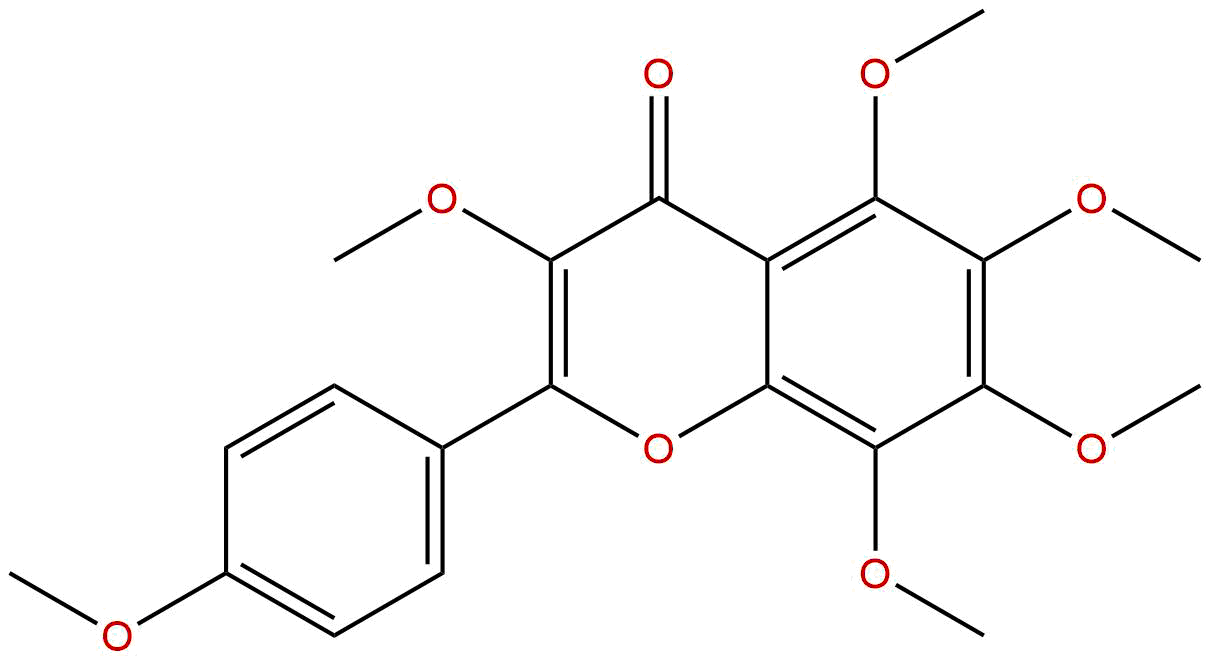


Product name: 3,5,6,7,8,4'-hexamethoxyflavone
Synonym name: 3-Methoxytangeretin
Catalogue No.: BP5012
Cas No.: 34170-18-8
Formula: C21H22O8
Mol Weight: 402.399
Botanical Source:
Type of Compound: Flavonoids
Purity: 95%~99%
Analysis Method: HPLC-DAD or/and HPLC-ELSD
Identification Method: Mass, NMR
Packing: Brown vial or HDPE plastic bottle
Storage: Store in a well closed container, protected from air and light. Put into refrigerate or freeze for long term storage.
Whenever possible, you should prepare and use solutions on the same day. However, if you need to make up stock solutions in advance, we recommend that you store the solution as aliquots in tightly sealed vials at -20℃. Generally, these will be useable for up to two weeks.
The product could be supplied from milligrams to grams
Inquire for bulk scale.
For Reference Standard and R&D, Not for Human Use Directly.
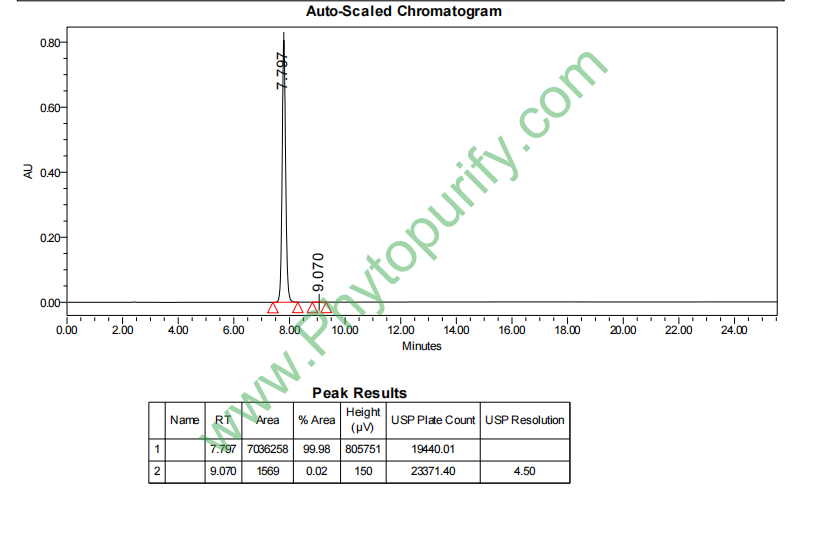
HPLC of 3,5,6,7,8,4'-hexamethoxyflavone
Storage conditions:Short-term storage at 2~8℃, long-term storage at -20 ~ -80℃
85.5900
2.6146
2.6148
.0071
3.1487
28.8052
High
84.3800
2.4677
Yes
No
Yes
No
Yes
Yes
0.6
Yes
No
No
Yes
Natural products have always been an important source of drug discovery and development, especially in the field of anti-tumor. Plant derived multi methoxy flavonoids have attracted much attention due to their unique chemical structure and significant biological activity. The multi methoxy flavonoids rich in citrus plants, such as naringin and tangerine peel extract, have been widely studied and proven to have various pharmacological effects, including anti-inflammatory, antioxidant, anti-tumor, and cardiovascular protection. Among these structurally diverse multi methoxy flavonoid families, 3,5,6,7,8,4 '- hexamethoxyflavone (HMF), as a highly methylated flavonoid compound, has gradually entered the field of researchers in recent years.
The chemical structure of HMF is characterized by the presence of six methoxy groups (- OCH ∝) attached to the A and B rings of its flavonoid core. This highly methylated modification endows it with unique physicochemical properties and biological activity that differ from ordinary hydroxyflavonoids. Compared with common polyphenolic flavonoids, polymethoxylation significantly enhances the lipophilicity of compounds, thereby affecting their transmembrane transport, interactions with target proteins, and metabolic fate in vivo. Although HMF is relatively low in nature, it has been found in the peels of various citrus fruits and can be obtained through modern separation and purification techniques.
From the perspective of pharmacological activity, HMF exhibits various biological effects, among which anti-tumor activity is the most prominent. Existing research has shown that HMF can affect the proliferation, apoptosis, invasion, and metastasis of tumor cells by regulating multiple key cellular signaling pathways, such as STAT3, MAPK/ERK, etc. In addition, it exhibits regulatory effects on apoptosis related proteins MCL1 and BCL2, as well as multiple molecular targets closely related to tumor occurrence and development, including matrix metalloproteinase MMP2, hypoxia inducible factor HIF1A, topoisomerase TOP1/TOP2A, aromatase CYP19A1, and estrogen receptor ESR1. The multi-target characteristic of HMF may have unique therapeutic advantages when targeting complex and highly heterogeneous malignant tumors.
However, like many natural products, HMF also faces challenges in its transition towards clinical applications, particularly its extremely low water solubility and potential metabolic stability issues. Therefore, systematically reviewing the chemical, biological, and pharmacological research progress of HMF, evaluating its pharmacological properties, is of great significance for a deeper understanding of its mechanism of action, guiding structural optimization, and promoting its development as a lead compound. This article aims to provide a comprehensive review of the chemical structure, sources, pharmacological activities, mechanisms of action, and pharmacological properties of 3,5,6,7,8,4 '- hexamethoxyflavonoids, and to explore their future research and application prospects.
The chemical name of 3,5,6,7,8,4 '- hexamethoxyflavone is 2- (4-methoxyphenyl) -3,5,6,7,8-pentamethoxy-4H-chromene-4-one, which belongs to the multi methoxyflavone subclass of the flavonoid compound family. Its core skeleton is the classic 2-phenylchromenone structure. On the A ring, positions C-5, C-6, C-7, and C-8 are all substituted with methoxy groups; On the C ring, the C-3 site is also replaced by a methoxy group; On the B ring, there is a methoxy group connected to the C-4 'site. Therefore, the molecule contains six methoxy groups, with a molecular formula of C ₂₁ H ₂₂ O ₈ and a molecular weight of 402.3990 g/mol. This highly methylated structural feature results in significant differences in physicochemical properties between it and common hydroxyflavonoids such as quercetin and kaempferol.
From the perspective of physical and chemical properties, HMF has strong lipid solubility, and its calculated oil-water partition coefficient (LogP) is 2.6146, indicating that its solubility in non-polar solvents is better than that in aqueous phase. This characteristic is related to the large amount of hydrophobic methoxy groups covering the periphery of its molecules. Correspondingly, the water solubility of HMF is extremely low, with a calculated water solubility value of only 0.0071 mg/mL. This is an important limiting factor in practical applications, especially when developing oral or injectable formulations, which require the use of solubilization technology or prodrug strategies to improve its bioavailability. Its polar surface area (TPSA) is 85.5900 Å ², which is at a moderate level. It is generally believed that molecules with TPSA less than 90 Å ² have good cell membrane permeability, which provides a structural basis for HMF to enter the cell interior and exert its pharmacological effects.
It is worth noting that the molecular weight of HMF (402.4 Da) is slightly higher than the classical "Lipinski Five Rules" limit of molecular weight less than 500 Da, and its LogP value is also within the appropriate range. However, its extremely high degree of methoxy substitution (with 8 hydrogen bond acceptors and 0 donors) renders the molecule completely devoid of hydrogen bond donor ability. While this enhances its lipophilicity and membrane permeability, it may also affect its hydrogen bond interactions with certain target proteins. In addition, the predictive model shows that HMF has a high blood-brain barrier penetration ability, which suggests that it may have potential value in the treatment of central nervous system diseases such as gliomas, but it may also bring central nervous system related side effects. In terms of safety, preliminary computer simulation predictions (such as Ames test results of 0.6, usually considered negative if less than 0.5) and hERG inhibition predictions (no results) indicate that the risk of HMF in genotoxicity and cardiotoxicity is relatively low, but this still needs to be validated through rigorous in vitro and in vivo experiments.
The distribution of 3,5,6,7,8,4 '- hexamethoxyflavonoids in nature is relatively limited, mainly found in the Rutaceae citrus genus(Citrus)The fruit of plants, especially in the peel (orange peel, orange peel), is rich in content. Citrus species that have been reported to contain HMF include sweet oranges(Citrus sinensis)Sour Orange(Citrus aurantium)Grapefruit(Citrus paradisi)And some wide skinned citrus fruits(Citrus reticulata)Variety. In addition, trace amounts have also been found in certain species of other families and genera, such as Asteraceae, but citrus plants remain their main and most viable natural source.
In citrus plants, HMF usually coexists with other methoxyflavones such as nobiletin, tangeretin, 5-demethylated nobiletin, etc. Its content varies significantly depending on the variety, place of origin, harvest season, fruit part, and processing method. Generally speaking, the content of HMF in citrus peel is much higher than that in pulp and juice, and is usually higher in immature or semi mature fruit peel. For example, HMF is one of the main active ingredients in the dried young fruit of lime (also known as the traditional Chinese medicine "Fructus Aurantii"). Due to its relatively low absolute content in natural plants (often lower than naringin and tangerine peel extract), efficient and highly selective extraction and separation methods are crucial for obtaining sufficient and high-purity HMF for subsequent research.
The traditional extraction method mainly relies on organic solvent extraction. Due to the good lipid solubility of HMF, methanol, ethanol, ethyl acetate, or their aqueous solutions are often used as extraction solvents. Usually, cold soaking, percolation, or reflux extraction are used to fully contact the crushed citrus peel raw materials with the solvent. For example, using 95% ethanol for reflux extraction at 60-80 ℃ can effectively dissolve HMF from plant matrix. After the extraction solution is concentrated under reduced pressure, crude extract is obtained. However, due to the presence of a large amount of lipid soluble impurities (such as wax, chlorophyll, and other flavonoids) in the crude extract, further separation and purification are required.
Modern separation technology has greatly improved the purification efficiency of HMF. Liquid liquid extraction is a common step in preliminary purification, which utilizes different solvents (such as petroleum ether, chloroform, ethyl acetate, n-butanol) to distribute the differences in solubility of the target compound. Due to the low polarity of HMF, it is usually enriched in chloroform or ethyl acetate extraction layers. Subsequently, column chromatography technology became the core purification method. Silica gel column chromatography is the most classic method, often using mixed solvent systems such as chloroform methanol or petroleum ether ethyl acetate for gradient elution. For flavonoids with similar structures, the separation effect of normal phase silica gel is sometimes not ideal. Therefore, more advanced separation technologies are widely used, such as high-performance counter current chromatography (HSCCC) and preparative high-performance liquid chromatography (pre HPLC). HSCCC utilizes the difference in distribution coefficients of solutes in two immiscible solvent systems for separation, with advantages such as high sample recovery and irreversible adsorption, making it particularly suitable for the separation of multi methoxy flavonoids. Preparative HPLC can achieve rapid preparation of high purity (usually>98%) and is a key means of obtaining HMF standards or research grade samples. In addition, in recent years, supercritical fluid extraction (SFE) technology, especially the use of carbon dioxide as a solvent, has been explored for the extraction of multi methoxyflavonoids from citrus peels due to its green and efficient characteristics, showing good application prospects.
The pharmacological activity research of 3,5,6,7,8,4 '- hexamethoxyflavone mainly focuses on its anti-tumor effect, while there are also a few studies involving its anti-inflammatory, antioxidant and other biological activities. Existing evidence suggests that HMF exhibits significant proliferation inhibition and pro apoptotic activity against various types of malignant tumor cells.
In terms of anti-tumor effects, HMF exhibits broad-spectrum cytotoxicity. In vitro experiments have confirmed that HMF can effectively inhibit the growth of many tumor cell lines, such as human breast cancer cells (such as MCF-7, MDA-MB-231), colorectal cancer cells (such as HCT-116, HT-29), liver cancer cells (such as HepG2), lung cancer cells (such as A549), prostate cancer cells (such as PC-3), and leukemia cells (such as HL-60). The half maximal inhibitory concentration (IC ₅₀) value is usually in the micromolar range, and the specific value varies depending on the cell type and treatment time. For example, in MCF-7 breast cancer cells, HMF can inhibit cell proliferation by inducing cell cycle arrest in G2/M phase and activating apoptosis of mitochondrial pathway. HMF has been reported to inhibit cell colony formation and induce significant morphological changes of apoptosis in HCT-116 colon cancer cells.
In addition to its direct cytotoxic effects, HMF also exhibits potential for anti invasion and anti metastasis. The invasion and metastasis of tumors are the main causes of patient death. Research has found that HMF can downregulate the expression and activity of matrix metalloproteinases MMP2 and MMP9, which play a key role in degrading extracellular matrix, promoting tumor cell migration and invasion. Meanwhile, the regulation of hypoxia inducible factor HIF1A by HMF is also worthy of attention. HIF1A is an important transcription factor for tumor survival and adaptation in a low oxygen microenvironment, and its overexpression is closely related to tumor angiogenesis, metabolic reprogramming, and drug resistance. HMF may help weaken the malignant phenotype of tumors by inhibiting the protein accumulation or transcriptional activity of HIF1A.
In addition, the inhibitory effect of HMF on topoisomerases (TOP1 and TOP2A) also provides important clues for its anti-tumor mechanism. Topoisomerase is a key enzyme in DNA replication and transcription processes, and many clinical anticancer drugs (such as camptothecin and etoposide) exert their therapeutic effects by inhibiting this enzyme. HMF may cause DNA damage and trigger tumor cell death by stabilizing topoisomerase DNA complexes. This mechanism suggests that HMF may have anti-cancer potential similar to classical topoisomerase inhibitors.
In terms of anti-inflammatory and antioxidant effects, although research is not as in-depth as anti-tumor studies, there have been preliminary reports. Multimethoxyflavones generally have anti-inflammatory activity, and HMF may reduce the production of pro-inflammatory cytokines such as TNF - α and IL-6 by inhibiting the nuclear factor kappa B (NF - κ B) or mitogen activated protein kinase (MAPK) signaling pathways. Its antioxidant activity may stem from its ability to scavenge free radicals. Although methoxy substitution reduces its direct hydrogen supply antioxidant capacity, it may exert a protective effect through other indirect pathways, such as activating the Nrf2/ARE pathway.
A deep understanding of the mechanism of action of 3,5,6,7,8,4 '- hexamethoxyflavonoids is crucial for developing them into effective therapeutic drugs. As mentioned earlier, the anti-tumor activity of HMF is not derived from the action of a single target, but is achieved by regulating a complex signaling network. According to existing research, the molecular targets involved mainly include apoptosis regulatory proteins, key kinases in signal transduction pathways, transcription factors, and metabolism related enzymes.
Regulating apoptosis and survival proteins HMF can significantly downregulate the expression of anti apoptotic proteins MCL1 and BCL2, while possibly upregulating the expression of pro apoptotic protein BAX, thereby breaking the balance of mitochondrial outer membrane permeability, promoting the release of cytochrome c, activating the caspase cascade reaction, and ultimately inducing tumor cell apoptosis. MCL1 and BCL2 are key anti apoptotic members of the BCL-2 family, highly expressed in many malignant tumors and closely associated with chemotherapy resistance. The inhibition of these two targets by HMF is one of its core mechanisms for inducing apoptosis.
Inhibition of STAT3 signaling pathway Signal transducer and activator of transcription factor 3 (STAT3) is a key oncogenic transcription factor that is continuously activated in various tumors, promoting cell proliferation, survival, angiogenesis, and immune escape. Research has shown that HMF can inhibit the phosphorylation of STAT3 (especially at the Tyr705 site), thereby preventing its dimerization and incorporation into the nucleus, and downregulating the transcription of downstream target genes such as Cyclin D1, Survivor, VEGF, etc. The inhibition of the STAT3 pathway is an important molecular basis for HMF to exert anti-tumor activity.
Regulating the MAPK/ERK pathway The mitogen activated protein kinase (MAPK) family, including ERK, JNK, and p38, plays a central role in cell proliferation, differentiation, and apoptosis. The regulatory effect of HMF on MAPK1 (i.e. ERK2) has been reported. In certain cell lines, HMF may inhibit the phosphorylation of ERK and block downstream proliferation signals of growth factor receptors; In other cases, stress-induced apoptosis may also be promoted by activating the JNK or p38 pathways. This regulation is cell type dependent.
Inhibition of invasion and angiogenesis related targets The inhibitory effect of HMF on MMP2 is directly related to its anti invasive activity. MMP2 is the main enzyme that degrades type IV collagen, and its reduced activity can effectively inhibit the migration of tumor cells. Meanwhile, the inhibition of HIF1A by HMF not only affects the adaptation of tumor cells to low oxygen, but also reduces the expression of its downstream target gene, vascular endothelial growth factor (VEGF), thereby exerting anti angiogenic effects. This constitutes another important pathway for HMF to inhibit tumor growth and metastasis.
Targeted Topoisomerase and Hormone Related Pathways The inhibition of TOP1 and TOP2A by HMF gives it the potential to directly interfere with DNA topology, which is a classic chemotherapy mechanism. In addition, HMF has potential regulatory effects on estrogen receptor ESR1 and aromatase CYP19A1, suggesting that HMF may have special value in hormone dependent tumors (such as breast cancer). Aromatase is a key enzyme that converts androgen into estrogen and plays an important role in the occurrence and development of postmenopausal breast cancer. HMF may act as an aromatase inhibitor to reduce the local estrogen level, and at the same time, it can double inhibit the growth of hormone sensitive breast cancer cells by antagonizing ESR1 signals.
In summary, HMF exerts its anti-tumor effect through a network regulation mode of "multi-target, multi pathway". It can directly act on apoptotic core proteins, intervene in upstream proliferation and survival signaling pathways, and also affect tumor invasion, angiogenesis, and hormone microenvironment. This multi-target action characteristic makes HMF potentially advantageous in overcoming tumor heterogeneity and drug resistance, but it also makes the study of its mechanism of action more complex, requiring deeper analysis through systems biology and network pharmacology methods.
The evaluation of drug properties is a crucial step in transitioning natural products from laboratory research to clinical applications. For 3,5,6,7,8,4 '- hexamethoxyflavonoids, their pharmacological properties exhibit a clear "double-edged sword" characteristic: on the one hand, their unique chemical structure endows them with good membrane permeability and target affinity; On the other hand, extremely low water solubility and potential metabolic instability constitute the main obstacles.
From the perspective of medicinal chemistry, HMF conforms to most drug like rules. Its molecular weight (402.4 Da) and LogP (2.61) are both within a reasonable range, indicating that it has suitable lipophilicity to penetrate biological membranes. TPSA (85.6 Å ²) also supports its good oral absorption potential. The predictive model shows that its blood-brain barrier penetration is high, which may be advantageous for the treatment of brain tumors or central nervous system diseases. At the same time, it does not inhibit hERG channels and has a low risk of Ames induced mutations, suggesting that its cardiac and genetic toxicity risks are controllable.
However, the most prominent pharmacological defect of HMF is its extremely poor water solubility (0.0071 mg/mL). This characteristic will seriously affect its dissolution and absorption after oral administration, resulting in extremely low bioavailability. In addition, the metabolism of multi methoxyflavonoids in the body is also a key issue. Although methoxy can resist hydroxylation reactions in phase I metabolism, cytochrome P450 enzymes in the liver (especially CYP1A1, CYP1A2, etc.) can catalyze O-demethylation reactions, converting HMF into corresponding hydroxylated metabolites. These metabolites may retain or alter their original biological activity, but they may also be rapidly bound (such as glucuronidation, sulfation) and excreted from the body. Therefore, the half-life of HMF in the body may be short and requires frequent administration to maintain effective blood drug concentrations.
The pharmacokinetic studies on HMF are currently relatively limited, with most data coming from in vitro experiments or preliminary exploration of animal models. Existing studies have shown that HMF is slowly absorbed after oral administration and has a lower absolute bioavailability. After intravenous administration, it is widely distributed in the body, but due to rapid metabolism, the systemic clearance rate is high. To overcome these limitations, researchers are exploring various strategies, including:
- Formulation improvement The use of nanotechnology (such as liposomes, polymer nanoparticles, solid lipid nanoparticles) or cyclodextrin inclusion technology can significantly improve the dispersibility and dissolution rate of HMF, thereby improving its oral bioavailability.
- Prodrug design Introducing water-soluble groups such as phosphate esters and amino acid esters onto HMF molecules to produce prodrugs, which are then released through enzymatic or chemical hydrolysis in vivo, is a classic strategy for improving water solubility.
- Structural modification On the basis of retaining the core pharmacophore, fine tune the position or quantity of methoxy groups, or introduce specific substituents to balance lipophilicity and water solubility, and optimize metabolic stability.
Overall, HMF has the potential to be developed as a lead compound, but its pharmacological properties still need to be optimized through systematic pharmacochemical and pharmaceutical methods. The future research focus should be on how to effectively enhance its water solubility and metabolic stability while maintaining or enhancing its original multi-target anti-tumor activity.
3,5,6,7,8,4 '- Hexamethoxyflavone, as a natural multi methoxyflavone with multi-target action characteristics, has shown promising application prospects in the field of tumor therapy. Its unique pharmacological activity spectrum, especially its regulation of multiple key oncogenic targets such as STAT3, MCL1, HIF1A, and topoisomerase, gives it potential advantages in dealing with complex and refractory tumors.
Firstly, HMF may have significant value in combination therapy. Given its multi-target mechanism of action, HMF is expected to be used in combination with traditional chemotherapy drugs or novel targeted drugs to enhance efficacy, reduce toxic side effects, or overcome drug resistance. For example, combining HMF with topoisomerase inhibitors such as irinotecan and etoposide may result in a synergistic DNA damage effect; Combined with BCL-2 inhibitors (such as Vinaclat), it can further activate the apoptotic pathway; Combined with immune checkpoint inhibitors, it may enhance anti-tumor immune response by regulating the tumor microenvironment. This combination strategy of "natural products+modern drugs" is one of the important directions for future precision cancer treatment.
Secondly, the regulation of HMF on hormone related targets (ESR1, CYP19A1) opens up the possibility of HMF in the treatment of breast cancer, especially hormone receptor positive breast cancer. It may serve as a natural aromatase inhibitor and estrogen receptor modulator, providing new candidate molecules for endocrine therapy. In addition, its high blood brain barrier penetrability makes it have unique development value in the treatment of brain glioma or breast cancer brain metastasis, which is beyond the reach of many existing chemotherapy drugs.
However, the clinical application of HMF still faces severe challenges, mainly reflected in the following aspects:
1. Pharmacokinetic defects As mentioned earlier, extremely low water solubility and potential rapid metabolism are the main bottlenecks limiting its clinical translation. Future research must prioritize addressing this issue by utilizing advanced drug delivery systems or prodrug strategies to achieve effective delivery and sustained exposure of HMF in vivo.
2. Deep analysis of the mechanism of action Although multiple targets have been identified, the direct binding mode, binding affinity, and dominant signaling pathways of HMF to these targets are not fully understood in different tumor types. It is necessary to use chemical biology methods (such as drug affinity reaction target stability technology, thermal proteomics analysis) to "fish" and verify the target, and clarify its true "primary target".
3. In vivo efficacy and safety evaluation At present, most research is still at the cellular level in vitro, lacking systematic in vivo pharmacological studies and comprehensive toxicological evaluations. It is necessary to validate its anti-tumor activity in various animal tumor models, including xenograft models, in situ models, and transgenic models, and evaluate its potential toxicity to normal tissues, especially considering its high blood-brain barrier penetration, with a focus on central nervous system toxicity.
4. Study on Structure Activity Relationship To guide structural optimization, it is necessary to systematically study the specific contributions of various methoxy groups on HMF molecules to their activity and pharmacokinetic properties. By synthesizing a series of analogues and establishing a detailed structure-activity relationship model, derivatives with stronger activity, higher selectivity, and better pharmacokinetic properties can be designed.
Looking ahead, with the development of green chemistry, nanotechnology, and systems biology, research on HMF will enter a new stage. By integrating multiple omics data, network pharmacology analysis, and AI assisted drug design, it is expected to more comprehensively reveal its action network and accelerate its transformation from natural products to clinical candidate drugs. Despite the twists and turns of the road, the research value and application potential of 3,5,6,7,8,4 '- hexamethoxyflavones, as a class of structurally unique natural anti-tumor lead compounds, cannot be ignored.
3,5,6,7,8,4 '- Hexamethoxyflavone, as an important multi methoxyflavone in citrus plants, occupies a special position in the fields of natural product medicinal chemistry and tumor pharmacology due to its unique chemical structure and multi-target pharmacological activity. This article systematically reviews the research progress on its chemical structure, physicochemical properties, plant origin, extraction methods, pharmacological activity, mechanism of action, and pharmacological evaluation.
Existing research fully demonstrates that HMF has broad-spectrum anti-tumor activity, and its mechanism of action involves the regulation of multiple key nodes such as apoptosis regulatory proteins (MCL1, BCL2), signal transduction pathways (STAT3, MAPK), invasion and metastasis related enzymes (MMP2), hypoxia adaptation factor (HIF1A), DNA topoisomerase (TOP1/TOP2A), and hormone signaling axis (ESR1, CYP19A1). This multi-target and multi pathway network regulation mode endows HMF with the potential to overcome tumor heterogeneity and drug resistance, and also reflects the unique advantages of natural products in the treatment of complex diseases.
However, the clinical translation of HMF is not a smooth road. Its extremely low water solubility, potential metabolic instability, and unclear pharmacokinetic properties in vivo are the main challenges currently faced. The future research focus should shift from simple activity discovery to systematic pharmacological optimization and in-depth mechanism analysis. This includes: developing efficient nano delivery systems or prodrug strategies to improve their bioavailability; Using advanced chemical biology techniques to accurately identify its direct target of action; Validate its efficacy and safety in various in vivo models; And guide structural optimization through the study of the structure-activity relationship of the system.
In summary, 3,5,6,7,8,4 '- hexamethoxyflavone is a natural anti-tumor lead compound with great research value and development potential. Although there is still a long way to go before clinical application, continuous and in-depth research on it not only helps to reveal the pharmacological secrets of multi methoxy flavonoids, but also provides valuable molecular templates and scientific basis for the development of new, efficient, and low toxicity anti-tumor drugs. With the advancement of related technologies and the deepening of interdisciplinary cooperation, HMF and its derivatives are expected to bring new treatment options for cancer patients in the future.
