Introduction/Overview
Natural products have always been an important source of innovative drug discovery, among which alkaloid compounds have attracted much attention due to their structural diversity and significant biological activity. Yuanamide (CAS number: 102421-42-1), as an isoquinoline alkaloid isolated from the traditional medicinal plant Corydalis, has gradually entered the research field in recent years due to its multi-target and multi pathway pharmacological activities in the field of anti-tumor. Purple violet plants are commonly used in traditional medicine for pain relief, sedation, and anti-inflammatory purposes. Modern pharmacological research has revealed their more profound therapeutic potential, especially in the field of anti-tumor treatment. The discovery of Yuanamide provides another powerful example for exploring new anti-tumor lead compounds from traditional herbs. This article aims to systematically review the chemical properties, plant origin, pharmacological activity, mechanism of action, pharmacological evaluation, and clinical application prospects of Yuanamide, in order to provide comprehensive academic references for the in-depth research and development of this compound.
Chemical structure and physicochemical properties
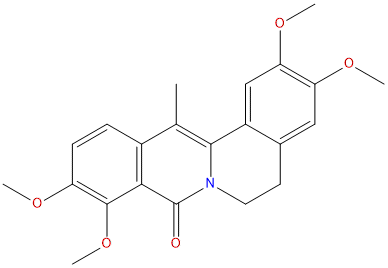
The molecular formula of Yuanamide is C22H23NO5, with a molecular weight of 381.4280. Its core structure belongs to isoquinoline alkaloids, usually with one or more methoxy or methylenedioxy substituents, which are closely related to its biological activity. From the analysis of physical and chemical properties, the calculated lipid water partition coefficient (LogP) is 3.7852, indicating that the compound has moderate lipophilicity, which is beneficial for its penetration of cell membranes, but may also affect its water solubility. Its topological polar surface area (TPSA) is 58.9200 Å ², which is relatively small, further supporting its good membrane permeability. However, its water solubility value is relatively low (about 0.0096 mg/mL), which may pose challenges in formulation development and in vivo bioavailability. In addition, preliminary pharmacological prediction models show that Yuanamide has a high blood-brain barrier permeability potential, which provides the possibility for its application in the treatment of central nervous system related tumors. The Ames test value is 1.2, indicating that no significant mutagenicity was observed under the testing conditions, and the preliminary safety is good. Meanwhile, the data shows that it has no significant hERG potassium channel inhibitory activity, reducing the potential risk of inducing cardiac toxicity (such as long QT syndrome), laying a relatively favorable safety foundation for its subsequent development.
Plant sources and extraction methods
Yuanamide mainly comes from plants of the Corydalis genus in the poppy family. There are a wide variety of plant species in this genus, widely distributed in northern temperate regions. Many species are used in traditional Chinese medicine, Tibetan medicine, and other medical systems, such as Corydalis yanhusuo. Yuanamide is usually extracted and isolated from the rhizomes or whole plants of this genus.
The extraction and purification process follows the conventional methods of natural product chemistry. Firstly, the dried plant material is crushed and subjected to cold soaking or reflux extraction using appropriate organic solvents (such as methanol, ethanol, or chloroform methanol mixture) to maximize the extraction of active ingredients, including alkaloids. Subsequently, the total extract is dissolved in acidic water (such as dilute hydrochloric acid or dilute sulfuric acid) to convert the alkaloids into salts and dissolve them in the aqueous phase, separating them from non alkaline impurities. After alkalization (such as ammonia water), the free alkaloids precipitate again and can be extracted with organic solvents (such as chloroform, ethyl acetate) to obtain the total alkaloid fraction.
Further separation and purification often use modern chromatographic techniques. Silica gel column chromatography is commonly used for preliminary separation using solvent systems of different polarities, such as chloroform methanol gradient elution. Subsequently, by combining reverse phase silica gel column chromatography (such as ODS column, methanol water system), preparative thin-layer chromatography, or high-performance liquid chromatography (HPLC), the target fraction was finely separated to obtain high-purity Yuanamide monomer compounds. Structural identification involves the comprehensive use of techniques such as nuclear magnetic resonance (NMR, including 1H-NMR, 13C-NMR, and 2D-NMR), mass spectrometry (MS), infrared spectroscopy (IR), and X-ray single crystal diffraction.
Pharmacological activity research
The pharmacological activity research of Yuanamide is currently mainly focused on the field of anti-tumor, and it has shown extensive inhibitory activity in various in vitro and in vivo models.
1. Cell proliferation inhibition: Research shows that Yuanamide has a significant proliferation inhibitory effect on a variety of human tumor cell lines, including breast cancer (such as MCF-7), liver cancer (such as HepG2), lung cancer (such as A549), colon cancer (such as HCT-116), etc. Its IC50 values are mostly at the micromolar level, showing a broad spectrum of anti-tumor potential.
2. cell cycle arrest Flow cytometry analysis shows that Yuanamide can block tumor cells at specific phases of the cell cycle, such as G0/G1 or G2/M, thereby preventing cells from entering the DNA synthesis or mitotic stage and inhibiting their unlimited proliferation.
3. Inducing cell apoptosis Yuanamide can significantly induce apoptosis in tumor cells, manifested as morphological changes (such as chromatin condensation, cell shrinkage), phosphatidylserine eversion (increased Annexin V positive staining), and activation of Caspase family proteases (such as Caspase-3, -9). This is one of the core pathways through which it exerts anti-tumor effects.
4. Inhibit cell migration and invasion In studies targeting highly metastatic tumor cells, Yuanamide has shown the ability to inhibit cell migration and invasion, which is related to its regulation of the expression of extracellular matrix degradation related proteins, suggesting its potential for anti-tumor metastasis.
5. In vivo anti-tumor activity In a nude mouse transplant tumor model, a significant reduction in tumor volume and weight was observed after administration of a certain dose of Yuanamide, and the effect on mouse body weight was relatively small, preliminarily demonstrating its in vivo anti-tumor effectiveness and certain safety.
Mechanism of action and molecular targets
The anti-tumor effect of Yuanamide is not achieved through a single target, but involves the regulation of multiple key signaling pathways and molecular targets, reflecting the typical characteristics of multi-target action of natural products. According to existing research, its related targets mainly include:
1. Regulating apoptosis related proteins (MCL1, BCL2)Yuanamide can downregulate the expression of anti apoptotic proteins Bcl-2 and Mcl-1, while possibly upregulating the expression of pro apoptotic proteins such as Bax, disrupting mitochondrial membrane potential, promoting cytochrome C release, and activating endogenous (mitochondrial) apoptotic pathways.
2. Inhibition of STAT3 signaling pathway Signal transducer and activator of transcription factor 3 (STAT3) is an important oncogenic transcription factor that is continuously activated in various tumors. Yuanamide can inhibit the phosphorylation (activation) of STAT3, prevent its nuclear translocation and the transcription of downstream target genes (such as Cyclin D1, Survivor, Bcl-2), thereby inhibiting proliferation and promoting apoptosis.
3. Affects cell cycle and DNA topology (TOP1, TOP2A)As a potential inhibitor of topoisomerase I (TOP1) and topoisomerase II alpha (TOP2A), Yuanamide may interfere with DNA replication, transcription, and repair processes, leading to DNA damage and triggering cell cycle checkpoint activation and apoptosis.
4. Inhibition of Matrix Metalloproteinase 2 (MMP2)Yuanamide can downregulate the expression and activity of matrix metalloproteinase-2 (MMP2). MMP2 is a key enzyme that degrades extracellular matrix and basement membrane, and inhibition of its activity can effectively reduce the invasion and metastasis ability of tumor cells.
5. Intervention in MAPK signaling pathway (MAPK1)Mitogen activated protein kinase 1 (MAPK1, ERK2) is a core member of the MAPK/ERK pathway, regulating cell growth and survival. Yuanamide may participate in its regulation of cell proliferation and apoptosis by affecting the activation state of this pathway.
6. Regulating hypoxia inducible factor 1A (HIF1A)In the hypoxic microenvironment of tumors, the stability and activation of HIF-1 α promote angiogenesis and metabolic adaptation. Yuanamide may interfere with tumor adaptation and growth by inhibiting the protein stability or transcriptional activity of HIF-1 α.
7. Affects hormone related pathways (ESR1, CYP19A1): For hormone dependent tumors (such as some breast cancer), Yuanamide may play an anti estrogen effect by antagonizing the activity of estrogen receptor α (ESR1) or inhibiting the activity of aromatase (CYP19A1, the key enzyme that converts androgen into estrogen), thereby inhibiting the growth of tumors.
In summary, Yuanamide forms a complex anti-tumor network by synergistically acting on multiple targets and pathways mentioned above, ultimately achieving multiple effects such as inhibiting proliferation, inducing apoptosis, blocking cycles, and resisting invasion and metastasis.
Evaluation of drug properties and pharmacokinetics
Based on its physicochemical parameters and preliminary biological data, a preliminary evaluation of the pharmacological properties of Yuanamide is conducted
* Absorption and distribution Moderate LogP values and lower TPSA are beneficial for oral absorption and transmembrane transport. The higher blood-brain barrier penetration prediction value gives it a unique advantage in treating brain tumors. However, its low water solubility may limit its dissolution rate in the gastrointestinal tract, thereby affecting oral bioavailability. In the future, it may need to be improved through formulation techniques such as making nanocrystals, solid dispersions, cyclodextrin inclusion complexes, etc.
* Metabolism and excretion As an isoquinoline alkaloid, Yuanamide is likely to be metabolized by cytochrome P450 enzymes (such as CYP3A4) in the liver. The specific metabolites, main metabolic pathways, and excretion modes (bile or kidney) still need to be elucidated through further in vitro liver microsomal experiments and in vivo pharmacokinetic studies. Understanding its metabolic characteristics is crucial for evaluating drug interactions and individual differences.
* Preliminary safety The negative result of Ames test (1.2) indicates a low risk of genetic toxicity. The absence of hERG inhibitory activity is a positive signal, reducing common concerns about cardiac toxicity in clinical development. However, comprehensive safety evaluation still requires routine preclinical studies such as acute toxicity, long-term toxicity, and reproductive toxicity.
* Pharmacokinetic characteristics Currently, there is a lack of publicly available pharmacokinetic studies on the Yuanamide system, such as absorption, distribution, metabolism, and excretion studies in rats or beagle dogs. In the future, it is necessary to clarify key pharmacokinetic parameters such as absolute bioavailability, plasma protein binding rate, tissue distribution characteristics, half-life, clearance rate, etc., to provide a basis for the design of dosing regimens.
Clinical application prospects and prospects
As a natural product with multi-target anti-tumor activity, Yuanamide has broad clinical application prospects, but also faces many challenges.
prospect:
1. New anti-tumor lead compounds Its unique multi-target mechanism of action may help overcome the problem of single target drug resistance in tumors, especially for complex and heterogeneous malignant tumors.
2. The potential of combination therapy Yuanamide can be used in combination with existing chemotherapy drugs (such as topoisomerase inhibitors, microtubule inhibitors) or targeted drugs, which may produce synergistic effects, reduce their respective dosages and toxic side effects.
3. Targeting specific tumor subtypes Its potential effects on ESR1 and CYP19A1 suggest that it may have practical value in the treatment of hormone receptor positive breast cancer. Its excellent blood-brain barrier permeability also makes it a candidate molecule for treating central nervous system tumors such as gliomas.
4. Modern development derived from traditional medicines Its research is an example of the modernization and internationalization of traditional Chinese medicine, which helps to clarify the modern scientific connotation of the traditional efficacy of "promoting blood circulation and relieving pain" in the purple violet genus medicinal materials, and enhance their value.
Challenges and Prospects:
1. In depth mechanism research At present, the understanding of the target of Yuanamide is mostly based on association studies and preliminary verification, and further research is needed (such as chemical biology methods, gene knockout/knockdown techniques, and co crystallization structure analysis) to confirm its direct target and precise molecular binding mode.
2. Optimization of drug properties in the system To address its poor water solubility, systematic structural modifications or prodrug design are needed to improve its solubility and pharmacokinetic properties while maintaining its activity. A comprehensive preclinical pharmacokinetic and toxicological evaluation is the necessary path to promote its clinical translation.
3. Formulation Development Developing advanced delivery systems suitable for Yuanamide, such as liposomes, polymer micelles, nanoparticles, etc., can improve its targeting, stability, and bioavailability, and may reduce systemic toxicity.
4. Clinical translational research After completing sufficient preclinical research, it is necessary to gradually advance clinical trials to evaluate its safety, tolerability, and preliminary efficacy in humans, and ultimately determine its clinical positioning.
Conclusion
As an isoquinoline alkaloid discovered from plants of the genus Corydalis, Yuanamide has demonstrated great potential as a new lead compound for anti-tumor drugs due to its multi-target and multi pathway anti-tumor mechanism. From chemical structure to pharmacological activity, from mechanism of action to preliminary pharmacological parameters, current research has outlined a promising outline for it. However, there is still a long road to explore from laboratory research to successful clinical application, including in-depth analysis of its molecular mechanism, systematic optimization of drug formulation, and rigorous clinical validation. In the future, through interdisciplinary collaboration and the latest advances in modern medicinal chemistry, pharmacology, pharmacy, and clinical medicine, it is expected to overcome existing challenges and promote the development of Yuanamide or its optimized derivatives into clinical anti-tumor drugs. This will not only provide new treatment options for cancer patients, but also provide important references for innovative drug research and development of natural products.