Introduction/Overview
Myrcetin-3-O-rutinoside (CAS number: 41093-68-9) is an important natural flavonoid glycoside derivative widely present in various plants. In recent years, with the rapid development of natural product pharmacology, myricetin and its derivatives have attracted much attention due to their significant biological activities. As the rutinoside form of myricetin, myricetin-3-glucoside has shown great research value in the fields of antioxidant, anti-inflammatory, and anti-tumor due to its unique structural characteristics and biological activity. This compound can be isolated from Picea abies, a plant in the genus Picea, and has good natural source advantages. This article aims to systematically review the chemical structure, physicochemical properties, plant sources, and extraction methods of myricetin-3-glucoside. Combining its pharmacological activity and mechanism of action, it explores its medicinal properties and clinical application prospects, providing a theoretical basis and research direction for subsequent related studies.
Chemical structure and physicochemical properties
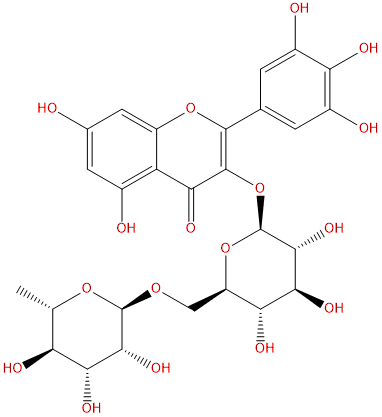
Yangmeisin-3-rutinoside is a flavonoid compound with a molecular formula of C27H30O17 and a molecular weight of 626.52. Its core structure is myricetin, which is a 3,5,7,3 ', 4', 5 '- hexahydroxyflavonoid. The 3-hydroxyl group is connected to a rutinoside residue through an O-glycosidic bond. Rutin is a disaccharide composed of glucose and xylose, which endows the molecule with high polarity and water solubility.
In terms of physical and chemical properties, the LogP value of myricetin-3-glucoside is -0.4346, indicating its strong hydrophilicity and good water solubility of 2.8859. The topological polar surface area (TPSA) is 289.66 Å ², reflecting its high molecular surface polarity, which is usually related to the ability of molecules to penetrate cell membranes. The low permeability of the blood-brain barrier suggests its limited ability to penetrate the central nervous system. The negative result of hERG channel inhibition experiment indicates a low risk of cardiac toxicity. The Ames test value is 0.6, indicating low mutagenicity and good safety.
Overall, myricetin-3-glucoside maintains the biological activity of myricetin while improving its water solubility and biocompatibility through glycosylation modification, providing a good molecular basis for its pharmacological activity.
Plant sources and extraction methods
Yangmeisin-3-rutinoside mainly comes from the pine family plant Picea abies (spruce), which is widely distributed in the mountainous areas of northern and central Europe. As a traditional herbal resource, Picea abies contains abundant flavonoids, especially myricetin and its glycoside derivatives, in its bark, leaves, and wood.
The extraction method usually uses solvent extraction combined with chromatographic separation technology. The specific steps include:
- Sample Pretreatment Collect fresh or dry Picea abies plant materials and grind them into fine powder.
- Solvent extraction Use methanol, water, or ethanol water mixed solvents for ultrasound assisted extraction or reflux extraction to improve extraction efficiency.
- Crude extract concentration Remove the solvent by rotary evaporation to obtain a concentrated extract.
- Separation and purification Separation and purification were performed using silica gel column chromatography, reverse phase high performance liquid chromatography (RP-HPLC), or preparative HPLC, and purity and structure were identified using mass spectrometry (MS) and nuclear magnetic resonance (NMR) techniques.
- Crystallization or freeze-drying Purified myricetin-3-glucoside can be obtained in stable powder form through crystallization or freeze-drying processes.
In recent years, with the development of extraction technology such as supercritical fluid extraction, membrane separation technology, and molecular imprinting technology, it is expected to further improve the extraction efficiency and purity of myricetin-3-glucoside, and reduce production costs.
Pharmacological activity research
The pharmacological activities of myricetin-3-glucoside mainly focus on antioxidant, anti-inflammatory, anti-tumor, and neuroprotective aspects, with antioxidant activity being the most significant.
antioxidant activity
As a glycoside derivative of myricetin, myricetin-3-glucoside has strong free radical scavenging ability. Multiple in vitro experiments have shown that this compound can effectively scavenge superoxide anion radicals, hydroxyl radicals, and hydrogen peroxide, significantly reducing oxidative stress levels. Its antioxidant mechanism mainly activates the intracellular antioxidant enzyme system, including superoxide dismutase (SOD1, SOD2), catalase (CAT), glutathione peroxidase (GPX1), and induces the expression of heme oxygenase-1 (HMOX1), thereby enhancing the cell's antioxidant defense ability.
anti-inflammatory effect
Yangmeisin-3-rutinoside can inhibit the expression of various pro-inflammatory factors, such as matrix metalloproteinase 1 (MMP1) and matrix metalloproteinase 3 (MMP3), reducing the damage of inflammatory mediators to tissues. In addition, the compound exerts anti-inflammatory and protective effects by regulating the nuclear factor erythroid 2-related factor 2 (NFE2L2/NRF2) signaling pathway, inhibiting inflammatory responses, reducing cytokine release.
Antitumor potential
Preliminary studies have shown that myricetin-3-glucoside has a growth inhibitory effect on various tumor cell lines. The mechanism may involve inducing cell apoptosis, blocking the cell cycle, and inhibiting tumor cell migration and invasion. By regulating the redox state and inflammatory microenvironment, myricetin-3-glucoside is expected to become a potential candidate for anti-tumor drugs.
Neuroprotective effect
Although myricetin-3-glucoside has low blood-brain barrier permeability, its antioxidant and anti-inflammatory properties provide a theoretical basis for adjuvant therapy of neurological diseases. By reducing oxidative damage and inflammatory response of nerve cells, it is expected to play a protective role in neurodegenerative diseases such as Alzheimer's disease and Parkinson's disease.
Mechanism of action and molecular targets
The biological activity of myricetin-3-glucoside is closely related to its action on multiple molecular targets, mainly involving antioxidant and anti-inflammatory signaling pathways.
Antioxidant related targets
- Superoxide dismutase (SOD1, SOD2)Yangmeisin-3-rutinoside can promote the expression and activity of SOD enzyme, catalyze the conversion of superoxide anion radicals into hydrogen peroxide, and alleviate oxidative damage.
- Catalase (CAT)Collaborate with SOD to decompose hydrogen peroxide into water and oxygen, preventing the damage of reactive oxygen species to cells.
- Glutathione peroxidase 1 (GPX1)By catalyzing the reduction of glutathione to remove peroxides, it protects cell membrane lipids from oxidative damage.
- Heme oxygenase-1 (HMOX1)As an important enzyme in cellular stress response, induction of HMOX1 helps alleviate oxidative stress and inflammatory response.
- Nuclear factor erythroid 2 related factor 2 (NFE2L2/NRF2)Yangmeisin-3-rutinoside activates the NRF2 signaling pathway, promotes transcription of antioxidant enzyme genes, and enhances cellular antioxidant defense.
Anti inflammatory targets
- Matrix metalloproteinase 1 (MMP1) and matrix metalloproteinase 3 (MMP3)Yangmeisin-3-rutinoside inhibits the expression of these two MMPs, prevents extracellular matrix degradation, and reduces inflammation related tissue damage.
- Tyrosinase (TYR)Although TYR is primarily associated with melanin synthesis, its regulatory effects may indirectly affect inflammatory responses and cellular oxidative states.
Overall, myricetin-3-glucoside achieves its antioxidant and anti-inflammatory pharmacological effects through multi-target and multi pathway synergistic effects, reflecting the advantages of natural product multi-target therapy.
Evaluation of drug properties and pharmacokinetics
The pharmacological evaluation of myricetin-3-glucoside shows that it has good safety and drug compatibility.
Physical and chemical properties of drugs
- Molecular weight (626.52)Relatively large, it may limit its oral bioavailability, but the glycosidic structure enhances water solubility, which is beneficial for intestinal absorption.
- LogP(-0.4346)Negative values indicate strong hydrophilicity of molecules, which is beneficial for dissolution in blood circulation, but may limit membrane penetration.
- TPSA(289.66 Ų)A higher polar surface area usually indicates lower cell membrane permeability, which is consistent with its low blood-brain barrier permeability.
safety evaluation
- HERG channel inhibition Negative indicates a low risk of cardiac toxicity.
- Ames test (0.6)Low mutagenicity and high safety.
Pharmacokinetic characteristics
At present, there is limited research on the in vivo pharmacokinetics of myricetin-3-glucoside. Based on its physicochemical properties, it is speculated that its oral absorption may be limited by molecular weight and polarity, resulting in a moderate to low bioavailability. The metabolic pathway may involve the hydrolysis of rutin glycosides by gut microbiota, releasing myricetin glycosides, which are further metabolized into various active metabolites. Excretion is mainly through the renal and biliary pathways.
In the future, systematic pharmacokinetic studies need to be conducted, including absorption, distribution, metabolism, and excretion (ADME) processes, to clarify their in vivo behavior and the activity of metabolites, providing a basis for clinical applications.
Clinical application prospects and prospects
Yangmeisin-3-rutinoside has broad clinical application potential due to its significant antioxidant and anti-inflammatory activities.
Antioxidant related diseases
Oxidative stress is the common pathological basis of many chronic diseases, such as cardiovascular diseases, diabetes, neurodegenerative diseases and tumors. Yangmeisin-3-rutinoside can effectively alleviate oxidative damage by regulating various antioxidant enzymes and signaling pathways, and has the potential to prevent and assist in the treatment of these diseases.
Inflammatory diseases
Its inhibitory effect on MMPs and activation of the NRF2 pathway make it therapeutic in chronic inflammatory diseases such as arthritis and inflammatory bowel disease. In the future, modern drug delivery systems can be combined to enhance their targeting and bioavailability.
Neuroprotection and anti-tumor effects
Although the blood-brain barrier has low permeability, it is expected to enhance its targeting ability to the nervous system through structural modification or nanocarrier technology. In addition, its anti-tumor activity provides ideas for the development of new anti-cancer drugs, especially for synergistic effects in combination therapies.
Future research directions
- Structural optimization and derivative development Improving pharmacokinetic performance through chemical modification, enhancing oral absorption and tissue distribution.
- Drug delivery system Enhance targeting and bioavailability through the use of nanotechnology, liposomes, and other carriers.
- Preclinical and clinical research Systematically evaluate its safety, efficacy, and dosage range to promote clinical translation.
- Analysis of multi-target mechanism Deeply reveal its functional network and guide precise treatment strategies.
Conclusion
Yangmeisin-3-rutinoside, as a natural flavonoid glycoside compound with multiple biological activities, exhibits excellent antioxidant and anti-inflammatory potential. Its unique chemical structure endows it with excellent water solubility and safety, making it suitable for further development as a natural medicine or functional health product. Although research on its pharmacokinetics and clinical applications is still in its early stages, with the advancement of modern drug development technology, myricetin-3-glucoside is expected to become an important candidate molecule in the treatment of antioxidant related diseases. In the future, it is necessary to strengthen its mechanism research, structural optimization, and clinical evaluation, promote its transition from laboratory to clinical application, and achieve innovative breakthroughs in natural product pharmacology.