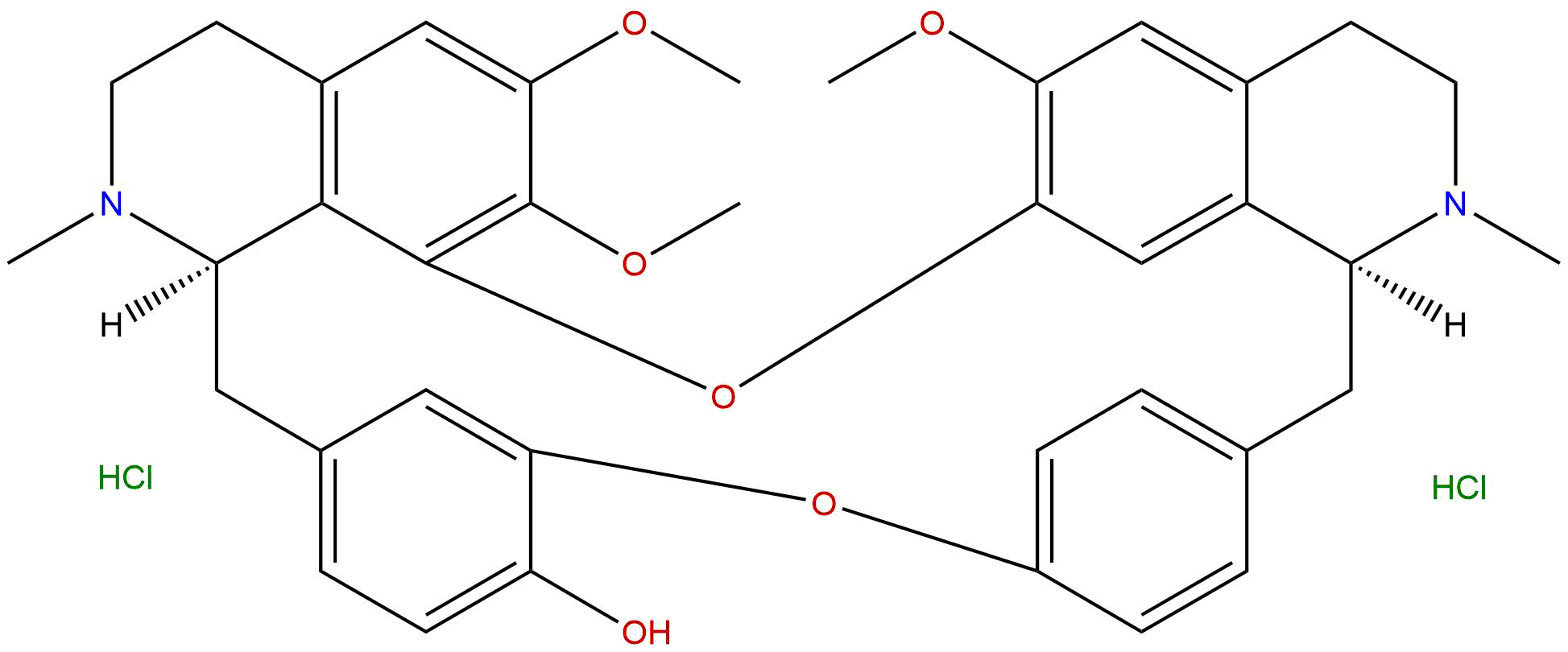


Product name:Berbamine Hydrochloride
Synonym name: Berbamine Dihydrochloride
Catalogue No.: BP0250
Cas No.: 6078-17-7
Formula: C37H42Cl2N2O6
Mol Weight: 681.651
Botanical Source:
Purity: 95%~99%
Analysis Method: HPLC-DAD or/and HPLC-ELSD
Identification Method: Mass, NMR
Packing: Brown vial or HDPE plastic bottle
Can be supplied from milligrams to grams.
For Reference Standard and R&D, Not for Human Use Directly.
Inquire for bulk scale.
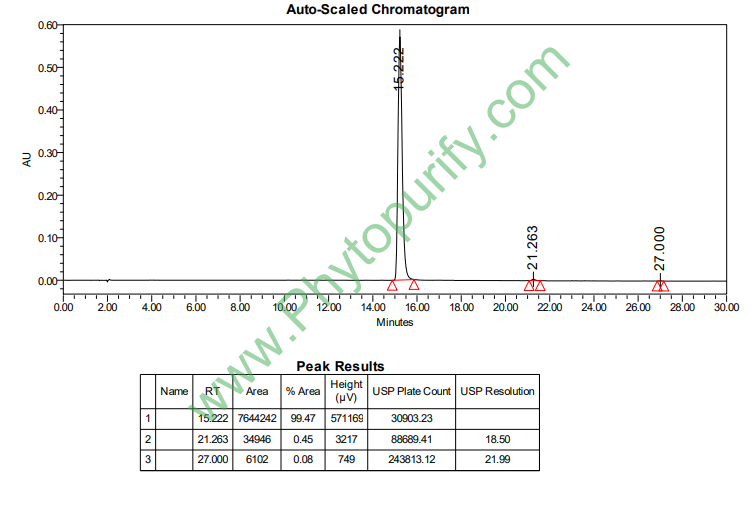
HPLC of Berbamine Hydrochloride
Storage conditions:Short-term storage at 2~8℃, long-term storage at -20 ~ -80℃
72.8600
5.7795
5.1437
.0059
4.7215
19.9985
Low
91.5576
5.8682
No
No
Yes
Yes
No
No
0.0
Yes
No
No
Yes
Berberine Hydrochloride (CAS: 6078-17-7) is a bisbenzylisoquinoline alkaloid derived from traditional medicinal plants. Its parent compound, Berberine, has been found in various Berberis and Mahonia plants. This compound has long been used in traditional medicine to treat inflammation, infections, and cardiovascular diseases. In recent years, with the deepening of modern pharmacological research, berberine hydrochloride has demonstrated a wide range of biological activities beyond traditional understanding, especially in the fields of neurodegenerative diseases, tumors, immune regulation, and cardiovascular protection, showing great potential. Among them, the potential therapeutic effect on central nervous system diseases such as dementia has attracted much attention due to its ability to regulate multiple neurotransmitter receptors in the dopaminergic and serotonergic systems. This article aims to systematically review the chemical properties, plant sources, pharmacological activities, mechanisms of action, pharmacological evaluation, and clinical application prospects of berberine hydrochloride, in order to provide comprehensive scientific references for the deep development and transformation research of this natural product.
The molecular formula of berberine hydrochloride is C37H40N2O6 · 2HCl, with a molecular weight of 608.7350. The parent nucleus structure is a bisbenzylisoquinoline skeleton formed by connecting two isoquinoline units through a double benzyl group. The hydrochloride form enhances its water solubility and stability. This compound has multiple chiral centers and exists in stereoisomers, and its biological activity is closely related to specific configurations.
In terms of physical and chemical properties, the calculated lipid water partition coefficient (LogP) is 5.7795, indicating that the compound has high lipophilicity. The topological polar surface area (TPSA) is 72.8600 Å ². Its water solubility is low, about 0.0059 mg/mL, which to some extent limits its bioavailability. These physicochemical parameters suggest that attention should be paid to the solubility and permeability of berberine hydrochloride during the development process. Its crystal morphology, melting point, and spectral characteristics (such as UV, IR, NMR, MS) have been fully characterized, laying the foundation for quality control and structural modification.
Berberidaceae plants, such as Berberis spp., B. poiretii, and Mahonia belei, are the main sources of berberine hydrochloride. These plants have a long history of application in traditional medicine in Asia, especially in China.
The extraction process usually uses dried plant roots and stem bark as raw materials. Classic methods include acid water extraction or acid precipitation after alcohol extraction. The optimization process is as follows: after crushing plant materials, soak or percolate them in low concentration hydrochloric acid or sulfuric acid solution to dissolve alkaloids into salts; The extract is alkalized (such as ammonia water) to precipitate free alkaloids, and then purified by extraction with organic solvents (such as chloroform, ethanol); Finally, the obtained berberine free base is salted with hydrochloric acid and crystallized to obtain pure berberine hydrochloride. The application of modern separation technologies such as macroporous adsorption resin method, high-speed countercurrent chromatography (HSCCC), and preparative high-performance liquid chromatography (HPLC) has significantly improved extraction efficiency and product purity. Sustainable plant cultivation and green extraction technology are important directions for future large-scale production.
Berberine hydrochloride has diverse and significant pharmacological activities, and its research has expanded from traditional applications to multiple modern disease fields.
The pharmacological effects of berberine hydrochloride stem from its interactions with multiple molecular targets, exhibiting characteristics of multi-target and network regulation.
In terms of anti dementia, its effect is highly correlated with regulating the central monoamine neurotransmitter system. Research has shown that berberine hydrochloride is a regulator of multiple G protein coupled receptors (GPCRs):
* 5-hydroxytryptamine receptor 2B (HTR2B)Regulating this receptor may affect neuroinflammation, synaptic plasticity, and emotional cognitive processes.
* Dopamine D1 like receptors (DRD1, DRD5) and D2 like receptors (DRD2)The dopamine system is crucial for learning, memory, reward, and motor control. Regulating the balance between DRD1/DRD5 (primarily excitatory) and DRD2 (primarily inhibitory) may improve cognitive impairment and neuropsychiatric symptoms associated with dementia.
* Adrenergic alpha 2A receptor (ADRA2A)As a presynaptic negative feedback receptor, it regulates the release of norepinephrine. Regulating ADRA2A may affect attention, wakefulness, and cognitive function.
In addition to receptor targets, its neuroprotective mechanism also involves: inhibition of A β aggregation and toxicity; Inhibit excessive phosphorylation of Tau protein; Activate the Nrf2/ARE antioxidant pathway; Inhibit NF - κ B-mediated neuroinflammation; And regulate survival and apoptosis signaling pathways such as PI3K/Akt and MAPK.
In the field of anti-tumor, its key targets include inducing DNA damage and activating the ATM/Chk2/p53 pathway; Inhibit the activity of transcription factors such as STAT3 and NF - κ B; Regulating the Bcl-2/Bax ratio to induce apoptosis; Inhibit MMPs and reduce metastasis; And reversing multidrug resistance by inhibiting the function of P-glycoprotein (P-gp).
Despite its significant pharmacological activity, the pharmacological properties of berberine hydrochloride face some challenges and require rational evaluation.
Absorption, distribution, metabolism, excretion (ADME):
Preliminary evaluation of safety:
Optimization strategy for drug properties To improve its drug properties, strategies that can be adopted include: preparing prodrugs to increase solubility and BBB penetration; Developing novel drug delivery systems such as nano formulations (such as liposomes, polymer micelles) or microemulsions; Perform structural modifications to reduce hERG inhibitory activity and optimize metabolic stability.
The clinical application prospects of berberine hydrochloride are broad, but the transformation path needs to overcome existing bottlenecks.
Potential indications:
R&D Challenge:
Future Prospects:
Berberine hydrochloride, as a natural product with a long history of application, is constantly being re recognized and explored for its modern pharmacological value. Its unique bisbenzylisoquinoline structure endows it with multi-target and multi pathway properties, demonstrating remarkable potential in anti dementia, anti-tumor, immune regulation, and other fields. Despite facing challenges such as insufficient brain permeability, potential cardiac toxicity, and poor physicochemical properties in terms of drug properties, these challenges are being actively addressed through modern medicinal chemistry, pharmacy, and pharmacology methods. In the future, through in-depth mechanism analysis, rational structural optimization, and innovative formulation strategies, berberine hydrochloride is expected to successfully transform from a traditional natural compound into a modern drug for treating major diseases such as neurodegenerative diseases and tumors, or provide an important lead compound skeleton for new drug development, demonstrating the sustained vitality of natural products in innovative drug discovery.
