Introduction/Overview
Natural products have always been an important source of innovative drug discovery, among which flavonoids have attracted much attention due to their wide range of biological activities. Kuwanon T, as an isoprenoid flavonoid isolated from the traditional medicinal plant Morus alba L., has gradually entered the field of pharmacological research in recent years. Its CAS number is 100187-66-4, and preliminary studies have revealed its significant antioxidant activity, showing a protective effect against oxidative stress induced by tert butyl hydroperoxide (t-BHP), with an EC50 value of 30.32 μ M. More noteworthy is that mulberry flavonoids T exhibit multi-target anti-tumor potential, involving the regulation of multiple key biological processes such as cell apoptosis, signal transduction, angiogenesis, and extracellular matrix degradation. This article aims to systematically review the chemical properties, plant sources, pharmacological activities, mechanisms of action, medicinal properties, and clinical application prospects of mulberry flavonoids T, in order to provide comprehensive scientific references for the in-depth research and development of this compound.
Chemical structure and physicochemical properties
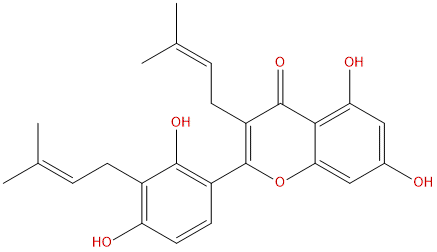
Mulberry flavonoids T belong to the class of isoprenoid flavonoids, characterized by the presence of isopentenyl side chains connected to the classical flavonoid skeleton. Its molecular formula is C25H26O6 and its molecular weight is 422.4770. This structure typically contains a benzo - γ - pyranone core (A and C rings), with a characteristic isopentenyl group attached to the B ring. This structural modification significantly enhances its lipophilicity and ability to interact with biomolecules.
Its physicochemical properties have a decisive impact on its biological activity and pharmacokinetic behavior. The calculated lipid water partition coefficient (LogP) is 5.2051, indicating that mulberry flavonoids T have high lipophilicity. The topological polar surface area (TPSA) is 111.1300 Å ², reflecting the presence of multiple polar atoms (such as hydroxyl and carbonyl oxygen atoms) in the molecule. The water solubility is relatively low, about 0.0348 mg/mL, which is consistent with its high LogP value, indicating that it may be well absorbed in the gastrointestinal tract, but its dissolution and distribution in the body may face challenges. These basic physicochemical parameters are the preliminary basis for evaluating its potential as a candidate drug.
Plant sources and extraction methods
Mulberry flavonoids T mainly come from the root bark of Morus alba L. plants in the family Moraceae. Mulberry trees, as the source of traditional Chinese medicine (mulberry bark), are rich in various flavonoids, alkaloids, and astragalus compounds in their root bark. Mulberry flavonoids T is one of the representative isoprenoid flavonoids.
Its extraction and separation usually use organic solvent extraction combined with various chromatographic techniques. The classic process is as follows: first, the dried mulberry bark is crushed and subjected to reflux extraction or cold soaking extraction using polar organic solvents such as methanol, ethanol, or acetone. After merging the extraction solutions, the crude extract was obtained by vacuum concentration. Subsequently, the crude extract was preliminarily separated using solvent partitioning methods (such as extraction with petroleum ether, ethyl acetate, and n-butanol in sequence), and mulberry flavonoids T were mostly enriched in the ethyl acetate fraction. Further purification relies on column chromatography technology, often using silica gel column chromatography with different ratios of petroleum ether ethyl acetate or chloroform methanol gradient elution. High performance liquid chromatography (HPLC) or preparative thin layer chromatography (PTLC) is commonly used for the purification and preparation of final monomer compounds. Modern technologies such as high-speed countercurrent chromatography (HSCCC) can also be used for efficient separation of such natural products. The optimization of the extraction process is crucial for obtaining high-purity mulberry flavonoids T for subsequent pharmacological research.
Pharmacological activity research
The pharmacological activity research of mulberry flavonoids T mainly focuses on two aspects: antioxidant and anti-tumor.
-
antioxidant activity This is the earliest reported activity of mulberry flavonoids T. In the t-BHP induced cellular oxidative stress model, mulberry flavonoids T showed clear protective effects with an EC50 of 30.32 μ M. Its antioxidant mechanism may involve directly clearing free radicals, activating endogenous antioxidant defense systems in cells (such as the Nrf2/ARE pathway), and protecting mitochondrial function, thereby reducing cell apoptosis or necrosis caused by oxidative damage.
-
Antitumor activity This is the most promising research direction for mulberry flavonoids T. Preliminary in vitro studies have shown that mulberry flavone T can inhibit proliferation and promote apoptosis of many human tumor cell lines (such as breast cancer, liver cancer, lung cancer, etc.). Its anti-tumor effect is not achieved through a single pathway, but is characterized by multiple targets and pathways. In addition to inducing tumor cell apoptosis, studies also suggest that it may inhibit tumor cell invasion, migration, and angiogenesis, which is related to its potential regulatory effects on targets such as MMP2 and HIF1A. Compared to some highly cytotoxic chemotherapy drugs, mulberry flavonoids T have shown relatively low toxicity to normal cells in some studies, suggesting that it may have a better therapeutic window, but this conclusion still needs more rigorous research to confirm.
Mechanism of action and molecular targets
The anti-tumor mechanism of mulberry flavonoids T is complex, involving the regulation of multiple key proteins and signaling pathways. Based on its relevant target information, its mechanism of action can be summarized into the following main aspects:
-
Regulating the apoptotic pathway of cells Mulberry flavonoids T may promote tumor cell apoptosis by affecting members of the Bcl-2 protein family. Its targets include anti apoptotic proteins MCL1 and BCL2. Downregulation of the expression or inhibition of the function of these proteins can lead to increased mitochondrial outer membrane permeability, release of cytochrome C, thereby activating the caspase cascade reaction and ultimately inducing programmed cell death.
-
Intervention in signal transduction pathways Signal transducer and activator of transcription factor 3 (STAT3) is a key oncogenic protein in the occurrence and development of tumors. Mulberry flavonoids T may inhibit tumor growth by suppressing the phosphorylation or dimerization of STAT3, blocking the transcription of downstream pro survival and proliferation genes such as Bcl xL and Cyclin D1. In addition, its potential impact on mitogen activated protein kinase 1 (MAPK1, ERK2) suggests that it may intervene in the important cell proliferation and survival signaling pathway of MAPK/ERK.
-
Inhibit tumor invasion and metastasis Matrix metalloproteinase-2 (MMP2) is a key enzyme that degrades extracellular matrix and promotes tumor invasion and metastasis. Mulberry flavonoids T may inhibit the invasive ability of tumor cells by downregulating the expression or activity of MMP2. Meanwhile, its potential inhibitory effect on hypoxia inducible factor 1 alpha (HIF1A) may interfere with tumor cell adaptation and angiogenesis (VEGF expression, etc.) in the hypoxic microenvironment, thereby inhibiting distant metastasis.
-
Interference with DNA metabolism and hormone regulation The potential effect of mulberry flavonoids T on topoisomerases I and II α (TOP1, TOP2A) suggests that it may interfere with DNA replication and transcription by forming stable "drug enzyme DNA" cleavable complexes, leading to DNA damage and cell death. In addition, its association with estrogen receptor α (ESR1) and aromatase (CYP19A1) suggests that it may have an anti estrogen effect in hormone dependent tumors (such as some breast cancer), and exert its therapeutic effect by antagonizing estrogen receptor or inhibiting estrogen synthesis.
It should be pointed out that currently, most target associations are based on database predictions or preliminary molecular docking studies. The precise direct interactions, binding sites, and regulatory details between mulberry flavonoids T and these targets still require extensive biochemical, structural biology, and cell biology experiments to confirm and elucidate.
Evaluation of drug properties and pharmacokinetics
Based on calculations and preliminary experimental data, a preliminary evaluation of the pharmacological properties of mulberry flavonoids T is conducted
-
Preliminary assessment of drug properties and safety Its molecular weight (422.5) conforms to the drug like rules (usually<500). A higher LogP value (>5) suggests strong lipid solubility, which may facilitate transmembrane absorption, but may also lead to rapid metabolism, tissue accumulation, or difficulty in formulation. The TPSA value (111.1) is within an acceptable range. The key safety indicators show that its Ames test result is 0.6 (generally considered to have mutagenic risk if it is greater than 1.5, and lower risk if it is less than 1.5), indicating a preliminary low risk of genetic toxicity. There was no significant inhibition of hERG potassium channels, indicating a lower potential risk of inducing QT interval prolongation in the heart, which is an important cardiac safety advantage. The predicted blood-brain barrier permeability is' low ', which means it may not easily enter the central nervous system. This can reduce central side effects for treating peripheral tumors, but also limits its therapeutic potential for brain tumors.
-
Pharmacokinetic prediction and challenges Low water solubility (0.0348 mg/mL) is the main challenge faced by its oral administration, which may lead to incomplete absorption and low bioavailability. High lipid solubility may result in a larger distribution volume in the body, making it easier to accumulate in adipose tissue, but it may also lead to faster liver metabolism (through the CYP450 enzyme system) and elimination. At present, there is very limited publicly available data on the in vivo pharmacokinetics of the mulberry flavonoids T system, including absorption, distribution, metabolism, and excretion. The specific metabolites, major metabolic enzymes, half-life, oral bioavailability, and other key parameters are still unknown, which is a research gap that must be filled in the process of promoting drug development.
-
Pharmaceutical considerations To improve its bioavailability, advanced formulation technologies such as nanocrystals, liposomes, solid dispersions, or cyclodextrin inclusion complexes may be required to enhance its solubility and dissolution rate.
Clinical application prospects and prospects
Mulberry flavonoids T, as a multi-target anti-tumor natural lead compound, has broad clinical application prospects, but also faces many challenges.
prospect:
1. Development of anti-tumor drugs Its multi target mechanism of action may help overcome the problem of single target drug resistance of tumors, and develop potential drugs for the treatment of liver cancer, breast cancer, lung cancer and other solid tumors, especially when combined with existing chemotherapy drugs, it may produce synergistic effects.
2. Chemical preventive agent Its clear antioxidant activity suggests that it may serve as a chemopreventive agent for preventing precancerous lesions caused by chronic oxidative stress.
3. Combination therapy and sensitizer Based on its mechanism of action, mulberry flavonoids T may serve as sensitizers for radiotherapy or certain targeted drugs, enhancing the efficacy of existing therapies.
Challenges and Future Research Directions:
1. In depth mechanism research The most urgent task at present is to use techniques such as gene knockout/knockdown, co immunoprecipitation, and surface plasmon resonance to confirm the direct interaction and specific regulatory mechanism between mulberry flavonoids T and the predicted targets at the cellular and molecular levels.
2. Systematic pharmacodynamic evaluation It is necessary to validate its in vivo anti-tumor activity, optimal dosing regimen, and toxicity profile in more and more clinically relevant tumor models, such as the patient derived xenograft model PDX.
3. Comprehensive pharmacokinetic studies Conduct systematic ADME research to clarify its in vivo processes and provide a basis for dosage form design and optimization of dosing regimens.
4. Structural optimization and derivative development In response to its poor water solubility and possible rapid metabolism, a series of derivatives or analogues are synthesized through medicinal chemical means for structural modification, in order to improve its drug properties while maintaining its activity.
5. Re evaluation of safety Although the preliminary safety indicators are good, a complete preclinical safety evaluation (GLP toxicology study) is still required, including long-term toxicity, reproductive toxicity, etc.
Conclusion
Mulberry flavonoids T is a natural product of isoprene flavonoids with multi-target anti-tumor potential discovered from the traditional medicinal plant mulberry. From antioxidant to multi pathway anti-tumor, its pharmacological activity is remarkable. The preliminary study of its mechanism of action has revealed the possibility of exerting its effects through intervention in multiple links such as apoptosis, signal transduction, invasion and metastasis, and hormone regulation. Although its pharmacological parameters show certain potential for development, especially in terms of cardiac safety, its low water solubility and unclear pharmacokinetic properties in vivo are the main obstacles to its clinical application. Future research needs to focus on further elucidating its molecular mechanism of action, conducting systematic in vitro and in vivo pharmacological and pharmacokinetic evaluations, and utilizing medicinal chemistry strategies for structural optimization. The research on mulberry flavonoids T not only contributes to the development of new anti-tumor candidate drugs, but also provides important clues for a deeper understanding of the structure-activity relationship and biological functions of isoprene flavonoids, reflecting the sustained value of searching for modern innovative drug sources from the treasure trove of traditional Chinese medicine.