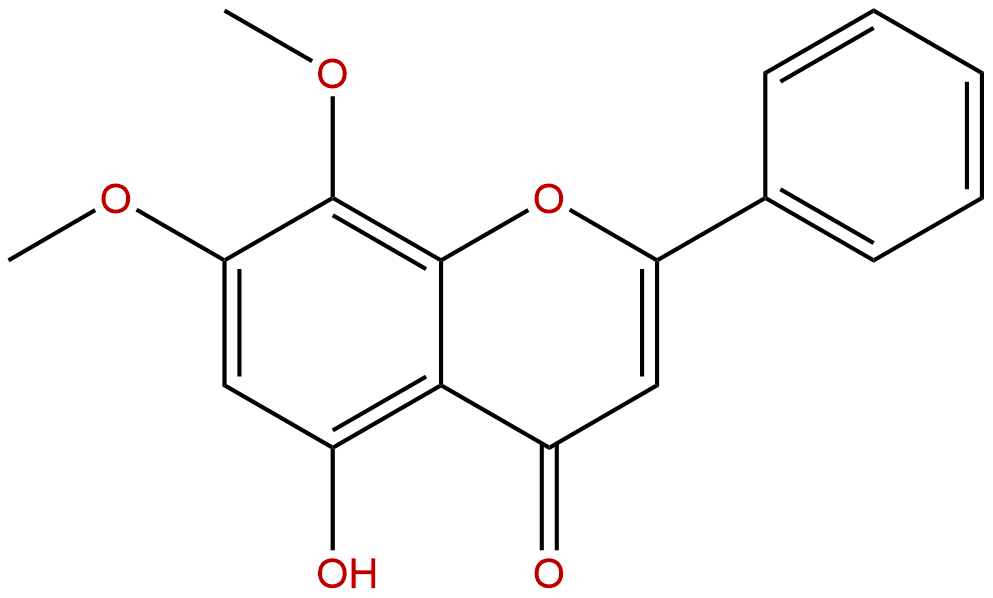


Synonym name: 5-Hydroxy-7,8-dimethoxyflavone; 7-O-Methylwogonin
Catalogue No.: BP0962
Cas No.: 3570-62-5
Formula: C17H14O5
Mol Weight: 298.294
Botanical Source: Mosla soochowensis Matsuda
Purity: 95%~99%
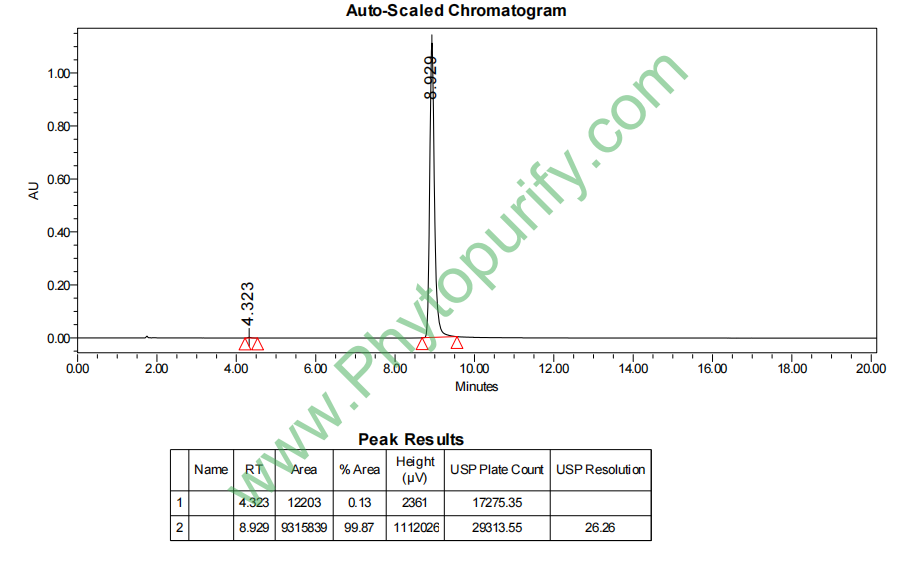
Analysis Method: HPLC-DAD or/and HPLC-ELSD
Identification Method: Mass, NMR
Packing: Brown vial or HDPE plastic bottle
Can be supplied from milligrams to grams.
For Reference Standard and R&D, Not for Human Use Directly.
Inquire for bulk scale.
HPLC of Moslosooflavone
Storage conditions:Short-term storage at 2~8℃, long-term storage at -20 ~ -80℃
68.9000
2.6989
2.6968
.0397
4.7733
42.5919
Low
90.7845
2.1639
Yes
No
No
No
Yes
No
0.6
No
No
Yes
No
Moslosooflavone (CAS number: 3570-62-5) is a flavonoid compound isolated from the traditional Chinese medicine Andrographis paniculata. As a medicinal plant widely used in traditional Asian medicine systems, Chuanxinlian has attracted much attention due to its significant anti-inflammatory, antiviral, and immunomodulatory effects. As one of its main active ingredients, flavonoids from Su Xie Moshu have attracted widespread research interest in the field of natural product pharmacology in recent years. Previous studies have shown that flavonoids from Su Xie Moshu not only have good anti hypoxia and anti-inflammatory activities, but also exhibit potential antiviral effects, especially in interventions targeting multiple virus related targets, showing unique advantages.
The purpose of this article is to systematically review the chemical structure and physicochemical properties, plant sources and extraction methods, pharmacological activity and mechanism of action of flavonoids from Mosuo, evaluate their clinical application potential based on their pharmacological parameters, and look forward to future research directions, providing theoretical basis and practical guidance for natural product pharmacology and new drug development.
Suxi Moshu flavonoids belong to flavonoid compounds, with a molecular formula of C17H14O5 and a molecular weight of 298.2940. Its structural feature is a typical flavonoid skeleton, consisting of two aromatic rings (A ring and B ring) and one heterocyclic ring (C ring), with hydroxyl and methoxy substituents at specific positions, which endow it with significant biological activity. The specific configuration of the molecular structure was confirmed through methods such as nuclear magnetic resonance (NMR), mass spectrometry (MS), and infrared spectroscopy (IR).
In terms of physical and chemical properties, the LogP value of Sophora japonica flavonoids is 2.6989, indicating that they have moderate lipid solubility and are beneficial for cell membrane penetration. The polar surface area (TPSA) is 68.9 Å ², indicating its advantages in biofilm permeability and intermolecular interactions. The low water solubility (0.0397 mg/mL) to some extent limits its oral bioavailability, but its dissolution and absorption characteristics can be improved through formulation optimization. The low permeability of the blood-brain barrier suggests limited direct impact on the central nervous system. The hERG channel inhibition experiment showed a negative result, indicating a low risk of cardiac toxicity. The Ames test result is 0.6, indicating a low risk of genotoxicity.
In summary, the physicochemical properties of flavonoids from Su Xie Moshu are moderate and have good potential for drug development, especially suitable for development as anti-inflammatory and antiviral drugs.
The main source of flavonoids in Su Xie Moshu comes from Andrographis paniculata, a plant widely distributed in tropical and subtropical regions of Asia. It is an important medicinal herb in traditional Chinese medicine and Indian Ayurvedic medicine. The whole plant of Chuanxinlian contains abundant flavonoids, diterpenoid lactones, and other polyphenolic compounds. Among them, the flavonoids from Mosuo, as one of the representative components of flavonoids, have significant biological activity.
The extraction method usually uses organic solvent extraction combined with chromatographic separation technology. The specific steps include:
In recent years, emerging technologies such as supercritical fluid extraction and microwave-assisted extraction have also been applied to the extraction of flavonoids from Moshu, improving extraction efficiency and purity, reducing solvent usage, and conforming to the concept of green chemistry.
Suxi Moshu flavonoids exhibit significant anti hypoxia effects. In the cell model, Suqian Moshu flavonoids can alleviate hypoxia induced cell damage, inhibit the activation of hypoxia related signaling pathways, protect mitochondrial function, reduce reactive oxygen species (ROS) generation, and thus improve cell survival rate. Its anti hypoxia effect provides a potential pharmacological basis for the treatment of cardiovascular and cerebrovascular diseases as well as ischemic injury.
As a natural flavonoid compound, Suqian Moshu flavonoids have good anti-inflammatory effects. In vitro and in vivo experiments have shown that flavonoids from Sophora japonica can significantly inhibit the production of inflammatory mediators such as tumor necrosis factor - α (TNF - α), interleukin-6 (IL-6), and nitric oxide (NO), reduce inflammatory cell infiltration, and alleviate tissue inflammatory responses. Its mechanism of action involves inhibition of the nuclear factor kappa B (NF - κ B) signaling pathway and enhancement of antioxidant enzyme activity.
Suxi Moshu flavonoids have shown extensive potential in the field of antiviral therapy. Research on multiple virus related targets has shown that this compound can interfere with virus replication and infection processes. Specific targets include myeloperoxidase (MPO), herpes virus proteins UL42, UL54, ICP27, thymidine kinase (TK), viral glycoprotein D (gD), as well as HIV related targets such as CCR5, CXCR4, HIV1 protease (HIV1-PR), and integrase (INT).
In vitro experiments have shown that flavonoids from Su Xie Moshu effectively inhibit virus replication and transmission by suppressing viral enzyme activity and blocking virus binding to host cell receptors. Especially in the HIV infection model, the inhibitory effect of Sophora flavescens on CCR5 and CXCR4 receptors suggests its potential value as an HIV invasion inhibitor.
In addition, the multi-target mechanism of action of Sophora flavescens on herpes virus enhances its development prospects as a broad-spectrum antiviral drug.
The biological activity of flavonoids in Su Xie Moshu is based on their interactions with various molecular targets, involving multiple signaling pathways such as anti-inflammatory, anti hypoxia, and antiviral effects.
Anti inflammatory mechanism
Suxi Moshu flavonoids inhibit the NF - κ B signaling pathway, block the transcriptional expression of pro-inflammatory cytokines such as TNF - α and IL-6, and alleviate inflammatory responses. At the same time, it activates the Nrf2/ARE antioxidant pathway, enhances the expression of intracellular antioxidant enzymes such as superoxide dismutase (SOD) and glutathione peroxidase (GPx), and reduces oxidative stress levels.
Anti hypoxia mechanism
This compound stabilizes the intracellular oxygen metabolism environment, protects mitochondrial function, and prevents cell apoptosis by regulating the HIF-1 α (hypoxia inducible factor-1 α) signaling pathway. In addition, flavonoids from Su Xie Moshu can inhibit hypoxia induced calcium influx, alleviate cellular calcium overload, and reduce cell damage.
Antiviral mechanism
Suxi Moshu flavonoids target key enzymes and receptors for virus replication, including:
MPO Regulating host immune response and reducing inflammatory damage.
Molecular docking and dynamic simulations further confirmed the high affinity binding of Suqian Moshu flavonoids to the aforementioned targets, revealing their multi-target synergistic antiviral mode.
The pharmacological parameters of Su Xie Moshu flavonoids show that they have good potential for drug development:
Pharmacokinetic studies have shown that isoflavones from Sophora japonica have a moderate half-life in vivo and are mainly metabolized by the liver. The metabolites are stable and have no significant toxicity. Its oral bioavailability is limited by low water solubility and first pass effect, but can be significantly improved through modern pharmaceutical technologies such as nanocarriers and solid dispersions.
In vivo distribution studies have shown that flavonoids from Su Xie Moshu are mainly distributed in the liver, lungs, and kidneys, which is consistent with its anti-inflammatory and antiviral target organs. The main excretion pathways are bile and urine.
Due to its multi-target and multi mechanism pharmacological activity, the flavonoids from Su Xie Moshu have broad clinical application prospects
Anti inflammatory disease treatment
Suitable for chronic inflammatory diseases such as rheumatoid arthritis, inflammatory bowel disease, and chronic obstructive pulmonary disease (COPD). Its low toxicity and good safety provide assurance for long-term use.
Diseases related to ischemia and hypoxia
It has potential protective effects in areas such as cardiovascular and cerebrovascular ischemic diseases, stroke, and hypoxic lung injury, and is particularly suitable for combining existing treatment plans to achieve synergistic effects.
antiviral therapy
For herpes virus, HIV, and other viral infections, suxi sujin, as an adjuvant or novel antiviral drug, can reduce virus replication and transmission, and lower the risk of drug resistance. Its multi-target mechanism of action helps overcome the limitations of single target drugs.
Drug development and formulation innovation
In the future, efforts should be made to strengthen the pharmacokinetic optimization of flavonoids in Su Xie Zhu, and develop efficient and safe drug delivery systems such as nanoparticles, liposomes, and sustained-release formulations to enhance clinical efficacy and patient compliance.
Clinical trials and safety evaluation
It is necessary to conduct systematic preclinical toxicology and clinical trials to verify its efficacy, safety, and dosage range, and promote its translation from laboratory research to clinical application.
As an important flavonoid component in Houttuynia cordata, the flavonoids from Su Xie Moshu exhibit significant anti hypoxia, anti-inflammatory, and antiviral potential due to their unique chemical structure and diverse pharmacological activities. Its multi-target mechanism of action not only enriches the research content of natural product pharmacology, but also provides valuable lead compounds for the development of new antiviral and anti-inflammatory drugs.
Despite the excellent pharmacological effects of flavonoids in vitro and animal models, their poor water solubility and low oral bioavailability still need to be addressed through pharmaceutical methods to develop medicinal properties. Future research should focus on pharmacokinetic optimization, in-depth analysis of the mechanism of action, and validation of clinical safety and efficacy.
In summary, as a natural product with broad application prospects, the flavonoids from Su Xie Moshu are worthy of further exploration and development in the fields of drug research and clinical treatment. It is expected that they will become important therapeutic drugs in the fields of anti-inflammatory, anti hypoxia, and antiviral in the future.
