


Synonym name: Embelic acid; Embeliaquinone
Catalogue No.: BP0530
Cas No.: 550-24-3
Formula: C17H26O4
Mol Weight: 294.391
Botanical Source: Embelia ribes, Embelia tsjersium-cottam, Embelia barbeyana, Embelia robusta, Embelia kilimandscharica, Ardisia humilis, Rapanea umbellata, Connarus ritchiei, , Myrsine africana, Myrsine semiserrata, Myrsine capitellata
Purity: 95%~99%
Analysis Method: HPLC-DAD or/and HPLC-ELSD
Identification Method: Mass, NMR
Packing: Brown vial or HDPE plastic bottle
Can be supplied from milligrams to grams.
For Reference Standard and R&D, Not for Human Use Directly.
Inquire for bulk scale.
HPLC of Embelin
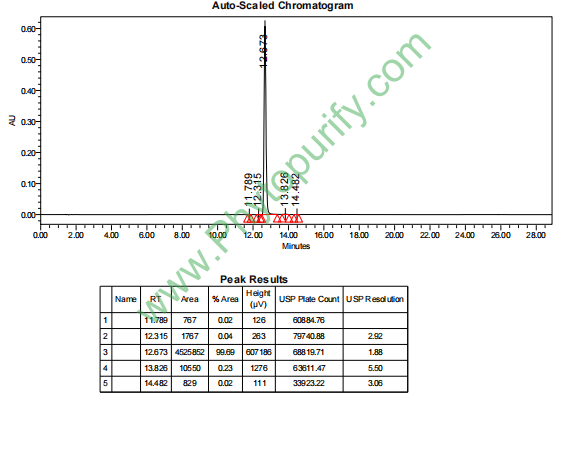
Storage conditions:Short-term storage at 2~8℃, long-term storage at -20 ~ -80℃
Embelin, also known as 5-hydroxy-2-octyl-1,4-anthraquinone and CAS number 550-24-3, is a natural small molecule compound derived from plants. It has attracted widespread attention in the field of natural product pharmacology due to its diverse pharmacological activities. As a non peptide XIAP (X-linked inhibitor of apoptosis) inhibitor of cell permeability, anthracycline has significant anti proliferation and pro apoptosis effects in a variety of tumor cells, especially in prostate cancer, oral squamous cell carcinoma, breast cancer and other malignant tumor models. In recent years, with the in-depth study of its molecular mechanism, anthracycline has been found to regulate multiple signaling pathways, including NF - κ B, caspase family, and autophagy related pathways, thereby achieving multi-target intervention on tumor cells. In addition, anthracycline has shown certain biological activities in anti-inflammatory, antioxidant, and antibacterial aspects, indicating its broad application prospects as a drug lead compound.
This article aims to systematically review the chemical structure and physicochemical properties, plant sources, and extraction methods of anthracycline, analyze its pharmacological activity and mechanism of action, evaluate its pharmacological properties and pharmacokinetic characteristics, explore its clinical application potential and development prospects, and provide theoretical basis and research direction for subsequent drug development and clinical translation.
The chemical structure core of anthracene quinone is anthraquinone skeleton, with a molecular formula of C17H26O4 and a molecular weight of 294.3910. Its structure contains a 1,4-anthraquinone core, a 5-hydroxy modification, and a 2-position connected octyl side chain, endowing it with strong hydrophobicity and cell membrane permeability. The LogP value of anthracycline is 4.1259, indicating its high lipid solubility, which is beneficial for penetrating cell membranes but may limit its water solubility. Its polar surface area (TPSA) is 74.6 Å ², and moderate polarity helps maintain a certain level of bioavailability. Low water solubility (0.0357 mg/mL) suggests the need to consider solubility improvement strategies in formulation development. Anthraquinone does not inhibit hERG channels, and the Ames mutagenicity test results are negative, indicating its high safety and low toxicological risk.
The chemical structure has good stability, and the anthraquinone skeleton endows it with certain antioxidant capacity. The hydroxyl and long-chain alkyl side chains in the structure provide diverse interaction sites for its binding with target proteins, promoting its specificity and selectivity.
Anthraquinone is mainly present in the plant Embelia ribs Burm. f. and its related species, and is one of the main active ingredients in this genus of plants. Embelia ribbons are widely distributed in India and Southeast Asia, traditionally used to treat various diseases such as parasitic infections, inflammation, and tumors.
The common methods for extracting anthracycline include solvent extraction, ultrasound assisted extraction, and hot reflux extraction. Ethanol or methanol are generally used as extraction solvents to improve extraction efficiency. After liquid-liquid separation and column chromatography purification, high-purity anthracycline can be obtained from the extraction solution. In recent years, supercritical CO2 extraction technology has also been applied to the extraction of anthracycline, which has the advantages of high efficiency and environmental protection.
During the purification process, methods such as silica gel column chromatography and reverse phase high-performance liquid chromatography (RP-HPLC) are commonly used for separation and identification. Structural confirmation often relies on nuclear magnetic resonance (NMR), mass spectrometry (MS), and infrared spectroscopy (IR) analysis.
Anthraquinone, as a XIAP inhibitor, exhibits significant anti proliferative effects in various tumor cell lines. XIAP, as a member of the apoptosis inhibiting protein family, can inhibit the activity of caspase-3, caspase-7, and caspase-9, and block the cell apoptosis signaling pathway. Anthraquinone binds to XIAP to release its inhibition of caspase and induce tumor cell apoptosis.
In prostate cancer cells, the IC50 of anthracycline is approximately 4.1 μ M, which can effectively inhibit cell growth and activate caspase-9, initiating the endogenous apoptotic pathway. Studies on oral squamous cell carcinoma cells have shown that anthracycline not only induces apoptosis, but also activates autophagy, indicating its diverse anti-tumor mechanisms.
In the field of breast cancer, anthracycline inhibits the proliferation, migration and drug resistance of tumor cells by regulating a variety of key molecular targets, such as AMPK, BCL2, STAT3, ESR2, etc. Its regulation of ABC transporters ABCB1 and ABCG2 is expected to overcome multidrug resistance (MDR) and enhance chemotherapy efficacy.
Anthraquinone can inhibit the NF - κ B signaling pathway, reduce the expression of inflammatory mediators such as TNF - α, IL-6, and IL-1 β, and exhibit good anti-inflammatory activity. It blocks the anti apoptotic and metastatic gene products regulated by NF - κ B, further enhancing its anti-tumor effect.
In addition, anthracycline also has a regulatory effect on immune cell function, promoting macrophage activation and cytokine secretion, and enhancing the body's immune surveillance ability.
Anthraquinone also exhibits certain antioxidant, antibacterial, and antiparasitic activities, expanding its pharmacological application scope. Its antioxidant effect is mainly attributed to the electron donor properties of anthraquinone structure, which can scavenge free radicals and alleviate oxidative stress damage.
The core mechanism of action of anthracycline is focused on inhibiting XIAP protein, relieving inhibition of the caspase family, and activating intracellular apoptotic signals. The specific mechanism includes:
XIAP inhibitory effect Anthraquinone directly binds to the BIR3 domain of XIAP, blocking its binding with caspase-9, promoting caspase-9 activation, and initiating the mitochondrial dependent endogenous apoptosis pathway.
Inhibition of NF - κ B signaling pathway Anthraquinone inhibits the activity of I κ B kinase (IKK), prevents the degradation of I κ B, inhibits the transfer of NF - κ B from cytoplasm to nucleus, and reduces the expression of anti apoptotic proteins and transfer related genes.
autophagy induction In oral squamous cell carcinoma cells, anthracycline activates the AMPK signaling pathway, promotes the expression of autophagy related protein LC3-II, induces cell autophagy, and synergistically promotes cell death.
Multi target regulation In breast cancer cells, anthracycline regulates STAT3, BCL2, PRKCA, MMP2 and other signaling molecules to inhibit tumor cell proliferation, migration and drug resistance.
ABC transporter regulation Anthraquinone affects the expression or function of ABCB1 and ABCG2, reduces drug efflux, and enhances intracellular accumulation of chemotherapy drugs.
In summary, anthracycline achieves effective inhibition of tumor cells through the synergistic regulation of multiple signaling pathways, and has the advantages of multiple targets and mechanisms.
The molecular weight of anthracycline is 294.39, which meets the drug affinity criteria of Lipinski rule. The LogP value of 4.13 suggests that it has high lipid solubility, which is beneficial for cell membrane permeability, but low water solubility (0.0357 mg/mL), which may limit its oral bioavailability and formulation development. Its TPSA is 74.6 Å ², suitable for cellular absorption.
The low blood-brain barrier penetration ability suggests that the application of anthracycline in central nervous system drug development is limited, but this also reduces the risk of central neurotoxicity. The hERG channel inhibition experiment was negative, indicating a low risk of cardiac toxicity. The Ames mutagenicity test result is 0, indicating low genetic toxicity risk and good safety.
In terms of pharmacokinetics, the absorption, distribution, metabolism, and excretion (ADME) characteristics of anthracycline still require systematic research. Existing studies have shown that anthracycline is absorbed slowly after oral administration and has limited bioavailability. It may be necessary to improve its pharmacokinetic properties through nanocarriers, liposomes, or other delivery systems. The metabolic pathway is speculated to mainly undergo oxidation and binding reactions through the liver enzyme system, and the activity and safety of metabolites need to be further evaluated.
Anthraquinone, as a natural XIAP inhibitor, has great potential for clinical translation due to its significant anti-tumor activity and good safety. Its application prospect in prostate cancer, oral squamous cell carcinoma, breast cancer and other malignant tumors is particularly prominent. By targeting apoptosis inhibitory proteins and regulating multiple signaling pathways, anthracycline is expected to become a lead compound for the new generation of anticancer drugs.
In future clinical development, it is important to focus on the following aspects:
Formulation optimization Develop new drug delivery systems, such as nanoparticles, liposomes, or solid dispersions, to address the issues of poor water solubility and low bioavailability, in order to improve in vivo exposure levels and therapeutic efficacy.
Combination therapy strategy The combination of anthracycline and traditional chemotherapy drugs or targeted drugs may overcome multidrug resistance and enhance anti-tumor effects, which is worthy of further research.
safety evaluation Systematic toxicology and pharmacokinetic studies are necessary in preclinical settings to ensure the long-term safety and tolerability of anthracycline.
Indications expansion Based on its multiple activities such as anti-inflammatory and immune regulation, the potential of anthracbeine in inflammatory diseases, autoimmune diseases and infectious diseases is also worth exploring.
Clinical trial design Conduct early clinical trials to determine the maximum tolerated dose, pharmacokinetic parameters, and preliminary efficacy of anthracycline, laying the foundation for subsequent clinical development.
Anthraquinone, as a natural compound with multiple targets and mechanisms, exhibits excellent anti-tumor activity and good safety, and has the potential to become a new type of anti-cancer drug. It effectively induces tumor cell apoptosis and autophagy, inhibits tumor growth and metastasis by inhibiting XIAP protein and blocking the NF - κ B signaling pathway. Meanwhile, the pharmacological evaluation of anthracycline shows that it has a good foundation for drug development, but the issues of water solubility and bioavailability still need to be addressed.
In the future, combining modern pharmaceutical formulation technology and precision medicine strategies, anthracycline is expected to play an important role in the field of anti-cancer treatment. The pharmacokinetics, toxicology, and clinical research of the system will drive it from the laboratory to clinical practice, bringing new treatment options for cancer patients. The in-depth development and interdisciplinary integration of natural product pharmacology will provide solid support for the drug development of anthracycline and similar compounds.
