Introduction/Overview
Flavonoids are a class of secondary metabolites widely present in nature, known for their diverse chemical structures and extensive biological activities. 3-Hydroxyflavone (CAS number: 577-85-5), as a member of the flavonoid family, is a monohydroxy derivative of the flavonoid nucleus that undergoes hydroxylation at the C-3 position, belonging to the flavonol subclass. Although its structure is relatively simple, it is the core skeleton of many complex flavonols such as quercetin and kaempferol, playing an important role in plant physiology and pharmacological activity. In recent years, with the global spread of multidrug-resistant pathogens, the development of new antibiotics has become an urgent need in the field of public health. The failure of traditional antibiotics has prompted researchers to turn their attention to natural products and search for antibacterial lead compounds with new mechanisms of action. 3-hydroxyflavonoids are gradually becoming a research hotspot in the fields of natural product pharmacology and medicinal chemistry due to their broad-spectrum antibacterial potential demonstrated in vitro studies, particularly their inhibitory effects on various key targets of bacteria and fungi. This article aims to systematically review the chemical properties, plant sources, pharmacological activities, especially the antibacterial mechanism and molecular targets of 3-hydroxyflavonoids, and to deeply explore and prospect their pharmacological properties and clinical application prospects.
Chemical structure and physicochemical properties
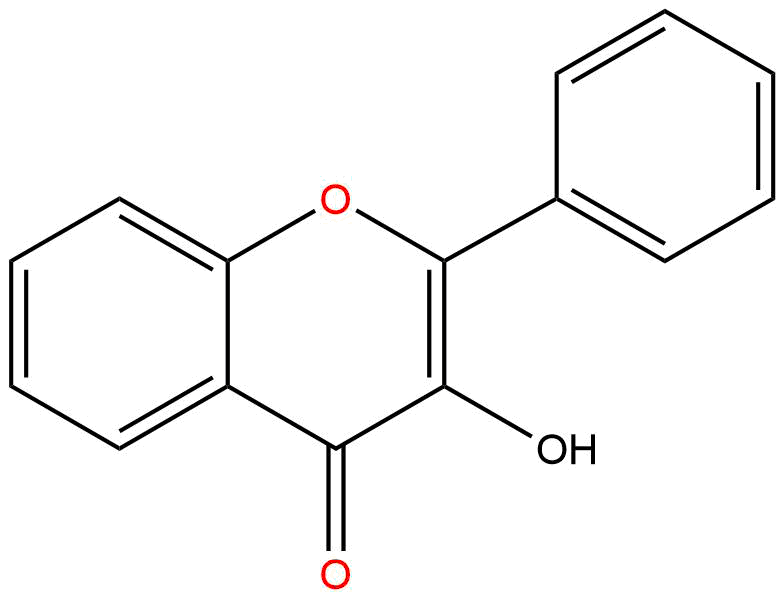
The molecular formula of 3-hydroxyflavone is C15H10O3, with a molecular weight of 238.2420. Its basic structure is composed of two benzene rings (A ring and B ring) connected by an oxygen-containing heterocyclic ring (C ring, γ - pyranone ring). Its characteristic modification is to attach a hydroxyl group (- OH) to the 3rd carbon atom of the C ring, making it the basic unit of flavonol compounds. The presence of this hydroxyl group significantly affects the physicochemical properties and biological activity of the molecule.
From the analysis of physical and chemical properties, 3-hydroxyflavonoids exhibit typical flavonoid compound characteristics. Its lipid water partition coefficient (LogP) is 3.0255, indicating that the molecule has moderate lipophilicity, which is beneficial for its penetration of cell membranes, but may also affect its water solubility. Its topological polar surface area (TPSA) is 50.4400 Å ², which is relatively low, further confirming its good membrane permeation potential. However, its water solubility is poor, about 0.0108 mg/mL, which may be one of the obstacles that need to be overcome for its development as a drug. In the preliminary prediction of drug properties, 3-hydroxyflavonoids showed high blood-brain barrier permeability potential, suggesting that they may have unique value in the treatment of central nervous system related infections. Preliminary safety screening shows that it has no significant inhibitory effect on hERG potassium channels (hERG inhibition: No), reducing the risk of inducing QT interval prolongation in the heart; The Ames test value is 0.9, indicating a low risk of mutagenicity, but further in vitro and in vivo experiments are needed for verification.
Plant sources and extraction methods
3-hydroxyflavones are not widely present in high concentrations in plants, but often appear as metabolic precursors or degradation products of flavonol compounds. According to literature reports, it can be detected in various plants, such as in the metabolic studies of some Asteraceae, Leguminosae plants, and certain medicinal plants such as Scutellaria baicalensis. It may also accumulate as a defensive secondary metabolite in certain plants under biotic or abiotic stress.
The extraction of 3-hydroxyflavonoids from plant materials often uses classic natural product extraction and separation techniques. Firstly, dry plant tissues are usually extracted using organic solvents, including methanol, ethanol, acetone, or their mixed solutions with water. Methods such as Soxhlet extraction, ultrasound assisted extraction, or microwave-assisted extraction are used to improve efficiency. After filtration and concentration, the obtained crude extract needs to be separated and purified through a series of chromatographic techniques. Silica gel column chromatography is commonly used for preliminary separation, and different components are eluted based on polarity differences. Subsequently, monitoring was carried out using thin-layer chromatography (TLC), and further fine separation and purification were performed using high-performance liquid chromatography (HPLC) or preparative thin-layer chromatography (PTLC) to obtain high-purity 3-hydroxyflavonoid monomers. Modern technologies such as high-speed countercurrent chromatography (HSCCC) have also been applied for the separation of such compounds due to their advantage of avoiding irreversible adsorption. Structural identification mainly relies on spectroscopic methods such as nuclear magnetic resonance (NMR, including 1H NMR and 13C NMR), mass spectrometry (MS), and ultraviolet spectroscopy (UV).
Pharmacological activity research
The pharmacological activity research of 3-hydroxyflavonoids is currently mainly focused on the antibacterial field and has shown promising potential. Research has shown that it has certain inhibitory activity against various Gram positive bacteria (such as Staphylococcus aureus, Enterococcus faecalis) and Gram negative bacteria (such as Escherichia coli, Pseudomonas aeruginosa). In addition, it also exhibits inhibitory effects on some fungi, such as Candida albicans. Its antibacterial activity may be achieved through the synergistic action of multiple mechanisms rather than a single target, which provides the possibility to overcome bacterial resistance.
In addition to antibacterial activity, 3-hydroxyflavonoids, as the basic structure of flavonoids, also possess some common biological activities of this class of compounds. For example, the phenolic hydroxyl groups in its structure give it a certain antioxidant capacity, which can eliminate free radicals and alleviate oxidative stress. Some studies also suggest that it may have the potential for anti-inflammatory, anti-tumor and other activities, but research in these areas is still in its early stages and requires more in-depth data support. At present, its most prominent and relatively concentrated pharmacological effect is still antibacterial activity.
Mechanism of action and molecular targets
The study on the antibacterial mechanism of 3-hydroxyflavonoids reveals their multi-target properties, which may be their advantage in combating drug-resistant strains. According to existing research, its potential targets involve multiple key life processes in bacterial and fungal cells:
- Nucleic acid synthesis and topoisomerase It may interfere with the replication, transcription, and repair processes of bacterial DNA by inhibiting the activity of bacterial DNA gyrases such as GYRA (DNA gyrase subunit A), leading to bacterial death. This is similar to the target of quinolone antibiotics, but the specific binding site may be different.
- Cell Wall and Cell Division Research has shown that 3-hydroxyflavonoids may target the bacterial cell division protein FtsZ (FTSZ). FtsZ is a key protein for prokaryotic cell division, which assembles into a Z-loop at the division site to drive cytoplasmic division. Interfering with the function of FtsZ can effectively inhibit bacterial division. In addition, it may also interact with penicillin binding proteins (such as PENA), affecting the synthesis of cell wall peptidoglycans.
- Cell membrane and membrane proteins Evidence suggests that 3-hydroxyflavonoids may affect the permeability or function of bacterial cell membranes. Targets such as GYPB (presumably membrane related) may mediate this process. For fungi, they may act on key enzymes in the cell membrane ergosterol synthesis pathway, such as ERG11 (lanosterol 14 α - demethylase) or CYP51A1 (its homolog), which is consistent with the target pathway of azole antifungal drugs.
- metabolic pathway The key enzyme in bacterial fatty acid biosynthesis pathway, acyl ACP reductase (FABI), is another potential target. Inhibition of FABI can block the elongation of bacterial fatty acid chains and affect the synthesis of cell membrane phospholipids. In addition, dihydrofolate reductase (DHFR), as a key enzyme in folate metabolism, is also one of its possible inhibitory targets, which is similar to the mechanism of action of trimethoprim.
- Exogenous pumps and drug resistance Regarding fungi, research suggests that 3-hydroxyflavonoids may affect the function or expression of efflux pumps (such as CDR1), thereby reducing drug efflux from cells, enhancing antifungal efficacy, or reversing drug resistance. The interaction between bacteria and resistance gene products such as MECA (mediating methicillin resistance) is also worth exploring.
This multi-target synergistic mode makes it difficult for bacteria or fungi to develop high-level drug resistance through a single gene mutation, providing a new strategy for the development of novel antibacterial drugs.
Evaluation of drug properties and pharmacokinetics
Although 3-hydroxyflavonoids have shown good antibacterial activity and multi-target potential in vitro, their pharmacological properties still need to be comprehensively evaluated. According to its physical and chemical parameters, a moderate LogP value and lower TPSA indicate good intestinal absorption and cell membrane penetration ability, while a higher predicted value of blood-brain barrier penetration is its characteristic advantage. However, low water solubility (0.0108 mg/mL) is its main drawback, which may lead to low oral bioavailability and difficulties in formulation development. In the subsequent optimization of medicinal chemistry, its solubility and bioavailability can be improved through structural modifications (such as salt formation, introduction of hydrophilic groups, preparation of prodrugs) or the use of advanced drug delivery systems (such as nanocrystals, liposomes, cyclodextrin inclusion complexes).
Regarding pharmacokinetics, there is currently a lack of systematic in vivo pharmacokinetic research data on 3-hydroxyflavonoids themselves. Referring to studies on other flavonoids, it can be inferred that they may undergo extensive metabolic transformations in the body. The main metabolic pathways may include hydroxylation, demethylation, and C-ring cleavage in phase I metabolism; In phase II metabolism, the binding reactions with glucuronic acid and sulfuric acid usually occur on phenolic hydroxyl groups, generating more water-soluble metabolites that are easily excreted through the kidneys or bile. The 3-hydroxy group of 3-hydroxyflavonoids is the main site for binding reactions. Its pharmacokinetic characteristics, such as absorption, distribution, metabolism, and excretion, will profoundly affect its administration regimen and efficacy. In the future, detailed in vivo pharmacokinetic and metabolite identification studies are needed to clarify its in vivo processes, effective concentrations, and potential toxicity.
Clinical application prospects and prospects
As a natural lead compound with multi-target antibacterial mechanism, 3-hydroxyflavonoids have the following clinical application prospects:
- Development of new antibacterial drugs In response to the increasingly severe multi drug resistant bacterial infections, the multi-target properties of 3-hydroxyflavonoids can reduce the rate of drug resistance development. It can serve as a lead compound and undergo structural optimization through medicinal chemical methods, aiming to enhance its antibacterial efficacy, improve water solubility and pharmacokinetic properties, and reduce potential toxicity, ultimately developing a new type of antibacterial drug with a novel mechanism of action.
- Antibacterial enhancer Given its potential to inhibit efflux pumps (such as fungal CDR1) or synergize with other antibacterial targets, 3-hydroxyflavonoids or their derivatives are expected to be developed as antibacterial enhancers, used in combination with existing antibiotics (such as fluconazole, beta lactams) to restore the sensitivity of resistant bacteria to existing drugs and extend the clinical lifespan of existing antibiotics.
- Local medication and special site infections Its good lipid solubility and blood-brain barrier penetration potential make it uniquely valuable for the treatment of skin and mucosal infections, as well as central nervous system infections such as bacterial meningitis and fungal meningitis. It can be made into external gel, cream or special preparation for central administration.
- Development of plant-based antibacterial agents In the fields of agriculture and food preservation, 3-hydroxyflavonoids can be used as candidate ingredients for plant-based antibacterial agents, for the prevention and control of crop diseases or as natural food preservatives.
However, there are still many challenges in its clinical application: firstly, it is necessary to conduct systematic preclinical studies to comprehensively evaluate its in vivo efficacy, acute and chronic toxicity, genetic toxicity, and reproductive toxicity. Secondly, it is necessary to thoroughly elucidate its precise mechanism of action, clarify the binding mode, affinity, and weight in the overall antibacterial contribution to each target. Finally, it is necessary to address its shortcomings in drug development, particularly in terms of solubility and metabolic stability.
Future research should focus on: ① using computer-aided drug design, structural biology, and chemical biology techniques to deeply analyze the details of their interactions with key target proteins, and guide rational drug design; ② Synthesize a series of 3-hydroxyflavonoid derivatives or analogues, conduct systematic structure-activity relationship studies, and search for candidate molecules with better activity and drug properties; ③ Conduct in-depth in vivo pharmacological evaluation, establish appropriate animal models of infection, and verify their therapeutic potential; ④ Explore its synergistic effects with other antibacterial drugs and develop reasonable combination therapy strategies.
Conclusion
3-hydroxyflavones, a relatively simple natural flavonol with a unique chemical structure and multi-target antibacterial mechanism, have shown great potential as novel antibacterial lead compounds in response to the global drug resistance crisis. The discovery of plant sources, confirmation of in vitro antibacterial activity, and preliminary revelation of its target network have laid an important foundation for its further development. Although there are still many challenges in drug development, in vivo efficacy, and safety, with the continuous advancement of modern drug research and development technology, through systematic structural optimization and in-depth biological research of 3-hydroxyflavonoids, it is expected to transform them from a potential natural product into antibacterial new drugs or enhancers with clinical application value. Its research not only provides new ideas for developing new anti infective drugs, but also enriches the connotation of natural product pharmacology, reflecting the important value of finding solutions to modern medical problems from the natural treasure trove.