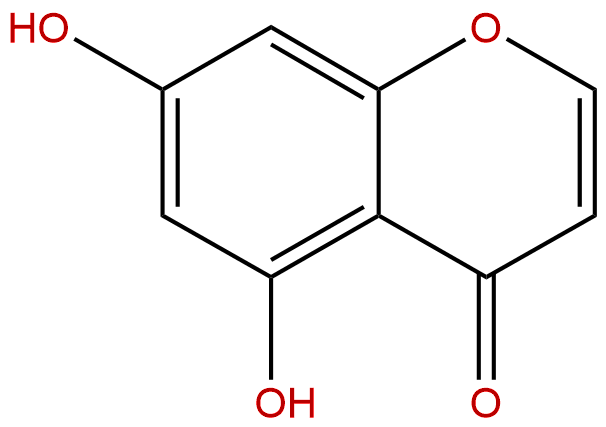


Synonym name: 5,7-Dihydroxy-4H-chromen-4-one
Catalogue No.: BP0081
Cas No.: 31721-94-5
Formula: C9H6O4
Mol Weight: 178.143
Botanical Source: various plant materials, e.g. Garcinia conrauana bark and peanut shells
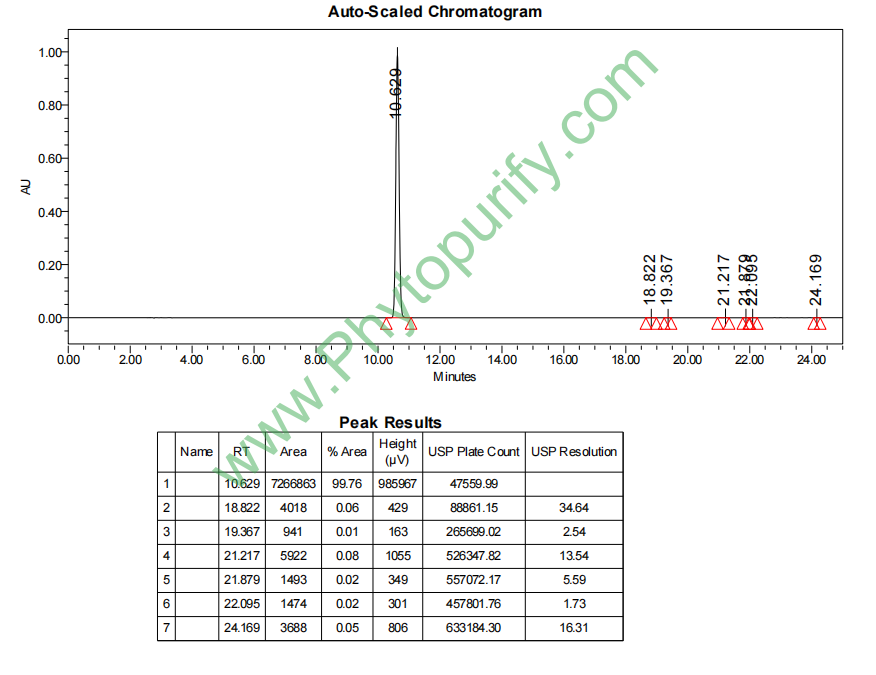
Purity: 95%~99%
Analysis Method: HPLC-DAD or/and HPLC-ELSD
Identification Method: Mass, NMR
Packing: Brown vial or HDPE plastic bottle
Can be supplied from milligrams to grams.
For Reference Standard and R&D, Not for Human Use Directly.
Inquire for bulk scale.
HPLC of 5,7-Dihydroxychromone
Storage conditions:Short-term storage at 2~8℃, long-term storage at -20 ~ -80℃
70.6700
.9922
.7373
1.2174
2.3291
31.3586
Low
81.1344
2.4841
Yes
No
No
No
Yes
Yes
1.2
Yes
No
Yes
No
Chromone compounds are a class of benzopyranone derivatives widely present in nature, which are important material basis for many medicinal plants to exert biological activity. Among them, 5,7-Dihydroxychromone (CAS: 31721-94-5), as a relatively simple but functionally diverse parent compound, has received increasing attention from natural product pharmacology researchers in recent years. This compound is not only a key biosynthetic precursor and metabolite of various complex natural products such as flavonoids and chromogens, but also exhibits a wide range of biological activities, including antioxidant, anti-inflammatory, anti-tumor, and neuroprotective effects.
Of particular note is that with the development of systems pharmacology and network pharmacology, studies have found that the potential targets of 5,7-dihydroxychromidone are highly correlated with the pathological network of endometriosis, a complex gynecological disease. Endometriosis is an estrogen dependent chronic inflammatory disease characterized by the growth of endometrioid tissue outside the uterine cavity, accompanied by pain, infertility, and pelvic adhesions. Its treatment faces significant challenges. Existing drugs often have side effects or limited efficacy, therefore, searching for multi-target, highly efficient and low toxicity new therapeutic molecules from natural products has become an important research direction. 5,7-dihydroxychromenone has shown unique therapeutic potential due to its potential regulatory ability on multiple endometriosis related targets, including monoamine oxidase A (MAOA), estrogen receptor (ESR1/ESR2), tumor necrosis factor (TNF), ATP binding cassette transporters (such as ABCB1, ABCG2), and inflammatory mediator synthase (such as ALOX5).
This article aims to systematically review the chemical properties, plant sources, pharmacological activities of 5,7-dihydroxychromenone, and focus on its multi-target mechanism of action, pharmacological characteristics, and clinical application prospects in endometriosis, in order to provide scientific basis for the deep development and transformation research of this natural product.
The chemical name of 5,7-dihydroxychromen-4-one is 5,7-dihydroxy-4H-benzopyran-4-one, with a molecular formula of C9H6O4 and a molecular weight of 178.1430. Its basic skeleton is a chromone core structure formed by the condensation of a benzene ring (A ring) and an oxygen-containing heterocyclic ring (C ring, γ - pyranone ring). The two phenolic hydroxyl groups are located at the 5th and 7th positions of the A ring, which are the key pharmacophores that exert various biological activities.
From the analysis of physical and chemical properties, this compound exhibits typical phenolic characteristics. The calculated lipid water partition coefficient (LogP) is 0.9922, indicating that it has moderate lipophilicity but overall leans towards hydrophilicity, which is related to the presence of two strongly polar hydroxyl groups in its molecule. The topological polar surface area (TPSA) is 70.67 Å ², further confirming its good polarity. The predicted value of water solubility is 1.2174 mg/mL, which belongs to the range of slightly soluble to soluble, which is beneficial for its absorption and distribution in organisms. However, its ability to cross the blood-brain barrier (BBB) is predicted to be "low", suggesting that it may not easily enter the central nervous system. This can sometimes be seen as an advantage for drugs that primarily act on the peripheral system, reducing central side effects. In early safety screening, the risk of hERG inhibition was "no", indicating a low potential risk of arrhythmia; The Ames test value is 1.2, indicating a low risk of mutagenicity, but further experimental verification is needed.
The UV spectrum of 5,7-dihydroxychromone exhibits characteristic absorption peaks at approximately 250 nm and 300 nm, corresponding to the absorption of the benzoyl system and cinnamoyl system, respectively. Its phenolic hydroxyl group endows it with strong antioxidant capacity, enabling it to scavenge free radicals through hydrogen atom transfer or single electron transfer mechanisms. The carbonyl and hydroxyl groups in the structure also make it easy to chelate with metal ions and can act as hydrogen bond donors/acceptors to interact with various biomolecules such as enzymes and acceptors.
5,7-dihydroxychromone is widely distributed in the plant kingdom and often exists as a glycoside or precursor in various medicinal plants. Its main sources include:
1. Poaceae plants Seedlings of wheat and barley, for example, were important sources for the early discovery of this compound.
2. fern It has been detected in many ferns and is one of their secondary metabolites.
3. Asteraceae plants Plants such as Artemisia and Chicory often contain their derivatives.
4. Lamiaceae plants It has also been found in research on some medicinal plants such as Prunella vulgaris and rosemary.
5. Other sources Glycosides or methylated derivatives of these compounds can also be found in leguminous and Rosaceae plants, which can be hydrolyzed or metabolized to produce 5,7-dihydroxychromenone.
In terms of extraction and separation, solvent extraction combined with modern chromatographic techniques is often used based on its polarity and solubility characteristics.
1. Extract Methanol, ethanol, acetone, or alcohol water mixed solvents with different ratios are commonly used for extraction, reflux, or ultrasound assisted extraction of plant materials. Due to the presence of phenolic hydroxyl groups, it is important to avoid strong acids, strong bases, or prolonged high-temperature treatment during the extraction process to prevent structural damage.
2. Separation and purification After vacuum concentration, the crude extract can be preliminarily enriched using liquid-liquid extraction (such as extracting the phenolic fraction with ethyl acetate). Further purification mainly depends on column chromatography, such as silica gel column chromatography, polyamide column chromatography or Sephadex LH-20 column chromatography. Reversed phase high performance liquid chromatography (RP-HPLC) is the ultimate effective method for obtaining high-purity monomers, commonly using methanol water or acetonitrile water as mobile phases.
3. appraisal The structural identification of compounds mainly relies on spectroscopic methods, including ultraviolet spectroscopy (UV), infrared spectroscopy (IR), mass spectrometry (MS, especially high-resolution mass spectrometry HR-MS), and nuclear magnetic resonance spectroscopy (NMR, including 1H NMR and 13C NMR). In its NMR spectrum, the proton signals of 5,7-disubstituted protons on the A ring (usually two aromatic protons coupled between positions, δ~6.1 ppm and~6.3 ppm, J ≈ 2.0 Hz) and the characteristic signals of H-2 and H-3 on the C ring are important structural identification criteria.
Although 5,7-dihydroxychromone has a simple structure, its pharmacological activity spectrum is broad, mainly covering the following aspects:
In response to the complex disease of endometriosis, the mechanism of action of 5,7-dihydroxychromidone exhibits a multi-target and multi pathway synergistic characteristic. Based on its physicochemical properties and existing pharmacological research, its potential target network can be analyzed as follows:
In summary, 5,7-dihydroxychromidone may achieve synergistic treatment of endometriosis by simultaneously acting on a multidimensional network of "hormone regulation (ESR) - inflammatory oxidation (TNF/ALOX5/XDH/APEX1) - neuropathic pain (MAOA/ADRA3) - drug transport (ABCB1/ABCG2)", which is in line with the concept of modern multi-target treatment strategies for complex diseases.
Although 5,7-dihydroxychromenone has shown good biological activity in vitro, its potential as a drug candidate molecule still requires systematic pharmacological evaluation.
At present, there are relatively few public reports on the pharmacokinetic studies of the 5,7-dihydroxychromone system, which is a gap that must be filled in its development. Future research requires the establishment of sensitive in vivo analysis and detection methods to clarify their pharmacokinetic parameters in different animal models.
5,7-dihydroxychromone, as a natural product lead compound with multi-target effects, has unique development prospects in the treatment of endometriosis, but also faces many challenges.
Application prospects:
1. As a multi-target therapeutic drug Due to the pathological characteristics of endometriosis with multiple intertwined factors, the development of single target drugs often has limited efficacy. 5,7-dihydroxychromidone simultaneously intervenes in inflammation, oxidation, hormone, and pain pathways, which may achieve a "one stone, multiple birds" therapeutic effect, especially suitable for patients who are intolerant or have poor efficacy of existing hormone therapies.
2. As a drug resistance reversal agent Combined with conventional hormones or chemotherapy drugs, its potential ABC transporter inhibitory ability may help overcome local drug tolerance in lesions and improve the efficacy of combination therapy.
3. Improve accompanying symptoms By inhibiting MAOA and regulating ADORA3, this compound may have a positive impact on comorbid symptoms such as chronic pain, anxiety, and depression associated with endometriosis, improving patients' quality of life.
4. Structural optimization and derivative development By using it as the parent nucleus for structural modification (such as introducing specific functional groups to enhance selectivity towards a target and improve pharmacokinetic properties), it is expected to discover a new generation of derivatives with stronger activity and better drug properties.
Challenges and future research directions:
1. Target validation and mechanism deepening At present, most of its direct interactions with the above-mentioned targets are based on computational predictions or indirect evidence, and there is an urgent need to experimentally verify their specific binding modes and functional regulation mechanisms through techniques such as surface plasmon resonance (SPR), isothermal titration calorimetry (ITC), co crystallization, or cell thermal shift analysis (CETSA).
2. Systematic pharmacodynamic evaluation It is necessary to comprehensively evaluate its effects on lesion volume, inflammatory infiltration, fibrosis, angiogenesis, and pain behavior in animal models that are closer to human diseases, such as mouse endometriosis autograft models.
3. Comprehensive drug development Systematic ADME and toxicology (acute toxicity, chronic toxicity, reproductive toxicity, etc.) studies must be conducted to evaluate their therapeutic window. At the same time, explore appropriate routes of administration and dosage forms to overcome potential drawbacks such as low bioavailability and rapid metabolism.
4. Explore combination therapy strategies Study its combination therapy with GnRH agonists, progestogens, or nonsteroidal anti-inflammatory drugs to explore the possibility of synergistic enhancement and reduction of their respective doses and toxic side effects.
5,7-dihydroxychromone, as a structurally sophisticated molecule endowed by nature, has value far beyond being a biosynthetic intermediate for complex natural products. Its intrinsic activities in antioxidant, anti-inflammatory, regulating hormone signaling, and affecting neurotransmitters perfectly complement the pathological network of endometriosis, a complex disease. The shift in research paradigm from a single anti-inflammatory molecule to a potential multi-target therapeutic candidate reflects the development trend of modern natural product pharmacology from phenomenon description to deep mechanism mining and network integration.
Although there is still a long way to go from laboratory research to successful clinical application, and there may be shortcomings in its pharmacokinetics, 5,7-dihydroxychromidone undoubtedly provides a highly inspiring lead structure for the development of new drugs for the treatment of endometriosis and other chronic inflammatory diseases. Future research should focus on experimental validation of its multi-target mechanism of action, rational optimization using medicinal chemistry methods to improve its drug properties, and confirmation of its efficacy and safety in rigorous preclinical models. Through continuous interdisciplinary efforts, this simple natural molecule is expected to give birth to new hope in addressing the challenges of complex diseases.
