


Product name: Eicosapentaenoic acid
Synonym name: EPA; cis-5,8,11,14,17-Eicosapentaenoic acid;Timnodonic acid;
Catalogue No.: BP4141
Cas No.: 10417-94-4
Formula: C20H30O2
Mol Weight: 302.458
Botanical Source:
Physical Description:
Type of Compound: Aliphatics
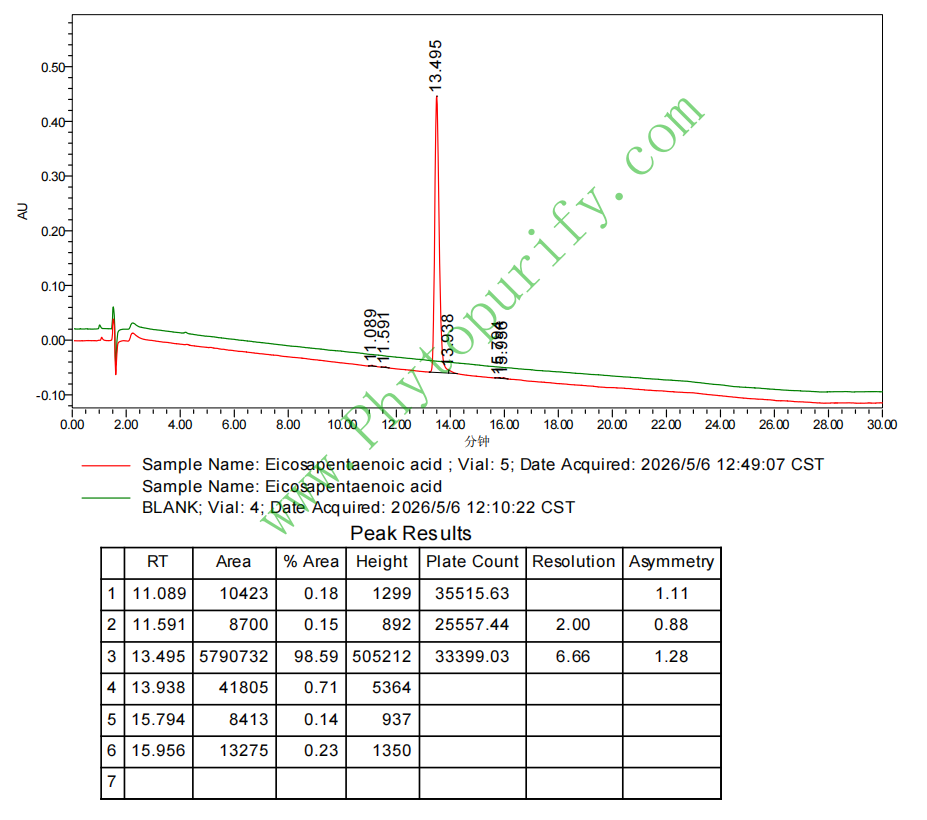
Purity: 95%~99%
Analysis Method: HPLC or/and GC
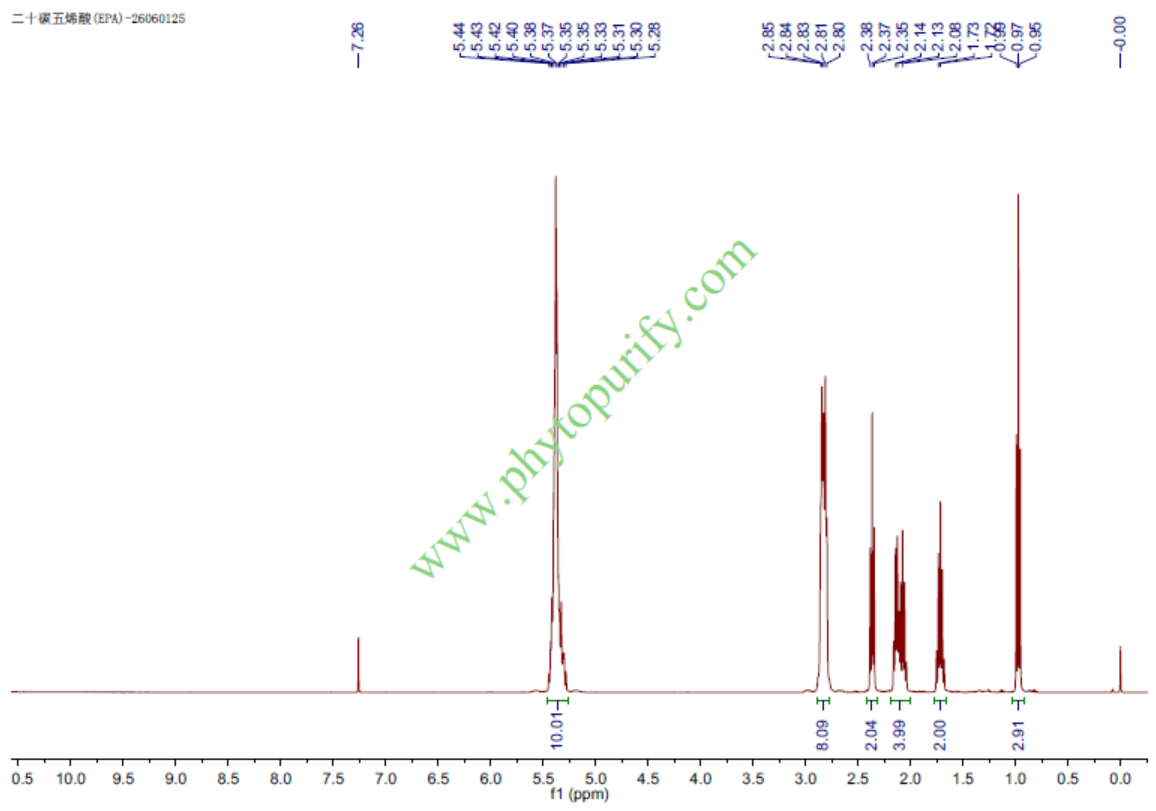
Identification Method: Mass, NMR
Packing: Brown vial or HDPE plastic bottle
Storage: Store in a well closed container, protected from air and light. Put into refrigerate or freeze for long term storage.
Whenever possible, you should prepare and use solutions on the same day. However, if you need to make up stock solutions in advance, we recommend that you store the solution as aliquots in tightly sealed vials at -20℃. Generally, these will be useable for up to two weeks.
The product could be supplied from milligrams to grams
Inquire for bulk scale.
For Reference Standard and R&D, Not for Human Use Directly.
HPLC of Eicosapentaenoic acid
HNMR of Eicosapentaenoic acid
Storage conditions:Short-term storage at 2~8℃, long-term storage at -20 ~ -80℃
37.3000
5.9936
3.6180
.0080
4.9123
2.7942
High
96.1827
3.0372
Yes
Yes
No
No
No
No
0.0
No
Yes
Yes
Yes
Eicosapentaenoic acid (EPA) is a typical omega-3 long-chain polyunsaturated fatty acid (omega-3 LC-PUFAs) widely present in deep-sea fish and some seaweed. As one of the representatives of essential fatty acids in the human body, EPA has received widespread attention in the fields of cardiovascular disease, inflammation regulation, tumor suppression, etc. in recent years due to its diverse biological functions and significant pharmacological activities. EPA is not only widely used as a dietary supplement, but its molecular mechanism of action is also gradually being elucidated, especially in regulating gene expression, signal transduction pathways, and cellular functions, demonstrating unique advantages. This article provides a systematic review of the chemical structure and physicochemical properties, sources and extraction methods, pharmacological activity, mechanism of action, drug evaluation, and clinical application prospects of EPA, aiming to provide comprehensive and in-depth references for researchers in the field of natural product pharmacology.
The chemical name of EPA is eicosapentaenoic acid, with a molecular formula of C20H30O2 and a molecular weight of 302.4580. Its structural features include 20 carbon atoms and 5 cis double bonds, with the double bonds located at 5, 8, 11, 14, and 17 carbon atoms, respectively. It belongs to a typical omega-3 polyunsaturated fatty acid. In the molecular structure of EPA, the terminal methyl side chain and carboxyl end form a typical fatty acid backbone, and the presence of double bonds endows it with high chemical reactivity and biological functions.
In terms of physical and chemical properties, the LogP value of EPA is 5.9936, indicating that it has strong lipid solubility and is difficult to dissolve in water (with a water solubility of about 0.0080), which is consistent with the properties of its long-chain fatty acids. Its polar surface area (TPSA) is 37.3 Å ², indicating that its molecule has certain polar groups, but overall it is still mainly hydrophobic. EPA can penetrate the blood-brain barrier (BBB), providing a basis for its potential application in central nervous system diseases. Importantly, EPA did not exhibit hERG channel inhibition and the Ames mutagenicity test was negative, indicating its high safety.
EPA mainly exists in marine organisms, especially in deep-sea fish (such as salmon, herring, cod) and some seaweed. Although EPA content is relatively low in the plant kingdom, certain microalgae such as diatoms and red algae can also synthesize EPA and become sustainable biological resources.
Traditional EPA extraction methods include:
Solvent extraction method Extract fatty acids from fish oil or algal oil using organic solvents such as ether and hexane, and then separate and purify EPA through saponification and esterification steps.
Supercritical CO2 extraction Using supercritical carbon dioxide as the extractant, it is mild and environmentally friendly, and can effectively extract high-purity EPA while avoiding thermal degradation.
Enzymatic hydrolysis Using lipase to selectively hydrolyze fatty acid esters in fish oil, enriching EPA, suitable for industrial scale production.
Fermentation method The production of EPA through engineering modification of microalgae or microbial fermentation has advantages such as strong controllability and environmental friendliness.
In recent years, with the development of biotechnology, research on the production of EPA by genetically engineered microalgae has gradually increased, providing new ideas for the sustainable supply of EPA.
EPA, as an important member of omega-3 fatty acids, exhibits various pharmacological activities, mainly covering cardiovascular protection, anti-inflammatory, anti-tumor, and neuroprotective aspects.
EPA can significantly improve blood lipid profile, reduce triglyceride levels, decrease low-density lipoprotein oxidation, inhibit platelet aggregation, and promote endothelial function improvement. Research shows that EPA plays a protective role by regulating a variety of cardiovascular related targets (such as SELP, PPARG, ACE, AKT1, ADRB2, KCNH2, NOS3, ICAM1, VCAM1, SLC8A1) to reduce the risk of atherosclerosis and myocardial infarction.
EPA is a precursor of inflammatory mediators such as prostaglandins and leukotrienes, and its metabolites have anti-inflammatory and immunomodulatory functions. EPA can inhibit the expression of pro-inflammatory cytokines such as TNF - α and IL-6, reduce inflammatory response, and alleviate the pathological progression of chronic inflammation related diseases.
EPA promotes the re expression of tumor suppressor gene CCAAT/enhancer binding protein delta (C/EBP delta), exerts DNA demethylation, and regulates the proliferation and apoptosis of tumor cells. In addition, EPA induces cell differentiation and suppresses malignant transformation in U937 leukemia cells by demethylating the H-RAS intron 1 CpG island, activating the RAS/ERK/C/EBP β signaling pathway.
EPA can promote the relaxation of vascular smooth muscle cells, enhance vasodilation response, and improve hemodynamics. This effect helps to lower blood pressure and alleviate vascular damage related to hypertension.
The biological effects of EPA depend on its regulation of intracellular signaling pathways and gene expression, and the specific mechanisms are as follows:
DNA demethylation regulates gene expression
EPA can mediate DNA demethylation, promote the re expression of tumor suppressor gene C/EBP δ, and restore its function of inhibiting tumor proliferation. In addition, EPA activates the RAS/ERK/C/EBP β signaling pathway by demethylating the H-RAS intron 1 CpG island, regulating the differentiation and proliferation of leukemia cells.
Regulating cardiovascular related targets
EPA acts on a variety of cardiovascular targets, including selectins (SELP), peroxisome proliferator activated receptor gamma (PPARG), angiotensin-converting enzyme (ACE), protein kinase B (AKT1), β 2-adrenergic receptor (ADRB2), potassium channel (KCNH2), endothelial nitric oxide synthase (NOS3), intercellular adhesion molecule 1 (ICAM1), vascular cell adhesion molecule 1 (VCAM1), and sodium calcium exchange protein (SLC8A1). By regulating these targets, EPA improves vascular function, inhibits inflammatory responses, and prevents thrombosis.
Regulation of anti-inflammatory signaling pathway
EPA metabolites such as E-series resolvins can inhibit the NF - κ B signaling pathway, reduce the release of inflammatory mediators, and regulate immune cell function.
Relaxation of vascular smooth muscle cells
EPA activates endothelial cell NOS3, promotes nitric oxide (NO) production, induces relaxation of vascular smooth muscle cells, and enhances vasodilation.
The pharmacological parameters of EPA indicate that it has good potential for drug development. Its molecular weight is moderate (302.4580), but its high LogP value (5.9936) and low water solubility (0.0080) suggest strong lipid solubility. Oral formulations need to optimize solubility and bioavailability. EPA can penetrate the blood-brain barrier, endowing it with potential applications in neurological diseases.
In terms of safety, EPA did not exhibit hERG channel inhibition, reducing the risk of arrhythmia. A negative Ames test indicates no significant mutagenicity and good safety.
Pharmacokinetic studies have shown that EPA can be effectively absorbed after oral administration and exists in the plasma in the form of free fatty acids and phospholipid binding. EPA is mainly metabolized through β - oxidation in the body, with a long half-life and sustained action ability. Its metabolites include various bioactive lipid mediators that participate in regulating inflammation and immune responses.
EPA is mainly used as an auxiliary therapeutic agent for cardiovascular diseases in clinic, especially in reducing hypertriglyceridemia, preventing atherosclerosis and myocardial infarction. Multiple clinical trials support that EPA supplements can reduce the incidence of cardiovascular events and improve patient outcomes.
In addition, EPA has shown broad application prospects in the fields of anti-inflammatory, anti-tumor, and neuroprotective effects. It may become an adjuvant drug for tumor treatment by regulating gene methylation and signaling pathways. The relaxing effect of EPA on vascular smooth muscle cells also suggests its potential in hypertension and vascular dysfunction diseases.
In the future, with the development of nanotechnology and drug delivery systems, the bioavailability and targeting of EPA are expected to be further enhanced. The technological advancement of genetically engineered microalgae for producing EPA will promote its sustainable supply and large-scale application. In addition, in-depth analysis of the molecular mechanism of EPA and its synergistic effects with other fatty acids will provide a theoretical basis for the development of new composite fatty acid drugs.
As an important omega-3 long-chain polyunsaturated fatty acid, eicosapentaenoic acid (EPA) exhibits significant pharmacological effects in cardiovascular protection, anti-inflammatory, anti-tumor, and vasodilation due to its unique chemical structure and diverse biological activities. It exerts complex and sophisticated biological regulatory functions by regulating DNA methylation, signaling pathways, and various molecular targets. The good safety and pharmacological parameters of EPA have laid a solid foundation for its clinical application. In the future, with the continuous deepening of extraction technology, drug formulations, and molecular mechanism research, EPA is expected to become an important research and application object in the field of natural product pharmacology, promoting the progress of prevention and treatment of related diseases.
