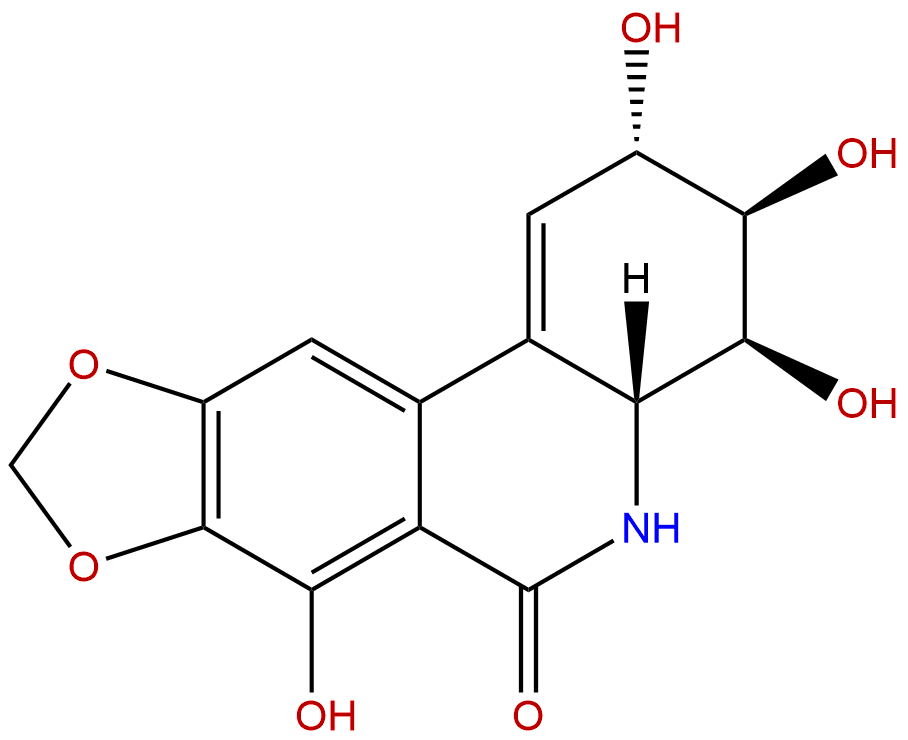


Synonym name: Lycoricidinol
Catalogue No.: BP0978
Cas No.: 29477-83-6
Formula: C14H13NO7
Mol Weight: 307.258
Botanical Source: Alkaloid from Narcissus incomparabilis, all Narcissus spp. examined, and present in many other Amaryllidaceae spp. Also found in the Texas grasshopper Brachystola magna
Purity: 95%~99%
Analysis Method: HPLC-DAD or/and HPLC-ELSD
Identification Method: Mass, NMR
Packing: Brown vial or HDPE plastic bottle
Can be supplied from milligrams to grams.
For Reference Standard and R&D, Not for Human Use Directly.
Inquire for bulk scale.
Storage conditions:Short-term storage at 2~8℃, long-term storage at -20 ~ -80℃
Narciclasine (CAS number: 29477-83-6) is a natural product derived from plants of the Narcissus genus, belonging to the isoquinoline alkaloid class. Since its first isolation from Narcissus spp. in the mid-20th century, narcissin has received widespread attention due to its unique biological activity, particularly in the field of anti-tumor potential. As a plant growth regulator, Narcissus not only plays an important role in plant physiology, but also provides a molecular basis for its function in cytoskeleton remodeling and cell movement by regulating the Rho/Rho kinase/LIM kinase/cofilin signaling pathway. In recent years, with the development of molecular pharmacology and medicinal chemistry, the anti-tumor mechanism of narcissin has gradually been revealed. Its targets include multiple key signaling molecules and transcription factors, such as MCL1, BCL2, STAT3, etc., showing good prospects for drug development.
This article will provide a systematic review of the chemical structure and physicochemical properties, plant sources and extraction methods, pharmacological activity and mechanism of action, pharmacological evaluation and pharmacokinetic characteristics of narcissin, and finally look forward to its clinical application potential, aiming to provide comprehensive reference materials for researchers and drug developers in the field of natural product pharmacology.
The molecular formula of narcissin is C16H15NO5, with a molecular weight of 307.2580. Its structure belongs to the isoquinoline alkaloids, with a multi hydroxy substituted benzene ring and nitrogen-containing heterocyclic structure. The molecule contains multiple hydroxyl and ketone groups, giving it high polarity. The specificity of its chemical structure determines its biological activity and ability to bind to targets.
In terms of physical and chemical properties, the LogP value of narcissin is about -0.4825, indicating its strong hydrophilicity and water solubility of 10.2780, demonstrating good water solubility. Its topological polar surface area (TPSA) is 128.48 Å ², and higher TPSA values are usually associated with poorer cell membrane penetration, which may affect its oral bioavailability. The low permeability of the blood-brain barrier suggests its limited distribution in the central nervous system, which helps to reduce the risk of central nervous system toxicity. The hERG channel inhibition experiment showed a negative result, indicating a low risk of cardiac toxicity from Narcissus. The Ames test score is 0.6, indicating a low risk of genotoxicity and meeting safety requirements.
Narcissus spp. mainly exist in the bulbs and leaves of Narcissus spp., and are one of the unique isoquinoline alkaloids in this genus of plants. Narcissus plants are widely distributed in Europe, North Africa, and some parts of Asia, traditionally used for horticulture and medicine.
The process of extracting narcissin usually includes the following steps:
In recent years, with the advancement of separation technology, supercritical fluid extraction and molecular imprinting techniques have also been attempted for efficient extraction and purification of narcissin, significantly improving yield and purity.
Narcissus cyclohexene exhibits significant pharmacological effects in various biological activities, especially in the field of anti-tumor.
Narcissocycline exerts its anti-tumor effect through multiple targets and pathways, covering a variety of tumor cell lines, including breast cancer, lung cancer, liver cancer, colorectal cancer and brain tumor. Its main manifestations are:
In addition to anti-tumor effects, narcissin, as a plant growth regulator, significantly enhances the activity of GTPase RhoA by regulating the Rho/Rho kinase/LIM kinase/cofilin signaling pathway, promotes actin stress fiber formation, and affects cytoskeleton remodeling and cell movement. This mechanism is not only of great significance for regulating plant cell growth, but also provides a molecular basis for its role in tumor cell migration and invasion.
The anti-tumor mechanism of narcissin is complex and diverse, mainly achieved through the following key targets and signaling pathways:
Narcissus significantly activates RhoA GTPase, which in turn activates downstream Rho kinase (ROCK) and LIM kinase (LIMK), regulates the phosphorylation status of actin binding protein cofilin, and promotes the formation of actin stress fibers. This process affects cell morphology and motility, inhibiting the migration and invasion of tumor cells.
Narcissus cycline downregulates the expression of anti apoptotic proteins such as MCL1 and BCL2, disrupts mitochondrial membrane potential, promotes intracellular reactive oxygen species (ROS) generation, and activates the apoptotic signaling pathway.
Narcissocycline also affects estrogen receptor (ESR1) and aromatase (CYP19A1), suggesting its potential application in hormone dependent tumors (such as breast cancer).
The molecular weight of narcissin is 307.2580, which meets the molecular weight requirements of Lipinski's rule. Its LogP value is -0.4825, indicating good water solubility, but lower lipid solubility may limit its cell membrane permeability. The TPSA value is 128.48 Å ², and higher polarity may affect oral absorption and bioavailability. Narcissus cycline does not inhibit hERG channels, reducing the risk of cardiac toxicity. Ames test results showed a low risk of genotoxicity and good safety.
At present, the pharmacokinetic studies of narcissin are relatively limited. Previous studies have shown that the oral bioavailability of narcissin is relatively low, mainly due to its high polarity and significant first pass effect. Its low blood-brain barrier permeability limits its application in central nervous system tumors. Metabolism in the body is mainly carried out through the liver enzyme system, and the metabolites need further identification.
In order to improve the pharmacokinetic properties of narcissin, researchers have attempted to enhance its in vivo stability and targeting through strategies such as nanocarriers, liposome encapsulation, and structural modification, thereby improving its anti-tumor effect.
Narcissus cycline, as a multi-target anti-tumor natural product, has broad clinical development potential. Its unique mechanism of action enables it to exhibit good inhibitory effects in various types of tumors, especially in refractory and drug-resistant tumors.
Future research directions include:
In addition, the research on the regulation of plant growth and cytoskeleton by narcissin has provided new ideas for its application in agriculture and cell biology.
Narcissus cycline, as a natural product with unique structure and multi-target mechanism of action, exhibits significant anti-tumor potential. It inhibits tumor cell proliferation, migration, and angiogenesis, and promotes tumor cell apoptosis by regulating the RhoA signaling pathway and various key regulatory factors. Although there are certain challenges in developing its pharmacological properties, through modern drug delivery technology and structural optimization, narcissin is expected to become an important candidate for the new generation of anti-tumor drugs. In the future, in-depth mechanism research and clinical development work will further promote the pharmacological process of narcissin, bringing new hope for tumor treatment.
