Progress in pharmacological research on natural products of kaempferol-3-O-rutinoside-7-O-glucoside: a multi-target flavonoid glycoside
Introduction/Overview
Natural products, as an important source of drug discovery, have long played an irreplaceable role in human health maintenance and disease treatment. Flavonoids, as the most widely distributed class of secondary metabolites in nature, have attracted much attention due to their structural diversity and extensive biological activity. Among them, Kaempferol and its glycoside derivatives are important subclasses of flavonoids, with various pharmacological activities such as antioxidant, anti-inflammatory, anti-tumor, and cardiovascular protection. Kaempferol 3-O-rutinoside 7-O-glucoside (K3R7G) is a complex glycoside form of kaempferol, and its unique glycosylation pattern endows the molecule with physicochemical and biological properties that differ from the parent compound.
In recent years, with the deepening of radiation protection research, K3R7G has gradually entered the field of researchers' vision due to its potential application value in anti radiation damage. Radiation damage involves complex molecular mechanisms, including multiple biological processes such as DNA damage, oxidative stress, cell apoptosis, and inflammatory response. K3R7G exhibits multi-target and multi pathway radiation protection by regulating key signaling molecules such as BCL2, TP53, BAX, CDKN1A, and ATM. This article will provide a systematic review of the research progress of K3R7G from the aspects of chemical structure, plant origin, pharmacological activity, mechanism of action, medicinal evaluation, and clinical application prospects, in order to provide reference for the in-depth research and development of this natural product.
Chemical structure and physicochemical properties
Chemical structural characteristics
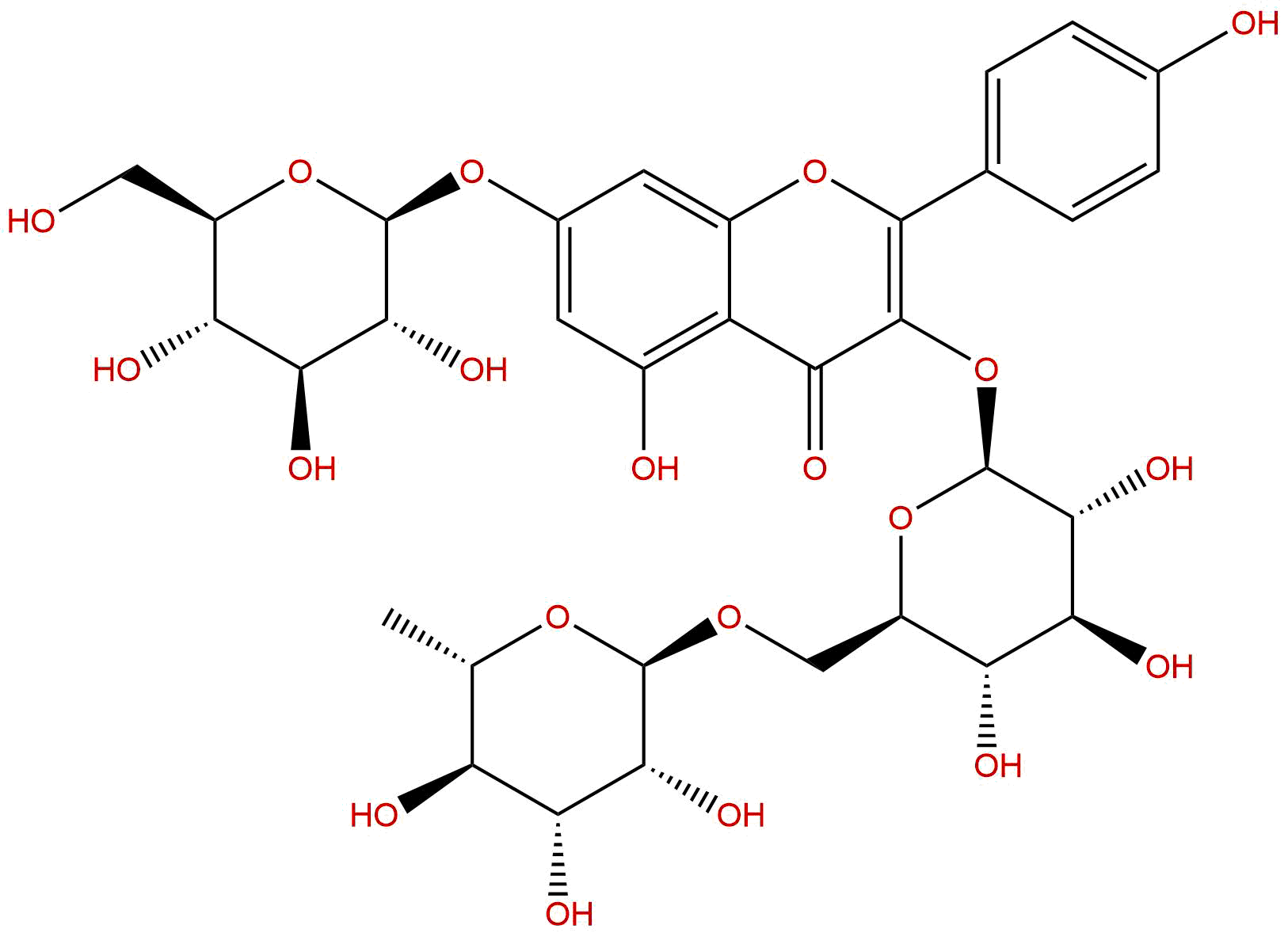
The chemical structure of K3R7G belongs to flavonol glycosides, and its parent nucleus is kaempferol (3,5,7-trihydroxy-2- (4-hydroxyphenyl) -4H-1-benzopyran-4-one). Compared with simple kaempferol, K3R7G is connected to different sugar units at the C-3 and C-7 positions: the C-3 position is connected to Rutinose (α - L-rhamnose - (1 → 6) - β - D-glucose), and the C-7 position is connected to β - D-glucose. The structural characteristics of this disaccharideization result in a molecular weight of 756.66 Da for K3R7G, significantly higher than that of kaempferol (286.24 Da) and common monoglycosides such as astragaloside (kaempferol-3-O-glucoside, molecular weight 448.38 Da).
From the perspective of structure-activity relationship, the C-3 rutin group and the C-7 glucose group not only increase the water solubility of the molecule, but may also affect its interaction mode with biological targets. The presence of sugar groups can alter the electronic distribution and spatial conformation of flavonoid parent nuclei, thereby regulating their antioxidant activity, metal ion chelating ability, and binding affinity with proteins. It is worth noting that the glycosylation pattern of K3R7G is relatively rare in nature, and this unique structure may be related to its specific biological activity and selectivity.
Physical and chemical property parameters
According to computational chemistry and experimental data, the physicochemical properties of K3R7G are as follows:
- molecular weight:756.66 Da
- Lipid water partition coefficient (LogP):-1.1068
- Polarized surface area (TPSA):328.35 Ų
- Water solubility: 4.8717 (LogS, good water solubility)
- Blood-brain barrier permeability: Low
- HERG inhibitory activity: None
- Ames test mutagenicity: Negative (0.0)
From these parameters, it can be seen that K3R7G has typical high polarity and low fat solubility characteristics. A negative LogP indicates that the solubility of the compound in the aqueous phase is much higher than in the lipid phase, which is consistent with the structural characteristics of the molecule containing multiple sugar and hydroxyl groups. The high TPSA value (>140 Å ²) further confirms its strong polarity and explains why the compound is difficult to penetrate the blood-brain barrier. Good water solubility (LogS>-4) provides favorable conditions for its oral administration and in vivo distribution, but low fat solubility may also limit its ability to enter cells through passive diffusion. The negative inhibition of hERG indicates that the compound has a low risk of cardiac toxicity, while a negative Ames test suggests that it does not have significant genetic toxicity. These safety features lay a good foundation for its subsequent development.
Plant sources and extraction methods
natural source
The distribution of K3R7G in nature is relatively limited, mainly existing in certain specific medicinal and edible plants. The currently reported plant sources containing K3R7G include:
-
Leguminous plants K3R7G has been detected in certain Sophora plants, such as Sophora flavescens and Sophora japonica. As a traditional Chinese medicine, Sophora japonica is commonly used for hemostasis and blood pressure reduction. Its flavonoid composition is complex, and K3R7G is one of the trace components with lower content.
-
Rosaceae plants K3R7G was isolated from the petals of some Rosa plants, such as Rosa rugosa. Rose petals are rich in various flavonoid glycosides, and K3R7G, as one of the representative components, may be related to its antioxidant and anti-inflammatory activities.
-
Asteraceae plants K3R7G has also been reported in certain Asteraceae plants such as Carthamus tinctorius. As a commonly used traditional Chinese medicine for promoting blood circulation and removing blood stasis, the chemical composition of safflower has been extensively studied, with K3R7G being a trace flavonoid component.
-
Other sources A few cruciferous plants such as broccoli (Brassica oleracea var. italica) have also been reported to contain K3R7G in their tender shoots, but the content is extremely low.
Overall, the content of K3R7G in plants is usually low and belongs to trace components, which poses challenges for its large-scale acquisition. Different plant sources, tissue parts, and harvest seasons can all affect the content of K3R7G. For example, in locust flowers, the content of K3R7G is usually less than 1/10 of the main flavonoid components such as rutin and Quercitin.
Extraction and purification methods
Given the low content and strong polarity of K3R7G in plants, its extraction and purification require specialized technical strategies.
extraction method:
- Solvent extraction method Due to the good water solubility of K3R7G, aqueous alcohol solvents (such as 50% -80% methanol or ethanol aqueous solutions) are usually used as extraction solvents. The extraction conditions are generally soaking or reflux extraction at room temperature or 40-60 ℃, with a solid-liquid ratio of 1:10-1:20 (w/v) and an extraction time of 1-3 hours. To improve extraction efficiency, ultrasound assisted extraction (UAE) or microwave-assisted extraction (MAE) techniques can be used, which promote the dissolution of target components by disrupting the cell wall structure.
- Enzyme assisted extraction method The use of cellulase and pectinase can degrade polysaccharides and pectin in plant cell walls, thereby increasing the extraction rate of K3R7G. This method has mild conditions and is suitable for extracting thermosensitive components.
Purification Method:
- Liquid-liquid extraction By utilizing the strong polarity of K3R7G and extracting it through a n-butanol water system, the target component can be enriched from the crude extract into the n-butanol phase.
- Column chromatography separation Commonly used macroporous adsorption resins (such as D101, AB-8) can effectively enrich flavonoid glycosides from crude extracts. The elution conditions usually use an ethanol water gradient system, and K3R7G is generally enriched in the 30% -50% ethanol elution fraction.
- Preparation type high performance liquid chromatography (Prep HPLC)For obtaining high-purity K3R7G, preparative HPLC is the most effective method. The commonly used chromatographic conditions are: C18 reverse phase column, mobile phase of acetonitrile water or methanol water system (containing 0.1% formic acid), detection wavelength of 254-360 nm. Due to the high polarity of K3R7G, its retention time in reverse phase chromatography is short, and the organic phase ratio needs to be appropriately reduced to achieve effective separation.
- High Speed Counter Current Chromatography (HSCCC)As a liquid-liquid distribution chromatography technique, HSCCC has unique advantages in separating polar flavonoid glycosides, which can avoid irreversible adsorption of samples on the stationary phase and is suitable for the preparation level separation of K3R7G.
Pharmacological activity research
Radiation resistance activity
Radiation damage is the most concentrated pharmacological activity area of K3R7G research. Ionizing radiation (such as X-rays, gamma rays) causes cellular DNA damage, oxidative stress, and inflammatory reactions through direct and indirect effects, leading to tissue damage and functional impairment. K3R7G has shown significant anti radiation protective effects in multiple in vitro and in vivo models.
Cell level research In normal cell models exposed to radiation, such as keratinocytes HaCaT, fibroblasts, and lymphocytes, K3R7G pretreatment can significantly improve cell survival and reduce radiation-induced cell apoptosis. Specifically, it manifests as reducing the levels of reactive oxygen species (ROS) caused by radiation, alleviating the decrease in mitochondrial membrane potential, and inhibiting the activation of caspase-3 and caspase-9. It is worth noting that the protective effect of K3R7G against radiation damage is dose-dependent, with significant effects in the concentration range of 10-100 μ M, while excessively high concentrations (>200 μ M) may result in cytotoxicity.
Animal model research In the mouse whole-body irradiation model, intraperitoneal injection or oral administration of K3R7G can significantly improve the survival rate of radiation exposed mice, alleviate radiation-induced bone marrow suppression and hematopoietic dysfunction. Specific indicators include: increasing peripheral blood white blood cell and platelet counts, promoting proliferation and differentiation of bone marrow hematopoietic stem cells, and reducing atrophy of the spleen and thymus. In addition, K3R7G can alleviate radiation-induced gastrointestinal damage, protect the integrity of small intestinal villi structure, and reduce intestinal permeability.
Tissue-specific protection K3R7G exhibits varying degrees of protective effects on radiation sensitive tissues such as the hematopoietic system, gastrointestinal epithelium, skin, and reproductive system. This organizational selectivity may be related to its distribution and metabolic differences in different tissues, as well as differences in the sensitivity of different tissue cells to radiation damage.
Other pharmacological activities
In addition to its anti radiation activity, K3R7G also exhibits other noteworthy pharmacological effects:
antioxidant activity As a flavonoid compound, K3R7G has direct free radical scavenging ability. Its antioxidant mechanism includes: direct clearance of hydroxyl radicals (• OH), superoxide anions (O ₂⁻ •), and peroxynitrite (ONOO ⁻); Chelate transition metal ions (such as Fe ² ⁺, Cu ² ⁺) to inhibit the Fenton reaction; Activate endogenous antioxidant enzyme systems, such as superoxide dismutase (SOD) and glutathione peroxidase (GPx). The antioxidant activity of K3R7G is closely related to its degree of glycosylation. Studies have shown that an increase in glycosylation may reduce its direct antioxidant capacity, but may enhance its in vivo antioxidant effect by improving pharmacokinetic properties.
anti-inflammatory activity In a macrophage model stimulated by lipopolysaccharide (LPS), K3R7G can inhibit the production of pro-inflammatory cytokines such as TNF - α, IL-6, IL-1 β, and reduce the release of nitric oxide (NO) and prostaglandin E2 (PGE2). Its anti-inflammatory mechanism involves inhibiting the activation of the NF - κ B signaling pathway and phosphorylation of the MAPK pathway.
Cell protective activity K3R7G exhibits protective effects on various cell damage models, such as oxidative stress, hypoxia/reoxygenation, and chemical toxin induction. This broad-spectrum cell protective activity may be related to its multi-target mechanism of action, including regulating apoptosis related protein expression, maintaining mitochondrial functional stability, and activating survival signaling pathways.
Mechanism of action and molecular targets
Regulation of core signaling pathways
The anti radiation mechanism of K3R7G involves the coordinated regulation of multiple signaling pathways, with the most critical being the regulation of DNA damage response (DDR) and apoptosis pathways.
ATM-p53 signaling axis ATM (Ataxia Telangiectasia Mutated) is a core kinase in response to DNA double strand break (DSB) damage. Radiation induced DNA damage first activates ATM, which then phosphorylates downstream effector molecules such as p53 (TP53). K3R7G can regulate the activation level of ATM and maintain moderate ATM activity after radiation exposure, ensuring the normal transmission of DNA damage signals and avoiding cell apoptosis caused by excessive activation. Research has shown that K3R7G treatment can promote moderate phosphorylation of ATM (Ser1981), while upregulating protein levels of p53, but inhibiting excessive phosphorylation of p53 (Ser15/Ser20), thereby achieving a balance between cell cycle arrest and DNA repair and apoptosis.
BCL2 family protein regulation BCL2 family proteins play a crucial role in regulating mitochondrial pathway induced cell apoptosis. K3R7G can upregulate the expression of anti apoptotic protein BCL2 and downregulate the expression of pro apoptotic protein BAX, thereby maintaining the balance of BCL2/BAX ratio. This regulatory effect can inhibit mitochondrial outer membrane permeabilization (MOMP), prevent the release of cytochrome c, and activate the caspase cascade reaction. In cells exposed to radiation, K3R7G treatment can significantly reduce the translocation of BAX to mitochondria, decrease mitochondrial membrane potential, and protect cells from radiation-induced apoptosis.
Regulation of CDKN1A (p21)The p21 protein encoded by CDKN1A is a cell cycle dependent kinase inhibitor that plays an important role in cell cycle arrest and DNA repair. K3R7G can upregulate the expression level of p21, promote G1/S phase arrest in radiation-induced cells, and buy time for DNA repair. It is worth noting that the upregulation of p21 depends on the activation of p53, but the induction of p21 by K3R7G may also involve p53 independent pathways, such as regulation through the TGF - β signaling pathway or PI3K/Akt pathway.
Oxidative stress and antioxidant defense
Radiation induced oxidative stress is one of the important mechanisms of cell damage. K3R7G alleviates oxidative damage through various pathways:
- Direct free radical scavenging The phenolic hydroxyl groups on the flavonoid nucleus (especially the 4 '- OH of the B ring and the 5,7-OH of the A ring) can provide hydrogen atoms, directly neutralizing free radicals.
- Activate Nrf2/ARE pathway K3R7G can promote nuclear translocation of nuclear factor E2 related factor 2 (Nrf2), activate gene expression driven by antioxidant response elements (ARE), including HO-1, NQO1, GCL and other antioxidant enzymes.
- Inhibition of NADPH oxidase K3R7G can inhibit radiation-induced activation of NADPH oxidase (NOX) and reduce excessive intracellular ROS production.
Epigenetic regulation
The latest research suggests that K3R7G may also exert radiation protection through epigenetic mechanisms. Preliminary data shows that K3R7G can regulate histone acetylation levels, particularly by increasing modifications of H3K9ac and H4K16ac, thereby promoting transcription of DNA repair related genes such as BRCA1 and RAD51. In addition, K3R7G may also affect the expression profile of radiation responsive genes by regulating the expression of microRNAs such as miR-21 and miR-34a.
Evaluation of drug properties and pharmacokinetics
Analysis of drug properties parameters
Based on Lipinski's Five Rules and Veber's Rules, the pharmacological parameters of K3R7G are as follows:
- molecular weight 756.66 Da (>500, does not comply with Lipinski rule)
- hydrogen bond donor Multiple hydroxyl groups (>5, not conforming to Lipinski rule)
- Hydrogen bond acceptor Multiple oxygen atoms (>10, not conforming to Lipinski rule)
- LogP-1.1068 (<5, compliant with Lipinski rule)
- Number of rotatable keys:>10 (may not comply with Veber rules)
- TPSA 328.35 Å ² (>140 Å ², not compliant with Veber rules)
From the above parameters, it can be seen that K3R7G does not meet the standards of traditional oral drugs in multiple pharmacological indicators. The high molecular weight and high polarity may result in lower oral bioavailability, consistent with its low LogP and high TPSA values. However, these parameters cannot completely negate its potential as a drug, especially for indications that require local or injectable administration. In addition, the hERG inhibition negative (low risk of cardiac toxicity) and Ames test negative (no genetic toxicity) of K3R7G are important safety advantages.
Pharmacokinetic characteristics
absorb Due to its high molecular weight and strong polarity, the oral absorption of K3R7G may be poor. Glycosidases in the intestine may partially hydrolyze K3R7G, releasing secondary glycosides or aglycones that affect its absorption and bioavailability. Studies have shown that oral absorption of flavonoid glycosides typically involves active transport mechanisms (such as SGLT1, MRP2), and K3R7G may be absorbed through similar transporters, but with lower efficiency.
distribution The distribution volume of K3R7G may be relatively small, mainly distributed in extracellular fluid and blood. Due to low blood-brain barrier permeability, the distribution of K3R7G in the central nervous system is limited, which limits its application in brain diseases but also reduces the risk of central nervous system toxicity. Organizational distribution studies have shown that K3R7G has higher concentrations in the liver, kidneys, and intestines, which is consistent with the high blood flow and metabolic function of these organs.
Metabolism The metabolism of K3R7G mainly occurs in the intestine and liver. β - glucosidase and rhamnosidase in the gut microbiota can gradually hydrolyze glycosides, producing secondary glycosides (such as kaempferol-3-O-rutinoside, kaempferol-7-O-glucoside) and aglycones (kaempferol). Phase II metabolic enzymes in the liver, such as UGT and SULT, can modify glycosides with glucuronidation and sulfation. The biological activity of these metabolites may differ from that of the parent compound, increasing the complexity of pharmacological research.
excretion K3R7G and its metabolites are mainly excreted through bile and urine. Due to its high molecular weight, bile excretion may be the main clearance pathway. Renal excretion may involve tubular secretion and passive filtration, but high protein binding rates may limit its renal clearance rate.
Formulation strategy
To overcome the shortcomings in the pharmacological properties of K3R7G, the following formulation strategies can be considered:
- Nano delivery system Liposomes, polymer nanoparticles, or solid lipid nanoparticles can encapsulate K3R7G, enhancing its water solubility and stability, and improving oral bioavailability.
- Prodrug design By chemical modifications such as phosphorylation and amino acid esterification, the lipid solubility of K3R7G is improved, promoting its transmembrane transport and releasing active ingredients after enzymatic hydrolysis in vivo.
- Absorption enhancer Combined use with P-glycoprotein inhibitors or intestinal permeability enhancers may enhance the oral absorption of K3R7G.
- Injection administration For indications such as acute radiation injury that require rapid onset of action, intravenous or intramuscular injection may be a more suitable route of administration.
Clinical application prospects and prospects
Potential indications
Based on the pharmacological activity of K3R7G, its potential clinical application directions include:
-
Radiation protection agent This is the most promising application direction for K3R7G. K3R7G can be used as a radiation protection drug in scenarios such as nuclear accidents, radiation therapy, and spaceflight. Compared with existing radiation protection agents such as amifostine, K3R7G has lower toxicity and may have a wider therapeutic window.
-
Adjuvant drugs for radiotherapy In tumor radiotherapy, K3R7G may selectively protect normal tissues (such as hematopoietic system, gastrointestinal tract) from radiation damage, while not affecting the killing effect on tumor cells. The differential effect of "radiation protection radiation sensitization" is an important advantage of it as an adjuvant therapy for radiotherapy.
-
Oxidative stress-related diseases Based on its antioxidant and anti-inflammatory activities, K3R7G may be used to treat chronic diseases related to oxidative stress, such as cardiovascular disease, neurodegenerative diseases, and metabolic syndrome.
-
Skin protection The local formulation of K3R7G may be used for the prevention and treatment of skin damage caused by ultraviolet radiation, including photoaging, sunburn, and skin cancer.
challenges faced
Although K3R7G exhibits promising pharmacological activity, its clinical translation still faces many challenges:
-
The issue of bioavailability Low oral bioavailability is the biggest obstacle faced by K3R7G. How to improve its bioavailability through formulation technology or structural modification is a key direction for future research.
-
The mechanism of action is unclear Although multiple targets (BCL2, TP53, BAX, CDKN1A, ATM) have been identified, the interaction network between these targets and the direct molecular target of K3R7G are still unclear. Further research is needed on the direct binding mode between K3R7G and these proteins.
-
Insufficient safety evaluation The current toxicological data mainly comes from in vitro experiments and short-term animal experiments, and there is a lack of long-term toxicity and reproductive toxicity research. Especially for chronic indications that require long-term use, safety evaluation is particularly important.
-
Source restrictions K3R7G has low content in nature and is difficult to synthesize chemically, which limits its large-scale production and research. Efficient biosynthetic or chemical synthesis methods need to be developed.
Future research directions
-
structural optimization By using semi synthetic or total synthetic methods, structural modifications can be made to K3R7G to improve its metabolic stability and bioavailability. For example, methylation or acetylation of hydroxyl groups may improve lipid solubility while retaining or enhancing biological activity.
-
Target validation Using techniques such as chemical proteomics, surface plasmon resonance (SPR), and molecular docking, identify the direct protein target of K3R7G and elucidate its precise molecular mechanism.
-
Combination therapy Study the synergistic effect of K3R7G with other radiation protective agents (such as antioxidants, growth factors) or radiosensitizers, and develop more effective combination therapy plans.
-
preclinical research Conduct systematic pharmacokinetic, pharmacodynamic, and toxicological studies, particularly in non-human primate models, to provide data support for clinical trials.
-
biosynthesis Using synthetic biology techniques to reconstruct the biosynthetic pathway of K3R7G in microorganisms such as Escherichia coli and yeast, achieving efficient and sustainable production.
Conclusion
As a structurally unique flavonoid glycoside, kaempferol-3-O-rutinoside-7-O-glucoside exhibits significant multi-target pharmacological activity in combating radiation damage. By regulating key molecules such as the ATM-p53 signaling axis, BCL2 family proteins, and CDKN1A, K3R7G can maintain a balance between cell survival and apoptosis after radiation exposure, protecting normal tissues from radiation damage. Its good water solubility, low cardiac toxicity, and no genetic toxicity provide favorable conditions for its development as a radiation protection agent.
However, K3R7G also faces challenges such as low oral bioavailability, unclear mechanism of action, and limited sources. Future research should focus on structural optimization, target validation, and formulation development to overcome these bottlenecks. With the increasing demand for radiation protection, such as nuclear energy utilization, space exploration, and tumor radiotherapy, K3R7G, as a natural multi-target radiation protection agent, has important research value and development potential. I believe that in the near future, through interdisciplinary collaboration, K3R7G is expected to move from the laboratory to clinical applications, providing new solutions for the prevention and treatment of radiation damage.