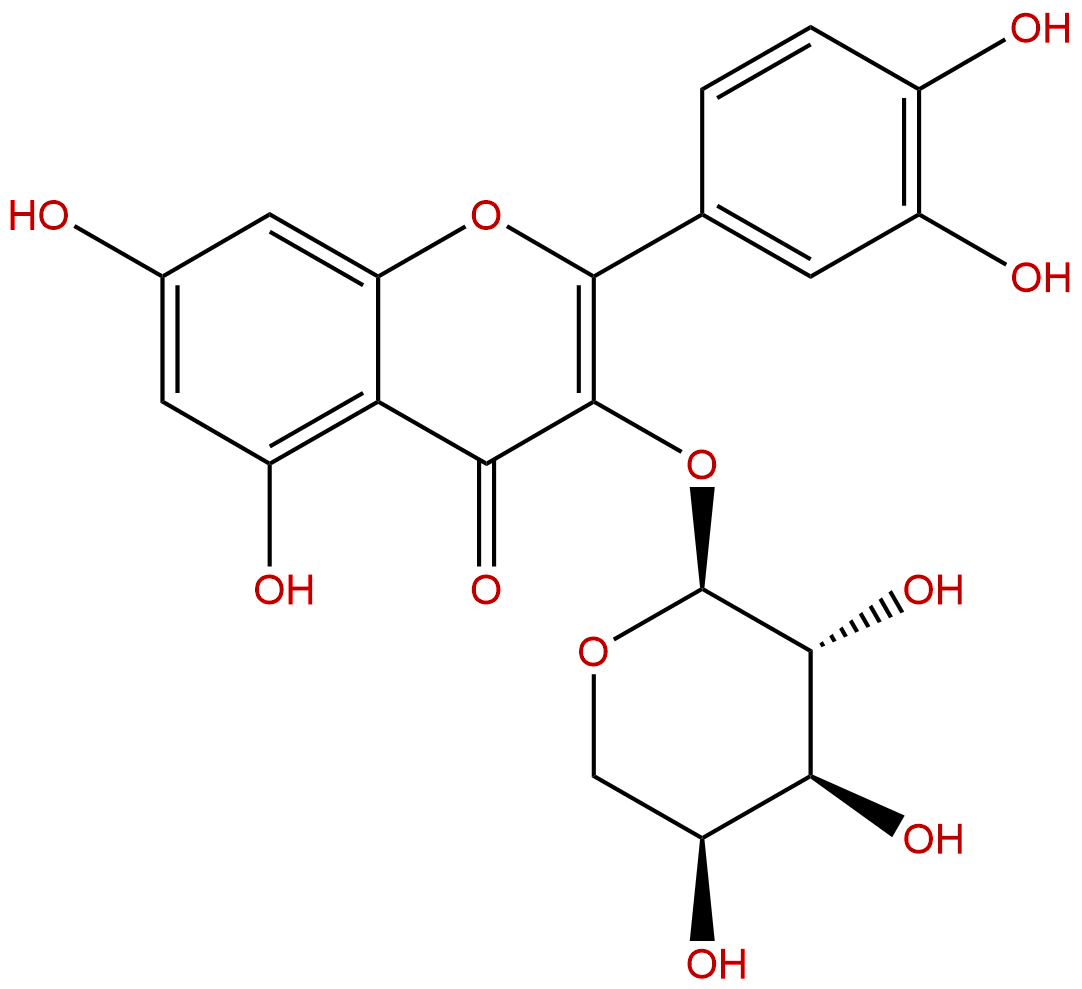


Name: Guaijaverin
Synonym name: Guaijaverin; Foeniculin; Guaiaverin; Quercetin 3-O-alpha-L-Arabinopyranoside
Catalogue No.: BP1188
Cas No.: 22255-13-6
Formula: C20H18O11
Mol Weight: 434.353
Botanical Source: Obt. from leaves of guava (Psidium guajava), Vaccinium myrtillus, Andromeda myriophyllum and other plants
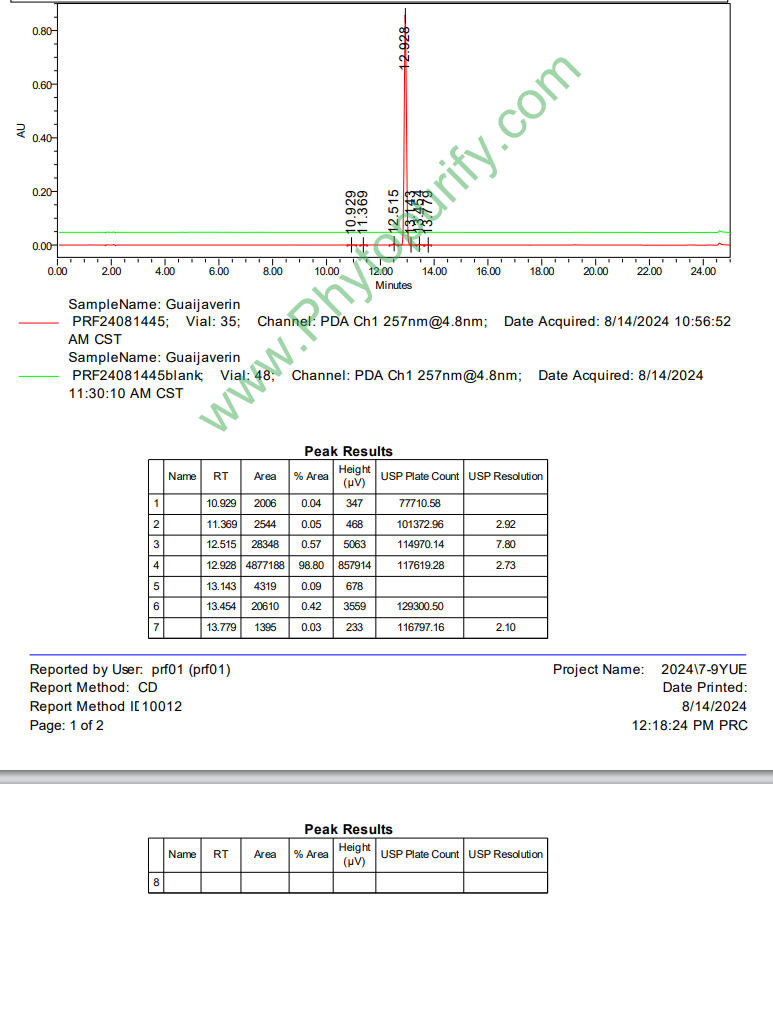
Purity: 95%~99%
Analysis Method: HPLC-DAD or/and HPLC-ELSD
Identification Method: Mass, NMR
Packing: Brown vial or HDPE plastic bottle
Can be supplied from milligrams to grams.
For Reference Standard and R&D, Not for Human Use Directly.
Inquire for bulk scale.
HPLC of Guaijaverin
Storage conditions:Short-term storage at 2~8℃, long-term storage at -20 ~ -80℃
190.2800
.4747
.2185
.7153
.5542
.5176
Low
78.4387
3.9305
Yes
No
Yes
No
Yes
No
1.2
Yes
No
Yes
Yes
Guaijaverin, also known as Quercetin-3-O - α - L-Arabinopyranoside, is a natural flavonoid glycoside widely found in the leaves and fruits of plants in the genus Guaijaverin. Since its isolation and identification, it has gradually become a hot topic in the field of natural product pharmacology research due to its unique chemical structure and diverse biological activities. Early studies revealed its significant antioxidant activity, followed by the discovery of its activity against Streptococcus mutans (the main pathogen causing dental caries) and its inhibition of urease (associated with Helicobacter pylori infection and gastric ulcer), suggesting its potential value in oral health and anti infection. In recent years, with the in-depth study of metabolic diseases, the pharmacological activity of guava glycoside in regulating blood glucose and its role in several diabetes related targets have attracted extensive attention of researchers. Its CAS number is 22255-13-6. As an active lead compound with clear structure, guava glycoside provides a valuable molecular template for the development of new, multi target anti diabetes drugs. This article aims to systematically review the chemical properties, plant sources, pharmacological activities, mechanisms of action, pharmacological evaluation, and clinical application prospects of guava glycosides, in order to provide comprehensive scientific references for the in-depth research and development of this compound.
The molecular formula of guava glycoside is C20H18O11, with a molecular weight of 434.3530. Its chemical structure is based on the flavonol parent nucleus quercetin, which is connected to an α - L-arabinopyranose group through a glycosidic bond on the 3rd hydroxyl group of the quercetin C-ring. This glycosylation modification significantly affects its physicochemical properties and biological activity. The quercetin mother nucleus itself has a conjugated system of catechol structure and 4-carbonyl-5-hydroxy group, which is the structural basis for its strong antioxidant activity. The formation of glycosidic bonds increases the polarity and water solubility of the molecule.
From the perspective of pharmacological parameters, the theoretical lipid water partition coefficient (LogP) of guaiacol is 0.4747, indicating its moderate lipophilicity but overall leaning towards hydrophilicity. Its topological polar surface area (TPSA) is as high as 190.28 Å ², mainly attributed to the numerous hydroxyl groups and oxygen atoms on the sugar ring in the molecule. High TPSA is a key factor limiting its passive diffusion across membranes. The calculated water solubility value is 0.7153 mg/mL, which belongs to the range of slightly soluble to soluble, which poses certain challenges for its absorption and distribution in organisms. These physicochemical properties determine the basic behavior of guava glycosides in vivo: oral bioavailability may be low, making it difficult to cross the blood-brain barrier (predicted as low permeability), but it is beneficial for them to function in hydrophilic environments such as extracellular fluid and certain tissue interstices.
Pomegranate glycosides mainly come from plants of the Primulaceae family and the Pomegranate genus, among which the leaves and immature fruits of Pomegranates are the most abundant. Guava, as a widely cultivated tropical fruit, its leaves are often used in folk tea to treat diarrhea and diabetes, which provides a traditional medical basis for the biological activity of guava glycoside. In addition, the compound is also present in some other plants, such as eucalyptus and some plants in the Ericaceae family, but the content is relatively low.
The extraction of guava glycosides from plant materials is usually carried out using solvent extraction method. Due to the high polarity of guava glycosides, methanol, ethanol, or their aqueous solutions are commonly used as extraction solvents. In order to improve extraction efficiency, modern extraction techniques such as ultrasound assisted extraction, microwave-assisted extraction, and pressurized solvent extraction have been widely used. These methods destroy plant cell walls through physical means, accelerate solvent penetration and active ingredient dissolution, and can achieve higher extraction rates in a shorter time and with fewer solvents. The crude extract after extraction needs to go through further separation and purification steps. It is often preliminarily enriched by macroporous adsorption resin column chromatography, and then finely separated by silica gel column chromatography, dextran gel column chromatography, high performance liquid chromatography and other chromatographic techniques to finally obtain high-purity guava glycoside monomer. The optimization of extraction process is crucial for achieving the large-scale preparation and subsequent research of this compound.
A large number of in vitro and in vivo pharmacological studies have shown that guava glycosides have various biological activities, which form the basis of their potential medicinal value.
antioxidant activity As a derivative of quercetin, guaiacol has strong ability to scavenge free radicals, such as DPPH free radicals, ABTS free radical cations, and superoxide anions. Its antioxidant mechanism includes directly providing electrons or hydrogen atoms to neutralize free radicals, as well as chelating transition metal ions (such as Fe ² ⁺, Cu ² ⁺) to prevent Fenton reaction. This activity is the starting point for many of its downstream pharmacological effects, particularly in combating oxidative stress-related tissue damage.
Antimicrobial activity:
Hypoglycemic and anti diabetes activity This is the pharmacological activity of guava glycoside that has received the most attention in recent years. In the streptozotocin induced diabetes rat model, guava glycoside extract or monomer showed significant effects in reducing fasting blood glucose, improving glucose tolerance and increasing insulin sensitivity. Its activity is not only limited to regulating blood sugar, but also extends to improving complications of diabetes, such as reducing renal oxidative damage and inhibiting protein glycosylation.
Other activities Preliminary studies also suggest that guava glycosides may have anti-inflammatory, hepatoprotective, and anti-tumor activities, but research in these areas is still in its infancy and requires more evidence to support it.
The hypoglycemic effect of guava glycoside is not achieved through a single pathway, but exhibits the characteristics of multi-target and multi pathway synergy, which is consistent with its natural product properties. Existing research has revealed that it interacts with multiple key targets of diabetes:
Enhancement of insulin signaling pathway:
Insulin secretion and regulation of glucagon like peptide-1 (GLP-1):
Peroxisome proliferator activated receptor gamma (PPARG) activation PPARG is a nuclear receptor and the target of insulin sensitizer thiazolidinedione drugs. Pomegranate glycoside may act as a partial agonist or regulator of PPARG, promoting adipocyte differentiation, increasing adiponectin secretion, and improving systemic insulin sensitivity.
Antioxidant stress and anti-inflammatory effects The state of diabetes is accompanied by severe oxidative stress and chronic low-grade inflammation, which will damage insulin signal. The powerful antioxidant capacity of guava glycosides can directly eliminate reactive oxygen species and protect pancreatic beta cells and insulin sensitive tissues by activating endogenous antioxidant pathways such as Nrf2/ARE. Its anti-inflammatory effect may be achieved by inhibiting inflammatory pathways such as NF - κ B, indirectly improving insulin resistance.
To sum up, guava glycoside acts on insulin secretion, signal transduction, peripheral glucose utilization, and the pathological environment of diabetes through a "multi pronged" approach, showing a good multi-target regulatory potential.
Although guava glycoside exhibits excellent biological activity in vitro, its drug like and pharmacokinetic (PK) properties are key factors determining its successful development as a drug.
Based on the provided pharmacological parameters and existing knowledge, the evaluation is as follows:
* absorb High TPSA (190.28) and moderate LogP (0.47) suggest that its ability to passively diffuse through intestinal epithelial cell membranes after oral administration is limited, which may lead to lower oral bioavailability. It may rely on active transporters in the intestine, such as certain sugar transporters, for absorption.
* distribution Predict that its blood-brain barrier permeability is low, which is consistent with the characteristics of most molecules with high polarity and TPSA. This means that it may not be easy to use for the treatment of central nervous system related diseases, but it also reduces potential central side effects. Its distribution may be more concentrated in tissues such as blood, liver, and kidneys.
* Metabolism As a flavonoid glycoside, guava glycoside is likely to undergo extensive metabolism in the body. Firstly, the glycosidase of the gut microbiota may hydrolyze it into aglycones quercetin and arabinose. Quercetin subsequently undergoes phase II metabolism (glucuronidation, sulfation, methylation) in the intestine and liver, producing various metabolites. These metabolites may still have biological activity and their polarity increases, making them more conducive to excretion.
* excretion Metabolites are mainly excreted from the body through the kidneys (urine) and bile (feces).
* Preliminary Safety Assessment According to the data, guaiacol does not significantly inhibit hERG potassium channels (hERG inhibition: No), indicating a low risk of causing QT interval prolongation in the heart. The Ames test value is 1.2 (usually considered to have a mutagenic risk of>1.5 or 2.0), indicating that there is no significant genetic toxicity risk, but more comprehensive in vitro and in vivo genetic toxicity tests are still needed to confirm.
Overall, the main challenges facing the pharmacological properties of guava glycosides are oral absorption and systemic exposure. Future formulation development strategies may include the preparation of novel drug delivery systems such as phospholipid complexes, cyclodextrin inclusion complexes, nanocrystals, or liposomes to enhance their solubility and membrane permeability; Or explore its potential as a prodrug modification.
The diverse pharmacological activities of guava glycosides depict broad prospects for their application in multiple fields.
Prevention and treatment of diabetes and its complications As a multi target anti diabetes lead compound, guava glycoside is the most promising application direction to develop new anti diabetes drugs or functional food/health products. Compared with existing single target drugs, its multi pathway synergistic effect may bring better blood glucose control effects and lower risk of side effects. Especially for people with early insulin resistance and pre diabetes, guava glycoside or its plant extract may be an effective intervention.
Oral health products: Based on its clear anti streptococcus mutans and antioxidant activity, guava glycoside can be directly used to develop toothpaste, mouthwash, oral spray and other daily care products with anti caries and anti plaque effects. Its natural origin characteristics meet the current market demand for "green" oral care products.
Assisted anti Helicobacter pylori infection Its urease inhibitory activity makes it possible to use it as an adjuvant ingredient in combination with antibiotics to improve the eradication rate of Helicobacter pylori, or to develop functional products that protect the gastric mucosa.
Antioxidant and anti-aging The powerful free radical scavenging ability makes it a potential antioxidant in cosmetics and health foods, used to delay skin photoaging and resist oxidative damage to the body.
However, to achieve the leap from "active compounds" to "drugs" or "mature products", there are still many challenges and future research directions:
* In depth preclinical research A more systematic study of animal pharmacology, long-term toxicology, reproductive toxicity, etc. is needed to comprehensively evaluate its safety window.
* Pharmacokinetic optimization The problem of low bioavailability must be addressed through formulation or structural modification strategies.
* Refined mechanism of action It is necessary to use techniques such as molecular docking, surface plasmon resonance, and gene knockout/knockdown to clarify the precise modes and binding sites of their interactions with various targets (such as DPP4, PPARG).
* clinical research Ultimately, its effectiveness and safety need to be validated through rigorous human clinical trials.
* Sustainable sources and synthesis Explore the use of biotechnology methods such as plant cell culture, microbial synthesis, or total chemical synthesis to achieve large-scale and sustainable production of guava glycosides.
Pomegranate glycoside, as a natural flavonoid glycoside derived from traditional medicinal plants, has become a bridge molecule connecting traditional medicine and modern drug development due to its unique chemical structure and diverse pharmacological activities. Its multi-target mechanism of action in lowering blood sugar is particularly noteworthy, providing new ideas for addressing complex metabolic disease networks. Although there are challenges in drug formulation, such as poor oral absorption, this is precisely the area that modern pharmacy and medicinal chemistry can focus on addressing. With the further clarification of its mechanism of action, the continuous optimization of its pharmacokinetic properties and the gradual advancement of clinical evaluation, guava glycoside is expected to move from laboratory to clinical application, which may not only bring new treatment options for diabetes patients, but also be expected to play a role in oral health care, anti infection and other fields. The continuous research on guava glycosides is not only an exploration of a single compound, but also a vivid interpretation of the proposition of natural products as sources of innovative drugs.
