| Catalog No | Package | Original Price | Price | Inventory | Quantity | Operating |
|---|---|---|---|---|---|---|
| BP4690-5mg | 5mg | $750.00 | Sign in |
|


Storage conditions:Short-term storage at 2~8℃, long-term storage at -20 ~ -80℃
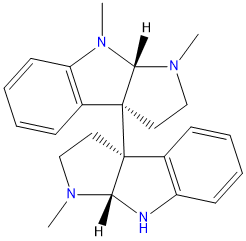
Calycanthidine (CAS number: 5516-85-8) is a natural product with a unique structure, belonging to the aldehyde amine organic nitrogen heterocyclic compound and classified as a member of the calyx alkaloid family. As a functional analogue of Calycanthine, Huameiding has attracted widespread attention in the field of natural product pharmacology. In recent years, with the deepening of research on the antiviral activity of natural products, Huameiding has become one of the hotspots in the development of antiviral drugs due to its significant antiviral potential and multi-target mechanism of action. This article will provide a systematic review of the chemical structure and physicochemical properties, plant sources and extraction methods, pharmacological activity and mechanism of action, pharmacological evaluation, pharmacokinetic characteristics, and clinical application prospects of Huameiding. The aim is to provide theoretical basis and practical guidance for further research and drug development of this natural product.
The molecular formula of Wamei Ding is C21H27N_3O3, with a molecular weight of 360.5050 Da. Its chemical structure is characterized by an aldehyde amine skeleton, containing multiple nitrogen heterocyclic structures, exhibiting strong organic alkalinity and multifunctional active sites. The typical cyclic system containing calyx alkaloids in the structure endows it with unique spatial conformation and chemical stability. The LogP value of Wamei Ding is 3.1308, indicating moderate lipid solubility that facilitates its penetration through the cell membrane. Its topological polar surface area (TPSA) is 21.75 Å ², indicating that its molecular polarity is low and it may have good membrane penetration ability. Low water solubility (0.1103 mg/mL) suggests limited solubility in aqueous phase, but good lipid solubility, which is beneficial for oral absorption and blood-brain barrier penetration.
It is worth noting that Chimonanthine has a high blood-brain barrier penetration ability, which provides potential advantages for its application in the treatment of central nervous system viral infections. However, the inhibition of hERG channel activity suggests a potential risk of cardiac toxicity, which needs to be given special attention in subsequent drug development. In addition, the Ames test result is 1.2, indicating that it has a certain genotoxicity risk and further safety assessment through in vivo and in vitro toxicology is needed.
Huamei Ding mainly exists in plants of the Huamei family, especially in the roots, stems, and leaves of plants of the Calycanthus genus. This type of plant is widely distributed in East Asia and North America, and is traditionally used as a traditional Chinese medicinal herb. It has the effects of clearing heat and detoxifying, anti-inflammatory and analgesic. As one of its main active ingredients, Huameiding has undertaken some biological activities.
The traditional method for extracting wax plum extract often uses organic solvent extraction combined with column chromatography separation. The specific process includes: first, reflux extraction of dried plant powder with ethanol or methanol, concentration of the extraction solution, and removal of impurities using liquid-liquid distribution method. Subsequently, purification was carried out using silica gel column chromatography or high-performance liquid chromatography (HPLC) to obtain high-purity Wameprazole. In recent years, ultrasound assisted extraction and supercritical CO2 extraction technologies have been introduced to improve extraction efficiency and purity, while reducing the use of organic solvents, in line with the principles of green chemistry.
During the extraction process, attention should be paid to controlling the temperature and pH value to avoid hydrolysis or degradation of the wax plum structure. In addition, mass spectrometry (MS), nuclear magnetic resonance (NMR), and infrared spectroscopy (IR) are commonly used to determine purity, ensuring the structural integrity and purity of the compound.
The pharmacological activity research of Huameiding mainly focuses on its antiviral effect. In vitro experiments have shown that wax plum extract has significant inhibitory effects on various viruses, including herpes virus (HSV), human immunodeficiency virus (HIV), and other enveloped viruses. Its antiviral activity is manifested through multiple mechanisms such as inhibiting virus replication, blocking virus invasion, and interfering with virus gene expression.
Antiherpesvirus activity
Huameiding can effectively inhibit the replication of HSV-1 and HSV-2, exhibiting a lower half maximal inhibitory concentration (EC_50). Its mechanism of action involves inhibition of viral DNA polymerase (UL54) and viral protein ICP27, blocking viral gene transcription and replication processes.
Anti HIV activity
Chimonanthine exhibits multi-target inhibitory effects on HIV-1, which can interfere with the functions of HIV protease (HIV1-PR), integrase (INT), and virus co receptors CCR5 and CXCR4, inhibiting virus entry and replication. In addition, wax plum extract also has a certain inhibitory effect on viral reverse transcriptase and other key enzymes, demonstrating broad-spectrum anti HIV potential.
Other antiviral effects
The study also found that Huameiding can enhance the body's antiviral ability by regulating the activity of myeloperoxidase (MPO) in the host immune response. In addition, its intervention on key targets such as viral protein UL42 and thymidine kinase (TK) further enhances its antiviral effect.
In addition to antiviral activity, preliminary studies also suggest that Huameiding has certain anti-inflammatory and immune regulatory effects, but the relevant data is not sufficient and further systematic research is needed.
The antiviral mechanism of Huameiding is complex and diverse, mainly achieved through interactions with viruses and key proteins in host cells. Based on the results of molecular docking and cell experiments, the main molecular targets of Huameiding include:
In addition, wax plum extract indirectly enhances antiviral effects by regulating cellular signaling pathways and immune regulatory factors. Its multi-target mode of action gives it high potential in antiviral therapy, especially for intervening in multidrug-resistant virus strains.
The pharmacological evaluation of Huameiding shows that it has certain potential for drug development, but at the same time, there are safety risks.
Overall, Huameiding has certain advantages in terms of medicinal properties, but its safety and pharmacokinetic characteristics need to be further optimized and validated.
Huameiding, as a multi-target antiviral natural product, has broad clinical application potential. Its efficient ability to inhibit viruses such as HSV and HIV provides new ideas for the development of antiviral drugs. Especially its inhibitory effects on HIV co receptors CCR5 and CXCR4 may provide new strategies for the treatment of drug-resistant HIV infections.
The clinical application prospects of future waxing mainly include the following aspects:
Development of antiviral drugs
By combining modern drug design techniques and optimizing the structure to reduce toxicity, improve selectivity and bioavailability, new antiviral drugs are developed. Can be used in combination with existing antiviral drugs to enhance efficacy and delay the development of drug resistance.
Treatment of central nervous system viral infections
The high blood-brain barrier penetration ability makes it potentially advantageous in the treatment of central nervous system viral infections such as meningitis and encephalitis.
Immune regulation and adjuvant therapy
By regulating MPO and immune related targets, Huamei Ding may assist in enhancing the body's antiviral immune ability and improving the immune status of patients with viral infections.
New drug delivery system
By utilizing nanotechnology and targeted delivery systems, the targeting and bioavailability of Wameprazole can be improved, reducing systemic toxic side effects.
However, the clinical translation of Huameiding still faces many challenges, such as safety risks, pharmacokinetic uncertainties, and difficulties in large-scale production. In the future, it is necessary to strengthen pharmacological and toxicological research, improve the preclinical evaluation system, and promote its entry into the clinical trial stage.
As a unique aldehyde amine natural calyx alkaloid, Huameiding exhibits multi-target antiviral activity and good blood-brain barrier penetration ability, with significant potential for drug development. Its complex mechanism of action covers multiple links such as virus replication, invasion, and host immune regulation, providing valuable molecular targets and strategies for antiviral drug design. Despite the risks of cardiotoxicity and genotoxicity, rational structural optimization and drug delivery technologies are expected to overcome these obstacles. In the future, combining modern pharmacology, medicinal chemistry, and clinical research, Huameiding is expected to become an important candidate molecule for the new generation of antiviral drugs, bringing new breakthroughs to the treatment of viral diseases.
In summary, the research on Huameiding not only enriches the theoretical system of natural product pharmacology, but also opens up new directions for the development of antiviral drugs, which is worthy of continuous attention and in-depth exploration by researchers and drug developers.
