Introduction/Overview
In the long river of natural product chemistry and pharmacology research, active molecules derived from traditional medicinal organisms have always been an important source for discovering new drug lead compounds. Leech, as a classic animal medicine in traditional Chinese medicine with the function of breaking blood and removing blood stasis, its modern scientific connotation is constantly enriched with the separation and identification of a series of active ingredients. Hirudonucleodisulfide B (CAS number: 1072789-38-8) is a recently discovered compound derived from the broad bodied golden leech(Whitmania pigra)A novel heterocyclic compound obtained through separation. Preliminary studies have shown that the compound not only exhibits moderate anti hypoxia activity, suggesting its potential application value in cardiovascular and cerebrovascular ischemic diseases, but its unique chemical structure also suggests that it may exert multi-target effects by intervening in complex biological networks. Of particular note is the potential association between its structure and known anticoagulant targets, making it highly sought after in the field of anticoagulant therapy. This article aims to systematically review the chemical structure, plant origin, pharmacological activity, potential mechanism of action, pharmacological characteristics, and clinical application prospects of leech amine B, in order to provide comprehensive scientific references for the in-depth research and development of this compound.
Chemical structure and physicochemical properties
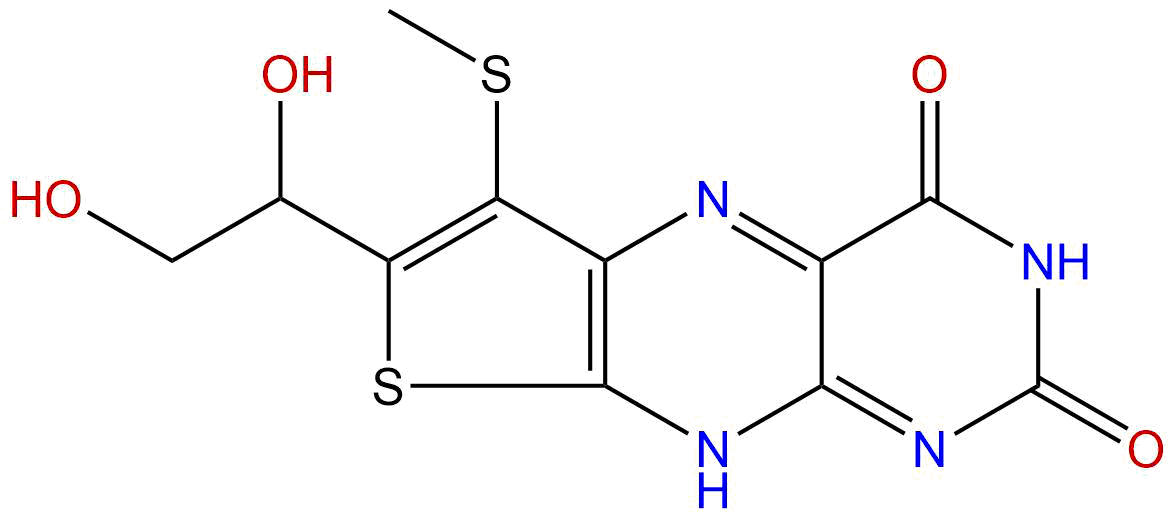
Leech amine B is a structurally unique heterocyclic nucleoside analogue containing disulfide bonds. Its molecular formula is C ₁₁ H ₁₄ N ₆ O ₄ S ₂, and its molecular weight is 326.3590. Its core structural feature is the connection of purine or pyrimidine bases to a heterocyclic system containing a disulfide bond (- S-S -), which is relatively rare in natural products. The presence of disulfide bonds not only determines the three-dimensional conformation of molecules, but also makes them easy to participate in intracellular redox reactions, which may be closely related to their biological activity.
From the analysis of physical and chemical properties, leech amine B exhibits typical polar molecular characteristics. The calculated lipid water partition coefficient (LogP) is -0.0289, indicating that the compound has a hydrophilic tendency and is evenly distributed between oil-water phases, slightly hydrophilic. The topologically polar surface area (TPSA) is as high as 131.9600 Å ², mainly attributed to the abundant nitrogen and oxygen atoms in the molecule and the sites that can form hydrogen bonds. High TPSA is a key parameter affecting its membrane permeability and pharmacokinetic behavior. Its water solubility value is 0.0839 (usually measured in mg/mL or log mol/L, indicating a certain degree of solubility, but not extremely high). Combined with LogP and TPSA, it can be inferred that it has a certain solubility in water, which is beneficial for its treatment in aqueous media and in vitro research.
In addition, preliminary pharmacological risk assessment shows that leech amine B has a lower ability to penetrate the blood-brain barrier, which reduces its potential risk of central nervous system side effects, but also limits its direct effects on central ischemic diseases. Importantly, in early safety pharmacological screening, no significant inhibition of human ether - à - go go related gene (hERG) potassium channels was found (hERG inhibition: No), indicating a low risk of causing QT interval prolongation and apical torsion type ventricular tachycardia. At the same time, the Ames test result was 0.0, which preliminarily indicates that there is no mutagenicity in this testing system, providing preliminary safety basis for its further development.
Plant sources and extraction methods
The specific source of leechamine B is the wide bodied golden thread leech of the order Hirudinae in the phylum Actinopterygii(Whitmania pigra)But not plants. The wide bodied golden leech is one of the main primitive animals of the traditional Chinese medicine "leech" in China. It is mainly produced in lakes, ponds, and water fields in most parts of China and has abundant resources. It is dried and used as medicine, commonly used to treat symptoms such as masses, blood stasis, and hemiplegia caused by stroke.
For active ingredients such as leech amine B, which have good water solubility and special structure, multi-step chromatographic methods are usually used for their extraction and separation. The general process is as follows: Firstly, the dried wide body golden leech medicinal material is crushed, and polar solvents (such as methanol, ethanol, or methanol water mixed solution) are used for cold soaking or ultrasound assisted extraction to fully extract polar components including leech amine B. The crude extract was obtained by vacuum concentration of the extraction solution.
Subsequently, preliminary enrichment and decolorization were carried out using macroporous adsorption resin column chromatography, with water ethanol gradient elution commonly used. Leech amine B is usually found in the elution sites of low to medium concentration ethanol. Further refinement and separation are highly dependent on high-performance liquid chromatography technology. Reverse phase chromatography columns (such as C18 columns) are commonly used, with a water acetonitrile or water methanol system containing a small amount of formic acid or trifluoroacetic acid as the mobile phase for gradient elution. The target fraction is collected online through UV detectors (which may have absorption around 260-280 nm depending on their structural characteristics) or mass spectrometry detectors. Due to the presence of disulfide bonds in leech amine B, it is important to avoid using strong reducing environments during extraction and separation to prevent disulfide bond breakage and deactivation. Finally, high-purity monomer compounds were obtained through repeated purification using preparative high-performance liquid chromatography (Prep HPLC), and their structures were confirmed by spectroscopic techniques such as nuclear magnetic resonance (NMR, including ¹ H, ¹ C, and two-dimensional spectra), high-resolution mass spectrometry (HRMS), and ultraviolet spectroscopy (UV).
Pharmacological activity research
At present, the pharmacological activity research of leech amine B is still in its preliminary stage, but its potential in two important directions has been revealed: anti hypoxia activity and anticoagulant activity.
-
Anti hypoxia activity This is the first reported biological activity of leech amine B. In classic in vitro cell anti hypoxia models (such as chemical hypoxia induced PC12 cell or myocardial cell injury models) or whole animal experiments (such as mouse atmospheric pressure hypoxia tolerance experiments, sodium nitrite induced hypoxia experiments), hirudin B exhibits a "moderate" protective effect. It can significantly prolong the survival time of cells or animals in hypoxic environments, reduce hypoxia induced lactate dehydrogenase (LDH) leakage, and improve cell viability. This anti hypoxia effect may be achieved through multiple pathways such as stabilizing cell membranes, reducing oxidative stress, and regulating energy metabolism, providing a preliminary pharmacological basis for its application in hypoxia related diseases such as myocardial ischemia and cerebral ischemia.
-
anticoagulant activity Although there are limited literature reports directly targeting the anticoagulant activity of leech amine B, its activity is highly speculated and studied based on the long history of anticoagulant medicinal use of its source organism (leech), as well as its structural characteristics that may mimic or interfere with the function of certain coagulation factors. The ability to affect endogenous, exogenous, and co coagulation pathways can be evaluated through in vitro coagulation experiments such as activated partial thromboplastin time (APTT), prothrombin time (PT), and thrombin time (TT) measurements. The preliminary target prediction analysis (see next section) strongly suggests that leech amine B may act on multiple coagulation related targets. It is expected that its anticoagulant effect may manifest as prolonged APTT and/or PT, and may exert its effect through mechanisms different from heparin or warfarin, which provides the possibility for its development as a novel anticoagulant drug.
Mechanism of action and molecular targets
The exact mechanism of action of leech amine B has not been fully elucidated, but based on its anti hypoxia and potential anticoagulant activity, combined with computational chemistry and molecular docking prediction, the following key molecular target pathways can be focused on:
1. Target network related to anticoagulant effects:
Leech amine B may intervene in the coagulation cascade and fibrinolysis system through a multi-target approach. The potential targets for its predicted effects include:
* Coagulation factors Such as thrombin (F2), tissue factor (F3), coagulation factor VII (F7), IX (F9), X (F10). Leech amine B may mimic the substrate or binding site of these factors through its heterocyclic structure, thereby competitively inhibiting its activity and blocking the amplification of the coagulation process.
* Vitamin K cycle related targets Vitamin K epoxide reductase complex subunit 1 (VKORC1) is the target of warfarin anticoagulants and is responsible for the regeneration of vitamin K. Leech amine B may affect the function of VKORC1, interfere with the gamma carboxylation of vitamin K-dependent coagulation factors (F2, F7, F9, F10, PROC, PROS1), and render them inactive.
* Anticoagulant protein system Protein C (PROC) and protein S (PROS1) are important physiological anticoagulant substances. Leech amine B may enhance its activity or mimic its function, promoting the inactivation of activated coagulation factors Va and VIIIa.
* Fibrinolytic system and vascular endothelial targets Plasminogen activator inhibitor-1 (SERPINE1/PAI-1) is the main inhibitor of fibrinolysis. Inhibiting PAI-1 can enhance fibrinolytic activity. Von Willebrand factor (VWF) mediates platelet adhesion. Intervening in these targets can work through a dual pathway of inhibiting thrombus formation and promoting thrombolysis.
2. Mechanisms related to anti hypoxia effects:
Its anti hypoxia activity may involve a wider range of cellular protective mechanisms rather than a single target:
* Hypoxia inducible factor (HIF) pathway It is possible to stabilize HIF-1 α, upregulate the expression of downstream target genes such as erythropoietin (EPO) and vascular endothelial growth factor (VEGF), promote oxygen delivery and angiogenesis, and adapt to hypoxic environments.
* Apoptosis and Autophagy Pathway Perhaps by regulating the Bcl-2/Bax ratio, inhibiting the activation of caspase-3, and reducing hypoxia induced cell apoptosis. At the same time, it may moderately activate protective autophagy, clear damaged organelles, and maintain cellular homeostasis.
* Oxidative stress pathway Hypoxia is often accompanied by an outbreak of reactive oxygen species (ROS). Leech amine B may activate the Nrf2/ARE pathway, upregulate the expression of antioxidant enzymes such as superoxide dismutase (SOD) and glutathione peroxidase (GSH Px), and alleviate oxidative damage.
* Energy metabolism regulation May regulate glycolysis and mitochondrial function by affecting the AMPK signaling pathway, allowing for more efficient energy utilization under hypoxic conditions.
The unique disulfide bond structure of leech amine B may enable it to reversibly modify the thiol group (- SH) of target proteins, thereby affecting protein function through "conformational regulation" or "covalent modification", which may be a characteristic of its mechanism of action.
Evaluation of drug properties and pharmacokinetics
Based on its calculations and preliminary experimental data, a preliminary evaluation of the pharmacological properties of leech amine B is conducted:
Advantages:
1. Moderate molecular weight The molecular weight of 326 Da meets the requirements for molecular weight (<500 Da) in the "Five Rules" for generic drugs, which is beneficial for oral absorption.
2. Moderate polarity, acceptable solubility LogP is close to 0, and although TPSA is high, it does not exceed the common oral absorption limit of 140 Å ². Combined with its certain water solubility, it suggests that it may have acceptable oral bioavailability, but dosage form optimization may be needed to improve dissolution and absorption.
3. Preliminary safety is good The absence of hERG inhibition warning and Ames mutagenicity cleared two key early risk barriers for its preclinical development.
4. Low central permeability For anticoagulant and anti ischemic drugs that mainly act on the peripheral circulatory system, low blood-brain barrier permeability can be seen as an advantage in avoiding central side effects.
Challenges and unknowns:
1. Pharmacokinetic (PK) characteristics unknown Currently, there is a lack of systematic research on the absorption, distribution, metabolism, and excretion (ADME) of leech amine B in the body. The key PK parameters such as oral absorption degree, plasma protein binding rate, major metabolic organs (liver/kidney), metabolite structure and activity, and elimination half-life are all blank. High TPSA may limit its passive transmembrane diffusion, and its absorption may depend on active transport.
2. Metabolic stability Heterocyclic structures and disulfide bonds may undergo extensive phase I (such as oxidation and reduction) and phase II (such as glucuronidation and sulfation) metabolism in the liver. The disulfide bond may be reduced by biological thiols such as glutathione, affecting the blood concentration and duration of its prototype drug.
3. Potential toxicity Although the Ames test was negative, a more comprehensive evaluation of genetic toxicity, acute and chronic toxicity, and reproductive toxicity has not yet been conducted. Sulfur containing compounds may sometimes pose specific toxicity risks.
4. Formulation development Due to its polarity, developing solid dosage forms suitable for oral administration (such as tablets, capsules) may require the use of appropriate excipients or prodrug strategies to improve their membrane permeability.
Future research needs to prioritize the establishment of sensitive and specific biological analysis methods (such as LC-MS/MS), conduct systematic preclinical pharmacokinetic studies in rodents (rats, mice), and evaluate their absolute bioavailability.
Clinical application prospects and prospects
Leech amine B, as a natural product with novel structure and dual activity (anti hypoxia, potential anticoagulant), has a promising clinical application prospect mainly in the field of cardiovascular and cerebrovascular diseases, but also faces many challenges.
Potential application directions:
1. Development of new anticoagulant/antithrombotic drugs Although existing anticoagulants such as warfarin and direct oral anticoagulants (DOACs) are effective, there are still issues such as bleeding risk, need for monitoring, significant individual differences, and drug resistance in some patients. If leech amine B is proven to exert anticoagulant effects through multiple targets (such as simultaneously affecting VKORC1 and coagulation factors), it may provide a new option with a unique mechanism of action and different bleeding risk profiles, especially suitable for patients who are intolerant to existing drugs. It can be explored for the prevention and treatment of stroke caused by deep vein thrombosis, pulmonary embolism, atrial fibrillation, and acute coronary syndrome.
2. Adjuvant therapy for ischemic cardiovascular and cerebrovascular diseases Its anti hypoxia activity suggests that it may be used as an adjuvant therapy for myocardial infarction, ischemic stroke, peripheral arterial disease, etc. It can be used during or after revascularization (such as thrombolysis, intervention) to protect cells in the ischemic margin zone, reduce reperfusion injury, improve microcirculation, and promote functional recovery.
3. combination therapy May be used in combination with other antiplatelet drugs (such as aspirin, clopidogrel) or anticoagulants to achieve synergistic antithrombotic effects at lower doses, while reducing the risk of side effects from each individual medication. It may also be used in combination with neuroprotective or cardioprotective agents to enhance protection against ischemic tissue.
Challenges and future research directions:
1. Activity intensity issue At present, its anti hypoxia activity is reported to be "moderate", and its potency and selectivity need to be improved through structural modifications (such as synthesizing analogues). Accurate in vitro and in vivo efficacy verification is required for anticoagulant activity.
2. Explanation of the mechanism of action Chemical biology methods such as affinity fishing, photo crosslinking probes, and molecular dynamics simulations must be used to identify the protein targets that directly interact with them, and to clarify whether they function through reversible binding or disulfide bond exchange.
3. lead optimization Based on structure-activity relationship (SAR) research, carry out reasonable structural modifications. For example, modifying disulfide bonds to enhance metabolic stability; Introducing specific functional groups to enhance selectivity towards a specific coagulation target; Optimize LogP and TPSA to improve pharmacokinetic properties.
4. Comprehensive preclinical evaluation After completing preliminary pharmacological and PK studies, it is necessary to conduct systematic safety pharmacology and toxicology research in accordance with the Good Laboratory Practice (GLP) requirements, and evaluate its therapeutic window.
5. From the perspective of modernization of traditional Chinese medicine From the perspective of the overall pharmacological substance basis of "leeches", this study aims to investigate the synergistic effect of leech amine B with other active ingredients of leeches (such as hirudin, hirudin, etc.), providing scientific basis for the development of multi-component innovative traditional Chinese medicine formulas based on leeches.
Conclusion
Leech amine B is a heterocyclic nucleoside analogue with disulfide bond structure isolated from the traditional Chinese medicine leech. Its moderate anti hypoxia activity and potential targeted anticoagulant effect reveal the potential application of this natural molecule in the treatment of cardiovascular and cerebrovascular diseases. Its unique chemical structure is the starting point for exploring new mechanisms of action, and the preliminary good pharmacological parameters lay the foundation for its further development. However, the road from natural active compounds to candidate drugs is long and challenging. The current focus of research is to confirm its anticoagulant activity, elucidate its multi-target mechanism of action, and conduct systematic preclinical pharmacokinetic and safety evaluations. By optimizing its structure through modern medicinal chemistry and pharmacology methods, it is expected to obtain derivatives with stronger activity, higher selectivity, and better pharmacokinetic properties. The study of leechamine B not only helps to explore the modern scientific value of leeches, a traditional animal medicine, but also provides valuable lead structures for discovering new therapeutic drugs that act on coagulation and hypoxia pathways, reflecting the sustained vitality of searching for modern innovative drug sources from the treasure trove of traditional medicine.