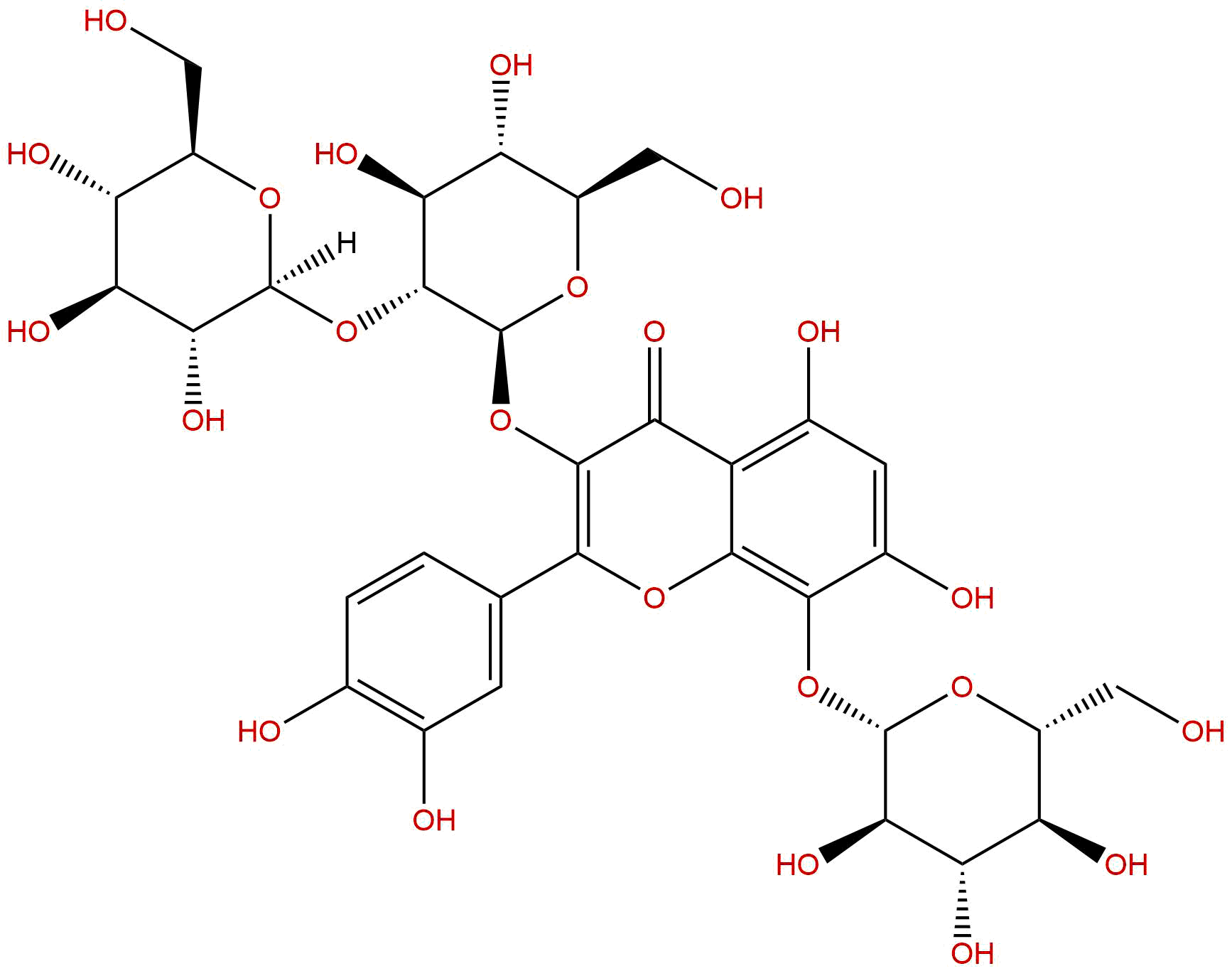
| Catalog No | Package | Original Price | Price | Inventory | Quantity | Operating |
|---|---|---|---|---|---|---|
| BP5091-5mg | 5mg | $750.00 | Sign in |
|


Product name: Gossypetin 3-sophoroside-8-glucoside
Synonym name:
Catalogue No.: BP5091
Cas No.: 77306-93-5
Formula: C33H40O23
Mol Weight: 804.66
Botanical Source:
Type of Compound: Flavonoids
Purity: 95%~99%
Analysis Method: HPLC-DAD or/and HPLC-ELSD
Identification Method: Mass, NMR
Packing: Brown vial or HDPE plastic bottle
Storage: Store in a well closed container, protected from air and light. Put into refrigerate or freeze for long term storage.
Whenever possible, you should prepare and use solutions on the same day. However, if you need to make up stock solutions in advance, we recommend that you store the solution as aliquots in tightly sealed vials at -20℃. Generally, these will be useable for up to two weeks.
The product could be supplied from milligrams to grams
Inquire for bulk scale.
For Reference Standard and R&D, Not for Human Use Directly.
Storage conditions:Short-term storage at 2~8℃, long-term storage at -20 ~ -80℃
389.0400
-1.7879
-1.8603
10.2151
.4362
.2759
Low
68.1221
5.5117
Yes
No
No
No
Yes
No
0.0
Yes
No
Yes
Yes
Natural products, as an important source of drug discovery, play an irreplaceable role in the long history of human fight against diseases. Flavonoids, as the most widely distributed class of secondary metabolites in nature, have attracted much attention due to their structural diversity and extensive biological activity. Among them, polyhydroxyflavonol compounds such as quercetin, kaempferol, myricetin, etc. have been proven to have various pharmacological effects such as antioxidant, anti-inflammatory, anti-tumor, and cardiovascular protection. However, flavonoids often exist in the form of glycosides in plants, and glycosylation modification not only affects their physicochemical properties such as solubility and stability, but also profoundly alters their bioavailability and pharmacological activity. Gossypotin-3-sophoroside-8-glucoside (G3S8G), as a structurally unique flavonol polysaccharide, has gradually entered the field of researchers in recent years. Gossypin, the parent nucleus of quercetin, is a 6-hydroxy derivative of quercetin. Compared to quercetin, it has an additional phenolic hydroxyl group, which gives it stronger antioxidant and metal chelating abilities. G3S8G is connected to sophorose (a disaccharide composed of two glucose molecules linked by a β -1,2 bond) at the C-3 position of cotton bark extract, and to glucose at the C-8 position, forming a highly glycosylated complex structure. This unique glycosylation pattern makes it stand out among numerous flavonoid glycosides and endows it with potential special biological activity.
From the perspective of plant chemical taxonomy, G3S8G mainly exists in Malvaceae plants, especially in the cotton genus(Gossypium)The flowers, leaves, and other parts of plants are rich in content. In traditional medicine, different parts of cotton, such as flowers and root bark, are used to treat inflammation, bleeding, and allergic diseases, suggesting that the flavonoids contained in them may have anti-inflammatory and anti allergic activities. Modern pharmacological research has preliminarily confirmed that G3S8G and its related compounds can inhibit various key enzymes and cytokines closely related to allergic reactions, such as 5-lipoxygenase (ALOX5), histamine receptor H1 (HRH1), interleukin-4 (IL4), interleukin-5 (IL5), interleukin-13 (IL13), etc. These targets cover multiple stages of allergic reactions from initiation (allergen recognition and IgE cross-linking), effects (mast cell degranulation, histamine release) to chronic inflammation (Th2 cytokine secretion, eosinophil infiltration), suggesting that G3S8G may serve as a multi-target natural product with unique advantages in the treatment of allergic diseases such as allergic rhinitis, asthma, and atopic dermatitis.
Although G3S8G has shown promising pharmacological prospects, systematic research on it is still in its infancy. The high polarity and high molecular weight brought about by its complex sugar chain structure pose challenges in terms of oral bioavailability, metabolic stability, and other aspects. However, in recent years, with the advancement of medicinal chemistry, nanoformulation technology, and pharmacokinetic research methods, research on the pharmacological modification and delivery strategies of these highly polar and difficult to absorb natural glycoside compounds has become increasingly in-depth. This article aims to systematically review the chemical structure, physicochemical properties, plant origin, extraction methods, pharmacological activity, mechanism of action, pharmacological evaluation, and clinical application prospects of G3S8G, in order to provide comprehensive scientific basis for the in-depth research and development of this unique natural product.
The chemical structure of cotton peelin-3-sophorodisaccharide-8-glucoside (G3S8G) has distinct characteristics. Its glycoside is Gossypin, with a chemical name of 3,5,7,8,3 ', 4' - hexahydroxyflavone. Compared with the common quercetin (3,5,7,3 ', 4' - pentahydroxyflavone), gossypol has an additional hydroxyl group at the C-8 position, which makes its intramolecular hydrogen bonding network more complex and has higher potential for antioxidant activity. In terms of glycosylation modification, G3S8G is linked to a sophorodisaccharide group at the C-3 position. Huaidi sugar is a disaccharide composed of two D-glucose units connected by a β (1 → 2) glycosidic bond, which is relatively rare in natural flavonoid glycosides and gives the molecule a unique spatial conformation. In addition, a separate β - D-glucose group is attached to the C-8 position. Therefore, the complete chemical name of G3S8G should be: cotton peelin-3-O - β - D-glucopyranosyl - (1 → 2) - β - D-glucopyranoside-8-O - β - D-glucopyranoside. Its molecular formula is C ∝ ∝ H ₄₀ O ₂∝, and its molecular weight is as high as 804.66 Da.
From the perspective of physical and chemical properties, G3S8G exhibits typical strong polar polyphenolic glycoside characteristics. The calculated lipid water partition coefficient (LogP) is -1.7879, indicating that it has strong hydrophilicity and is almost insoluble in lipid solvents, but easily soluble in polar solvents such as water, methanol, and ethanol. This high water solubility is beneficial for its transport and storage in plants, but also poses a huge challenge for its absorption in organisms, as the passive diffusion ability of drugs through cell membranes is extremely low. Its topological polar surface area (TPSA) is as high as 389.04 Å ², far exceeding the recommended upper limit of 140 Å ² for oral medications, further confirming its extremely difficult to penetrate biofilm characteristics. The water solubility parameter is 10.2151 mg/mL, indicating good solubility in water, which provides convenience for in vitro experiments and formulation development. In terms of stability, as a polyphenolic compound, G3S8G is sensitive to light, heat, and alkaline environments, and is prone to oxidative degradation. Its glycosidic bonds may undergo hydrolysis under acidic or specific enzyme action (such as β - glucosidase), gradually removing glycosides and generating secondary glycosides or aglycones. This metabolic instability is a key variable for its pharmacological effects in the body.
The discovery and isolation of G3S8G mainly stem from chemical research on plants in the Malvaceae family. It is currently known that it mainly exists in the cotton genus(Gossypium)In plants, especially upland cotton(Gossypium hirsutum)And grass cotton(Gossypium herbaceum)The content is relatively high in the petals and leaves. In addition, in the genus Hibiscus(Hibiscus)Plants like rose eggplant(Hibiscus sabdariffa)It has also been found in the sepals. These plants are often used in traditional medicine to treat inflammation, fever, and allergic symptoms, and G3S8G is considered one of their active ingredients. It is worth noting that the content of G3S8G in plants is greatly influenced by variety, growth stage, and environmental factors such as light, temperature, and water stress. Usually, during the blooming period of flowers, the accumulation of G3S8G in petals reaches its peak, which may be related to its physiological functions in plant defense against ultraviolet radiation and attracting pollinators.
For the extraction of G3S8G, the classic solvent extraction method combined with modern chromatographic separation technology is currently mainly used. Due to the high polarity of G3S8G, high concentration methanol or ethanol aqueous solution is usually used as the extraction solvent. For example, multiple extractions or ultrasound assisted extraction of dried cotton petal powder using 70% methanol or 80% ethanol at room temperature or heating conditions (40-60 ° C) can efficiently obtain crude extracts. Ultrasound assisted extraction and microwave-assisted extraction can significantly improve extraction efficiency and shorten extraction time due to their ability to destroy cell walls and accelerate solvent permeation. After vacuum concentration of the extraction solution, preliminary separation is carried out through liquid-liquid extraction (such as extraction with petroleum ether, ethyl acetate, and n-butanol in sequence). G3S8G is mainly enriched in the n-butanol phase or aqueous phase due to its high polarity.
Further purification and separation typically rely on various column chromatography techniques. Macroporous adsorption resin (such as D101, AB-8) is a commonly used first step purification method, which can remove a large amount of impurities such as sugars and pigments through gradient elution (water ethanol system), and enrich flavonoid glycoside components. Subsequently, further separation can be achieved by gradient elution using polyamide column chromatography or silica gel column chromatography with solvent systems such as chloroform methanol water or ethyl acetate methanol water. For complex flavonoid glycoside mixtures with similar structures, high-performance liquid chromatography (HPLC) or preparative high-performance liquid chromatography (Prep HPLC) is the key means to obtain high-purity G3S8G monomers. Usually, a reverse phase C18 chromatography column is used, with acetonitrile water or methanol water (containing a small amount of formic acid or acetic acid) as the mobile phase for isocratic or gradient elution, combined with a UV detector (detection wavelength usually set at 254 nm or 280 nm) for monitoring. Finally, the isolated compounds were structurally identified using nuclear magnetic resonance spectroscopy (NMR, including ¹ H-NMR, ¹ ³ C-NMR, 2D-NMR such as HSQC, HMBC) and high-resolution mass spectrometry (HR-ESI-MS) to confirm their sugar linkage positions, configurations, and sequences.
At present, there are relatively limited reports on the direct pharmacological activity of G3S8G. However, based on the prediction of its parent nucleus cotton bark extract, related glycosides, and target network, it can be inferred that it has multiple pharmacological potentials, among which anti allergic activity is the most core research direction.
Antiallergic activity This is the pharmacological activity of G3S8G that has received the most attention. Allergic reactions are usually classified into immediate type (Type I hypersensitivity reaction) and delayed type. In acute hypersensitivity, allergens crosslink with IgE antibodies bound to the surface of mast cells and eosinophils, causing cell degranulation and releasing allergens such as histamine, leukotrienes, prostaglandins, etc., leading to acute symptoms. G3S8G is predicted to act on multiple key nodes. Firstly, it may inhibit the activity of 5-lipoxygenase (ALOX5). ALOX5 is a key enzyme involved in the metabolism of arachidonic acid to produce leukotrienes (such as LTB4, LTC4, LTD4). Leukotrienes are potent bronchoconstrictors and pro-inflammatory mediators, playing a central role in asthma and allergic rhinitis. Inhibiting ALOX5 can reduce the production of leukotrienes, thereby alleviating airway spasms and inflammation. Secondly, G3S8G may act as an antagonist of the histamine H1 receptor (HRH1). Histamine is one of the most important mediators released in allergic reactions, causing vasodilation, increased permeability, smooth muscle contraction, and itching by binding to HRH1. Antagonism against HRH1 is the mechanism of action of classic anti allergic drugs such as loratadine and cetirizine. In addition, G3S8G may also inhibit the expression and secretion of Th2 cytokines (IL4, IL5, IL13). IL4 is a key factor in inducing IgE production in B cells, IL5 is a key factor in eosinophil activation, proliferation, and survival, and IL13 is involved in airway hyperresponsiveness and mucus secretion. By downregulating these cytokines, G3S8G can fundamentally inhibit the establishment and maintenance of Th2 type immune responses. Meanwhile, it may also affect the expression or signal transduction of high affinity IgE receptor (FCER1A), as well as inhibit smooth muscle contraction and platelet aggregation mediated by thromboxane A2 receptor (TBXA2R). Inhibition of the signal transduction molecule STAT6 will block the downstream signaling pathway of IL4/IL13, further weakening the Th2 response. Finally, the inhibition of thymic stromal lymphopoietin (TSLP) is also of great significance. TSLP is an epithelial cell-derived alarm hormone that can effectively activate dendritic cells and promote Th2 differentiation, and is one of the initiating factors of allergic reactions. Therefore, G3S8G exhibits a multi-target and multi-level anti allergic action mode by acting on multiple targets such as ALOX5, HRH1, IL4, IL5, IL13, FCER1A, TBXA2R, STAT6, TSLP, etc., which is expected to overcome the limitations of limited efficacy or obvious side effects of single target drugs.
Antioxidant and anti-inflammatory activities Cotton bark extract itself has strong free radical scavenging ability due to its multi hydroxyl structure. Although some phenolic hydroxyl groups of G3S8G are blocked due to glycosylation, its aglycone portion can still exert antioxidant effects after enzymatic release in vivo. Antioxidant activity is the basis of many anti-inflammatory effects. By clearing reactive oxygen species (ROS), it can inhibit the activation of redox sensitive transcription factors such as NF - κ B, thereby reducing the production of pro-inflammatory cytokines (such as TNF - α, IL-1 β, IL-6). Therefore, G3S8G may indirectly exert broad-spectrum anti-inflammatory effects through antioxidant mechanisms.
Other potential activities Given the extensive activity of flavonoids, G3S8G may also have anti-tumor, cardiovascular protective, and antimicrobial effects. For example, exerting anti-tumor effects by inhibiting topoisomerase or inducing cell apoptosis; Protecting vascular endothelium through vasodilation, inhibition of platelet aggregation, and antioxidant activity; It exerts antimicrobial effects by destroying bacterial cell walls or inhibiting virus replication. However, these activities currently lack direct experimental evidence and require further research.
The mechanism of action of G3S8G is closely related to its multi-target properties, mainly focusing on anti allergic reactions. Its mechanism of action can be elucidated from the following aspects:
1. Inhibition of synthesis and release of allergic mediators:
- Inhibit ALOX5 G3S8G may competitively inhibit the binding of arachidonic acid by binding to the active site of ALOX5, or chelate the necessary iron ions for its activity, thereby blocking the synthesis of leukotrienes. Leukotrienes (especially LTD4) are potent bronchoconstrictors, and inhibiting their production is a key strategy for treating asthma.
- Stable mast cell membrane Although direct evidence is insufficient, many flavonoid glycosides have the ability to stabilize mast cell membranes and inhibit their degranulation. G3S8G may reduce the release of mediators such as histamine and leukotrienes by interfering with signal transduction on the cell membrane or inhibiting calcium ion influx.
2. Antagonism against allergen receptors:
- Antagonistic HRH1 G3S8G may act as a competitive antagonist of HRH1, occupying receptor binding sites to prevent histamine from binding, thereby inhibiting histamine induced symptoms such as vasodilation, increased permeability, and itching. This is one of the most direct mechanisms by which it exerts its anti allergic effect.
- Antagonistic TBXA2R Thromboxane A2 (TXA2) is a potent vasoconstrictor and platelet aggregation inducer, involved in airway smooth muscle contraction and microcirculation disorders in allergic reactions. G3S8G may alleviate these pathological reactions by blocking TBXA2R.
3. Regulation of Th2 type immune response:
- Inhibit cytokine expression G3S8G may inhibit the gene transcription of Th2 cytokines (IL4, IL5, IL13) by affecting the activity of transcription factors such as GATA3 and STAT6. IL4 is a key signal for IgE class switching, IL5 is a major factor in eosinophil activation, and IL13 is associated with airway remodeling and mucus secretion. Inhibiting these cytokines can intervene at the source of the immune response.
- Inhibition of STAT6 phosphorylation STAT6 is a key signaling molecule downstream of IL4 and IL13 receptors. G3S8G may inhibit the activity of JAK kinase, prevent phosphorylation and nuclear translocation of STAT6, thereby blocking the signal transduction of IL4/IL13 and downregulating the expression of its target genes (such as FCER1A, MUC5AC, etc.).
- Inhibit TSLP production TSLP is an alarm cytokine derived from epithelial cells, produced in large quantities under allergen stimulation, and is an upstream key factor in initiating Th2 type immune responses. G3S8G may exert inhibitory effects in the initial stage of immune response by inhibiting the activity of transcription factors such as NF - κ B or AP-1, reducing the production of TSLP.
4. Interference with IgE Fc ε RI signal:
- Downregulation of FCER1A expression High affinity IgE receptor (Fc ε RI) is expressed on the surface of mast cells and eosinophils, and its alpha subunit (FCER1A) is responsible for binding IgE. G3S8G may downregulate the expression of FCER1A by inhibiting the signaling of cytokines such as IL4, thereby reducing the sensitivity of cells to allergen IgE complexes and reducing the occurrence of degranulation.
In summary, G3S8G acts on the initiation, response, and chronic inflammatory stages of allergic reactions through a network regulatory mode of "multi-target, multi pathway". This mechanism makes it a potential lead compound for treating complex allergic diseases such as asthma and atopic dermatitis, but it also increases the complexity of its mechanism of action research. Future research requires the use of techniques such as molecular docking, surface plasmon resonance (SPR), and cellular thermal transition analysis (CETSA) to confirm their direct binding and binding constants to various targets. Through experiments such as gene knockout or RNA interference, the relative contributions of each target to the overall efficacy of G3S8G need to be verified.
The evaluation of drug properties is a crucial step in determining whether natural products can be transported from the laboratory to clinical practice. For compounds like G3S8G, which have a large molecular weight, high polarity, and extremely low LogP, their pharmacological properties face significant challenges.
1. Absorption The LogP of G3S8G is -1.7879 and the TPSA is as high as 389 Å ², which strongly indicate poor oral absorption. The passive diffusion of drugs through the gastrointestinal epithelial cell membrane is almost impossible to occur. Its absorption may mainly rely on the following pathways: firstly, it slowly diffuses through the paracellular pathway in the intercellular space, but with extremely low efficiency; The second is active transport through transport proteins on intestinal epithelial cells, such as glucose transporter 1 (SGLT1) or organic anion transport peptides (OATPs). Flavonoid glycosides are often reported to be transported through SGLT1, but the long sugar chain of G3S8G may affect its binding to transport proteins. Thirdly, after oral administration, under the action of enzymes such as β - glucosidase secreted by the gut microbiota, secondary glycosides or aglycones with lower polarity (cotton bark extract) are gradually hydrolyzed and released, which may be absorbed through passive diffusion. Therefore, the oral bioavailability of G3S8G is expected to be extremely low, which is the biggest bottleneck for its drug development.
2. Distribution Due to its high polarity and low fat solubility, the distribution volume of G3S8G in the body may be relatively small, mainly distributed in extracellular fluid and blood. Its binding rate to plasma proteins (such as albumin) may be high because polyphenol structures are easily bound to proteins. The blood-brain barrier (BBB) permeability is predicted to be "low", which is consistent with its high polarity and high molecular weight, meaning it is difficult to enter the central nervous system. This may be an advantage for treating peripheral allergic diseases such as rhinitis and asthma, as it can reduce central side effects.
3. Metabolism The metabolism of G3S8G mainly occurs in the intestine and liver. In the intestine, as mentioned earlier, microbial enzymes gradually hydrolyze its glycosidic bonds to produce gossypol-3-sophorodisaccharide and gossypol-8-glucoside, ultimately producing the glycoside gossypol. In the liver, aglycones or absorbed small amounts of glycosides undergo phase II metabolic reactions such as glucuronidation, sulfation, and methylation, producing metabolites that are more easily excreted. These metabolites may still have biological activity, or even stronger activity. For example, the antioxidant and anti-inflammatory activities of cotton bark extract may be higher than its parent glycoside. Therefore, G3S8G may be a prodrug whose in vivo efficacy is mainly mediated by its metabolites.
4. Excretion Due to its high polarity, G3S8G and its metabolites are mainly excreted through bile and kidneys. Metabolites excreted through bile may enter the enterohepatic circulation, prolonging their retention time in the body. But overall, its half-life may be relatively short.
5. Security Preliminary pharmacological parameters show that G3S8G has no risk of hERG inhibition (hERG inhibition: No), and the Ames test result is 0.0, indicating no significant mutagenicity or cardiotoxicity risk. This provides a certain initial guarantee for its safety. However, a comprehensive toxicological evaluation, including acute toxicity, long-term toxicity, reproductive toxicity, etc., is still necessary for its subsequent development.
6. Drug modification strategy Given the extremely poor absorption characteristics of G3S8G, advanced formulation technology is necessary to develop it into an oral medication. For example: ① nano-formulation Encapsulating G3S8G in liposomes, polymer nanoparticles, or solid lipid nanoparticles can improve its encapsulation efficiency, protect it from enzymatic degradation, and promote absorption through lymphatic pathways. ② Phospholipid complex Forming complexes with phospholipids can increase their lipid solubility and improve transmembrane transport. ③ Prodrug design Esterification or etherification modification of its phenolic hydroxyl group, such as preparing acetylated prodrugs or amino acid ester prodrugs, can improve lipid solubility and release the original drug through enzymatic interpretation in vivo. ④ Absorption enhancer Used in combination with surfactants or P-glycoprotein inhibitors. In addition, developing non oral routes of administration, such as transdermal administration (for atopic dermatitis), nasal administration (for allergic rhinitis), or inhalation administration (for asthma), may be a more realistic choice as these routes can bypass the first pass effect of the liver and directly act on target organs.
Although the research on G3S8G is still in its early stages, its unique chemical structure and multi-target anti allergic mechanism indicate broad application prospects.
1. Treatment of allergic diseases This is the most direct application direction of G3S8G. Its multi-target mode of action makes it a promising new and more comprehensive anti allergic drug. Compared with traditional antihistamines (which only antagonize HRH1) or leukotriene receptor antagonists (which only antagonize CysLT1 receptors), G3S8G simultaneously acts on multiple links such as mediator synthesis, receptor antagonism, and immune regulation, and may have better therapeutic effects on moderate to severe or refractory allergic diseases (such as severe asthma and atopic dermatitis). Especially its inhibition of TSLP and IL4/IL13/STAT6 pathways gives it the potential for disease modifying, rather than just relieving symptoms.
2. As a functional food or dietary supplement Given its presence in edible plants such as cotton petals, G3S8G can be used as a functional food ingredient to prevent or assist in alleviating mild allergic symptoms. For example, developing cotton flower tea or extract capsules rich in G3S8G. However, it should be noted that its oral bioavailability is extremely low, and when used as an oral supplement, its in vivo efficacy may be much lower than its in vitro activity. Therefore, it is necessary to combine formulation technology or clarify its in vivo active metabolites.
3. Optimize the structure as a lead compound The complex sugar chain structure of G3S8G is both a challenge and an opportunity. Pharmaceutical chemists can simplify or modify the structure using its parent nucleus, gossypol, as a starting point. For example, retaining key phenolic hydroxyl groups, replacing or simplifying sugar chains, and designing and synthesizing a series of novel structures, stronger activity, and better pharmacokinetic properties of cotton bark extract derivatives. Through structure-activity relationship (SAR) studies, essential pharmacophores for activity can be identified and unnecessary structural units can be removed, resulting in candidate drugs with smaller molecular weight and more reasonable LogP.
4. Research Challenges and Future Directions:
- In depth mechanism research Modern molecular biology techniques such as CRISPR-Cas9 gene editing, ChIP seq, RNA seq, etc. are needed to systematically elucidate the precise targets and signaling networks of G3S8G at the cellular and animal levels.
- In vivo pharmacological and pharmacokinetic studies Establish appropriate animal models for allergic diseases (such as ovalbumin induced asthma mouse model and DNCB induced atopic dermatitis mouse model), and evaluate the efficacy of G3S8G through different administration routes (oral, intraperitoneal injection, local application). At the same time, conduct systematic pharmacokinetic studies to clarify its absorption, distribution, metabolism, and excretion characteristics, and identify its active metabolites in vivo.
- Formulation development Focus on developing new delivery systems that can improve their bioavailability, such as nanoemulsions, liposomes, polymer micelles, etc., and evaluate their in vitro and in vivo performance.
- Toxicity evaluation Conduct comprehensive preclinical toxicology studies to ensure its safety.
- Resource sustainability Establish chemical synthesis or biosynthetic methods for G3S8G to eliminate dependence on plant resources and ensure the supply of raw materials for future large-scale production.
Cotton peelin-3-sophorodisaccharide-8-glucoside (G3S8G) is a naturally occurring flavonol polysaccharide with a unique structure and clear source. It exhibits multi-level anti allergic potential by acting on multiple key targets such as ALOX5, HRH1, IL4, IL13, STAT6, TSLP, and is expected to provide a new and more comprehensive strategy for the treatment of allergic diseases. However, its high polarity and high molecular weight pose the biggest challenge for oral absorption in its drug development. Future research should focus on further elucidating its in vivo mechanism of action and metabolic pathways, and overcoming its pharmacokinetic barriers through modern medicinal chemistry and nanoformulation technology. The in-depth study of G3S8G not only helps to reveal the material basis of the anti allergic activity of traditional medicinal plant cotton, but also may open up new paths for the development of new anti allergic drugs derived from natural products. Despite the challenges ahead, the enormous potential contained in this unique natural product deserves continuous efforts and exploration from researchers.
Batch can search by a CAS number,one per line
