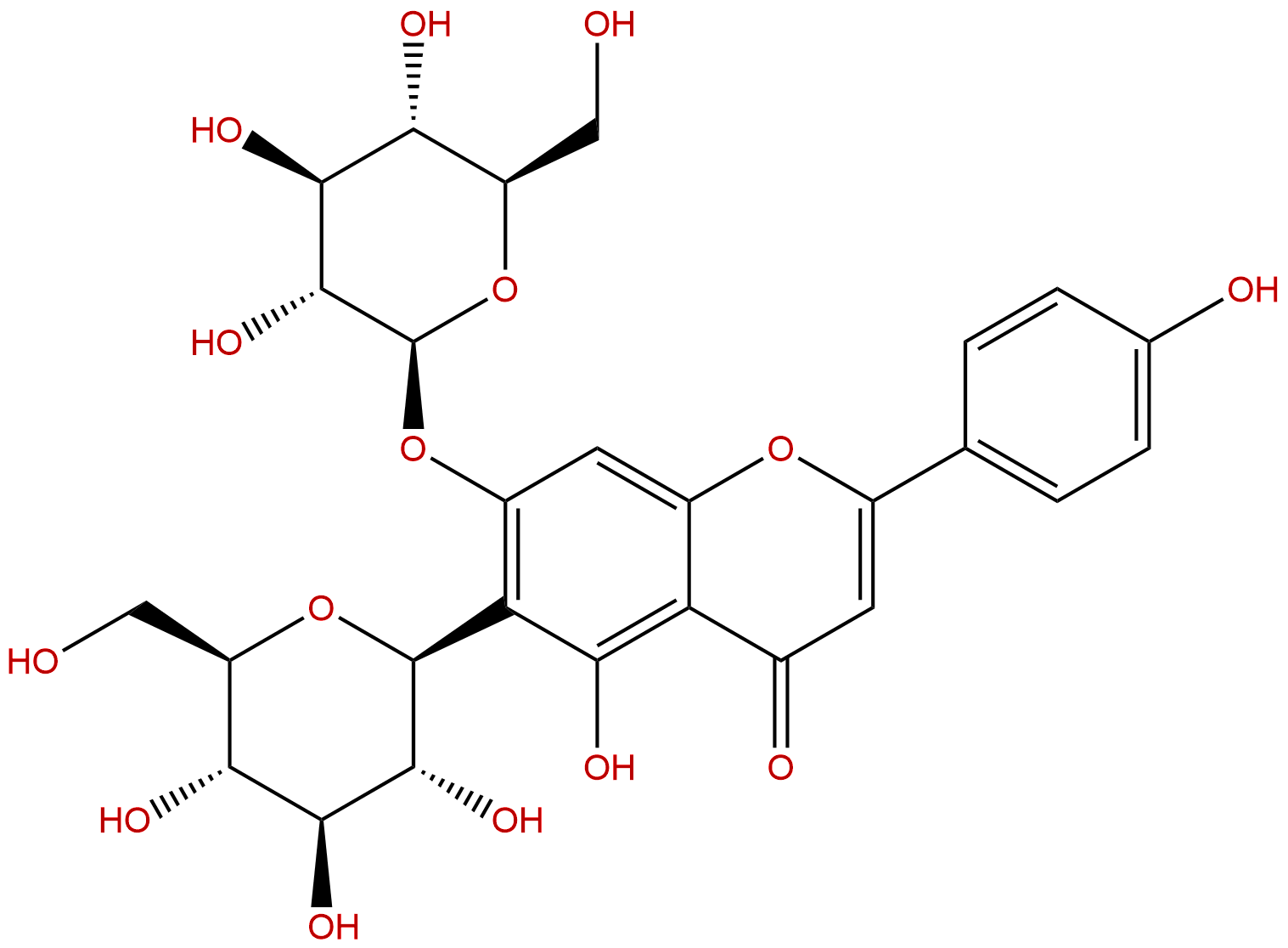


Synonym name: Petrocomoside
Catalogue No.: BP1256
Cas No.: 20310-89-8
Formula: C27H30O15
Mol Weight: 594.522
Botanical Source: numerous plant spp.
Purity: 95%~99%
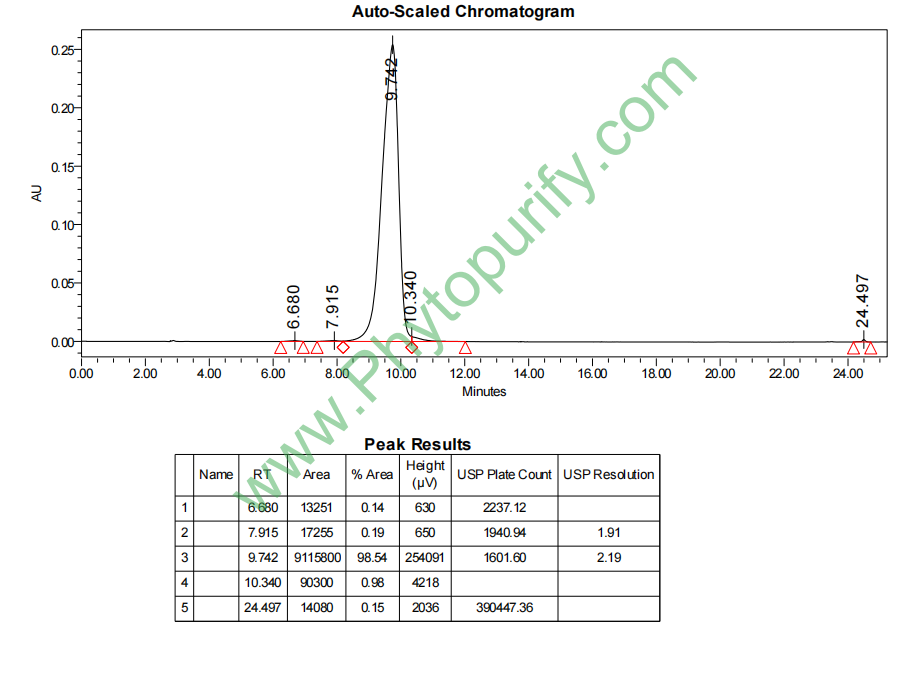
Analysis Method: HPLC-DAD or/and HPLC-ELSD
Identification Method: Mass, NMR
Packing: Brown vial or HDPE plastic bottle
Can be supplied from milligrams to grams.
For Reference Standard and R&D, Not for Human Use Directly.
Inquire for bulk scale.
HPLC of Saponarin
Storage conditions:Short-term storage at 2~8℃, long-term storage at -20 ~ -80℃
260.2000
-.9994
-1.0130
2.5788
.4427
.1370
Low
76.8026
4.7174
Yes
No
No
No
Yes
No
0.6
Yes
Yes
Yes
Yes
Flavonoids, as a widely present class of secondary metabolites in nature, have attracted the attention of pharmacological researchers due to their diverse biological activities. Among them, Saponarin, also known as isovitexin 7-O-glucoside, is a flavonoid carbon glycoside with significant biological activity. Since its isolation and identification from Caryophyllaceae plants, its various pharmacological effects have gradually been revealed. Modern pharmacological research shows that soap grass glycoside not only shows strong antioxidant and anti-inflammatory activities, but also shows potential therapeutic value in metabolic diseases (such as diabetes, non-alcoholic fatty liver), cardiovascular protection and nervous system regulation (such as improving sleep). Its mechanism of action involves the regulation of key nodes in cellular signaling pathways such as NF - κ B and MAPK, as well as the activation of the energy metabolism core regulatory factor AMPK. This article aims to systematically review the chemical properties, plant sources, pharmacological activities, molecular mechanisms of action, and potential medicinal properties of soapberry glycosides, in order to provide comprehensive scientific references for the in-depth research and future development of this natural product.
The chemical name of soapberry glycoside is isovitexin 7-O-glucoside, with a CAS number of 20310-89-8, a molecular formula of C27H30O15, and a molecular weight of 594.5220. Structurally, it is a typical flavonoid carbon glycoside, with a core skeleton of flavonoids (2-phenylchromenone). Its structural feature is that the 6th and 8th positions of the A ring are respectively connected to glucose groups with carbon carbon bonds, forming a dual carbon glycosidic structure; Meanwhile, the 4 'position of the B ring is connected to a methoxy group, while the 7 position is connected to a glucose group through an oxygen glycosidic bond. This unique structure of carbon glycosides coexisting with oxygen glycosides gives it higher chemical stability and hydrolysis resistance compared to ordinary oxygen glycosides flavonoids, which may be one of the structural foundations for its ability to maintain activity after oral administration.
In terms of physicochemical properties, the theoretical lipid water partition coefficient (LogP) of soapberry glycoside is approximately -0.9994, indicating its good hydrophilicity. Its topological polar surface area (TPSA) is as high as 260.2000 Å ², mainly attributed to the abundant hydroxyl and sugar structures in the molecule. These data are consistent with their predicted water solubility values (2.5788 mg/mL), indicating that soapberry glycosides have a certain solubility in aqueous media, which is beneficial for their absorption and distribution in organisms. However, its high polarity and molecular weight also pose challenges for its transmembrane transport, especially in penetrating the blood-brain barrier (BBB), which is predicted to have low blood-brain barrier permeability. In addition, preliminary safety assessments of the drug indicate a negative risk of hERG channel inhibition, with an Ames test result of 0.6 (usually considered negative if<1.5), suggesting a low potential mutagenic risk and providing preliminary safety evidence for its further development.
Soap grass glycoside was originally isolated from Caryophyllaceae plants, and its name comes from the Saponaria genus in this family. Subsequent research has found that its main natural sources include Gypsophila trichotoma(a type of bamboo), barley (Hordeum vulgare) seedlings, and some cruciferous plants. The content of soapberry glycosides varies in different plants, usually higher in young tissues (such as seedlings), which is consistent with their function as secondary metabolites related to plant stress resistance and defense.
Solvent extraction method is commonly used to extract soapberry glycosides from plant materials. Methanol, ethanol, or their aqueous solutions are commonly used extraction solvents because they can effectively dissolve flavonoid glycosides. In order to improve extraction efficiency, modern extraction techniques such as ultrasound assisted extraction (UAE), microwave-assisted extraction (MAE), and pressurized liquid extraction (PLE) have been applied. These methods destroy plant cell walls through physical means, accelerate solvent penetration and target compound dissolution, thereby achieving higher extraction rates in a shorter time and reducing the degradation of thermosensitive components.
The crude extract after extraction needs further separation and purification to obtain high-purity soapberry glycosides. The conventional purification process includes: first, using macroporous adsorption resins (such as AB-8, D101) for preliminary enrichment, and removing a large amount of impurities based on polarity differences; Subsequently, silica gel column chromatography, polyamide column chromatography or Sephadex LH-20 column chromatography were used for subdivision; The final high-purity preparation often relies on high-performance liquid chromatography (HPLC) or preparative thin layer chromatography (PTLC). In recent years, high-speed countercurrent chromatography (HSCCC) has shown promising application prospects in the separation and purification of natural products such as soapberry glycosides as a solid-liquid distribution chromatography technique without solid carriers, due to its high recovery rate and advantages in maintaining the natural activity of compounds.
Numerous in vitro and in vivo pharmacological experiments have confirmed that soapberry glycosides have broad and significant biological activities.
1. Antioxidant activity: Soap saponin is an effective free radical scavenger. The phenolic hydroxyl group in its molecular structure can provide hydrogen atoms or electrons, neutralize reactive oxygen species (ROS) and reactive nitrogen species (RNS), such as superoxide anions, hydroxyl radicals, and peroxynitrite anions. This antioxidant capacity is the cornerstone of many of its protective effects, which can alleviate oxidative stress damage to cell membranes, proteins, and DNA.
2. Anti inflammatory activity: This is one of the core pharmacological effects of soapberry glycoside. In various acute and chronic inflammation models, such as lipopolysaccharide induced macrophage inflammation model, carrageenan induced rat paw swelling model, and mouse ear swelling model, soapberry glycoside can significantly inhibit inflammatory response. It can effectively reduce the production and release of key pro-inflammatory mediators, including interleukin-1 β (IL-1 β), tumor necrosis factor - α (TNF - α), interleukin-6 (IL-6), as well as the expression of inducible nitric oxide synthase (iNOS) and cyclooxygenase-2 (COX-2) and the levels of their products (NO, PGE2).
3. Metabolic regulation and hepatoprotective effects:
* Lowering blood sugar and improving insulin resistance: In the cell model induced by high glucose or high fat and the animal model of diabetes induced by streptozotocin, soapgrass glycoside can improve glucose tolerance and enhance insulin sensitivity. Its hepatoprotective effect is particularly prominent in non-alcoholic fatty liver disease (NAFLD) models, which can reduce liver lipid accumulation, lower serum transaminase levels, and improve liver steatosis and inflammation.
* Hypoglycemic effect: Research has shown that soapberry glycosides may induce vasodilation by promoting the release of nitric oxide (NO) from vascular endothelium, resulting in a mild hypotensive effect.
4. Neuroprotection and Sleep Improvement: Recent studies have found that soapberry glycosides have a regulatory effect on the central nervous system. In animal models of sleep disorders induced by sleep deprivation or chronic stress, soapberry glycosides can prolong total sleep time, especially slow wave sleep time, reduce sleep latency and wakefulness frequency. This sleep promoting effect may be related to its anti-inflammatory, antioxidant, and regulation of the neurotransmitter system, providing possibilities for its application in neurological and psychiatric fields such as anxiety and insomnia.
The multiple pharmacological activities of soapberry glycoside stem from its precise regulation of multiple key signaling pathways within cells, and its target network is complex and orderly.
1. Inhibit the NF - κ B and MAPK inflammatory pathways: Nuclear factor kappa B (NF - κ B) and mitogen activated protein kinase (MAPK) are the core signaling axes that regulate inflammatory responses. Soap grass glycoside can effectively inhibit the degradation of I κ B α and the nuclear translocation of NF - κ B p65 subunit, thereby blocking the transcriptional activity of NF - κ B. Meanwhile, it can also inhibit the phosphorylation activation of MAPK family members ERK and p38. The inhibition of these two pathways ultimately leads to a comprehensive downregulation of downstream pro-inflammatory factors (TNF - α, IL-1 β, IL-6), inflammatory enzymes (iNOS, COX-2), and chemokine gene expression.
2. Activate AMPK energy metabolism hub: Adenosine activated protein kinase (AMPK) is the master switch of cellular energy metabolism. Soap saponin can activate AMPK (increase phosphorylation of its Thr172 site). Activated AMPK promotes fatty acid oxidation and reduces lipid synthesis by inhibiting acetyl CoA carboxylase (ACC), activating carnitine palmitoyltransferase 1 (CPT1), and other pathways; On the other hand, it can improve insulin signaling transduction and promote glucose uptake. This is the core molecular mechanism of its ability to lower blood sugar, lipid, and improve liver steatosis.
3. Regulating NLRP3 inflammasome: During the inflammatory process, soapberry glycoside can also inhibit the assembly and activation of NLRP3 inflammasomes, reduce the cleavage and activation of caspase-1, and thereby inhibit the maturation and release of IL-1 β and IL-18. This provides a mechanistic basis for its use in the treatment of chronic diseases related to excessive activation of inflammasomes, such as metabolic syndrome and neurodegenerative diseases.
4. Impact on other key targets: The study also suggests that soapberry glycosides may exert analgesic and anti neuroinflammatory effects by antagonizing transient receptor potential vanillic acid subtype 1 (TRPV1) and anchoring protein subtype 1 (TRPA1) channels; By regulating the activity of signal transduction and transcription activator 3 (STAT3), it affects cell proliferation and immune response.
In summary, soapberry glycosides form a synergistic network of multiple targets and pathways by acting on key targets such as NF - κ B, MAPK, AMPK, and NLRP3, thereby systematically exerting multiple effects such as anti-inflammatory, antioxidant, metabolic regulation, and neuroprotection.
Although soapberry glycosides have shown great potential in preclinical studies, their pharmacological properties still need to be comprehensively evaluated.
Pharmacokinetic (PK) characteristics: The existing literature on the pharmacokinetics of the soapberry glycoside system is relatively limited. Based on the structural characteristics of its flavonoid carbon glycosides, it can be inferred that after oral administration, it may undergo the following process: in the upper part of the intestine, some oxygen glycosides may be hydrolyzed by intestinal microbiota or intestinal mucosal enzymes, releasing aglycones (isovitexin) and glucose; The carbon glycosidic bond is relatively stable and may be absorbed in its original form or after deglycosylation metabolism. The absorbed soapberry glycoside and its metabolites may undergo further II binding reactions (such as glucuronidation and sulfation) in the liver. Its high hydrophilicity and molecular weight may result in moderate or low oral bioavailability, limited distribution volume, mainly distributed in organs with abundant blood supply, but difficult to freely penetrate the blood-brain barrier, which is consistent with the calculated prediction of "low BBB permeability". Its excretion pathway may mainly be through the kidneys and bile.
Challenges and optimization of drug formulation (DMPK):
1. Solubility and permeability: Although it has a certain degree of water solubility, its membrane permeability may be limited by high TPSA and molecular weight. This may be the main limiting step for its oral absorption.
2. Metabolic stability: As a glycoside compound, its enzymatic stability in the gastrointestinal tract and liver is crucial. The carbon glycoside structure provides partial protection, but the overall metabolic fate needs to be clarified through in vitro liver microsomal and hepatocyte experiments, as well as in vivo studies.
3. Formulation strategy: To improve its bioavailability, advanced drug delivery technologies may be required. For example, the production of phospholipid complexes, cyclodextrin inclusion complexes, solid dispersions, or nano formulations (such as liposomes, polymer nanoparticles) can enhance their solubility, protect them from premature metabolism, and promote their transmembrane absorption and targeted delivery.
4. Preliminary safety assessment: The existing calculations and preliminary experimental data (hERG negative, Ames test negative) suggest that it has a good safety starting point, but comprehensive preclinical toxicology research, including acute toxicity, subchronic toxicity, reproductive toxicity, etc., is the necessary path to promote its development.
The multi-target and multifunctional properties of soapberry glycosides have depicted broad prospects for their application in various disease fields.
Potential therapeutic areas:
1. Chronic inflammatory diseases: Such as rheumatoid arthritis, inflammatory bowel disease (IBD), asthma, etc. Its powerful anti-inflammatory mechanism, especially its inhibition of the NF - κ B and NLRP3 pathways, makes it a promising supplement or alternative to traditional anti-inflammatory drugs.
2. Metabolic disorders: In the prevention and treatment of type 2 diabetes, nonalcoholic fatty liver disease (NAFLD), obesity and related cardiovascular complications, soapgrass glycoside plays a very valuable role in the "metabolic regulator" by activating AMPK, which may be used to improve insulin resistance, reduce liver fat and blood lipids.
3. Neuropsychiatric disorders and sleep disorders: Its activity in improving sleep provides clues for the development of new natural sources of sedative hypnotic or anti anxiety functional foods or drugs. In addition, its anti-inflammatory and antioxidant properties may also play a role in the prevention of neurodegenerative diseases such as Alzheimer's disease and Parkinson's disease.
4. Chemical prevention: Based on its antioxidant and anti-inflammatory properties, soapberry glycoside can be used as a functional ingredient to prevent tissue carcinogenesis driven by chronic oxidative stress and inflammation.
Future research directions and challenges:
1. In depth mechanism research: More precise elucidation of its direct molecular targets (such as whether it is a direct activator of AMPK) is needed, and the necessity of key pathways in its effects needs to be validated using gene knockout/knockdown techniques.
2. Systematic pharmacokinetics and toxicology research: Complete preclinical ADME (absorption, distribution, metabolism, excretion) and GLP toxicology studies must be conducted to clarify their in vivo processes, effective dose range, and safety window.
3. Structural modification and optimization: Using it as a lead compound, reasonable structural modifications (such as glycosylation, hydroxyl protection, or derivatization) are carried out to improve its metabolic stability, membrane permeability, and targeting, and optimize its drug properties.
4. Clinical translational studies: Rigorous clinical trials are designed to first verify the human safety and improvement effects on specific endpoints (such as sleep quality and mild inflammation indicators) in the field of dietary supplements or functional foods, gradually advancing towards drug development.
5. Multi component collaborative research: As a natural product, studying its synergistic effects with other components in the source plant and developing standardized extracts may be more cost-effective and have overall regulatory advantages than using a single component.
As a plant derived flavonoid carbon glycoside, soapberry glycoside exhibits excellent pharmacological activities in antioxidant, anti-inflammatory, metabolic regulation, and neuroprotection due to its unique chemical structure and multi-target mechanism of action. From inhibiting NF - κ B/MAPK inflammatory signaling to activating AMPK energy metabolism hub, its molecular action network is clear and powerful, providing new potential strategies for the treatment of various chronic diseases. Despite facing challenges such as pharmacokinetic optimization, systematic toxicology evaluation, and clinical validation on the path towards clinical application, these challenges are expected to be overcome one by one with the continuous development of modern medicinal chemistry, pharmacology, and molecular pharmacology. The continuous in-depth research on soapberry glycosides will not only help to explore the full value of this natural molecule, but also provide important scientific basis and inspiration for the development of innovative drugs or health products that originate from nature and act on multiple targets.
