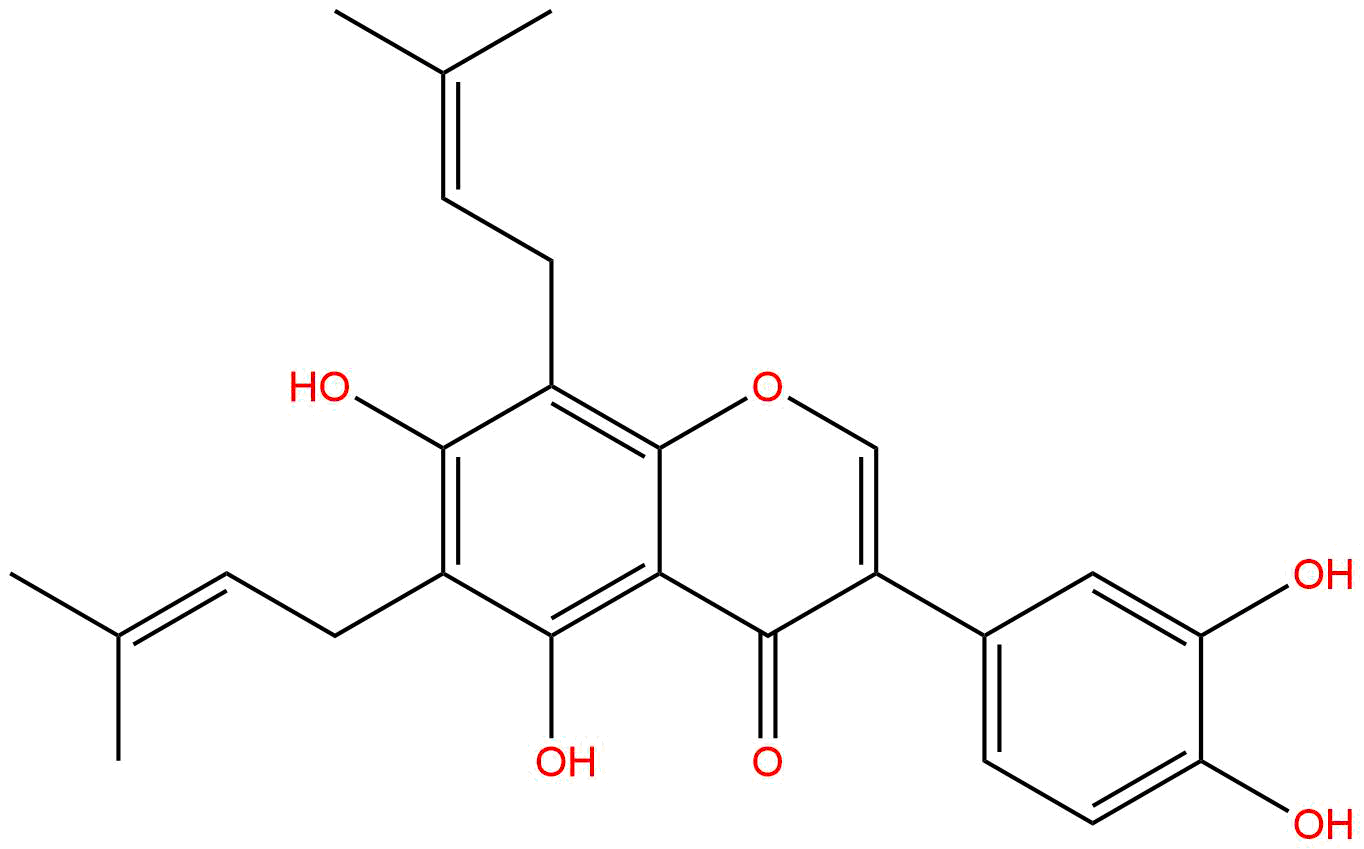


Product name: 6,8-Diprenylorobol
Synonym name:
Catalogue No.: SBP02466
Cas No.: 66777-70-6
Formula: C25H26O6
Mol Weight: 422.477
Botanical Source:
Physical Description: Yellow powder
Type of Compound: Xanthones
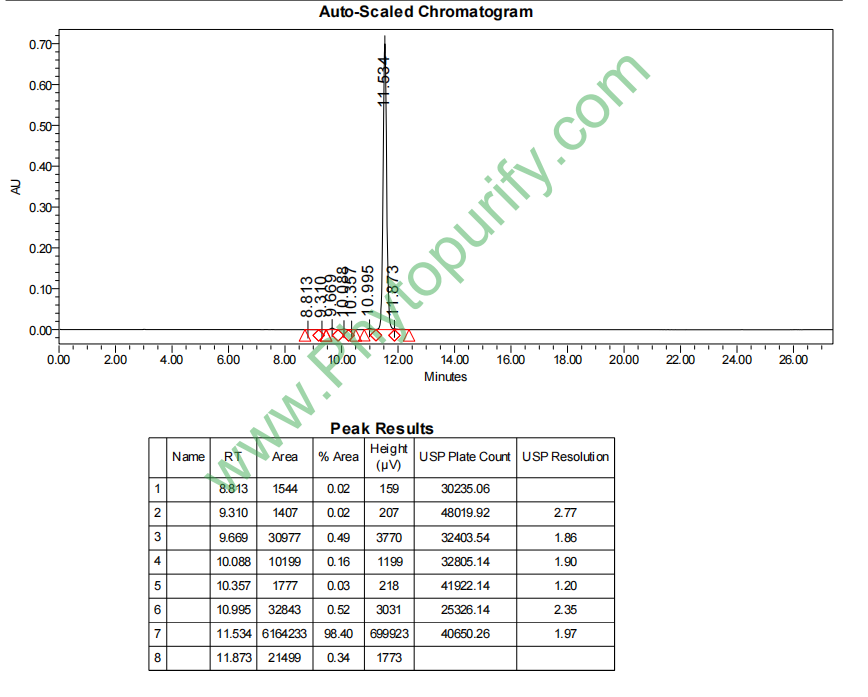
Purity: 95%~99%
Analysis Method: HPLC-DAD or/and HPLC-ELSD
Identification Method: Mass, NMR
Packing: Brown vial or HDPE plastic bottle
The product could be supplied from milligrams to grams. Inquire for bulk scale.
We provide solution to improve the water-solubility of compounds, thereby facilitating the variety of activity tests and clinic uses.
For Reference Standard and R&D, Not for Human Use Directly.
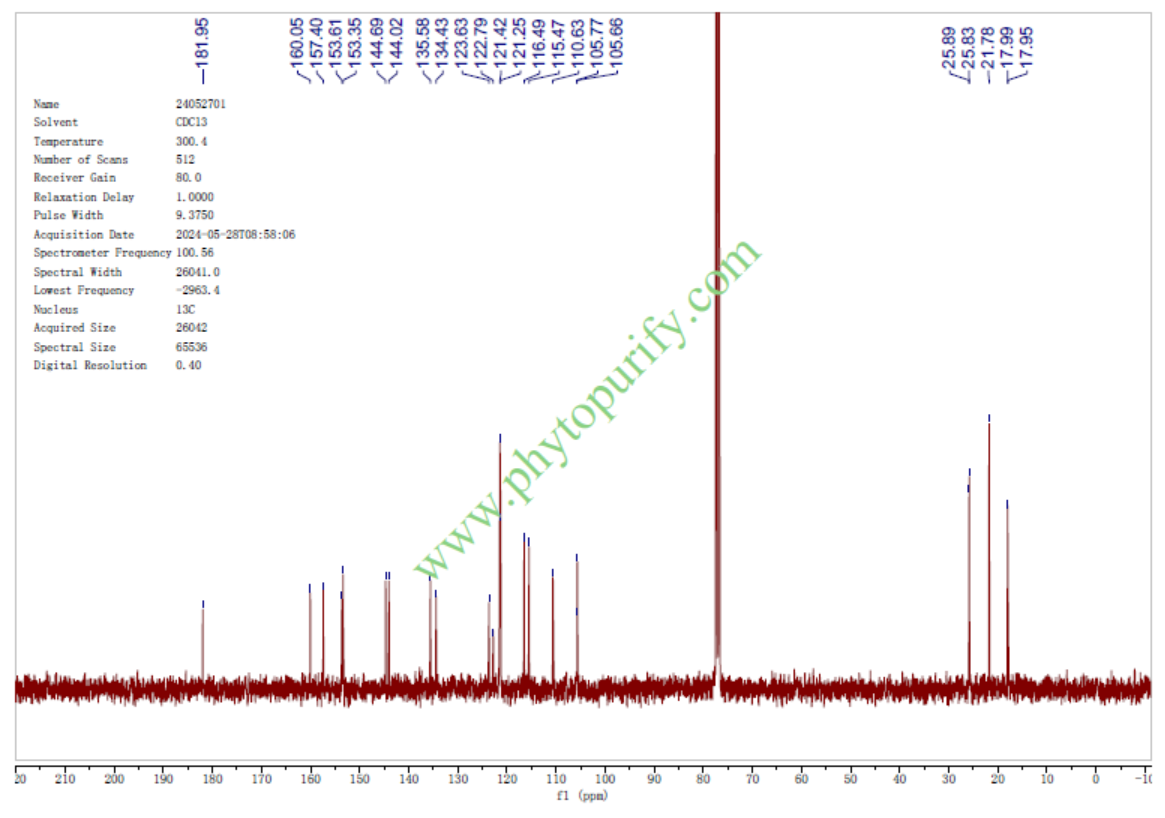
NMR of 6,8-Diprenylorobol
HPLC of 6,8-Diprenylorobol
Storage conditions:Short-term storage at 2~8℃, long-term storage at -20 ~ -80℃
101.4800
4.0000
3.5000
Low
Unknown
Unknown
Unknown
Unknown
Unknown
Unknown
Unknown
6,8-Diprenylorobol is a naturally occurring flavonoid compound that has received widespread attention in the field of natural product pharmacology in recent years due to its unique structural characteristics and diverse biological activities. As a typical diisoprenyl modified coumarin, 6,8-diisoprenyl coumarin not only exhibits significant antioxidant, anti-inflammatory, and anti-tumor activities, but also shows potential therapeutic value in various pathological states such as metabolic diseases and neurodegenerative diseases. This article will systematically review the chemical structure, sources, pharmacological activity, mechanism of action, and pharmacological evaluation of the compound, aiming to provide theoretical basis and research direction for its further drug development and clinical application.
The molecular formula of 6,8-diisoprenyl coumarin is C28H30O6, with a molecular weight of 426.47. Its structure is based on the orobol skeleton, with one isoprenyl side chain introduced at each of the 6th and 8th positions. This diisoprenyl modification significantly affects its hydrophobicity and biological activity. The LogP value of this compound is about 4.0, indicating that it has good lipid solubility, which is beneficial for cell membrane penetration, but may also affect its water solubility and bioavailability.
Its polar surface area (TPSA) is 101.48 Å ² and the number of hydrogen bond acceptors is 6, indicating that its molecule has certain polarity and hydrogen bonding ability, which may affect its binding affinity with biological targets. According to current calculations, it is predicted that the compound has low blood-brain barrier permeability, suggesting that its direct role in central nervous system diseases may be limited. There is currently no clear data on safety indicators such as hepatotoxicity, cardiotoxicity, and hERG channel inhibition, and further in vitro and in vivo experimental verification is needed.
6,8-diisoprenyl coumarin is mainly found in leguminous plants, especially in the roots and stems of certain plants in the Genista and Medicago genera. Although its content is not as abundant as mainstream flavonoids, it has become a focus of natural product research due to its unique biological activity.
Extraction is usually carried out using organic solvent extraction methods, such as ethanol or methanol extraction, combined with ultrasound assisted extraction or reflux extraction to improve efficiency. Subsequently, high-purity 6,8-diisoprenyl coumarin was obtained through separation and purification techniques such as liquid-liquid distribution, silica gel column chromatography, and high-performance liquid chromatography (HPLC). In recent years, supercritical fluid extraction and membrane separation techniques have also been attempted to be applied to the extraction of this compound in order to improve yield and purity while reducing the use of organic solvents.
6,8-diisoprenyl coumarin exhibits significant free radical scavenging ability and can effectively inhibit free radical generation in vitro models such as DPPH and ABTS. Its antioxidant effect is mainly attributed to the electron donor effect of the phenolic hydroxyl and isopentenyl side chains of the flavonoid skeleton, which can stabilize free radicals and reduce oxidative stress-related cell damage.
Multiple in vitro cell model studies have shown that 6,8-diisoprenyl coumarin can inhibit the production of inflammatory mediators such as tumor necrosis factor - α (TNF - α), interleukin-6 (IL-6), and nitric oxide (NO). The mechanism involves inhibition of the nuclear factor kappa B (NF - κ B) signaling pathway, reduction of pro-inflammatory gene expression, and alleviation of inflammatory response.
The compound showed cell proliferation inhibition in a variety of tumor cell lines, including breast cancer, liver cancer and colon cancer cells. Research has shown that 6,8-diisoprenyl coumarin can induce cell cycle arrest and promote apoptosis, with mechanisms involving mitochondrial pathway activation and regulation of apoptosis related proteins. In addition, it also has a certain inhibitory effect on the migration and invasion ability of tumor cells, indicating potential anti metastatic activity.
Preliminary research suggests that 6,8-diisoprenyl coumarin may improve metabolic syndrome related indicators by regulating lipid metabolism and insulin signaling pathways. It can regulate adipocyte differentiation and inflammatory status, showing the potential of treating obesity and type 2 diabetes.
Although the permeability of the blood-brain barrier is low, 6,8-diisoprenyl coumarin exhibits certain neuroprotective effects in neurodegenerative disease models by regulating peripheral inflammatory responses and oxidative stress. The specific mechanism of action and clinical significance still need to be further studied.
The biological activity of 6,8-diisoprenyl coumarin is closely related to its multi-target action. The main mechanisms of action include:
At present, there is a lack of high-throughput target screening and structural biology analysis for this compound. Future research needs to combine proteomics and molecular docking techniques to clarify its key targets and action network.
From the perspective of pharmacological parameters, 6,8-diisoprenyl coumarin has high lipid solubility (LogP=4.0), which facilitates cell membrane penetration, but may lead to insufficient water solubility, affecting oral absorption and bioavailability. The TPSA is 101.48 Å ², which is within an acceptable range, but the high number of hydrogen bond acceptors (6) may limit its membrane permeability.
The calculation prediction shows that its blood-brain barrier permeability is low, which limits its application in central nervous system diseases. In terms of safety, there is no clear data on liver toxicity, cardiac toxicity, and hERG channel inhibition, and a systematic evaluation is needed through in vitro cytotoxicity tests and animal experiments.
Pharmacokinetic studies are still in their early stages, and preliminary in vivo experiments have shown that the plasma concentration of this compound is low after oral administration, which may lead to first pass effects or faster metabolic rates. The metabolic pathway is speculated to mainly generate various water-soluble metabolites through the phase I and phase II enzyme systems of the liver. Detailed pharmacokinetic and pharmacokinetic studies are needed in the future to optimize dosing regimens and dosage form design.
Given the multiple activities of 6,8-diisoprenyl coumarin in anti-inflammatory, anti-tumor, and metabolic regulation, its potential as a candidate drug cannot be ignored. Future research directions should focus on:
In addition, with the development of multi omics technologies, combined with genomics, metabolomics and other methods, revealing the network of action and personalized therapeutic potential of 6,8-diisoprenyl coumarin will provide a solid foundation for its clinical translation.
6,8-diisoprenyl coumarin, as a structurally unique natural flavonoid compound, exhibits rich pharmacological activity and broad application prospects. Although the current understanding of its mechanism of action and pharmacokinetics is not comprehensive, existing research has laid the foundation for it as a new natural drug candidate. In the future, through interdisciplinary collaboration, in-depth analysis of its molecular targets, optimization of drug properties, and systematic preclinical research, 6,8-diisoprenyl coumarin is expected to achieve clinical translation in anti-inflammatory, anti-tumor, and metabolic disease fields, becoming an important breakthrough in the development of natural product drugs.
