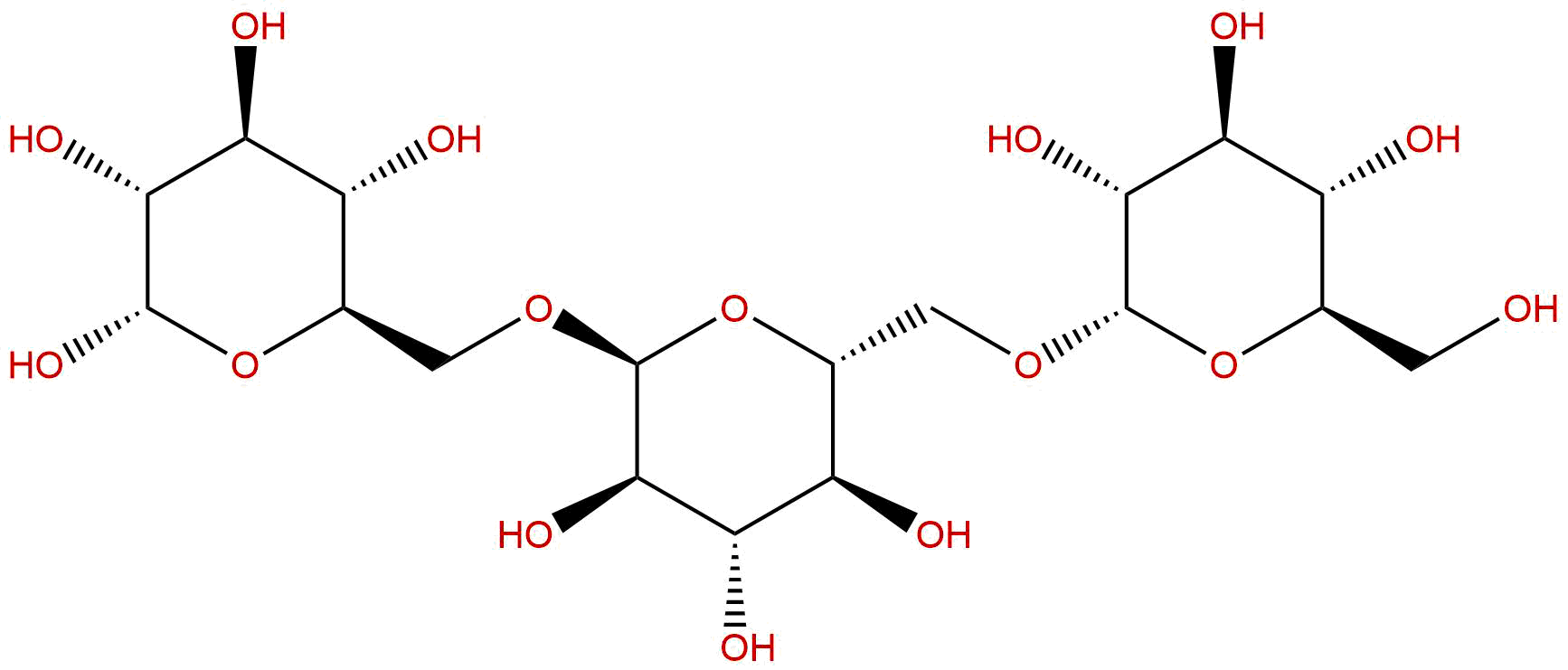


Product name: Isomaltotriose
Synonym name: 6-α-Isomaltosylglucose
Catalogue No.: BP2339
Cas No.: 3371-50-4
Formula: C18H32O16
Mol Weight: 504.438
Botanical Source:
Type of Compound: Oligose
Purity: 95%~99%
Analysis Method: HPLC-DAD or/and HPLC-ELSD
Identification Method: Mass, NMR
Packing: Brown vial or HDPE plastic bottle
Storage: Store in a well closed container, protected from air and light. Put into refrigerate or freeze for long term storage.
Whenever possible, you should prepare and use solutions on the same day. However, if you need to make up stock solutions in advance, we recommend that you store the solution as aliquots in tightly sealed vials at -20℃. Generally, these will be useable for up to two weeks.
The product could be supplied from milligrams to grams
Inquire for bulk scale.
For Reference Standard and R&D, Not for Human Use Directly.
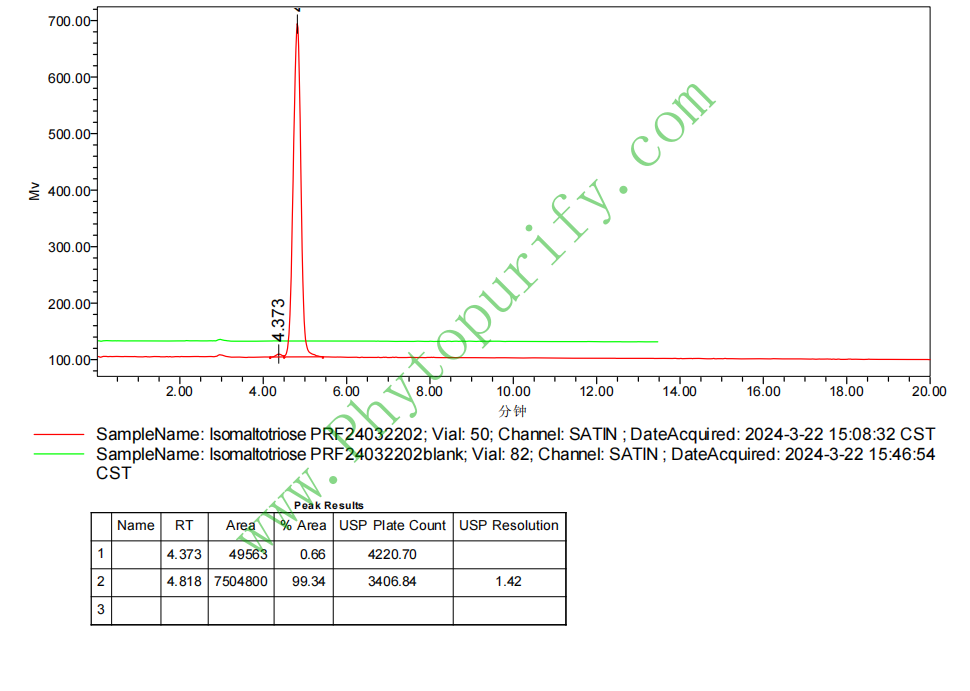
HPLC of Isomaltotriose
Storage conditions:Short-term storage at 2~8℃, long-term storage at -20 ~ -80℃
268.6800
-3.2684
-3.2678
126.4288
.3813
.1693
Low
13.1706
4.7183
Yes
No
No
No
No
No
0.0
Yes
Yes
Yes
Yes
In the grand map of human health and disease research, the gut microbiota and its interactions with hosts have become one of the core topics. The intestine is not only the main site for digestion and absorption, but also the largest immune organ in the human body. Maintaining its homeostasis has profound significance for the prevention and treatment of inflammatory bowel disease (IBD), metabolic syndrome, autoimmune diseases, and even neurological diseases. In this context, functional oligosaccharides, as an important class of prebiotics, have attracted much attention due to their ability to selectively stimulate the growth of beneficial gut microbiota and regulate host immune responses. Isomaltotriose, as a trisaccharide composed of α -1,6 glycosidic bonds, is a representative molecule in this field that combines fundamental research value and potential application prospects.
The chemical structure of isomaltotriose is O - α - D-glucopyranosyl - (1 → 6) - O - α - D-glucopyranosyl - (1 → 6) - D-glucopyranosyl, and its CAS registration number is 3371-50-4. It naturally exists in fermented foods such as honey, soy sauce, and sake, and can also be prepared by enzymatic conversion from starch or sucrose. Unlike the common straight chain maltotriose (linked by alpha-1,4 glycosidic bonds), the unique alpha-1,6 glycosidic bond of isomaltotriose gives it higher resistance to digestive enzyme hydrolysis, allowing it to reach the large intestine smoothly and be fermented and utilized by specific intestinal microorganisms. This structural characteristic endows it with the potential as a prebiotic, but its biological functions extend far beyond that.
In recent years, with the deepening development of glycobiology and immunonutrition, researchers have found that isomaltotriose and its homologs (such as isomaltooligosaccharides) can not only regulate the composition of intestinal microbiota, promote the proliferation of beneficial bacteria such as bifidobacteria and lactobacilli, but also directly or indirectly act on the intestinal immune system. Specifically, it can exert anti-inflammatory and immune stability maintenance effects by regulating pattern recognition receptors (such as TLR4, NOD2), influencing the expression of key inflammatory factors (such as TNF, TGFB1, IL10), maintaining intestinal barrier function (such as MUC2), and regulating T cell differentiation (such as FOXP3) in multiple dimensions. These findings elevate the cognitive level of isomaltotriose from a simple "prebiotic substrate" to a "gut immunomodulatory agent".
This article aims to systematically review the chemical and physical properties, preparation sources, pharmacological activities, molecular mechanisms of action, pharmacological evaluation, and clinical application prospects of isomaltotriose in the field of intestinal health. By integrating existing research results, this article aims to outline a panoramic map of this natural product from basic chemistry to translational medicine, providing a solid theoretical basis for subsequent functional food development, nutritional intervention strategy design, and potential drug research and development.
The chemical structure of isomaltotriose is the basis of its biological function. At the molecular level, it is composed of three D-glucopyranose units connected by two consecutive alpha-1,6 glycosidic bonds. This connection method is completely different from the alpha-1,4 bonds in starch or glycogen and the beta-1,4 bonds in cellulose. α-1, The presence of 6 glycosidic bonds gives rise to the characteristic of "branching points" in the molecular chain. Although isomaltotriose itself is a linear molecule, its conformation is more flexible and its steric hindrance is greater, which directly affects its binding ability with digestive enzymes such as alpha amylase and sucrase isomaltase complexes.
In terms of physicochemical properties, isomaltotriose exhibits typical oligosaccharide characteristics. Its molecular weight is 504.44 Da, belonging to the category of small molecule carbohydrates. The calculated lipid water partition coefficient (LogP) is -3.27, indicating that it has extremely high hydrophilicity and is almost insoluble in lipid solvents. The topologically polar surface area (TPSA) is as high as 268.68 Å ², reflecting the presence of a large number of hydroxyl groups on the molecular surface, which is highly consistent with its strong water solubility (126.43 mg/mL). This high water solubility means that it can quickly dissolve and evenly distribute in the gastrointestinal tract, which is beneficial for contact with gut microbiota and host cells.
From a stability perspective, isomaltotriose is relatively stable in acidic environments (such as gastric juice) and high temperature conditions, and is not easily hydrolyzed. However, the presence of its reducing end gives it a certain degree of reducibility, and under strong alkaline conditions, Maillard reaction or isomerization may occur. It is worth noting that the sweetness of isomaltotriose is about 30-40% of sucrose, and its taste is mild without any unpleasant aftertaste, which provides convenience for its application in the food industry.
Among the parameters related to drug properties, isomaltotriose exhibits extremely low blood-brain barrier penetration ability, mainly attributed to its high polarity and large molecular volume, which means that the risk of central nervous system side effects is extremely low. In addition, the hERG inhibition test result was negative, ruling out the risk of cardiac toxicity; The Ames test result is 0.0, indicating that it has no mutagenicity under standard testing conditions. These data preliminarily outline a safe molecular profile, providing favorable conditions for its subsequent development.
Isomaltotriose is not a traditional "secondary metabolite of plants", but a functional oligosaccharide widely present in natural fermentation products. Its natural sources mainly include honey, sake, soy sauce, miso, and certain fermented dairy products. In these matrices, isomaltriosaccharides are usually produced by glucanase or transglycosidase produced by microorganisms (such as Leuconostoc, Aspergillus, and Bacillus) acting on sucrose or starch substrates.
However, directly extracting isomaltotriose from naturally fermented foods is inefficient, costly, and difficult to obtain high-purity products. Therefore, in industry, enzymatic synthesis or biotransformation strategies are mainly used for large-scale production. The most classic preparation route is to use dextran sucrase produced by Leuconostoc mesenteroides NRRL B-512 strain, take sucrose as substrate, control reaction conditions (such as temperature, pH, substrate concentration), directionally synthesize oligosaccharide mixture with α -1,6 bond as the main component, and then purify it through chromatographic separation technology (such as activated carbon column chromatography, ion exchange chromatography, gel filtration chromatography) to obtain high-purity isomaltriosaccharide.
In recent years, with the development of enzyme engineering and immobilized enzyme technology, researchers have developed more efficient preparation processes. For example, using recombinant expression of glucan sucrase combined with membrane reactor technology can achieve continuous production and improve product yield. In addition, the application of simulated moving bed chromatography (SMB) enables large-scale separation and purification, with product purity reaching over 95%. It is worth noting that the preparation process of isomaltotriose usually involves the generation of by-products such as glucose, fructose, isomaltose, isomaltotriose, etc. Therefore, precise separation and purification steps are key to ensuring product quality.
From a sustainability perspective, the enzymatic synthesis route using sucrose or starch hydrolysate as raw materials conforms to the principles of green chemistry, with mild reaction conditions, controllable by-products, and low energy consumption. This makes it feasible for large-scale commercial production of isomaltotriose as a functional food ingredient.
The pharmacological activity research of isomaltotriose mainly focuses on its functions as a prebiotic and intestinal immune modulator. Despite its simple structure, in vitro and in vivo studies have revealed its multifaceted biological effects.
The most classic biological function of isomaltotriose is its ability to selectively promote the proliferation of beneficial gut microbiota. In vitro fermentation experiments have shown that isomaltotriose can be efficiently utilized by Bifidobacterium spp. and Lactobacillus spp. to produce short chain fatty acids (SCFAs), especially butyric acid, propionic acid, and acetic acid. These SCFAs are not only important energy sources for intestinal epithelial cells, but also lower intestinal pH and inhibit the growth of pathogens such as Salmonella and Clostridium perfringens. Animal experiments further confirmed that dietary supplementation with isomaltotriose can significantly increase the relative abundance of bifidobacteria in the cecum of mice, while reducing the proportion of potentially harmful bacteria such as Desulfovibrio.
In intestinal inflammation models, isomaltotriose exhibits significant anti-inflammatory potential. In a mouse colitis model induced by dextran sulfate sodium (DSS), oral administration of isomaltotriose can reduce weight loss, disease activity index (DAI) score, and colonic tissue pathological damage. Mechanistically, it can downregulate the expression of pro-inflammatory cytokines (such as TNF - α, IL-6, IL-1 β), while upregulating the levels of anti-inflammatory cytokines (such as IL-10, TGF - β 1). This immunomodulatory effect partially depends on its regulation of gut microbiota, but there is also evidence to suggest that isomaltotriose can directly act on host immune cells.
The integrity of the intestinal barrier is the first line of defense against the invasion of endotoxins and pathogens. Isomaltotriose has been shown to enhance intestinal epithelial barrier function. In the Caco-2 cell monolayer model, treatment with isomaltotriose can increase the transepithelial electrical resistance (TEER) value and reduce cell paracellular permeability. The mechanism may be related to the upregulation of tight junction proteins (such as Occludin, Claudin-1, ZO-1) and mucin MUC2 expression. MUC2 is the main mucin secreted by intestinal goblet cells, forming an important backbone of the mucus layer. Upregulation of its expression helps to enhance physical barriers and limit direct contact between bacteria and epithelial cells.
In addition to intestinal health, isomaltotriose also has a certain impact on host metabolism. In a high-fat diet induced obese mouse model, supplementation with isomaltotriose can reduce weight gain, improve glucose tolerance, and lower serum endotoxin levels. These effects may be related to SCFAs mediated intestinal hormone secretion (such as GLP-1, PYY) and energy metabolism regulation.
The biological effects of isomaltotriose cannot be explained by a single mechanism, but involve a complex interaction network between gut microbiota, host immune cells, and intestinal epithelial cells. The following systematically explains its mechanism of action at the molecular target level.
Toll like receptor 4 (TLR4) is a key receptor for recognizing lipopolysaccharides (LPS), and its overactivation is closely related to intestinal inflammation. Research has shown that isomaltotriose can indirectly inhibit the TLR4 signaling pathway by reducing the proportion of Gram negative bacteria in the gut and lowering LPS levels. In addition, in vitro experiments suggest that isomaltotriose may directly bind to TLR4/MD2 complex, competitively inhibiting LPS induced NF - κ B activation, thereby reducing the release of pro-inflammatory factors such as TNF - α.
Nucleotide binding oligomerization domain protein 2 (NOD2) is an intracellular pattern recognition receptor that recognizes the muroyl dipeptide (MDP) in bacterial peptidoglycans. NOD2 functional loss mutations are closely associated with an increased risk of Crohn's disease. Isomaltotriose has been reported to upregulate the expression of NOD2, enhance the host's immune tolerance to symbiotic bacteria, and promote the secretion of antimicrobial peptides (such as defense factors) to maintain intestinal homeostasis.
Tumor necrosis factor (TNF) is the core driving factor of intestinal inflammation. Isomaltotriose significantly reduces the transcription and secretion of TNF - α by inhibiting the NF - κ B and MAPK signaling pathways. Meanwhile, it can upregulate the expression of transforming growth factor beta 1 (TGFB1) and interleukin 10 (IL10). TGF - β 1 plays a key role in regulating the differentiation of T cells (Tregs) and intestinal immune tolerance, while IL-10 is a recognized anti-inflammatory cytokine that can inhibit the overactivation of macrophages and dendritic cells.
Forkhead box protein P3 (FOXP3) is a key transcription factor that regulates T cells (Tregs). Animal experiments have shown that feeding with isomaltotriose can increase the proportion of FOXP3+Treg cells in the intestinal lamina propria. This effect may be related to SCFAs (especially butyric acid) promoting FOXP3 gene expression by inhibiting histone deacetylase (HDAC) activity. The expansion of Treg cells helps to suppress the excessive response of effector T cells (such as Th1, Th17), thereby alleviating intestinal inflammation.
Mucin 2 (MUC2) is the main component of the intestinal mucus layer. Isomaltotriose activates the STAT3 and PI3K/Akt signaling pathways, promotes MUC2 gene transcription, and enhances mucus layer thickness and barrier function.
X-box binding protein 1 (XBP1) is a key regulatory factor in endoplasmic reticulum (ER) stress response. In intestinal goblet cells, the absence of XBP1 can lead to excessive activation of ER stress and cell apoptosis, thereby disrupting barrier function. Isomaltotriose has been reported to moderately upregulate XBP1 expression, alleviate ER stress, and protect goblet cell function.
The autophagy related gene 16 like protein 1 (ATG16L1) is a key component of the autophagy process, and its polymorphism is associated with susceptibility to Crohn's disease. Isomaltotriose may enhance autophagy activity mediated by ATG16L1 by activating the AMPK pathway, promoting the clearance of intracellular pathogens and damaged organelles, and maintaining epithelial cell homeostasis.
Interleukin-23 receptor (IL23R) is a key receptor for the maintenance and function of Th17 cells. IL-17 secreted by Th17 cells plays a dual role in intestinal inflammation, but is typically pathogenic in IBD. Isomaltotriose reduces IL-17-mediated tissue damage by downregulating the expression of IL23R, inhibiting the expansion and effector function of Th17 cells.
In summary, isomaltotriose maintains intestinal homeostasis through a multi-target and multi pathway action network, synergistically regulating microbiota, maintaining barriers, innate immunity, and adaptive immunity from multiple dimensions. This "multi-target" mode of action gives it a unique advantage in treating complex intestinal diseases.
To push isomaltotriose from functional food ingredients to drug development, a systematic evaluation of its pharmacological properties is required. The following analysis will focus on pharmacokinetics, safety, and formulation feasibility.
The ADME characteristics of isomaltotriose are mainly determined by its chemical structure. Due to the presence of alpha-1,6 glycosidic bonds, human digestive enzymes such as alpha amylase and sucrase isomaltase have extremely low hydrolysis efficiency. Therefore, after oral administration, most of the isomaltotriose can pass through the small intestine in its intact form and reach the large intestine. In the large intestine, it is fermented and utilized by the gut microbiota to produce SCFAs and gases. Only a very small amount (usually<5%) may be absorbed into the bloodstream through passive diffusion or paracellular pathways. Once it enters the bloodstream, due to its high polarity and low fat solubility, isomaltotriose is mainly distributed in the extracellular fluid, making it difficult to penetrate the cell membrane or blood-brain barrier. It is mainly eliminated through the kidneys in its original form or through liver metabolism.
The existing toxicological data supports that isomaltotriose has good safety. The acute toxicity test showed that its LD50 value was much higher than the clinically expected dose. In the subchronic toxicity test, no significant toxic reactions were observed in rats fed continuously for 90 days. The results of genetic toxicity tests (Ames test, micronucleus test) were all negative. In addition, its low blood-brain barrier penetration and lack of hERG inhibitory activity further reduce the risk of neurological and cardiac toxicity. It is worth noting that high-dose intake may cause gastrointestinal discomfort such as bloating and diarrhea, which is consistent with the commonality of all indigestible oligosaccharides and can be controlled through dose adjustment.
The strong water solubility and good stability of isomaltotriose make it suitable for development as oral formulations, such as powders, granules, tablets, or oral liquids. Its taste is mild and easy to mask. However, as a prebiotic, its "bioavailability" does not refer to blood drug concentration, but rather to its efficiency in reaching the colon and being utilized by the microbiota. Therefore, formulation design should focus on how to protect it from damage by stomach acid and digestive enzymes, and ensure its effective release in the large intestine. Enteric coating or sustained-release technology may be a feasible strategy to improve its colon targeting.
Overall, isomaltotriose has a good pharmacological basis: high safety, oral feasibility, simple formulation process, and clear target. However, as a highly polar molecule, its oral bioavailability (measured by systemic absorption) is extremely low, which determines that its indications should focus on local intestinal diseases (such as IBD, irritable bowel syndrome, antibiotic associated diarrhea) rather than systemic diseases. In addition, its mechanism of action depends on the gut microbiota, and individual differences in microbiota may lead to heterogeneity in therapeutic efficacy, which is an issue that needs to be addressed in future clinical translation.
Based on the pharmacological activity and safety data mentioned above, isomaltotriose has broad clinical application prospects in the field of intestinal health, but still faces many challenges.
Crohn's disease and ulcerative colitis are typical chronic intestinal inflammatory diseases. Although existing treatment methods (such as anti TNF monoclonal antibodies and immunosuppressants) are effective, there are problems such as limited response rates and significant side effects. Isomaltotriose is expected to serve as an adjuvant therapy for IBD through multiple mechanisms such as regulating microbiota, enhancing barriers, and inducing Treg cells. Preliminary preclinical studies have shown positive signals, but high-quality randomized controlled trials (RCTs) are still needed to validate its efficacy and safety in patients.
IBS is characterized by abdominal pain, bloating, and changes in bowel habits, often accompanied by dysbiosis of the gut microbiota and low-grade inflammation. The prebiotic effect and anti-inflammatory activity of isomaltotriose may help alleviate IBS symptoms. However, some IBS patients (especially those with diarrhea type) are sensitive to fermentable oligosaccharides, disaccharides, monosaccharides, and polyols (FODMAPs), while isomaltotriose belongs to the low FODMAP component and theoretically has good tolerance, but still needs individualized evaluation.
With the widespread use of immune checkpoint inhibitors (such as anti-PD-1/PD-L1 antibodies) in tumor treatment, immune related adverse events (irAE), especially colitis, have become a clinical management challenge. The immunomodulatory properties of isomaltotriose make it promising for the prevention or alleviation of iatrogenic intestinal inflammation.
Nonalcoholic fatty liver disease (NAFLD), type 2 diabetes and other metabolic diseases are often accompanied by "intestinal leakage" and endotoxemia. Isomaltotriose may have an auxiliary effect on improving metabolic disorders by repairing the intestinal barrier and reducing the entry of LPS into the bloodstream.
Despite its promising prospects, the clinical translation of isomaltotriose still faces the following challenges: firstly, its effect depends on the host microbiota, and individual differences in microbiota may lead to inconsistent therapeutic effects. In the future, precise nutritional strategies based on microbiota typing need to be developed. Secondly, as oligosaccharides, their patent protection space is limited, and commercial development needs to be combined with the positioning of functional foods. Finally, more mechanistic research is needed to elucidate the molecular details of its direct interaction with host immune cells, as well as safety data for long-term use.
Looking ahead to the future, with the development of synthetic biology and enzyme engineering, it is expected to develop structurally optimized isomaltotriose derivatives to enhance their targeting and efficacy. At the same time, by combining multi omics technologies such as metagenomics and metabolomics, a deep analysis of the network of microbiota host interactions will be conducted, laying a scientific foundation for precise intervention strategies based on isomaltotriose.
Isomaltotriose, a seemingly simple trisaccharide molecule, actually contains complex biological connotations. From a chemical structure perspective, α-1, The 6 glycosidic bonds endow it with anti digestive and prebiotic properties; From the perspective of pharmacological activity, it constructs a three-dimensional regulatory network from microbiota to immunity, from barrier to metabolism by regulating a series of key targets such as TLR4, NOD2, TNF, TGFB1, IL10, FOXP3, MUC2, XBP1, ATG16L1, IL23R, etc. Its excellent safety, low toxicity, and oral feasibility demonstrate unique translational potential in the field of intestinal health.
However, there is still a long way to go from laboratory discoveries to clinical applications. We need to be aware that isomaltotriose is not a panacea, and its efficacy depends on the host state, microbial composition, and disease background. Future research should focus on precise and personalized applications, and explore their synergistic effects with other prebiotics, probiotics, or drugs. As researchers in the field of natural product pharmacology, we have reason to believe that as our understanding of the gut microbiota deepens, the ancient and novel molecule of isomaltotriose will play a more important role in maintaining human health.
