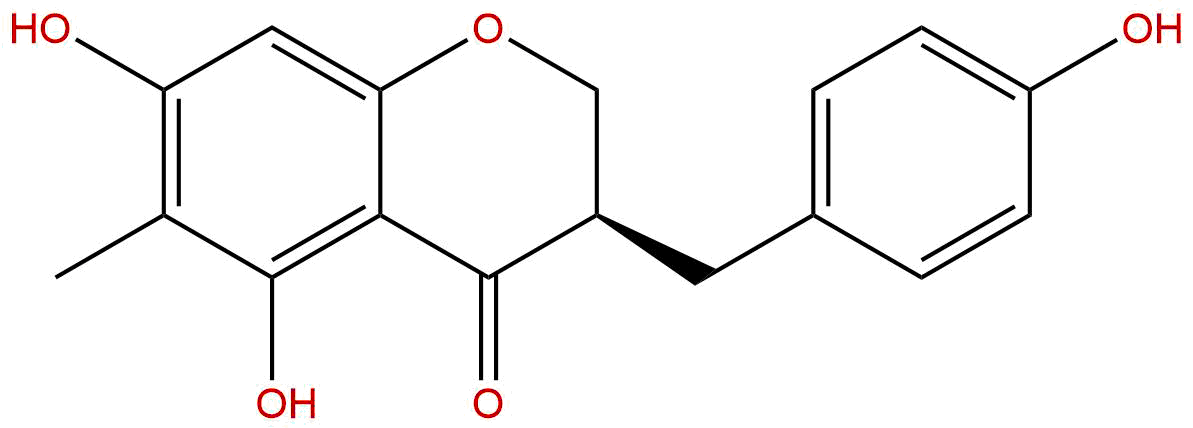
(3R) -5,7-Dihydroxy-6-methyl-3- (4 '- hydroxybenzyl) chroman-4-one: Pharmacological research progress of a natural isoflavone compound
Introduction/Overview
Natural products, as an important source of drug discovery, play an irreplaceable role in human health maintenance and disease treatment. Among numerous natural active molecules, isoflavone compounds have attracted much attention due to their unique chemical structures and extensive biological activities. This type of compound mainly exists in leguminous plants and has various pharmacological activities such as estrogen like effects, antioxidant, anti-inflammatory, anti-tumor, etc. It is one of the hot topics in plant chemistry and pharmacology research.
(3R)-5,7-Dihydroxy-6-methyl-3-(4'-hydroxybenzyl)chroman-4-one, As a natural product with a typical isoflavone skeleton, its chemical structure contains rich biological information. This compound belongs to the class of flavanone derivatives, which contain active functional groups such as phenolic hydroxyl and carbonyl groups in their molecules, providing a structural basis for their interaction with biomolecules. In recent years, with the continuous deepening of research on the active ingredients of natural products, this compound has gradually entered the field of researchers due to its potential therapeutic value for estrogen related diseases.
From a taxonomic perspective, this compound belongs to a special subclass of isoflavones, characterized by a 4 '- hydroxybenzyl substituent attached to the C-ring at position 3. This structural feature distinguishes it from common isoflavones such as daidzein and genistein. This unique substitution pattern may endow it with special biological activity and target selectivity. Preliminary pharmacological studies have shown that this compound can interact with estrogen receptors (ER) and also regulate key targets such as sex hormone binding globulin (SHBG) and aromatase (CYP19A1), suggesting its potential application value in the treatment of estrogen related diseases.
This article will systematically review the research status of this natural product from multiple dimensions, including chemical structure and physicochemical properties, plant sources and extraction methods, pharmacological activity research, mechanism of action and molecular targets, drug evaluation and pharmacokinetics, clinical application prospects and prospects, in order to provide theoretical basis and reference for subsequent drug development and clinical translation.
Chemical structure and physicochemical properties
Chemical structure analysis
(3R)-5,7-Dihydroxy-6-methyl-3-(4'-hydroxybenzyl)chroman-4-one The chemical structure belongs to the flavanone skeleton, and its core structure is 2,3-dihydrochroman-4-one, where the C-ring is a saturated pyran ring and the 4-position is a carbonyl group. The systematic naming of this compound clearly reveals its structural features: there is a hydroxyl substitution at each of the C5 and C7 positions, a methyl substitution at the C6 position, a 4 '- hydroxybenzyl side chain is connected at the C3 position, and the C3 position has a chiral center with an R configuration.
From the analysis of structural features, the compound has the following key structural units:
1. A ring Having a resorcinol structure, the C5 and C7 hydroxyl groups form a typical meta phenolic hydroxyl arrangement, which facilitates the formation of intramolecular hydrogen bonds and affects the polarity and solubility of the compound.
2. B ring Through the benzyl linkage at the C3 position, a 4 '- hydroxyphenyl substitution is formed, which is a structural feature different from the B-ring linkage of classical isoflavones and may affect their binding mode with receptors.
3. C ring The saturated pyranone ring can form intramolecular hydrogen bonds between the 4-carbonyl group and the C5 hydroxyl group, enhancing the stability of the structure. The chiral center at the C3 position determines the stereoconfiguration of the molecule and may have a significant impact on its biological activity.
The molecular formula of this compound is C17H16O5, with a molecular weight of 300.3100 Da. The phenolic hydroxyl and carbonyl groups in its structure give it various chemical reactivity, including redox reactions, coordination reactions, and hydrogen bond formation, which provide a chemical basis for its interaction with biological targets.
Physical and chemical property parameters
According to computational chemistry and experimental data, the compound exhibits the following key physicochemical properties:
Lipid water partition coefficient (LogP): 2.7127. This value indicates that the compound has moderate lipid solubility, which allows it to dissolve in lipid environments and has a certain degree of water solubility, which is beneficial for absorption and distribution in living organisms. LogP values within the range of 2-3 are generally considered the ideal lipid water distribution equilibrium range for drug molecules.
Topological Polarity Surface Area (TPSA): 86.9900 Å ². TPSA is an important parameter for measuring the polarity and hydrogen bonding ability of compounds. The TPSA value of this compound indicates that it contains multiple polar groups (phenolic hydroxyl and carbonyl) and has strong hydrogen bonding donor and acceptor abilities. This characteristic is beneficial for forming hydrogen bonding interactions with target proteins, but it may also affect their transmembrane transport ability.
Water solubility:0.2152 mg/mL。 This compound has low solubility in water and belongs to the category of slightly soluble compounds. This property may limit its oral bioavailability and needs to be improved through formulation techniques or structural modifications.
Blood-brain barrier permeability: Low. According to the predictive model, the compound is not easily able to cross the blood-brain barrier, which to some extent limits its pharmacological effects related to the central nervous system, but also reduces the potential risk of neurotoxicity.
HERG inhibition: Negative. HERG potassium channel inhibition is an important indicator of drug cardiac toxicity, and this compound has no inhibitory effect on hERG channels, indicating its good cardiac safety.
Ames test: 0.6. The Ames test results indicate that the compound has a low risk of genetic toxicity, providing a safety basis for subsequent drug development.
Based on the above physicochemical properties, this compound has the basic conditions as a lead compound, but its poor water solubility and low blood-brain barrier permeability require attention and optimization in subsequent drug development.
Plant sources and extraction methods
Plant-based
(3R)-5,7-Dihydroxy-6-methyl-3-(4'-hydroxybenzyl)chroman-4-one Originally isolated from leguminous plants, it mainly exists in certain specific medicinal plants. According to existing literature reports, this compound has been found in the following plants:
-
Licorice plants Glycyrrhiza uralensis and its related species are important sources of flavonoids. The active ingredients in licorice include glycyrrhizin, isoglycyrrhizin, etc., and (3R) -5,7-Dihydroxy-6-methyl-3- (4 '- hydroxybenzyl) chroman-4-one, as a trace component, may have unique biological activity.
-
Astragalus plants Plants such as Astragalus membranaceus also contain various isoflavone compounds, which may exist as minor components.
-
Other leguminous plants Some leguminous plants such as Pueraria lobata and Trifolium pratense may also contain this compound or its structural analogues.
It is worth noting that the content of this compound in plants is usually low and belongs to trace components, which poses certain challenges for its isolation and purification. Meanwhile, different plant sources, production areas, harvest seasons, and processing methods can all affect the content and composition of this compound.
extraction method
Researchers have developed various methods for extracting this compound, including:
1. Traditional solvent extraction method
The traditional solvent extraction method is one of the most commonly used methods. Due to the presence of phenolic hydroxyl groups in the compound and its polarity, polar solvents are often used for extraction. Common solvent systems include:
-Ethanol water mixed solvent (such as 70% ethanol)
-Methanol water mixed solvent
-Ethyl acetate
-N-butanol
The extraction conditions are usually: a solid-liquid ratio of 1:10-1:20, a temperature of 40-60 ℃, an extraction time of 2-4 hours, and repeated extraction 2-3 times. This method is easy to operate and cost-effective, but the extraction efficiency is greatly affected by solvent polarity and temperature.
2. Ultrasound assisted extraction method
Ultrasound assisted extraction utilizes the cavitation and mechanical effects of ultrasound to effectively destroy plant cell walls and promote the dissolution of active ingredients. Compared with traditional methods, ultrasound assisted extraction has the advantages of short extraction time, low temperature, and high efficiency. Research has shown that under the conditions of ultrasound power of 200-400W, temperature of 40-50 ℃, and time of 30-60 minutes, the extraction rate of this compound can be significantly improved.
3. Microwave assisted extraction method
Microwave assisted extraction utilizes the penetrability and selective heating properties of microwaves to quickly and efficiently extract target compounds. This method is suitable for compounds with high polarity, and the extraction time is usually 10-30 minutes. The amount of solvent used is relatively small, making it a green and environmentally friendly extraction technique.
4. Supercritical fluid extraction method
Supercritical CO ₂ extraction is an advanced extraction technology with advantages such as no solvent residue, good selectivity, and low operating temperature. By adding entrainers such as ethanol, the extraction efficiency of the compound can be effectively improved. This method is particularly suitable for the extraction of thermosensitive compounds, but the high equipment cost limits its large-scale application.
Separation and purification methods
The crude extract obtained requires further separation and purification to obtain high-purity target compounds. Common separation and purification methods include:
1. Column chromatography
Silica gel column chromatography is the most commonly used separation method, which uses solvent systems such as chloroform methanol or petroleum ether ethyl acetate for gradient elution. In addition, polyamide column chromatography and Sephadex LH-20 gel column chromatography are also commonly used for the separation and purification of isoflavones.
2. High performance liquid chromatography method
Prepa HPLC is an effective method for obtaining high-purity compounds. By using a reverse phase C18 chromatography column with acetonitrile water or methanol water as the mobile phase and optimizing the gradient elution program, efficient separation of the compound can be achieved.
3. High speed countercurrent chromatography
High speed countercurrent chromatography is a liquid-liquid distribution chromatography technique that does not require a solid stationary phase, avoiding irreversible adsorption of the sample on the stationary phase. This method is suitable for the separation of polar compounds and has the advantages of high separation efficiency and good sample recovery rate.
Pharmacological activity research
Estrogen like activity
As an isoflavone compound, (3R) -5,7-Dihydroxy-6-methyl-3- (4 '- hydroxybenzyl) chroman-4-one's most noteworthy pharmacological activity is its estrogenic effect. Research has shown that this compound can bind to estrogen receptors (ER) and exert the effects of estrogen agonists or antagonists, depending on the target tissue and cell type.
In vitro experiments, the compound can promote the proliferation of estrogen receptor positive breast cancer cells (such as MCF-7 cells), indicating that it has estrogen agonist activity. However, compared with the classical estrogen 17 β - estradiol, its activity is relatively weak and belongs to the category of plant estrogens. It is worth noting that the selectivity of this compound towards estrogen receptor beta (ER β) may be higher than that towards estrogen receptor alpha (ER α), which gives it potential advantages in regulating specific physiological functions.
antioxidant activity
The compound molecule contains multiple phenolic hydroxyl groups, endowing it with significant antioxidant activity. Research has shown that this compound can effectively scavenge 1,1-diphenyl-2-trinitrophenylhydrazine (DPPH) free radicals, 2,2 '- bis (3-ethylbenzothiazole-6-sulfonic acid) (ABTS) cationic free radicals, and hydroxyl free radicals.
In cell models, this compound can reduce the levels of reactive oxygen species (ROS) induced by oxidative stress, protecting cells from oxidative damage. Its antioxidant mechanism may include direct clearance of free radicals, chelation of transition metal ions (such as Fe ² ⁺, Cu ² ⁺), activation of antioxidant enzyme systems (such as superoxide dismutase SOD, glutathione peroxidase GPx), etc.
anti-inflammatory activity
Inflammatory response is an important pathological process in various diseases, and this compound also exhibits certain activity in anti-inflammatory aspects. In a macrophage model stimulated by lipopolysaccharide (LPS), this compound can inhibit the production of pro-inflammatory cytokines such as tumor necrosis factor - α (TNF - α), interleukin-6 (IL-6), and interleukin-1 β (IL-1 β).
Further research suggests that the anti-inflammatory effect of this compound may be related to the inhibition of the nuclear factor kappa B (NF - κ B) signaling pathway. By inhibiting the phosphorylation and degradation of I κ B α, the nuclear translocation of NF - κ B is reduced, thereby downregulating the expression of inflammation related genes. In addition, the compound may indirectly exert anti-inflammatory effects by activating the nuclear factor E2 related factor 2 (Nrf2) pathway, enhancing the antioxidant defense system.
Antitumor activity
Preliminary studies have shown that this compound has inhibitory effects on proliferation and induces apoptosis in certain tumor cell lines. In breast cancer cells, the compound can inhibit cell proliferation, induce cell cycle arrest and apoptosis. Its anti-tumor mechanism may involve:
-Regulating the estrogen receptor signaling pathway
-Inhibition of cyclin dependent kinase (CDK) activity
-Activate the cysteine aspartate protease (caspase) cascade reaction
-Regulating the expression of Bcl-2 family proteins
However, the anti-tumor activity of this compound is relatively weak, and its efficacy may need to be enhanced through structural modification or combination therapy.
Other pharmacological activities
In addition to the aforementioned activities, the compound also exhibits other pharmacological effects:
- Neuroprotective effect In neuronal cell models, this compound can alleviate cell damage caused by oxidative stress and excitotoxicity.
- Metabolic regulation effect May improve insulin resistance by regulating lipid metabolism and glucose metabolism.
- Antibacterial activity Has inhibitory effects on certain bacteria and fungi.
Mechanism of action and molecular targets
Estrogen receptor signaling pathway
The interaction between this compound and the estrogen receptor (ER) is its core mechanism of action. Molecular docking and molecular dynamics simulations have shown that this compound can enter the ligand binding pocket of ER, forming hydrogen bonds and hydrophobic interactions with key amino acid residues.
Specifically, the C5 and C7 hydroxyl groups of the compound can form hydrogen bonding networks with residues such as Glu353, Arg394, and His524 in the binding domain of the ER ligand, while the C4 'hydroxyl group interacts with another binding site of the ER. This binding pattern is similar to the classical estrogen 17 β - estradiol, but with relatively low affinity.
It is worth noting that the selectivity of this compound towards ER β is higher than that towards ER α. ER β is expressed in various tissues, including the breast, uterus, ovaries, bones, and central nervous system. Selective activation of ER β may bring specific therapeutic advantages. For example, in breast tissue, the activation of ER β may antagonize the proliferation promoting effect mediated by ER α, thereby reducing the risk of breast cancer.
Regulation of sex hormone binding globulin (SHBG)
SHBG is a plasma transporter protein that can bind to sex hormones such as testosterone and estradiol, regulating their bioavailability. Research has shown that this compound can bind to SHBG and affect the transport and metabolism of sex hormones.
The binding of this compound to SHBG may alter its conformation and affect its affinity for sex hormones. In addition, the compound may indirectly affect the homeostasis of sex hormones by regulating the synthesis and secretion of SHBG. This mechanism of action is of great significance for the treatment of hormone related diseases.
Aromatase (CYP19A1) inhibition
Aromatase is a key enzyme in estrogen biosynthesis, catalyzing the conversion of androgens to estrogens. This compound has an inhibitory effect on CYP19A1 and can reduce the production of estrogen in the body.
Molecular docking studies have shown that the compound can enter the active site of CYP19A1, interact with heme cofactors and key amino acid residues, and competitively inhibit the binding of substrates such as androstenedione. This mechanism has potential application value in the treatment of estrogen dependent breast cancer and other diseases.
Progesterone receptor (PGR) regulation
This compound also has a certain regulatory effect on the progesterone receptor (PGR). PGR plays an important role in the female reproductive system, participating in physiological processes such as menstrual cycle regulation and pregnancy maintenance. This compound may serve as a ligand for PGR, regulating its transcriptional activity.
Multi-target action network
Based on the above analysis, this compound exerts its pharmacological effects through multiple targets and pathways. Its functional network involves:
- Direct target:ERα、ERβ、SHBG、CYP19A1、PGR
- Downstream signaling pathway:NF-κB、Nrf2、MAPK、PI3K/Akt
- biological effect Regulating gene transcription, antioxidant, anti-inflammatory, anti proliferative, and inducing apoptosis
This multi-target mode of action gives it unique advantages in treating complex diseases such as estrogen related diseases, but it also increases the complexity of studying the mechanism of action.
Evaluation of drug properties and pharmacokinetics
Drugability assessment
Based on the aforementioned physicochemical property parameters and preliminary pharmacological activity data, a comprehensive evaluation of the pharmacological properties of the compound is conducted
Advantage:
-Moderate molecular weight (300.31 Da), in accordance with the Lipinski rule for class five drugs
-LogP value (2.71) is within the ideal range
-Having multiple modifiable active sites (phenolic hydroxyl groups) for structural optimization
-Preliminary safety is good (hERG negative, Ames test negative)
insufficient:
-Poor water solubility (0.2152 mg/mL), may affect oral absorption
-Low blood-brain barrier permeability limits central nervous system applications
-Metabolic stability unknown, further research is needed
-Lack of bioavailability data
Pharmacokinetic characteristics
At present, there is limited research on the pharmacokinetics of this compound, but based on its structural characteristics and studies of its analogues, it can be inferred that its possible pharmacokinetic features may be:
absorb Oral absorption may be poor, mainly due to low water solubility and first pass metabolic effects. It may be necessary to use formulation techniques such as nanoemulsions, liposomes, and cyclodextrin inclusion complexes to improve their bioavailability.
distribution The binding of this compound to plasma proteins (especially SHBG) may be high, affecting its free concentration and distribution volume. The tissue distribution may mainly focus on liver, kidney, and estrogen target tissues.
Metabolism Isoflavones are mainly biotransformation through phase II metabolism (glucuronidation and sulfation). The phenolic hydroxyl group of this compound is the main metabolic site, which may form glucuronic acid or sulfate complexes. In addition, oxidative metabolism of the C-ring may also occur.
excretion Metabolites are mainly excreted through bile and urine. Due to the presence of enterohepatic circulation, this compound may have a longer residence time in the body.
Structural optimization strategy
To address the shortcomings of this compound, the following structural optimization strategies can be adopted:
1. Improve water solubility Introducing polar groups (such as phosphate groups, amino acid groups) or preparing prodrugs
2. Enhance metabolic stability Methylation or ethylation of phenolic hydroxyl groups, blocking metabolic sites
3. Improve target selectivity Enhancing selectivity towards ER β or CYP19A1 through structural modification
4. Improve pharmacokinetics Using sustained-release formulations or targeted delivery systems
Clinical application prospects and prospects
Treatment of estrogen related diseases
This compound has broad application prospects in the treatment of estrogen related diseases:
1. Menopausal syndrome: As a phytoestrogen, this compound may alleviate menopausal symptoms (such as hot flashes, night sweats, mood fluctuations), while avoiding the side effects of traditional hormone replacement therapy (such as increasing the risk of breast cancer and thrombosis).
2. Osteoporosis Estrogen plays an important role in maintaining bone density. This compound may activate ER β, promote osteoblast activity, inhibit osteoclast differentiation, and thus prevent and treat osteoporosis.
3. breast cancer The inhibitory effect of this compound on CYP19A1 makes it have potential in the treatment of estrogen dependent breast cancer. In addition, its selective activation of ER β may antagonize the pro proliferative effect mediated by ER α.
4. Endometriosis By regulating the estrogen signaling pathway and anti-inflammatory effects, this compound may improve the symptoms of endometriosis.
Other potential applications
In addition to estrogen related diseases, this compound also has potential applications in other fields:
- Metabolic diseases Improving insulin resistance and lipid metabolism disorders through antioxidant and anti-inflammatory effects
- Neurodegenerative diseases Although the blood-brain barrier has low permeability, it may be used for the treatment of Alzheimer's disease and Parkinson's disease through structural modification or nano delivery systems
- skin diseases As an antioxidant and anti-inflammatory agent, used for the treatment of skin aging and inflammatory skin diseases
Research Prospects
Although this compound has multiple pharmacological activities and potential applications, current research is still in its early stages, and the following work needs to be carried out in the future:
1. In depth mechanism research Using molecular biology, structural biology, and systems biology methods, elucidate the interaction patterns and signal networks between the compound and various targets.
2. Pharmacokinetic studies Conduct pharmacokinetic experiments in vivo to clarify its absorption, distribution, metabolism, and excretion characteristics, providing a basis for the design of clinical dosing regimens.
3. Toxicity evaluation Conduct systematic toxicological studies, including acute toxicity, chronic toxicity, reproductive toxicity, and carcinogenicity, to evaluate their safety.
4. Research on Structure Modification and Structure Activity Relationship By synthesizing a series of structurally similar compounds, establishing a structure-activity relationship model to guide the optimization of lead compounds.
5. Formulation development Develop new formulations (such as nano formulations, liposome formulations, solid dispersions, etc.) to improve their bioavailability and therapeutic efficacy.
6. Preclinical studies Validate its efficacy and safety on animal models, laying the foundation for clinical trials.
Conclusion
(3R) -5,7-Dihydroxy-6-methyl-3- (4 '- hydroxybenzyl) chroman-4-one, as a natural flavonoid compound, has shown important research value in the treatment of estrogen related diseases due to its unique chemical structure and multi-target mechanism of action. This compound can interact with multiple targets such as estrogen receptors, sex hormone binding globulin, aromatase, and progesterone receptors, exerting pharmacological activities such as estrogen like, antioxidant, anti-inflammatory, and anti-tumor effects.
From a chemical structure perspective, this compound has a typical isoflavone skeleton, with a 4 '- hydroxybenzyl substitution at the C3 position and a methyl substitution at the C6 position endowing it with special biological activity. The physicochemical properties parameters indicate that the compound has moderate lipid solubility and good safety, but further optimization is needed to address issues such as poor water solubility and low blood-brain barrier permeability.
At present, the research on this compound is still in its infancy, and its content in plants is relatively low. The extraction and purification process needs to be improved. Pharmacological activity research mainly focuses on in vitro experiments, with a lack of in vivo efficacy and pharmacokinetic data. In the future, it is necessary to conduct systematic mechanism research, pharmacokinetic research, and toxicological evaluation, and improve its drug properties through structural modification and formulation development.
With the continuous deepening of natural product chemistry and pharmacology research, as well as advances in drug discovery technology, (3R) -5,7-Dihydroxy-6-methyl-3- (4 '- hydroxybenzyl) chroman-4-one is expected to become a new candidate drug for the treatment of estrogen related diseases. However, the transformation from natural products to clinical drugs is a long and complex process that requires collaborative efforts from multiple disciplines such as chemistry, biology, pharmacology, and medicine. I believe that in the near future, this compound and its derivatives will contribute to the cause of human health.