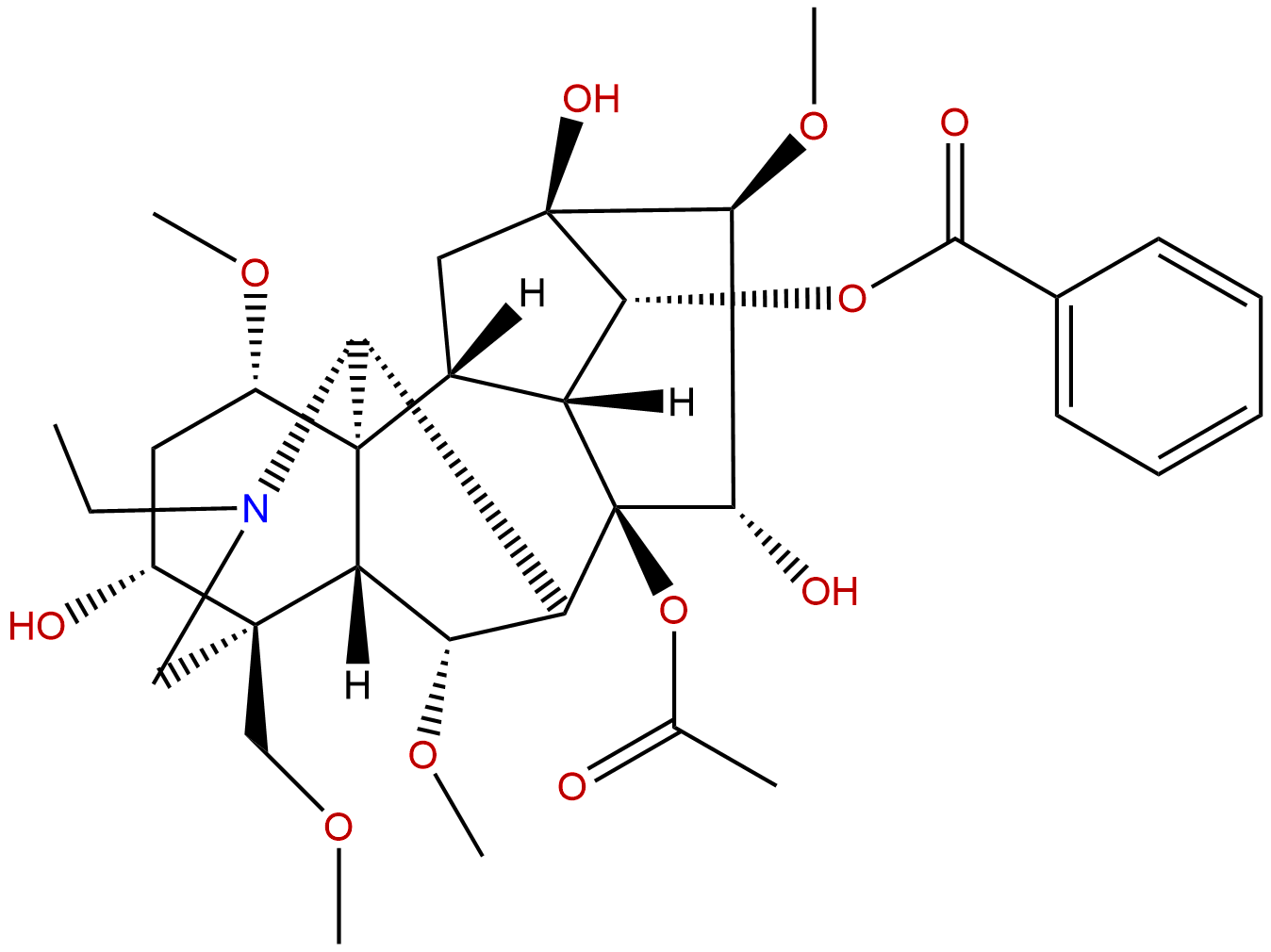


Product name: Aconitine
Synonym name:
Catalogue No.: BP0121
Cas No.: 302-27-2
Formula: C34H47NO11
Mol Weight: 645.746
Botanical Source: Sessile Stemona Root
Physical Description:
Type of Compound: Alkaloids
Purity: 95%~99%
Analysis Method: HPLC-DAD or/and HPLC-ELSD
Identification Method: Mass, NMR
Packing: Brown vial or HDPE plastic bottle
Storage: Store in a well closed container, protected from air and light. Put into refrigerate or freeze for long term storage.
The product could be supplied from milligrams to grams
Inquire for bulk scale.
Description:
Aconitine, one of the major Aconitum alkaloids, is a highly toxic compound from the Aconitum species, it appears to exert a long-lasting cholinergic action in the causation of severe arrhythmias leading to death.
References:
Forensic Sci Int. 2005 Feb 10;148(1):21-9.
Effects of long-term administrations of aconitine on electrocardiogram and tissue concentrations of aconitine and its metabolites in mice.
Aconitum alkaloids are well known for their acute and high toxicity, for example, in the causation of severe arrhythmias leading to death. Aconitine, one of the major Aconitum alkaloids, is a highly toxic compound from the Aconitum species. However, there has been no studies reported on the influence of the chronic administration of Aconitine. Thus, this study was conducted to investigate the influence of chronic administration of Aconitine in experimental animal models.
METHODS AND RESULTS:
A dose of 1mg/kg per day was administered to the experimental animal models. We determined the concentration of Aconitine and its metabolites (benzoylaconine and aconine) in organs and blood with gas chromatography/selected ion monitoring (GC/SIM). In addition, we concurrently recorded the electrocardiogram (ECG). Fifteen minutes after administration on day 0, the early Aconitine administered group (acute group) revealed peak organ and blood concentration levels of Aconitine with a gradual decrease, thereafter. The concentration of Aconitine in organs and blood (from days 0 to 22; 90 min after the last administration of Aconitine) gradually decreased according to repeated administration, whereas benzoylaconine and aconine increased. ECG revealed various types of arrhythmias. However, the frequency of arrhythmias remarkably decreased with time and repeated administration of Aconitine.
CONCLUSIONS:
These results indicate two possibilities. First, the increase in the activity of Aconitine metabolism. Secondly, the decrease of effectiveness to the heart due to long-term (chronic) administration of Aconitine.
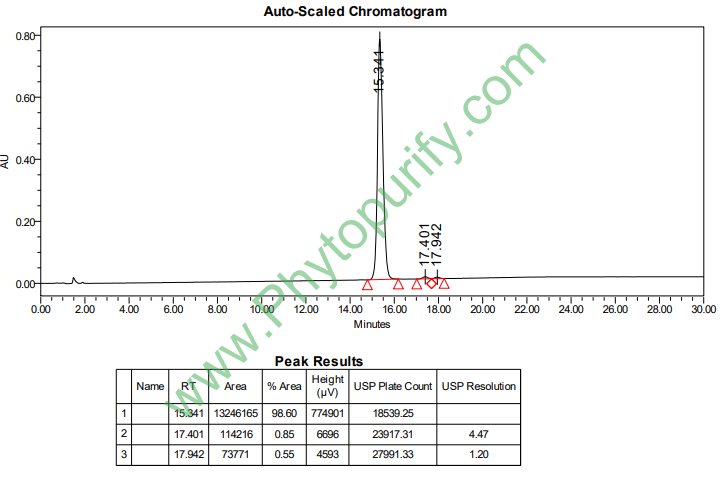
HPLC of Aconitine
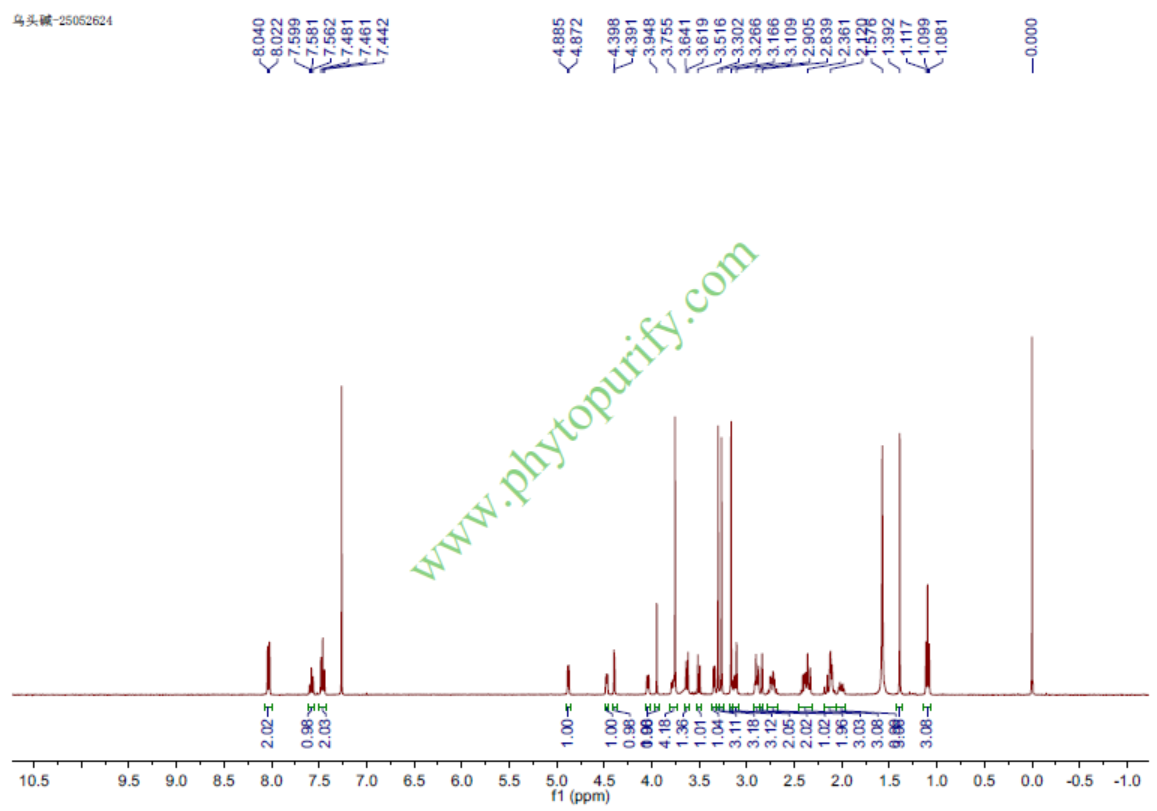
HNMR of Aconitine
Storage conditions:Short-term storage at 2~8℃, long-term storage at -20 ~ -80℃
153.4500
1.8286
1.7175
.1909
1.0465
6.3394
Low
65.3464
7.2567
No
No
Yes
No
No
No
0.6
Yes
No
Yes
Yes
Aconitine, CAS number 302-27-2, is a natural diterpenoid alkaloid with a long history and complex duality. It is not only a key active ingredient in traditional Chinese medicine "Aconitum" or "Fuzi" that works, but also one of the most toxic plant toxins known. The subtle balance of its "toxicity effect" relationship runs through the entire research history. Aconitum spp. are widely used in multiple traditional medical systems worldwide, mainly for the treatment of rheumatism, neuralgia, and heart failure. However, their treatment window is extremely narrow, and poisoning events occur from time to time, mainly manifested as severe arrhythmia and neurotoxicity, which can often be fatal. In recent years, with the deepening of modern pharmacology and molecular biology techniques, research on aconitine has gradually shifted from simply focusing on its toxicity to exploring its potential pharmacological activities, especially in the field of central nervous system diseases. This article aims to systematically review the chemical properties, pharmacological activities, molecular mechanisms of action, pharmacological properties, and research progress of aconitine in cognitive impairment and other diseases, in order to provide a scientific perspective for the future research and development of this high-risk and high potential compound.
The chemical structure of aconitine is complex and belongs to the C19-demethylditerpenoid aconitine alkaloids. Its system is named 20-ethyl-3 α, 13,15 α - trihydroxy-1 α, 6 α, 16 β - trimethoxy-4- (methoxymethyl) aconitine-8,14 α - diol, with acetate and benzoate groups at positions 8 and 14, respectively. This highly modified skeleton is the structural basis for its high biological activity. The ester bonds in the molecule, especially the acetoxy group at C8 and the benzoyloxy group at C14, are crucial for maintaining its strong sodium ion channel activation activity. The hydrolysis of these groups is the main pathway for the metabolic inactivation and detoxification of aconitine in vivo.
From the analysis of physical and chemical properties, the molecular weight of aconitine is 645.7460, and the calculated LogP value is about 1.83, indicating that it has a certain lipophilicity. Its topological polar surface area (TPSA) is as high as 153.45 Å ², reflecting the presence of multiple hydrogen bond acceptors (hydroxyl, methoxy, ester carbonyl) in the molecule. The theoretical water solubility is relatively low, about 0.1909 mg/mL, which is related to its crystal morphology and strong hydrophobic skeleton. These properties collectively determine the distribution and metabolic characteristics of aconitine in organisms: a certain degree of lipophilicity facilitates its penetration through cell membranes, but its high TPSA and molecular weight limit its passive diffusion efficiency, especially its ability to penetrate the blood-brain barrier (BBB), which is predicted to be "low". This not only challenges its action on the central nervous system, but may also explain to some extent the phenomenon of more prominent peripheral toxicity.
Aconitine mainly comes from the tubers of various plants in the Aconitum genus of the Ranunculaceae family, such as Aconitum carmichaelii, Aconitum kusnezoffi, and Aconitum brachypodum. In these plants, aconitine often coexists with a series of structurally similar aconitine alkaloids (such as aconitine, aconitine, etc.), and its content varies significantly depending on species, place of origin, harvest season, and processing methods. Traditional Chinese medicine uses complex processing techniques such as soaking, steaming, and co frying with excipients to reduce the content of diester alkaloids such as aconitine, hydrolyzing them into less toxic monoester or amine alcohol alkaloids, thereby improving medication safety while retaining certain therapeutic effects.
Modern extraction and separation technologies are mainly based on solvent extraction and chromatographic methods. The conventional process includes soaking or percolating the dried Aconitum root powder in alkaline organic solvents (such as ammonia chloroform or ammonia ether), and enriching it by utilizing the characteristic of alkaloids being free and soluble in organic solvents under alkaline conditions. The crude extract is extracted with acidic water, and the alkaloids are converted into salts and transferred to the aqueous phase. After alkalization, they are back extracted with organic solvents to obtain the total alkaloids. Further purification relies on techniques such as silica gel column chromatography, reverse phase high performance liquid chromatography (RP-HPLC), or high-speed counter current chromatography (HSCCC) to separate and purify various alkaloids based on their polarity and distribution coefficients, ultimately obtaining high-purity aconitine monomers. Mass spectrometry (MS) and nuclear magnetic resonance (NMR) are the core techniques for identifying its structure.
The pharmacological activity of aconitine presents a distinct "double-edged sword" characteristic, and its strong toxic effect itself is an extreme "pharmacological effect". Recent studies have also revealed some potential and potentially guided therapeutic directions.
Neurotoxicity/Analgesia and Anti inflammatory Activity Aconitine has an excitatory and then paralyzing effect on both sensory and motor nerves, which is related to its activation of voltage-gated sodium channels (VGSCs), leading to sustained influx of sodium ions and membrane depolarization. This strong stimulation of the nerves is the common basis for producing severe pain (early symptoms of poisoning) and local anesthetic effects. After low-dose or structural modification, its derivatives may exhibit analgesic effects. In addition, some studies suggest that aconitine may exhibit anti-inflammatory effects in specific models by regulating the expression of inflammatory factors such as TNF - α, IL-1 β, IL-6, which may be related to its traditional use in rheumatoid arthritis.
Cardiotoxicity/Potential cardiotonic effects Aconitine is one of the strongest known arrhythmogenic substances. It continuously activates VGSCs in myocardial cells, prolongs the opening of sodium channels, leading to intracellular sodium overload, and then causes calcium overload through sodium calcium exchangers, triggering delayed depolarization and early depolarization, causing ventricular tachycardia, ventricular fibrillation, and even sudden death. However, under strict control of dosage and formulation, this effect of enhancing myocardial excitability and conductivity has been explored historically for the treatment of heart failure and shock, but its safety margin is too small and has been largely abandoned in modern clinical practice.
Antitumor activity In recent years, in vitro studies have shown that aconitine can inhibit the proliferation and induce apoptosis of many tumor cell lines (such as liver cancer, gastric cancer, lung cancer, breast cancer cells). The mechanism may involve inducing the generation of reactive oxygen species (ROS), decreasing mitochondrial membrane potential, cell cycle arrest, and regulating apoptosis related proteins such as Bcl-2/Bax and Caspase.
Potential impact on cognitive function (new research focus)Although the neurotoxicity of aconitine may impair cognition, some cutting-edge research is beginning to explore its regulatory potential for Alzheimer's disease (AD) related pathology under specific conditions. This is closely related to the target group that this article focuses on. For example, studies suggest that extremely low concentrations of aconitine or its metabolites may affect key enzymes and proteins associated with Alzheimer's disease, but the evidence is insufficient and highly controversial, with specific effects (beneficial or harmful) highly dependent on concentration, model, and exposure time.
The most classic and clear mechanism of action of aconitine is as an agonist or modulator of voltage-gated sodium channels (VGSCs). It binds to site 2 of the channel protein, inhibits channel inactivation, stabilizes it in an open state, and causes continuous influx of sodium ions, which is the core molecular basis for its acute toxicity such as neural excitation and cardiac arrhythmia.
In the field of cognitive impairment, research is still in the early exploratory stage, but multiple potential targets have been identified, which form a complex network:
At present, most of the direct interaction evidence between aconitine and these targets comes from computational simulations or preliminary biochemical experiments. The exact functional effects, direction of action (inhibition or activation), and concentration dependence of aconitine in the living nervous system still require extensive and rigorous research to confirm. A reasonable hypothesis is that aconitine or its structural modifications may affect AD related signaling networks through multi-target and fine-tuning, but its strong sodium channel activation toxicity is the first obstacle that must be overcome or avoided in any therapeutic exploration.
From the perspective of modern medicinal chemistry, the pharmacological properties of aconitine as a drug lead compound face severe challenges.
The clinical application prospects of aconitine are full of challenges, but there is also theoretical exploration space.
Limitations of direct application Due to its high toxicity and extremely narrow therapeutic window, aconitine itself is not suitable for direct use as a modern chemical drug. At present, medicinal herbs containing aconitine (such as Aconitum and Aconitum carmichaelii) are still strictly limited to compound use in traditional Chinese medicine clinical practice, and emphasize long-term decoction and compatibility to reduce toxicity. They are treated by experienced physicians based on syndrome differentiation and are used for critical and severe conditions (such as heart failure, shock) or refractory pain. This belongs to the experience system of traditional medicine, which is different from the modern concept of drug development.
Development of new drugs as lead compounds This is the most scientifically valuable potential direction. Focusing on the field of cognitive impairment (such as AD), future research should:
Other potential areas In terms of anti-tumor effects, the possibility of combining it with targeted delivery systems or studying it as an immune adjuvant can be explored, but it must also be based on controllable toxicity.
Aconitine is a typical natural product that combines "toxicity" and "potential activity". Its strong sodium channel activation has established its position as a classic toxin and tool drug, while also setting an insurmountable barrier for its direct drug development. However, with the deepening understanding of complex diseases such as Alzheimer's disease, multi-target intervention strategies are increasingly being valued. The ability of aconitine's complex chemical structure to potentially interact with multiple targets related to neurological diseases has given it new research value. The future path is not to directly use it as medicine, but to use modern medicinal chemistry and pharmacology as tools to deeply "transform" and "reshape" it. Through rational structural modification and in-depth mechanism exploration, it is expected to blunt the sharp and toxic edge of this "double-edged sword" and even transform it into precise tools for specific pathological processes, thus developing new therapeutic candidates for tackling major diseases such as cognitive impairment from this ancient and dangerous molecule. This process is full of challenges, but it is also the charm and mission of natural product chemistry.
