| Catalog No | Package | Original Price | Price | Inventory | Quantity | Operating |
|---|---|---|---|---|---|---|
| SBP02918-5mg | 5mg | $196.00 | Sign in |
|


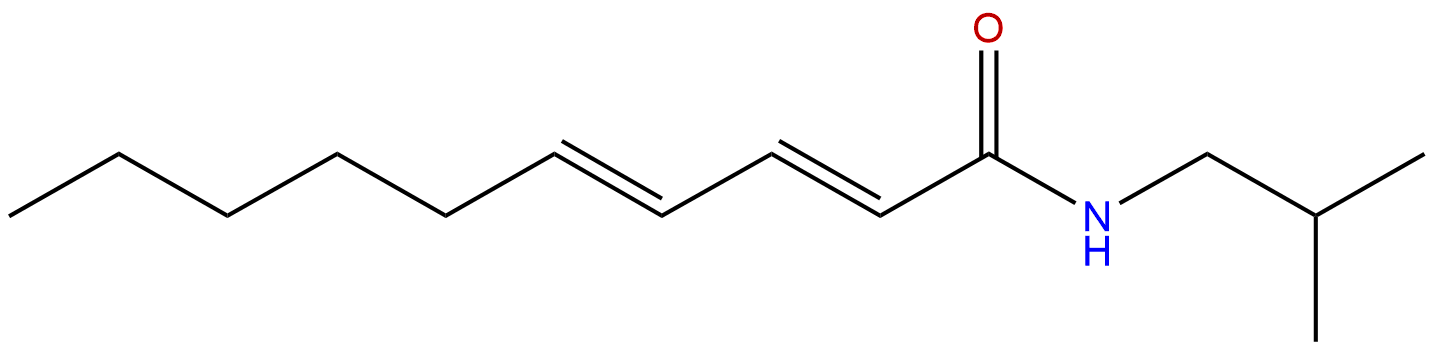
Product name: Pellitorine
Synonym name:
Catalogue No.: SBP02918
Cas No.: 18836-52-7
Formula: C14H25NO
Mol Weight: 223.36
Botanical Source:
Type of Compound:
Purity: 95%~99%
Analysis Method: HPLC-DAD or/and HPLC-ELSD
Identification Method: Mass, NMR
Packing: Brown vial or HDPE plastic bottle
Storage: Store in a well closed container, protected from air and light. Put into refrigerate or freeze for long term storage.
Whenever possible, you should prepare and use solutions on the same day. However, if you need to make up stock solutions in advance, we recommend that you store the solution as aliquots in tightly sealed vials at -20℃. Generally, these will be useable for up to two weeks.
The product could be supplied from milligrams to grams
Inquire for bulk scale.
For Reference Standard and R&D, Not for Human Use Directly.
Storage conditions:Short-term storage at 2~8℃, long-term storage at -20 ~ -80℃
38.3300
3.9800
3.5000
Low
Unknown
Unknown
No
Unknown
No
Unknown
Pellitorine (CAS number: 18836-52-7) is a natural amide compound that was initially isolated from various plants and has attracted much attention due to its unique structure and diverse biological activities. In recent years, with the deepening development of natural product pharmacology, berberine has shown significant pharmacological potential in multiple fields such as anti-inflammatory, anti pain, cognitive function improvement, antithrombotic, anticancer, and anti infection. Its mechanism of action involves multiple signaling pathways and molecular targets, particularly in TRPV1 receptor antagonism, BDNF-ERK1/2-CREB pathway activation, and Nrf2-HO-1 antioxidant defense system regulation. In addition, berberine plays a role in anti sepsis and anti thrombosis by regulating HMGB1, RAGE/TLR4, and coagulation factor activity, demonstrating broad clinical application prospects. This article provides a systematic review of the chemical structure, plant origin, pharmacological activity, mechanism of action, evaluation of medicinal properties, and future development directions of berberine, aiming to provide theoretical basis and reference for research and development in related fields.
Wall grass alkali is a natural amide compound with a molecular formula of C15H27NO and a molecular weight of 223.36. Its structural feature is a long-chain fatty amide skeleton, containing a fatty acid side chain connected to an amino group, belonging to the natural products of fatty amides. The LogP value of wall grass alkali is 3.98, indicating good lipid solubility and facilitating membrane penetration; The polar surface area (TPSA) is 38.33 Å ² and the number of hydrogen bond acceptors is 2, indicating that its polarity is moderate and may affect its bioavailability and targeting. Although it has high lipid solubility, its ability to penetrate the blood-brain barrier is low, suggesting that its direct action in the central nervous system may be limited. The pharmacological evaluation shows that berberine has no significant hepatotoxicity, cardiotoxicity, or hERG channel inhibition, and has good safety. However, the mutagenicity of Ames is not yet clear and further toxicological research is needed to support it.
Wall grass alkali mainly comes from various traditional medicinal plants, especially Pellionia and its related species. Common plants include Pellionia perens and pepper plants. Traditionally, these plants have been used in folk therapies such as pain relief, anti-inflammatory, and anti infective treatments.
The extraction method usually uses organic solvent extraction combined with column chromatography separation. The specific steps include:
1. Reflux extraction of dried plant materials using ethanol or methanol as solvents;
2. After rotary evaporation concentration, the crude extract is purified by silica gel column chromatography or high-performance liquid chromatography (HPLC);
3. Confirm the structure through techniques such as mass spectrometry (MS) and nuclear magnetic resonance (NMR).
In recent years, the application of ultrasound assisted extraction (UAE) and supercritical fluid extraction (SFE) technologies has improved the extraction efficiency and purity of berberine, laying the foundation for its large-scale production.
Curcumin can competitively antagonize transient receptor potential vanillic acid receptor 1 (TRPV1), block receptor activation induced by capsaicin, and reduce the transmission of pain signals. TRPV1 is an important ion channel for perceiving thermal pain and inflammatory pain, and berberine exhibits significant analgesic effects by regulating it. In addition, berberine also promotes neuroplasticity and pain regulation by upregulating brain-derived neurotrophic factor (BDNF), activating mitogen activated protein kinase 1/2 (ERK1/2), and cyclic adenosine monophosphate response element binding protein (CREB) signaling pathways, and alleviating chronic pain symptoms.
In the cognitive impairment model, berberine activates the BDNF ERK1/2-CREB pathway, promotes neuronal survival and synapse formation, and improves learning and memory abilities. At the same time, berberine upregulates nuclear factor E2 related factor 2 (Nrf2) and its downstream antioxidant enzyme heme oxygenase 1 (HO-1), enhancing cellular antioxidant capacity and reducing oxidative stress damage. Its regulation of glutathione peroxidase 4 (GPX4) and dihydroorotate dehydrogenase (DHODH) effectively inhibits lipid peroxidation, resists ferroptosis, and provides a molecular basis for neuroprotection.
Wall grass alkaloids inhibit the release of high mobility group protein B1 (HMGB1) and the expression of its receptors RAGE (AGER) and Toll like receptor 4 (TLR4), block the activation of downstream nuclear factor kappa B (NF - κ B) signaling pathway, reduce the secretion of pro-inflammatory factors such as tumor necrosis factor alpha (TNF - α) and interleukin-6 (IL-6), and significantly alleviate inflammatory responses. This mechanism is particularly prominent in sepsis models, and berberine has potential clinical application value by regulating immune inflammatory responses and reducing the risk of multi organ damage.
Curcumin can prolong clotting time, inhibit the activity of key coagulation factors (such as thrombin F2, coagulation factor Xa F10) and platelet glycoprotein IIb/IIIa complex (ITGA2B/ITGB3), and block platelet aggregation and fibrin formation. Meanwhile, its regulation of plasminogen activator inhibitor-1 (SERPINE1) and angiotensin-converting enzyme (ACE) further enhances its antithrombotic effect, indicating its potential in the prevention and treatment of thrombotic related diseases.
Tetrandrine has inhibitory effects on many tumor cell lines, especially on leukemia and breast cancer cells, with obvious effects of cell proliferation inhibition and apoptosis induction. Its anti-cancer mechanism involves cell cycle arrest, activation of pro apoptotic signals, and regulation of the antioxidant defense system. In addition, berberine exhibits antibacterial activity against various bacteria, possibly by disrupting cell membrane integrity and inhibiting key enzyme activity.
Wall grass alkaloids interfere with the ion balance and water regulation of Aedes aegypti larvae by inhibiting V-type H ⁺ - ATPase and aquaporin 4 (AaAQP4), exerting insecticidal effects and providing new ideas for mosquito borne disease prevention and control.
The multi-target mechanism of action of berberine reflects its broad pharmacological activity:
In addition, berberine also exhibits certain inhibitory activity against malaria related targets such as PFCRT, PFMDR1, PFDHFR, etc., indicating its potential application in the field of anti malaria.
The molecular weight of wall grass alkali is moderate (223.36), with high lipid solubility (LogP=3.98) and moderate polarity, which is conducive to cell membrane penetration and in vivo distribution. Its blood-brain barrier permeability is low, which may limit its direct action in the central nervous system, but it can still exert cognitive and analgesic effects by regulating peripheral nerves and indirect signaling pathways. The internal safety is good, with no significant liver toxicity, cardiac toxicity, or hERG channel inhibition, reducing the risk of cardiovascular adverse reactions.
At present, there is limited pharmacokinetic data on berberine, and preliminary studies have shown that its oral bioavailability is moderate. In vivo metabolism is mainly carried out through the liver enzyme system, and the metabolites and excretion pathways need further clarification. In the future, systematic ADME (absorption, distribution, metabolism, excretion) research and toxicological evaluation are needed to support its clinical development.
Due to its multi-target and multi pathway pharmacological properties, berberine has shown extensive potential in the treatment of chronic pain, cognitive impairment, inflammatory diseases, thrombosis, and tumors. Especially in the current management of chronic pain and treatment of neurodegenerative diseases, berberine, as a TRPV1 antagonist and neurotrophic factor modulator, provides a new treatment strategy.
In addition, the role of berberine in anti sepsis and anti thrombosis provides the possibility for adjuvant therapy in critically ill patients. Its anti-cancer and antibacterial activities also lay the foundation for the development of new anti-tumor and anti infective drugs. Based on its ability to kill Aedes aegypti larvae, berberine may also be used for vector control in the public health field.
Future research should focus on:
1. Pharmacokinetic and toxicological system evaluation of berberine;
2. Structural optimization and derivative design to improve its bioavailability and targeting;
3. In depth analysis of multi-target mechanisms and revealing their synergistic effects;
4. Pre clinical and clinical trials to verify its safety and efficacy.
Through interdisciplinary collaboration, berberine is expected to develop into a multifunctional natural drug candidate molecule that meets diverse clinical needs.
As a natural amide compound with rich biological activity, berberine has shown unique research value and application prospects in the field of natural product pharmacology. Its multi-target and multi mechanism pharmacological effects provide new ideas for the treatment of various diseases such as chronic pain, cognitive impairment, inflammation, thrombosis, and tumors. Although the pharmacokinetics and clinical research of berberine are still in the preliminary stage, its good safety and wide pharmacological activity make it a natural drug candidate molecule worth further development. In the future, through systematic mechanism research and clinical verification, berberine is expected to become an important representative of natural product drug development, contributing new treatment options to human health.
