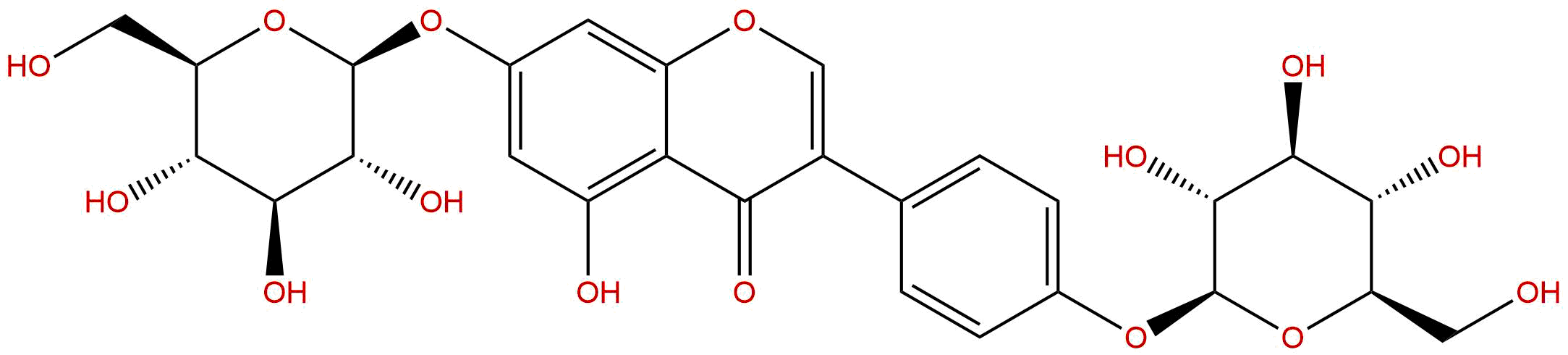


Product name: Genistein 7,4'-O-diglucoside
Synonym name: Genistein 4',7-diglucoside
Catalogue No.: BP4834
Cas No.: 36190-98-4
Formula: C27H30O15
Mol Weight: 594.522
Botanical Source:
Type of Compound: Isoflavones
Purity: 95%~99%
Analysis Method: HPLC-DAD or/and HPLC-ELSD
Identification Method: Mass, NMR
Packing: Brown vial or HDPE plastic bottle
Storage: Store in a well closed container, protected from air and light. Put into refrigerate or freeze for long term storage.
Whenever possible, you should prepare and use solutions on the same day. However, if you need to make up stock solutions in advance, we recommend that you store the solution as aliquots in tightly sealed vials at -20℃. Generally, these will be useable for up to two weeks.
The product could be supplied from milligrams to grams
Inquire for bulk scale.
For Reference Standard and R&D, Not for Human Use Directly.
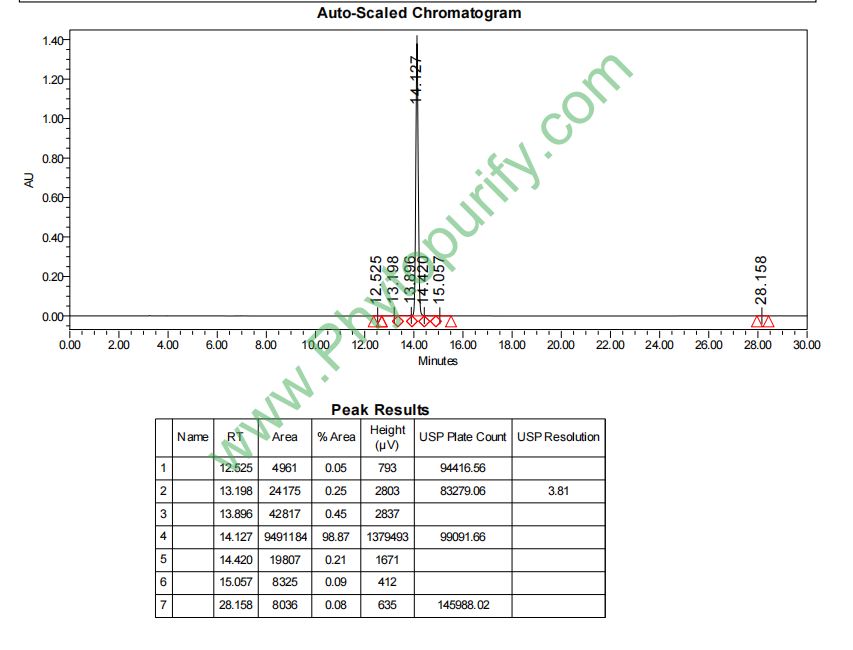
HPLC of Genistein 7,4'-O-diglucoside
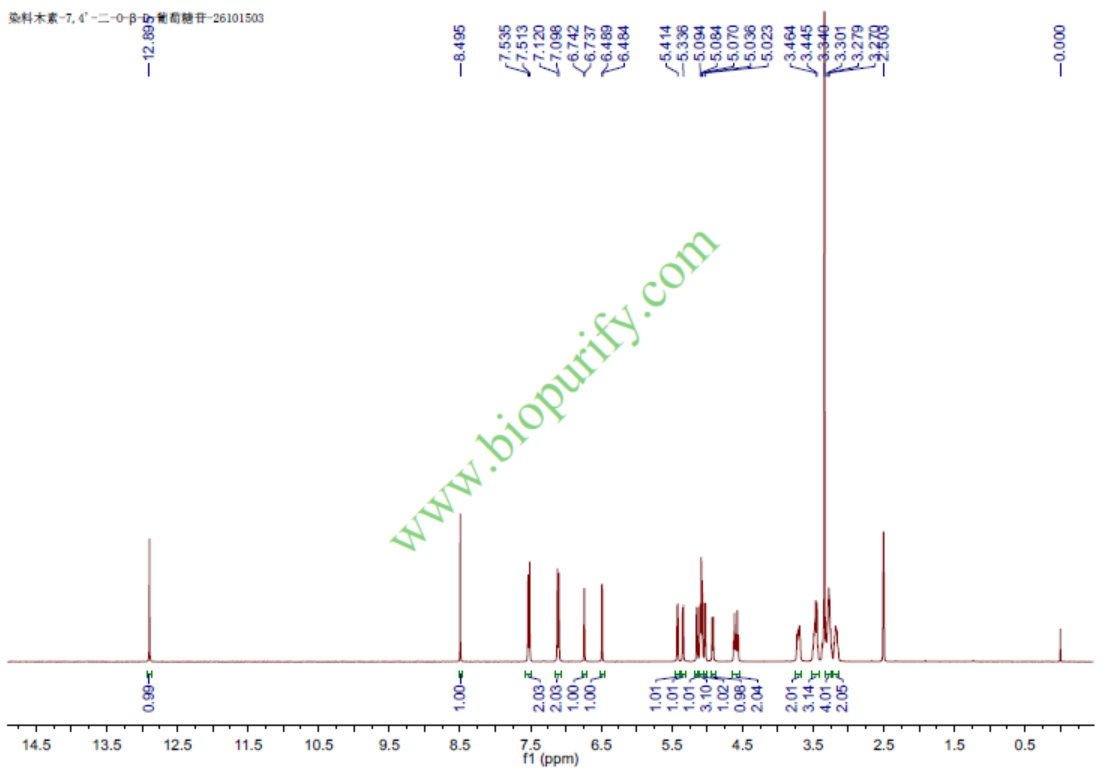
HNMR of Genistein 7,4'-O-diglucoside
Storage conditions:Short-term storage at 2~8℃, long-term storage at -20 ~ -80℃
249.2000
-.7025
-.7066
3.3851
.5777
.2218
Low
79.4284
4.5985
Yes
No
No
No
Yes
No
1.2
Yes
Yes
Yes
Yes
Natural products have always been an important source of drug discovery, especially in the field of anti-tumor. Plant derived active ingredients have attracted much attention due to their structural diversity and unique biological activity. Soy isoflavones, as an important class of plant estrogens, have been widely studied for their relationship with human health, especially for their potential in cancer prevention and treatment. Among numerous soy isoflavones, genistein has become a research hotspot due to its significant tyrosine kinase inhibitory activity. However, naturally occurring isoflavones mostly exist in the form of glycosides, and their bioavailability and pharmacological activity differ significantly from their aglycone form.
Genistein 7,4 '- di-O - β - D-glucoside (G7DG) is a diglucoside derivative of genistein, characterized by its chemical structure where the hydroxyl groups at positions 7 and 4' of the lignin core are linked to one molecule of β - D-glucose via glycosidic bonds. This disaccharide modification not only changes the physicochemical properties of the molecule, but also endows it with unique pharmacokinetic characteristics and biological activity spectrum. Compared with genistein glycosides, G7DG has higher water solubility and better oral bioavailability, while retaining its activity as a multi tyrosine kinase inhibitor. It can exert anti-tumor effects by regulating multiple processes such as cell apoptosis, cell cycle, angiogenesis, and metastasis.
In recent years, with the in-depth study of G7DG, its therapeutic potential in breast cancer and other malignant tumors has gradually been revealed. Research has shown that G7DG can achieve multidimensional inhibition of tumor cell proliferation, survival, and metastasis by regulating multiple signaling pathway molecules such as AMPK, MCL1, BCL2, NOTCH1, STAT3, ESR2, etc. This article will provide a systematic review of the research progress of G7DG from the aspects of chemical structure, plant origin, pharmacological activity, mechanism of action, pharmacological evaluation, and clinical application prospects, in order to provide reference for the in-depth development and clinical translation of this natural product.
The chemical name of G7DG is 5,7,4 '- trihydroxyflavone-7,4' - di-O - β - D-glucoside, with a molecular formula of C27H30O15 and a molecular weight of 594.5220 Da. Its core structure is the flavonoid core, which is the 3-phenylchromenone skeleton, with one molecule of β - D-glucopyranose connected to the 7th position of the A ring and the 4th position of the B ring, respectively. This dual glycosylation pattern is common in natural isoflavones, but the unique feature of G7DG is that the two glycosides are located on different rings of the mother nucleus, and this spatial distribution has a significant impact on its interaction with biological targets.
From the perspective of structure-activity relationship, the 5-hydroxy group (5-OH) and 4-carbonyl group (4-C=O) of the flavonoid parent nucleus can form intramolecular hydrogen bonds, which are crucial for maintaining the planarity of the molecule and its binding ability to target proteins. Although glycosylation modifications at positions 7 and 4 'reduce the direct binding ability of the molecule to certain targets, they significantly improve the water solubility and metabolic stability of the molecule. It is worth noting that the presence of sugar groups may alter the interaction mode with tyrosine kinase ATP binding pockets by affecting the spatial conformation of the molecule, resulting in an inhibitory activity spectrum different from that of nucleosides.
The physicochemical properties of G7DG provide important basis for its pharmacological evaluation. The lipid water partition coefficient (LogP) of this compound is -0.7025, indicating its strong hydrophilicity, which is consistent with the presence of multiple hydroxyl and sugar structural units in its molecule. The topological polar surface area (TPSA) is 249.2000 Å ², which is much higher than the recommended upper limit of 140 Å ² for oral drugs, indicating that the compound may be difficult to penetrate cell membranes through passive diffusion. The water solubility parameter is 3.3851, belonging to the category of moderate water solubility, which provides certain feasibility for the development of its oral formulation.
In terms of absorption, distribution, metabolism, and excretion (ADME) related parameters, the blood-brain barrier penetration ability of G7DG is evaluated as "low", which is consistent with its high polarity and high molecular weight characteristics, suggesting that the application of this compound in the treatment of central nervous system diseases may be limited. The risk assessment of hERG inhibition is' no ', indicating a low risk of cardiac toxicity, which is a favorable safety feature. The Ames test result is 1.2, indicating that the compound may have a slight genetic toxicity risk, but further in vivo experiments are needed for verification.
Compared with genistein aglycone (LogP about 2.8, water solubility about 0.1 mg/mL), the water solubility of G7DG has increased by about 30 times, which provides convenience for its oral administration. However, high polarity also brings about the problem of reduced membrane permeability, which may be one of the main reasons for its limited oral bioavailability.
G7DG is mainly found in leguminous plants, especially in soybeans (Glycine max) and their processed products. In unfermented soy products, isoflavones mainly exist in the form of glycosides, with genistein glycosides accounting for 50% -60% of the total isoflavone content. G7DG is one of the main glycoside forms of genistein, with a content of approximately 0.1-0.5 mg/g dry weight in soybean seeds. The specific content varies depending on the variety, origin, growth conditions, and processing method.
In addition to soybeans, G7DG is also found in other leguminous plants such as Pueraria lobata, Trifolium pratense, and Cicer arietinum. It is worth noting that there are differences in the content and glycosylation patterns of G7DG in different plant sources, which may be related to the expression and activity of glycosyltransferases in plants. In addition, some traditional Chinese medicines such as kudzu root and fermented soybean paste also contain a certain amount of G7DG, which provides a material basis for their application as dietary supplements or active ingredients in traditional Chinese medicine.
The extraction of G7DG usually adopts solvent extraction method, and commonly used extraction solvents include methanol, ethanol, acetone and their aqueous solutions. Due to the high polarity of G7DG, aqueous alcohol solvents (such as 70% -80% ethanol) often achieve high extraction efficiency. During the extraction process, factors such as temperature, time, solid-liquid ratio, and pH value can all affect the extraction efficiency. Research has shown that under the conditions of 60-70 ° C, using 70% ethanol as the extraction solvent, with a solid-liquid ratio of 1:10 (w/v), extracting 2-3 times for 1-2 hours each time, can achieve a relatively ideal extraction rate.
After concentration, the extract can be purified using various chromatographic techniques. Macroporous adsorption resins (such as HPD-100 and D101) are commonly used preliminary purification methods that can effectively remove impurities such as sugars and proteins. Subsequently, further separation and purification were performed using silica gel column chromatography, polyamide column chromatography, or preparative high-performance liquid chromatography (HPLC). Among them, reverse phase C18 column chromatography combined with methanol water or acetonitrile water gradient elution system can achieve effective separation of G7DG from other isoflavone glycosides. In recent years, new separation methods such as high-speed countercurrent chromatography (HSCCC) and molecular imprinting technology have also been applied to the efficient purification of G7DG.
It is worth noting that during the extraction and purification process, high temperature, strong acid or strong base conditions should be avoided to prevent hydrolysis of glycosidic bonds. In addition, due to the sensitivity of G7DG to light, the operation process should avoid light as much as possible to maintain the stability of the compound.
The anti-tumor activity of G7DG is one of its most concerned pharmacological effects. In vitro experiments have shown that G7DG can inhibit the proliferation of many tumor cell lines, including breast cancer (MCF-7, MDA MB-231), prostate cancer (PC-3, LNCaP), colon cancer (HT-29, HCT-116), lung cancer (A549) and liver cancer (HepG2). Its half maximal inhibitory concentration (IC50) is usually in the range of 10-50 μ M, and the specific value varies depending on the cell type and treatment time.
In the study of breast cancer, G7DG showed a dual inhibitory effect on estrogen receptor positive (ER+) and negative (ER -) cell lines. For ER+MCF-7 cells, G7DG can exert anti estrogen like effects by competitively binding to the estrogen receptor (ER β); For ER - MDA-MB-231 cells, their anti proliferative effect mainly relies on non estrogen receptor-mediated mechanisms, such as tyrosine kinase inhibition and cell cycle arrest. It is worth noting that G7DG has low toxicity to normal breast epithelial cells and exhibits certain selective anti-tumor effects.
G7DG can induce apoptosis of tumor cells through various pathways. Research has shown that G7DG treatment can lead to a decrease in mitochondrial membrane potential, an increase in cytochrome c release, and subsequently activate caspase-9 and caspase-3, initiating the endogenous apoptotic pathway. Meanwhile, G7DG can upregulate the expression of pro apoptotic protein Bax, downregulate the expression of anti apoptotic proteins Bcl-2 and Mcl-1, alter the Bax/Bcl-2 ratio, and promote apoptosis.
In addition, G7DG can induce exogenous apoptosis by activating the death receptor pathway. In some tumor cells, G7DG treatment can upregulate the expression of Fas and FasL, activate caspase-8, and then connect endogenous and exogenous apoptotic pathways through the cleavage of Bid protein. This multi-channel apoptosis induction mechanism enables G7DG to overcome the resistance of certain tumor cells to a single apoptotic pathway.
Abnormal regulation of the cell cycle is an important characteristic of tumor occurrence and development. G7DG can block tumor cells at specific cell cycle phases by affecting the expression of checkpoint related proteins. It has been found that G7DG treatment can cause G2/M phase arrest of breast cancer cells, which is related to the down-regulation of key G2/M phase regulatory proteins such as cyclin B1, CDK1 and CDC25C. Meanwhile, G7DG can upregulate the expression of CDK inhibitors such as p21 and p27, further enhancing the cell cycle arrest effect.
It is worth noting that the effect of G7DG on the cell cycle is cell type dependent. In some tumor cells, G7DG mainly causes G0/G1 phase arrest, which is associated with the inhibition of cyclin D1 and CDK4/6 expression. This difference may be related to the differences in signaling pathway networks in different cells, and also suggests that G7DG may regulate cell cycle progression through multiple mechanisms.
Angiogenesis and metastasis are key steps in the malignant progression of malignant tumors. G7DG can exert anti angiogenic effects by inhibiting the expression and secretion of vascular endothelial growth factor (VEGF), as well as suppressing the proliferation, migration, and tubular structure formation of endothelial cells. In the chicken embryo chorioallantoic membrane (CAM) model, G7DG can significantly inhibit the formation of new blood vessels.
In terms of anti metastasis, G7DG can inhibit the migration and invasion ability of tumor cells. Research has shown that G7DG treatment can downregulate the expression and activity of matrix metalloproteinases (MMP-2 and MMP-9), while upregulating the expression of tissue metalloproteinase inhibitors (TIMP-1 and TIMP-2), thereby inhibiting the degradation of extracellular matrix. In addition, G7DG can maintain epithelial phenotype and reduce the invasion and metastasis ability of tumor cells by inhibiting the expression of epithelial mesenchymal transition (EMT) related proteins such as Snail, Twist, N-cadherin.
In addition to its anti-tumor activity, G7DG also has pharmacological effects such as antioxidant, anti-inflammatory, and neuroprotective properties. Its antioxidant activity mainly comes from the phenolic hydroxyl structure of the flavonoid core, which can directly scavenge free radicals and chelate metal ions. In terms of anti-inflammatory effects, G7DG can inhibit the activation of the NF - κ B pathway and reduce the production of pro-inflammatory cytokines such as TNF - α, IL-6, IL-1 β. These activities may be related to their potential applications in the prevention of chronic diseases.
As a multi tyrosine kinase inhibitor, the mechanism of action of G7DG mainly involves competing with ATP to bind to the kinase catalytic domain. Molecular docking studies have shown that the flavonoid core of G7DG can embed into the ATP binding pocket of tyrosine kinases such as EGFR, HER2, VEGFR, etc., and bind to key amino acid residues through hydrogen bonding and hydrophobic interactions. Compared with genistein glycosides, the glycosyl portion of G7DG may extend to the hydrophilic region of the kinase surface, forming additional interactions that affect its inhibitory activity and selectivity.
In the EGFR signaling pathway, G7DG can inhibit the autophosphorylation of EGFR and the activation of downstream signaling molecules such as PI3K/Akt and MAPK/ERK. This inhibitory effect not only directly inhibits the proliferation of tumor cells, but also enhances their sensitivity to chemotherapy drugs and radiotherapy. Research has shown that the combination of G7DG with paclitaxel or cisplatin can produce a synergistic anti-tumor effect.
AMPK (AMP activated protein kinase) is a key regulatory factor in cellular energy metabolism and plays an important role in tumor metabolic reprogramming. G7DG can inhibit protein synthesis and cell growth by activating the AMPK signaling pathway, suppressing mTOR activity. Research has found that G7DG treatment can lead to an increase in phosphorylation of the Thr172 site of AMPK α subunit, which may be related to its inhibition of the activity of mitochondrial respiratory chain complex I, resulting in an increase in intracellular AMP/ATP ratio.
The activation of AMPK also mediates the regulatory effects of G7DG on lipid metabolism and glucose metabolism. In breast cancer cells, G7DG inhibits the expression of fatty acid synthase (FASN) through AMPK dependent manner, reduces lipid synthesis, and thus inhibits the growth of tumor cells. In addition, activation of AMPK can promote autophagy, which may be related to G7DG induced cell death.
The regulation of apoptosis related proteins by G7DG is one of the core mechanisms of its anti-tumor effect. In terms of BCL2 family proteins, G7DG can downregulate the expression of anti apoptotic proteins MCL1 and BCL2, while upregulating the expression of pro apoptotic proteins BAX and BAK. This change in expression profile leads to an increase in mitochondrial outer membrane permeability, promoting the release of cytochrome c and the formation of apoptotic bodies.
The NOTCH1 signaling pathway plays an important role in maintaining the characteristics of tumor stem cells. Research has shown that G7DG can inhibit the activation of NOTCH1, downregulate the expression of its target genes HES1 and HEY1, thereby inhibiting the self-renewal ability of tumor stem cells. This mechanism may be related to the long-term anti-tumor effect and prevention of tumor recurrence of G7DG.
The STAT3 signaling pathway is a convergence point for the signaling of various cytokines and growth factors. G7DG can inhibit the phosphorylation of the Tyr705 site of STAT3, reducing its nuclear translocation and transcriptional activity. The inhibition of STAT3 activity leads to downregulation of downstream target genes (such as cyclin D1, survivor, VEGF), thereby inhibiting cell proliferation, inducing apoptosis, and suppressing angiogenesis.
As an isoflavone compound, G7DG has the ability to bind to the estrogen receptor (ER). Compared with genistein glycosides, G7DG has a lower affinity for ER, but can still exert biological effects through the ER β - mediated signaling pathway. In ER+breast cancer cells, G7DG can competitively bind ER β, inhibit ER α activation induced by estradiol, and thus play an anti estrogen like role.
In addition, G7DG can also regulate estrogen signaling through non genomic pathways. Research has shown that G7DG can inhibit the activation of G protein coupled estrogen receptor (GPER), thereby suppressing the reactivation of EGFR and the activation of downstream MAPK/ERK signaling pathways. This non genomic mechanism may explain why G7DG can still play an anti-tumor role in ER breast cancer cells.
Multidrug resistance (MDR) is one of the main reasons for the failure of tumor chemotherapy. G7DG can reverse tumor cell resistance to chemotherapy drugs by inhibiting the expression and function of drug efflux pump proteins such as ABCB1/P-gp and ABCG2/BCRP. Research has shown that G7DG treatment can downregulate the mRNA and protein levels of ABCB1 and ABCG2, while inhibiting their ATPase activity, reducing drug efflux, and increasing intracellular drug concentration.
In addition, G7DG can also affect the phosphorylation status and function of drug efflux pumps by inhibiting the activity of PRKCA (protein kinase C alpha). The inhibition of PRKCA can also affect the activity of transcription factors such as NF - κ B and AP-1, further regulating the expression of MDR related genes. This multi-target MDR reversal mechanism makes G7DG potentially advantageous in overcoming tumor drug resistance.
Based on the aforementioned physical and chemical properties parameters, the pharmacological properties of G7DG exhibit obvious duality. Its good water solubility (3.3851) and low LogP value (-0.7025) are beneficial for the development of oral formulations and in vivo dissolution, but high polarity also brings about the problem of poor membrane permeability. According to the Lipinski Five Rules, the molecular weight of G7DG (594.52 Da) exceeds 500 Da, the number of hydrogen bond donors (10 hydroxyl groups) exceeds 5, and the number of hydrogen bond acceptors (15 oxygen atoms) exceeds 10. These characteristics suggest that its oral bioavailability may be low.
However, the pharmacokinetic characteristics of natural product glycosides are often different from traditional small molecule drugs. G7DG may be hydrolyzed by β - glucosidase produced by gut microbiota in the intestine into genistein, which has higher membrane permeability and can be effectively absorbed. This "prodrug" strategy may result in higher oral bioavailability of G7DG than predicted based on physicochemical parameters.
The pharmacokinetic studies on G7DG are relatively limited, but existing research has revealed some key characteristics of its in vivo processes. After oral administration, G7DG is partially hydrolyzed into genistein glycosides in the gastrointestinal tract, which are absorbed by intestinal epithelial cells and undergo glucuronidation and sulfation binding reactions in the liver and intestinal wall, forming phase II complexes. These complexes are excreted into the intestine through bile and may be reabsorbed after being unbound by the gut microbiota, forming the enterohepatic circulation.
The plasma concentration time curves of G7DG and its metabolites usually exhibit a bimodal phenomenon, with the first peak corresponding to the absorption of the prototype drug and early metabolites, and the second peak possibly related to the enterohepatic circulation. Its elimination half-life is about 6-8 hours, and its main excretion pathways are urine and bile. It is worth noting that there are significant individual differences in the metabolism of G7DG, which may be related to gut microbiota composition, genetic polymorphism, and dietary factors.
Preliminary safety evaluation indicates that G7DG has good safety features. In acute toxicity experiments, the LD50 value of oral administration of G7DG in mice is greater than 2000 mg/kg, indicating that it is a low toxicity compound. In the subchronic toxicity study, no significant organ toxicity or hematological parameter abnormalities were observed after 28 days of continuous administration. The hERG inhibition risk assessment is negative, indicating a low risk of cardiac toxicity.
However, the Ames test result was 1.2, indicating that the compound may have a slight genetic toxicity risk. This result needs to be taken seriously, but considering that many compounds with anti-tumor activity in natural products (such as resveratrol and curcumin) also show weak positive results in Ames tests, their clinical significance needs to be comprehensively evaluated in combination with in vivo experiments and long-term toxicity studies. In addition, as an isoflavone compound, the estrogenic activity of G7DG may have potential effects on the endocrine system, and the safety of long-term use needs further research.
Based on the multi-target mechanism of G7DG on breast cancer cells, its application prospect in the treatment of breast cancer deserves special attention. For ER+breast cancer, G7DG can be used as an auxiliary drug for anti estrogen therapy. It can overcome endocrine therapy resistance by simultaneously inhibiting ER signal and growth factor signal pathways. For triple negative breast cancer (TNBC), G7DG can play an anti-tumor role by inhibiting EGFR, STAT3, NOTCH1 and other signal pathways, providing a new treatment option for this breast cancer subtype that lacks targeted treatment.
In addition, the combination of G7DG and chemotherapy drugs such as paclitaxel, doxorubicin, and cisplatin has shown a synergistic effect, which can reduce the dosage of chemotherapy drugs and minimize toxic side effects. The reversal of multidrug resistance of G7DG also makes it potentially valuable in the treatment of drug-resistant breast cancer. In the future, combination therapy based on G7DG is expected to enter the clinical trial stage.
In addition to breast cancer, G7DG also shows anti-tumor activity in prostate cancer, colon cancer, lung cancer and liver cancer. In prostate cancer, G7DG can inhibit tumor cell proliferation and induce apoptosis by suppressing androgen receptor signaling and PI3K/Akt pathway. In colon cancer, the anti-inflammatory and antioxidant activities of G7DG may be related to its preventive effects. These studies provide a scientific basis for the broad-spectrum anti-tumor application of G7DG.
Multiple formulation development strategies are being explored to address the issue of low oral bioavailability of G7DG. Nanotechnology, such as liposomes, polymer nanoparticles, and solid lipid nanoparticles, can improve the encapsulation efficiency and oral absorption of G7DG. Phospholipid complex technology can improve the lipid solubility of G7DG and promote its absorption through the intestinal lymphatic system. In addition, prodrug design strategies such as chemically modifying the glycosylation of G7DG may further enhance its metabolic stability and bioavailability.
Although significant progress has been made in the research of G7DG, there are still many issues that need to be addressed. Firstly, the in vivo metabolites and biological activities of G7DG need to be systematically identified to clarify its true active form in exerting pharmacological effects. Secondly, more research is needed on the long-term safety of G7DG in normal tissues, especially its effects on the endocrine system and gut microbiota. Thirdly, based on the derivative design and synthesis of G7DG structure, it is expected to obtain lead compounds with stronger activity and higher selectivity. Finally, the synergistic mechanism of G7DG with other natural products or chemotherapy drugs needs to be further studied to provide theoretical basis for clinical combination therapy.
Dye lignin-7,4 '- di-O - β - D-glucoside, as an important active ingredient of soy isoflavones, has shown unique value in the field of anti-tumor research due to its multi tyrosine kinase inhibitory activity and multi-target mechanism of action. It can regulate AMPK, MCL1, BCL2, NOTCH1, STAT3, ESR2 and other signal pathway molecules to achieve multi-dimensional inhibition of tumor cell proliferation, apoptosis, angiogenesis and metastasis, providing a new idea for the treatment of breast cancer and other malignant tumors.
In the process of transforming natural products into candidate drugs, G7DG faces multiple challenges such as optimizing drug properties, improving pharmacokinetics, and evaluating safety. However, its good water solubility, low cardiac toxicity, and multidrug resistance reversal activity give it the potential for further development. With the continuous development of nanomedicine technology, prodrug design strategies, and combination therapy regimens, G7DG is expected to become an important component of comprehensive cancer treatment in the future.
The development of natural product drugs is a long and challenging process, and the research history of G7DG once again proves that a deep understanding of the chemical structure, pharmacological activity, and mechanism of action of natural products, combined with modern medicinal chemistry and pharmaceutical technology, can transform traditional knowledge into therapeutic weapons for modern medicine. Looking forward to more basic research and clinical translational studies on G7DG in the future, contributing to the cause of human health.
