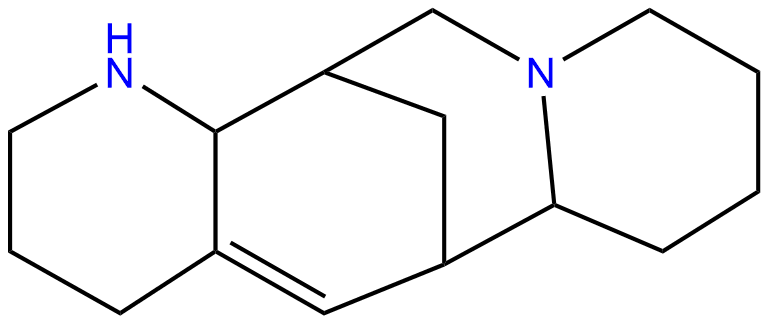


Product name: Aloperine
Synonym name:
Catalogue No.: BP1503
Cas No.: 56293-29-9
Formula: C15H24N2
Mol Weight: 232.371
Botanical Source: Seeds and green parts of Sophora alopecuroides (Leguminosae)
Physical Description:
Type of Compound: Alkaloids
Purity: 95%~99%
Analysis Method: HPLC-DAD or/and HPLC-ELSD
Identification Method: Mass, NMR
Packing: Brown vial or HDPE plastic bottle
The product could be supplied from milligrams to grams. Inquire for bulk scale.
We provide solution to improve the water-solubility of compounds, thereby facilitating the variety of activity tests and clinic uses.
For Reference Standard and R&D, Not for Human Use Directly.
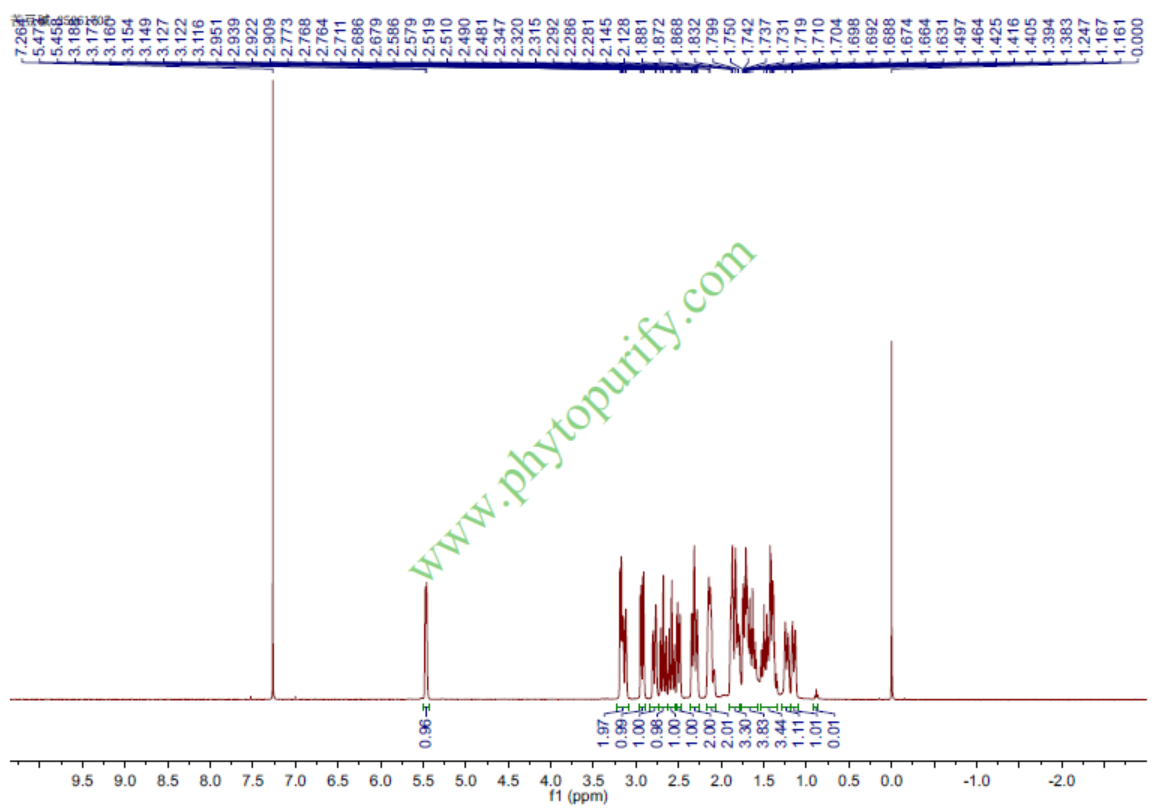
HNMR of Aloperine
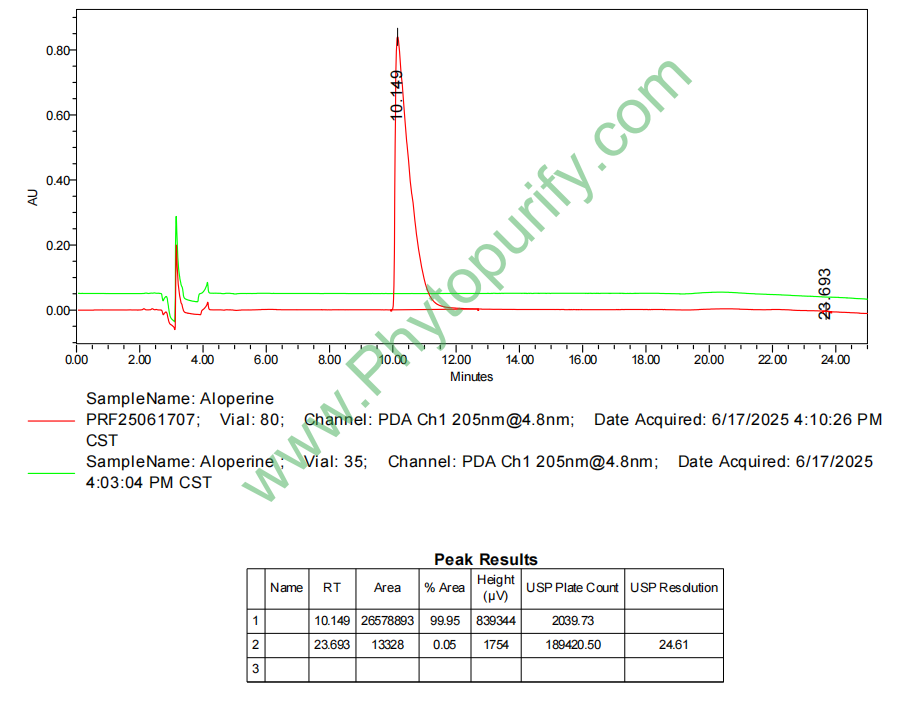
HPLC of Aloperine
Storage conditions:Short-term storage at 2~8℃, long-term storage at -20 ~ -80℃
15.2700
2.2002
-.4119
4.8123
3.0743
10.5105
High
39.6150
4.8919
No
Yes
Yes
No
Yes
No
0.0
No
No
Yes
No
Natural products, as an important treasure trove for drug discovery and development, play an irreplaceable role in the long history of human fight against diseases. Among them, alkaloid compounds have always been a hot topic in medicinal chemistry and pharmacology research due to their structural diversity and significant biological activity. Aloperine, a quinolone alkaloid isolated from Sophora flavescens plants in the legume family, has attracted much attention since its discovery due to its wide range of pharmacological activities. Its CAS number is 56293-29-9, mainly derived from the traditional medicinal plant Sophora alopecuroides(Sophora alopecuroides L.)。 Early research has revealed that coumarin has multiple biological effects such as anti-inflammatory, anti allergic, antiviral, and anti-tumor effects, especially in the study of skin inflammatory diseases such as allergic contact dermatitis. In recent years, with the development of molecular pharmacology and structural biology, the anticancer (such as inducing apoptosis and autophagy in HL-60 cells) and antiparasitic activities and their targets of action of coumarin have been gradually elucidated, laying a solid scientific foundation for its transformation from traditional medicinal ingredients to modern innovative drugs. This article aims to systematically review the chemical properties, plant sources, pharmacological activities, molecular mechanisms of action, pharmacological evaluation, and clinical application prospects of bitter bean alkaloids, in order to provide comprehensive references for the in-depth research and development of this natural product.
Ku Dou alkaloid is a tetracyclic quinolone alkaloid with a molecular formula of C15H24N2 and a molecular weight of 232.3710. Its core structure is composed of two fused pyridine rings, forming a rigid four ring skeleton, which is the material basis for its biological activity. From the analysis of physical and chemical properties, the lipid water partition coefficient (LogP) of bitter bean alkaloids is 2.2002, indicating that they have moderate lipophilicity, which is beneficial for transmembrane transport and cell permeation. Its topological polar surface area (TPSA) is relatively low, only 15.2700 Å ², which further confirms its characteristics of low molecular polarity and strong lipid solubility. The water solubility value is 4.8123 (usually expressed in log mol/L or similar units, indicating weak water solubility), which is consistent with the characteristics of most alkaloids. These physicochemical parameters collectively determine the basic behavior of coumarin in vivo: good membrane permeability indicates its oral absorption potential, but poor water solubility may affect its formulation development. It is worth noting that the calculation predicts high blood-brain barrier permeability, suggesting that it may have potential therapeutic value for central nervous system related diseases or parasitic infections (such as cerebral malaria). In addition, preliminary pharmacological risk assessment showed that coumarin has no significant hERG potassium channel inhibitory activity and genetic toxicity (Ames test negative), providing preliminary positive signals for its safety evaluation.
Bitter bean alkaloids mainly come from various plants of the Sophora genus in the legume family, among which bitter bean alkaloids(Sophora alopecuroides L. The content is the most abundant. Sophora alopecuroides is widely distributed in arid and semi-arid regions such as northwest China and Mongolia. In traditional medicine, it is often used for clearing heat and dampness, relieving pain and killing insects. The accumulation sites of coumarin in plants are mainly concentrated in the roots and seeds. The extraction and separation methods have undergone development from traditional to modern. In the early days, solvent extraction was commonly used, which involved leaching with acidic aqueous solutions (such as dilute hydrochloric acid) or organic solvents (such as methanol and ethanol), and then utilizing the alkaline characteristics of alkaloids for preliminary purification through acid-base precipitation. With the advancement of separation technology, modern methods tend to adopt efficient and environmentally friendly processes. For example, ultrasound assisted extraction and microwave-assisted extraction can significantly improve extraction efficiency and shorten time. Subsequently, by utilizing techniques such as macroporous adsorption resin, silica gel column chromatography, and reverse phase high performance liquid chromatography (RP-HPLC) for refining, high-purity coumarin monomers can be obtained. In recent years, preparative chromatography techniques such as high-speed counter current chromatography have shown unique advantages in natural product separation due to their high recovery rate and avoidance of irreversible adsorption by solid adsorbents, and are also suitable for the large-scale preparation of coumarin. Optimizing the extraction and purification process is a prerequisite for achieving subsequent pharmacological research and drug development of coumarin.
Ku Dou alkaloid exhibits diverse and significant pharmacological activities, and its research has extended from whole animal models to cellular and molecular levels.
Anti inflammatory and anti allergic activity This is one of the earliest areas where coumarin was extensively studied. Numerous studies have shown that coumarin has a clear inhibitory effect on various acute and chronic inflammation models, such as carrageenan induced rat foot swelling and cotton ball granuloma, as well as skin inflammatory disease models such as allergic contact dermatitis and atopic dermatitis. Its function is closely related to inhibiting the production of pro-inflammatory factors such as TNF - α, IL-1 β, IL-6, reducing the release of inflammatory mediators such as histamine and PGE2, and regulating the function of T lymphocyte subsets.
Antitumor activity Ku Dou alkaloid exhibits growth inhibition and induces cell death in various tumor cell lines. For example, in human promyelocytic leukemia HL-60 cells, coumarin can induce both apoptosis and autophagy simultaneously. In addition, the study also found that it has proliferation inhibition, cycle arrest, migration and invasion inhibition effects on solid tumor cells such as liver cancer, gastric cancer, breast cancer, colon cancer, etc., showing a broad spectrum of anti-cancer potential.
Antiviral activity Research has reported that coumarin has inhibitory effects on certain viruses such as Coxsackievirus and respiratory syncytial virus, and its mechanism may be related to interference with virus adsorption, entry, or replication processes.
Antiparasitic activity This is a highly distinctive research direction of coumarin. It has inhibitory activity against malaria parasites, Leishmania parasites, Toxoplasma gondii, etc. In malaria research, coumarin is considered a multi-target candidate for antimalarial treatment, involving multiple key life processes of the parasite.
Other activities In addition, coumarin also exhibits potential activities such as immune regulation, neuroprotection, and cardiovascular protection, indicating its broad pharmacological effects.
The multiple pharmacological activities of coumarin stem from its interactions with various biomolecules, and its mechanism of action is complex and has multi-target characteristics.
In Anti parasitic In the field, especially in the area of anti malaria, research has identified multiple potential targets:
- PFCRT (Plasmodium chloroquine resistance transporter) & PFATP6 (Plasmodium sarcoplasmic/endoplasmic reticulum calcium ATPase)Ku Dou alkaloid may disrupt the survival environment of malaria parasites by affecting proteins related to drug resistance and ion homeostasis.
- DHFR (dihydrofolate reductase)This is a classic anti malaria target. Ku Dou alkaloid may inhibit the DHFR of malaria parasites and interfere with their nucleic acid synthesis.
- Protein synthesis related targets As follows:EIF2A (eukaryotic translation initiation factor 2A)、RPS14 (ribosomal protein S14)、RPLP0 (ribosomal protein P0)This suggests that coumarin may interfere with the protein translation process of malaria parasites.
- Metabolic and stress-related targets:PFKFB3 (6-phosphofructose-2-kinase/fructose-2,6-diphosphatase 3, although more commonly found in mammals, homologs may be related)、HSPA8 (Heat Shock Protein A8)、CYP51 (lanosterol 14 α - demethylase) Involved in sugar metabolism, stress response, and ergosterol synthesis, it is crucial for the survival of parasites.
- GABAAR (gamma aminobutyric acid type A receptor): Affects chloride ion channels and may lead to dysfunction of the parasitic neuromuscular system.
In Anti inflammatory and immune regulation In terms of regulation, coumarin mainly downregulates the expression of inflammatory factors by regulating key inflammatory signaling pathways such as NF - κ B, MAPK (such as p38, JNK, ERK), JAK/STAT. In antitumor In terms of inducing apoptosis, its mechanism involves activating the caspase cascade reaction, regulating the Bcl-2/Bax protein ratio, and inducing a decrease in mitochondrial membrane potential; The induced autophagy is related to the regulation of signaling pathways such as PI3K/Akt/mTOR and AMPK. At the same time, it can also inhibit epithelial mesenchymal transition by affecting Wnt/β - catenin, TGF - β and other pathways, thereby preventing tumor metastasis.
Based on its physicochemical properties, bitter bean alkaloids exhibit certain medicinal properties. Moderate LogP and low TPSA indicate good oral bioavailability potential. High blood-brain barrier permeability is its advantage in combating central nervous system parasitic infections. The absence of hERG inhibition and Ames mutagenicity provides preliminary guarantees for its safety.
However, comprehensive drug development still requires in-depth pharmacokinetic (PK) and toxicological studies. The existing literature reports are relatively limited, but preliminary analysis can be conducted based on its properties: as an alkaloid, coumarin may be well absorbed in the gastrointestinal tract after oral administration, but its first pass effect, plasma protein binding rate, in vivo distribution (especially based on its lipophilicity accumulation in adipose tissue), metabolic pathway (presumably mainly through liver CYP450 enzyme system metabolism), and excretion mode still need to be experimentally clarified. The problem of poor water solubility may need to be improved in formulation development through techniques such as salt formation (such as hydrochloride salt formation), cyclodextrin inclusion, and preparation of nanocrystals or liposomes. Although the preliminary safety indicators are good, its long-term toxicity, reproductive toxicity, maximum tolerated dose, etc. still need to be evaluated through standardized preclinical studies. In the future, systematic ADMET (absorption, distribution, metabolism, excretion, and toxicity) research data is needed to promote its clinical translation.
The clinical application prospects of coumarin are broad, but the road is long and requires precise positioning.
Skin inflammatory diseases: Based on a solid foundation of anti inflammation and anti allergy research, the development of external preparations of aloperine (such as cream, gel) for the treatment of eczema, atopic dermatitis, allergic contact dermatitis, etc., is the most likely direction of rapid clinical application. Its natural product identity may also have a place in functional cosmetics or skin care products.
Antiparasitic Agents Especially in the context of the increasingly severe threat of multidrug-resistant malaria, coumarin, as a novel and multi-target antimalarial lead compound, has important development value. It can be considered to be used in combination with existing antimalarial drugs, or to optimize the structure using it as a framework to develop a new generation of antimalarial drugs. The therapeutic potential for other parasitic diseases is also worth exploring.
Antitumor adjuvant therapy Although its anti-cancer activity is significant, the development of a single chemotherapy drug faces challenges. A more realistic approach may be to use it as an adjuvant therapy for tumors, utilizing its anti-inflammatory and immune regulatory properties in combination with radiotherapy, chemotherapy, or immunotherapy to enhance efficacy and reduce side effects. Or precisely develop tumor subtypes targeting specific targets.
Structural modification and optimization Natural coumarin is an ideal lead compound. By using medicinal chemical methods to modify its structure (such as introducing different functional groups, preparing derivatives or prodrugs), it is expected to improve its water solubility, enhance activity, reduce potential toxicity, optimize pharmacokinetic properties, and thus obtain more valuable candidate drugs for development.
Multi target therapy strategy The multi-target properties of coumarin are in line with the treatment concept of modern complex diseases such as cancer and autoimmune diseases. In depth research on the network pharmacology mechanism of its multi-target synergistic effect is expected to provide a new paradigm for the development of novel multi-target drugs for the treatment of complex diseases.
The challenges faced mainly include: the mechanism of action network has not been fully resolved; Lack of systematic preclinical pharmacokinetic and toxicological data; Efficient large-scale synthesis or extraction purification processes are required to ensure the supply of raw materials.
Ku Dou alkaloid, as a natural alkaloid derived from traditional medicinal plants, has become an important molecule in the pharmacological research of natural products due to its unique structure and rich pharmacological activity of quinazolidine. From anti-inflammatory and anti allergic to anti-tumor, to unique anti parasitic activity, its multifaceted biological effects are constantly validated by modern science. With the increasing clarification of its molecular targets (such as multi targets such as anti malaria PFCRT, DHFR, etc.) and action networks (such as regulating apoptosis, autophagy, and inflammatory signaling pathways), the mechanism of action of coumarin is becoming increasingly clear. Although a significant amount of systematic preclinical research is still needed in terms of drug development, its demonstrated potential is encouraging. In the future, through interdisciplinary collaboration and integration of the strengths of plant chemistry, medicinal chemistry, pharmacology, pharmacy, and clinical medicine, in-depth development and research on coumarin is expected to not only transform it into a clinical drug for treating skin diseases, parasitic infections, and even tumors, but also provide valuable experience and ideas for innovative drug development based on natural products. The research process of coumarin is a vivid example of the combination of traditional wisdom and modern technology to explore the natural treasure trove for the benefit of human health.
