| Catalog No | Package | Original Price | Price | Inventory | Quantity | Operating |
|---|---|---|---|---|---|---|
| BP4719-5mg | 5mg | $380.00 | Sign in |
|


Storage conditions:Short-term storage at 2~8℃, long-term storage at -20 ~ -80℃
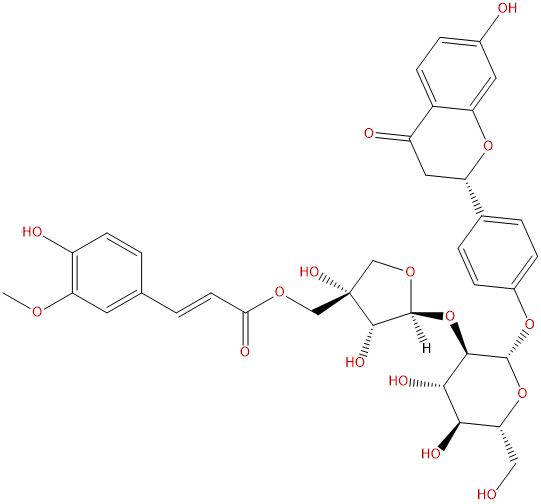
Glycyrrhiza uralensis, as an important component of traditional Chinese medicine, has long been a focus of attention in the fields of pharmacology and natural product chemistry due to its rich active ingredients and diverse pharmacological effects. Licorice glycoside C2 (CAS number: 202657-55-4) is a triterpenoid glycoside of the oleanane type isolated from licorice, which has become a research hotspot in recent years due to its significant biological activity. Glycyrrhizin C2 not only inherits the traditional pharmacological effects of licorice extract, such as antiviral, antimicrobial, antioxidant, and anti-inflammatory effects, but also exhibits significant therapeutic potential for gastrointestinal diseases, especially gastric ulcers. This article aims to systematically review the chemical structure and physicochemical properties, plant sources and extraction methods, pharmacological activity, mechanism of action and molecular targets, pharmacological evaluation and pharmacokinetic characteristics of glycyrrhizin C2, and finally look forward to its clinical application prospects.
Glycyrrhizin C2 belongs to the oleanane type triterpenoid saponin class, with a molecular weight of 726.6840. It is structurally composed of oleanane type triterpenoid mother nuclei connected to multiple glycosides through glycosidic bonds. Its LogP value is 1.1515, indicating that it has moderate lipid solubility, which is conducive to membrane penetration but not too hydrophobic. The total polar surface area (TPSA) is as high as 240.3600, indicating strong molecular polarity, which is closely related to its polysaccharide structure. The water solubility is 0.1963, indicating a certain solubility in water and suitable solvent system for oral administration. The low blood-brain barrier permeability of glycyrrhizin C2 suggests that it mainly acts on peripheral targets, reducing the risk of central nervous system toxicity. In addition, the hERG channel inhibition test result was negative, indicating a low risk of cardiac toxicity, while the Ames mutagenicity test result was 0.0, indicating no significant genetic toxicity.
Glycyrrhizin C2 is mainly extracted from the roots and rhizomes of licorice (Glycyrrhiza uralensis). Licorice is a leguminous plant widely distributed in northern China and Central Asia. Traditional extraction methods often use water or ethanol as solvents for reflux extraction, followed by multi-stage separation and purification processes to obtain the target components. Modern extraction techniques include ultrasound assisted extraction, microwave-assisted extraction, and high-performance liquid chromatography (HPLC) separation and purification, greatly improving the extraction efficiency and purity of glycyrrhizin C2. The specific steps are usually as follows: after drying and crushing licorice, 70% ethanol reflux extraction is used, and after concentration, impurities are removed by liquid-liquid extraction. Then, it is separated by silica gel column chromatography or reverse phase HPLC to obtain high-purity glycyrrhizin C2. This method not only ensures the structural integrity of the compound, but also is suitable for large-scale production.
The pharmacological activity research of glycyrrhizin C2 mainly focuses on its anti ulcer, anti-inflammatory, antiviral, and antioxidant properties. Numerous in vitro and in vivo experiments have shown that glycyrrhizin C2 can significantly alleviate gastric mucosal damage and promote ulcer healing. Its anti ulcer effect is not only reflected in reducing gastric acid secretion and protecting the gastric mucosal barrier, but also in regulating the expression of gastrointestinal hormones and inflammatory factors.
In terms of anti-inflammatory effects, glycyrrhizin C2 exhibits good anti-inflammatory effects by inhibiting the release of inflammatory mediators and regulating immune cell function. The antioxidant activity is mainly achieved by clearing free radicals, inhibiting lipid peroxidation, and enhancing endogenous antioxidant enzyme activity. In addition, some studies have reported that glycyrrhizin C2 has inhibitory effects on certain viruses such as HIV, indicating its potential application value in the field of antiviral therapy.
The anti ulcer effect of glycyrrhizin C2 involves multiple molecular targets and signaling pathways. Its main targets include:
In addition, glycyrrhizin C2 inhibits inflammatory signaling pathways such as NF - κ B through antioxidant and anti-inflammatory mechanisms, reduces the expression of inflammatory factors such as TNF - α and IL-1 β, and alleviates gastric mucosal inflammation.
The pharmacological parameters of glycyrrhizin C2 indicate that it has good potential for drug development. Moderate LogP value and high water solubility ensure its good absorption and distribution in the body. Although a higher polar surface area limits its blood-brain barrier penetration, it is beneficial for reducing central nervous system side effects. HERG inhibition is negative and non mutagenic, indicating its high safety.
At present, pharmacokinetic studies on glycyrrhizin C2 are relatively limited. Preliminary data suggests that after oral administration, glycyrrhizin C2 can be absorbed by the gastrointestinal tract, with a moderate peak time in plasma concentration and a suitable half-life for daily administration. Its metabolism is mainly through the liver enzyme system, and the metabolites may include deglycosylated compounds, some of which still have biological activity. The main excretion pathways are bile and urine. Further systematic pharmacokinetic and toxicological studies are needed in the future to improve its clinical development foundation.
Given the significant activity of glycyrrhizin C2 in anti ulcer and gastrointestinal protection, its development as a novel therapeutic drug for gastric ulcers has broad prospects. Compared with traditional drugs, the multi-target mechanism of action and good safety of glycyrrhizin C2 provide advantages for its clinical application. In addition, its anti-inflammatory, antioxidant, and antiviral effects also provide potential for the treatment of related gastrointestinal diseases and viral infections.
Future research should focus on preclinical safety evaluation, formulation optimization, and clinical trial design of glycyrrhizin C2, exploring its application in adjuvant therapy for gastric ulcers, gastritis, and even gastric cancer. At the same time, combining modern molecular biology techniques to deeply elucidate its mechanism of action and target network can help guide precision medication and combination therapy strategies.
Glycyrrhizin C2, as an important class of oleanane type triterpenoid oligoglycosides in licorice, has shown great potential in the treatment of ulcers and gastrointestinal diseases due to its diverse pharmacological activities and good medicinal properties. The systematic study of chemistry, pharmacology, and mechanisms has laid a solid foundation for its clinical translation. In the future, with the deepening of research and advances in technology, glycyrrhizin C2 is expected to become an important candidate molecule in the development of natural product drugs, bringing new treatment options for gastrointestinal disease patients.
