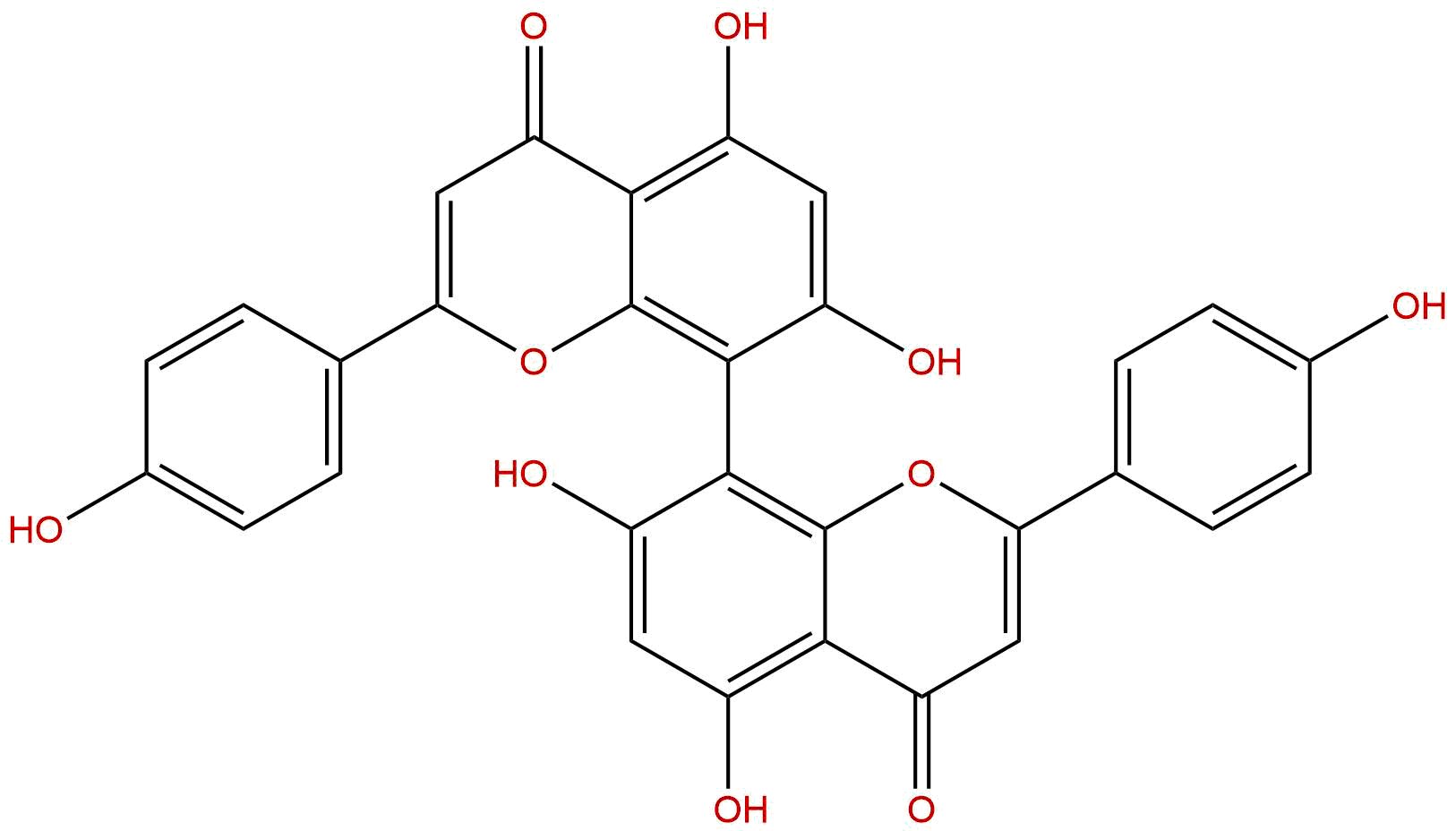
| Catalog No | Package | Original Price | Price | Inventory | Quantity | Operating |
|---|---|---|---|---|---|---|
| BP5084-5mg | 5mg | $650.00 | Sign in |
|


Storage conditions:Short-term storage at 2~8℃, long-term storage at -20 ~ -80℃
Cupressuflavone (CAS number 3952-18-9) is a natural flavonoid compound derived from the Cupressus macrocarpa plant in the family Berberidaceae. As a polyphenolic dimer flavonoid, cypress flavonoids have attracted widespread attention in the field of natural product pharmacology in recent years due to their unique chemical structure and diverse biological activities. Numerous studies have shown that Baimu flavonoids have significant anti-inflammatory, anti ulcer, and hepatorenal protective effects, especially in alleviating CCl4 induced hepatorenal toxicity in mice. In addition, increasing evidence supports its potential applications in the field of neuroprotection, involving multiple key molecular targets such as BCL2, APP, BACE1, MAPT, SIRT1, etc., suggesting that it may achieve the prevention and treatment of neurological diseases through multi-target regulation.
This article aims to systematically review the chemical structure and physicochemical properties, plant sources and extraction processes, pharmacological activity and mechanism of action, pharmacological evaluation and pharmacokinetic characteristics of Baimu flavonoids, and explore their potential and development direction in clinical applications in the future, in order to provide theoretical basis and reference for the in-depth research and drug development of this natural product.
Baimu flavonoids belong to the flavonoid dimer class, with a molecular formula of C30H18O10 and a molecular weight of 538.4640. Its structure is formed by two flavonoid units connected by carbon carbon bonds, with a typical polyphenolic hydroxyl structure that endows it with strong antioxidant capacity. Its molecular structure contains multiple phenolic hydroxyl groups and benzene rings, with high polarity and spatial conformational complexity.
In terms of physical and chemical properties, the LogP value of Baimu flavonoids is 3.2843, indicating moderate lipid solubility that facilitates membrane penetration. However, its low water solubility (0.0030) limits its solubility and bioavailability in aqueous biological systems. Its topological polar surface area (TPSA) is 181.8 Å ², and higher TPSA values are usually related to molecular polarity and the number of hydrogen bond donors and acceptors, indicating certain limitations when crossing biological membranes such as the blood-brain barrier. The permeability of the blood-brain barrier was evaluated as low, indicating that it is difficult for quercetin to directly enter the central nervous system, but its neuroprotective effect may be achieved through indirect mechanisms or peripheral nervous system effects. The hERG channel inhibition experiment showed a negative result, indicating a low risk of cardiac toxicity. The Ames test score is 0.6, indicating a low risk of genotoxicity and a good safety foundation.
Baimu flavonoids are mainly found in Cupressus macrocarpa (large leaved cypress), which is widely distributed along the Mediterranean coast and in North America. Traditionally, it has been used to prevent and treat various diseases. Baimu flavonoids, as an important active ingredient in this plant, are usually obtained through plant extraction and purification.
The extraction method mainly adopts organic solvent extraction technology, and commonly used solvents include ethanol, methanol, and their aqueous solution systems. The specific process usually includes: drying and crushing of plant materials, reflux extraction with 70% ethanol, concentration of the extract, and separation and purification using liquid-liquid distribution and column chromatography techniques (such as silica gel column and reverse phase C18 column). High performance liquid chromatography (HPLC) and mass spectrometry (MS) techniques are widely used for the qualitative and quantitative analysis of Baimu flavonoids.
In recent years, emerging technologies such as ultrasound assisted extraction (UAE) and microwave-assisted extraction (MAE) have also been attempted to be applied to the extraction of flavonoids from cypress wood, in order to improve yield and extraction efficiency, reduce the amount of organic solvents used, and comply with the concept of green chemistry.
Baimu flavonoids exhibit significant anti-inflammatory activity. Both in vitro and in vivo experiments have confirmed that it can inhibit the production of various inflammatory mediators, such as tumor necrosis factor - α (TNF - α), interleukin-1 β (IL-1 β), and prostaglandin E2 (PGE2). Its anti-inflammatory mechanism may be closely related to the inhibition of the activation of the nuclear factor kappa B (NF - κ B) signaling pathway, thereby reducing the expression of pro-inflammatory genes.
In terms of gastrointestinal protection, Baimu flavonoids have shown protective effects on various ulcer models. Its mechanism includes enhancing the defense function of gastric mucosa, inhibiting gastric acid secretion, and reducing oxidative stress damage. Animal experiments have shown that Baimu flavonoids can significantly alleviate gastric mucosal damage induced by alcohol and nonsteroidal anti-inflammatory drugs (NSAIDs), and promote ulcer healing.
Regarding the CCl4 induced mouse liver and kidney toxicity model, Baimu flavonoids showed good protective effects. Its mechanism of action involves antioxidant, anti-inflammatory, and apoptosis regulation. Baimu flavonoids can significantly reduce serum transaminase (ALT, AST) and renal function indicators (BUN, Cr), alleviate pathological damage to liver and kidney tissues, and enhance endogenous antioxidant enzyme activity and reduce reactive oxygen species (ROS) generation by activating the nuclear factor erythroid 2-related factor 2 (NRF2) signaling pathway.
The research on Baimu flavonoids in the field of neuroprotection is gradually increasing. It exerts its effects by regulating various neural related targets, including anti apoptotic protein BCL2, amyloid precursor protein (APP), β - secretase BACE1, microtubule associated protein Tau (MAPT), acetylcholinesterase (ACHE), serine protease CASP3, α - synuclein (SNCA), and longevity protein SIRT1. Related studies have shown that Baimu flavonoids can alleviate neuronal damage, inhibit neuroinflammation, improve cognitive dysfunction, and have potential value in the prevention and treatment of Alzheimer's and Parkinson's diseases.
The multi-target mechanism of action of Baimu flavonoids is the basis for their various pharmacological activities. It mainly involves the following aspects:
Regulation of antioxidant and anti-inflammatory pathways
Baimu flavonoids activate the NRF2 signaling pathway, promote the expression of downstream antioxidant enzymes such as superoxide dismutase (SOD) and glutathione peroxidase (GPx), eliminate excess ROS, and alleviate oxidative stress damage. At the same time, inhibiting the NF - κ B signaling pathway, reducing the expression of pro-inflammatory factors, and alleviating inflammatory responses.
Regulation of cell apoptosis
By upregulating the anti apoptotic protein BCL2 and inhibiting the activation of the pro apoptotic protein CASP3, Baimu flavonoids protect cells from apoptosis induction and maintain tissue structure and function.
Regulation of neuroprotective targets
Baimu flavonoids can regulate Alzheimer's disease-related proteins APP and BACE1, reduce the production of β - amyloid protein, and inhibit neurotoxic deposition. Meanwhile, regulating the abnormal phosphorylation of Tau protein can alleviate the formation of neurofibrillary tangles. The activation of SIRT1 promotes neuronal survival and metabolic homeostasis, improving cognitive function.
Neurotransmitter metabolism regulation
By inhibiting acetylcholinesterase (ACHE) activity, quercetin increases the content of acetylcholine, improves nerve conduction function, and helps alleviate cognitive impairment.
Regulation of protein aggregation related proteins
The regulation of α - synuclein (SNCA) expression by Baimu flavonoids helps alleviate the toxic aggregation of neurons in Parkinson's disease.
The evaluation of drug properties is an important step in the development of natural product drugs. The physicochemical properties of Baimu flavonoids show that they have moderate lipid solubility (LogP 3.28), which is beneficial for cell membrane penetration, but their poor water solubility limits their oral bioavailability. The high TPSA value (181.8) and low blood-brain barrier permeability suggest that it is difficult for it to directly enter the central nervous system, but this does not rule out its neuroprotective effect through the peripheral nervous system or indirect mechanisms.
In terms of toxicological evaluation, the hERG channel inhibition test was negative, indicating a low risk of cardiac toxicity. The Ames test results show that its genotoxicity risk is relatively low and its safety is good.
There is currently limited research on pharmacokinetics. Preliminary data suggests that the absorption of Baimu flavonoids is slow and the plasma concentration is low after oral administration, which may be related to their low water solubility and larger molecular weight. Its metabolic pathway may involve the phase I and phase II enzyme systems of the liver, and the specific metabolites and their activities need further investigation. Future research should focus on improving its pharmacokinetic properties, such as enhancing its bioavailability and targeting through nanocarriers, liposomes, or structural modifications.
Baimu flavonoids have shown broad clinical application potential due to their multi-target and multi pathway pharmacological activities. Its anti-inflammatory, anti ulcer, and liver and kidney protective effects provide new treatment ideas for chronic inflammatory diseases, liver and kidney injuries, etc. Especially in the field of neuroprotection, Baimu flavonoids have the potential to become an adjuvant therapy for neurodegenerative diseases by regulating targets related to Alzheimer's disease and Parkinson's disease.
However, the clinical research on Baimu flavonoids is still in its infancy and lacks systematic clinical trial data. In the future, it is necessary to strengthen its pharmacokinetics, toxicology, and preclinical evaluation, optimize the dosage form and administration route, and enhance its in vivo stability and targeting. At the same time, combining modern drug design and biotechnology methods, structural modification and derivative development are carried out to explore their broader pharmacological applications.
In addition, as a natural product, the sustainable utilization and quality control of Baimu flavonoids are also important guarantees for clinical promotion. Standardized extraction processes and quality evaluation systems should be established to ensure stable sources and consistent composition of medicinal materials.
Baimu flavonoids, as a natural flavonoid dimer with multiple pharmacological activities, exhibit therapeutic potential in various aspects such as anti-inflammatory, anti ulcer, liver and kidney protection, and neuroprotection. Its complex mechanism of action involves multiple key molecular targets, reflecting the advantage of natural products in multi-target disease regulation. Although there are certain challenges in its drug development, such as poor water solubility and low blood-brain barrier permeability, modern drug research and development technologies are expected to overcome these limitations.
In the future, in-depth research on Baimu flavonoids should focus on pharmacokinetic optimization, mechanism analysis, and clinical translation, promoting their transition from laboratory to clinical applications. As an important member of the field of natural product pharmacology, the development of Baimu flavonoids not only enriches natural drug resources, but also provides new strategies and hope for the treatment of various diseases.
