Introduction/Overview
Ovarian cancer is the most lethal gynecological malignancy, and its treatment has long faced significant challenges of chemotherapy resistance, recurrence, and metastasis. Therefore, exploring lead compounds with novel structures and unique mechanisms from natural products has become an important strategy for the development of anti-tumor drugs. Euonymine (CAS: 33458-82-1), as a sesquiterpene pyridine alkaloid isolated from the genus Menispermaceae, has attracted widespread attention in the field of natural product pharmacology in recent years due to its complex chemical structure and preliminary multi-target pharmacological activity, especially against ovarian cancer. This type of alkaloid typically exhibits significant cytotoxicity and unique molecular mechanisms of action, making it a valuable resource for discovering novel anti-tumor candidate drugs. This article aims to systematically review the chemical properties, plant sources, extraction methods, pharmacological activities, molecular mechanisms of action, pharmacological evaluation, and clinical application prospects of berberine, in order to provide comprehensive academic references for the in-depth research and development of this compound.
Chemical structure and physicochemical properties
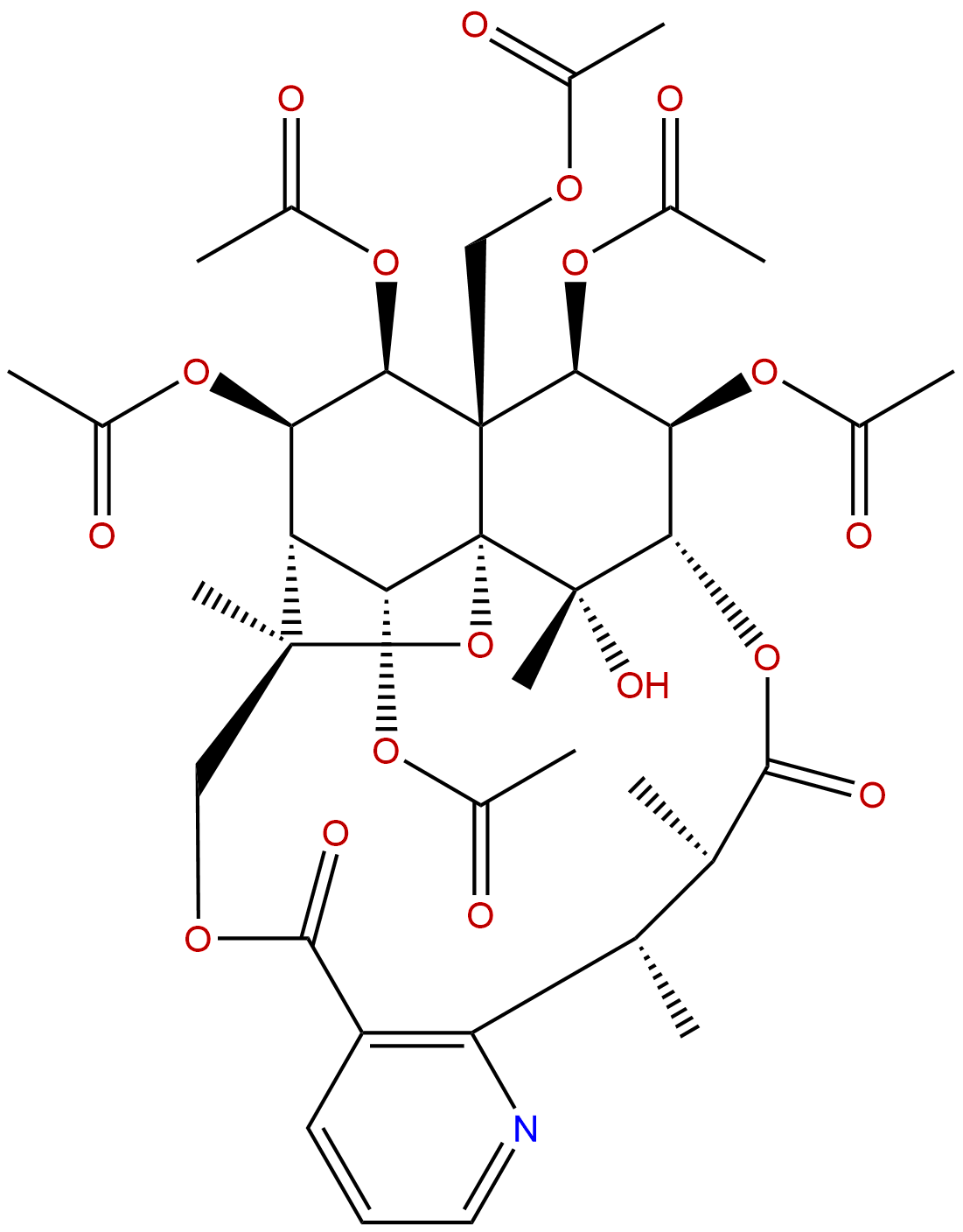
Euonymus alkaloids belong to the sesquiterpene pyridine alkaloid family, with distinct molecular structural features. They are composed of a highly oxidized sesquiterpene skeleton (usually of the syringine or macrocyclic lactone type) connected to one or more pyridine carboxylic acid units through ester bonds. This unique hybrid structure endows it with complex stereochemistry and significant biological activity.
Its molecular formula is C ₄₀ H ₄₇ NO ₁₇, and its molecular weight is 805.7830. According to the analysis of drug parameters, its lipophilic water partition coefficient (LogP) is 1.4134, indicating that the compound has moderate lipophilicity, which is beneficial for its penetration of cell membranes, but may also affect its water solubility. Its topological polar surface area (TPSA) is as high as 252.7500 Å ², which is mainly attributed to the numerous oxygen and nitrogen atoms in the molecule, forming a large number of hydrogen bond acceptor and donor sites. High TPSA is one of the key factors leading to its low water solubility (0.0537 mg/mL), which suggests that strategies such as salt formation or the use of solubilizers may be needed in formulation development to improve its solubility. In addition, its larger molecular weight and higher polarity also determine its lower blood-brain barrier permeability, which may actually reduce the potential risk of neurotoxicity for the treatment of solid tumors outside the central nervous system, such as ovarian cancer. Preliminary toxicity predictions indicate that it has no significant inhibitory tendency on hERG potassium channels (hERG inhibition: No), and the Ames test predicted a value of 0.0, suggesting that it may not have mutagenicity. These provide preliminary positive signals for its safety as a lead compound.
Plant sources and extraction methods
Euonymus alkaloids are mainly isolated from plants of the genus Euonymus in the family Euonymus, and literature reports that their initial source was from Maytenus chiapensis The leaves. The plants of the genus Menispermaceae are widely distributed in tropical and subtropical regions around the world, and are often used in traditional medicine to treat diseases such as inflammation, pain, and tumors. This provides clues for their chemical composition in modern drug development.
The extraction and separation process follows the conventional process of natural product chemistry, but optimization is needed for its structural characteristics. Usually, the dried and crushed plant leaves are first subjected to cold soaking or heated reflux extraction with polar organic solvents (such as methanol, ethanol, or methanol water mixed solvents) to fully extract alkaloids and other polar components, including berberine. The extract is concentrated under reduced pressure to obtain a crude extract. Subsequently, the crude extract is dissolved in acidic water (such as dilute hydrochloric acid) to dissolve the alkaloid components into salts, while lipid soluble impurities are filtered out. After alkalization (such as ammonia water) of this acidic water layer, free alkaloids precipitate, which can be extracted with medium polarity organic solvents such as chloroform or dichloromethane to obtain the total alkaloid fraction.
Due to the complex structure of berberine and its frequent coexistence with structurally similar homologs, further purification requires the use of various chromatographic techniques. Normal phase silica gel column chromatography is commonly used for preliminary separation, with different ratios of chloroform methanol or dichloromethane methanol gradient elution. The fraction rich in the target compound is further refined and purified by reverse phase high performance liquid chromatography (RP-HPLC, commonly C18 column, using methanol water or acetonitrile water as mobile phase), monitored by ultraviolet detector (usually with characteristic absorption at 220-280 nm), and structurally identified and purity confirmed by mass spectrometry (MS) and nuclear magnetic resonance spectroscopy (NMR). The entire separation process requires precise process control to obtain high-purity berberine for subsequent pharmacological research.
Pharmacological activity research
The most remarkable pharmacological activity of berberine is reflected in its anti-tumor effect, especially in the research on ovarian cancer models, which has shown great potential.
1. In vitro anti-tumor activity: Multiple cellular level studies have shown that berberine exhibits significant proliferation inhibitory activity on various human ovarian cancer cell lines, such as SKOV-3, A2780, OVCAR-3, etc. Its half maximal inhibitory concentration (IC ₅₀) is usually at the micromolar or even nanomolar level, and its activity is superior to or comparable to some clinical chemotherapy drugs. It is worth noting that studies have shown that it still maintains strong cytotoxicity against certain cisplatin resistant or paclitaxel resistant ovarian cancer cell lines, suggesting its potential to overcome common clinical chemotherapy resistance. In addition to its direct cytotoxic effect, berberine can also induce cell cycle arrest (mostly occurring in the G2/M phase) and apoptosis in tumor cells.
2. In vivo anti-tumor activity: In nude mouse transplant tumor models, intraperitoneal or intravenous injection of berberine can significantly inhibit the growth of ovarian cancer xenografts in a dose-dependent manner. Compared with the positive control drug, the tumor weight of mice in the berberine treatment group was significantly reduced, and the growth of tumor volume was significantly slowed down. Some studies have also observed the inhibitory effect of berberine on tumor metastasis. At the therapeutic dose, the weight loss of mice was not significant, and no serious damage was found in the pathological examination of major organs, indicating that it has acceptable in vivo safety within a certain dose range.
3. Other pharmacological activities: In addition to its core anti-tumor effect, based on its structural characteristics and preliminary screening, berberine may also exhibit auxiliary activities such as anti-inflammatory and antioxidant effects. For example, its potential regulatory effect on the nuclear factor E2 related factor 2 (NFE2L2/Nrf2) pathway may help alleviate oxidative stress in the tumor microenvironment, but its specific activity and significance in these areas still need to be further explored.
Mechanism of action and molecular targets
The anti-tumor effect of berberine, especially its activity against ovarian cancer, is not achieved through a single pathway, but involves the synergistic effect of multiple targets and pathways, which provides a molecular basis for overcoming drug resistance. According to the provided target information, its mechanism of action can be summarized as follows:
1. Inducing apoptosis and regulating apoptosis related proteins: Euonymus alkaloids can significantly downregulate the expression of B-cell lymphoma-2 (BCL-2) protein. BCL-2 is an important anti apoptotic protein, and its overexpression is a key mechanism for tumor cells to resist apoptosis and develop drug resistance. Inhibition of BCL-2 can promote apoptosis of the mitochondrial pathway. Meanwhile, it can also inhibit the phosphorylation and activation of signal transduction and transcription activator 3 (STAT3). STAT3 is a core signaling node for tumor cell survival, proliferation, and immune escape, and its sustained activation is closely related to poor prognosis in ovarian cancer. Inhibiting the STAT3 pathway can further promote apoptosis and inhibit tumor growth.
2. Inhibit tumor cell proliferation and survival signals: Euonymus alkaloids have potential inhibitory effects on extracellular signal regulated kinases (MAPK1/ERK) and estrogen receptor alpha (ESR1). The ERK pathway regulates cell cycle progression and proliferation, while ESR1 is expressed and involved in growth signaling in some ovarian cancers, especially high-grade serous cancers. Blocking these pathways can directly inhibit the malignant proliferation of tumor cells.
3. Interference with DNA metabolism and repair: Euonymus alkaloids are predicted to be inhibitors of topoisomerase I (TOP1) and topoisomerase II alpha (TOP2A). Topoisomerase is a key enzyme in DNA replication, transcription, and repair, and is a target of various clinical chemotherapy drugs such as topotecan and etoposide. Inhibiting these enzymes can lead to the accumulation of DNA damage. In addition, its inhibitory effect on tyrosine DNA phosphodiesterase 1 (TDP1) is particularly noteworthy. TDP1 is a key enzyme in repairing DNA damage caused by TOP1 inhibitors, and its overexpression is an important reason for TOP1 inhibitor resistance. The simultaneous inhibition of TOP1 and TDP1 by berberine theoretically produces a synergistic effect, effectively overcoming or delaying the occurrence of such drug resistance.
4. Affects drug efflux and cellular defense: The berberine has the potential to act on ATP binding cassette transporter B1 (ABCB1/P-gp). P-gp is a classic drug efflux pump, and its overexpression is one of the main mechanisms of multidrug resistance (MDR) in tumors. Regulating P-gp function may help reverse MDR and increase intracellular drug concentration. Meanwhile, its regulation of NFE2L2 (Nrf2) may affect the antioxidant stress defense system of cells, and overactivation of this system is also associated with chemotherapy resistance.
5. Other potential targets: Its inhibitory activity on tyrosinase (TYR) suggests that it may affect melanin synthesis, but its specific significance in ovarian cancer is not yet clear, perhaps related to metabolic interventions in certain specific pathological types.
In summary, berberine forms a multi pronged anti-tumor network by simultaneously acting on multiple key targets and pathways, including apoptosis regulation (BCL-2, STAT3), proliferation signaling (MAPK1, ESR1), DNA metabolism repair (TOP1, TOP2A, TDP1), and drug transport (ABCB1). This may be the fundamental reason for its high efficiency and potential to overcome drug resistance.
Evaluation of drug properties and pharmacokinetics
Although berberine has shown excellent anti-tumor activity in vitro and in vivo models, its ultimate development into a drug depends on the systematic drug efficacy evaluation and pharmacokinetic properties.
1. Physical, chemical, and biopharmaceutical properties: As mentioned earlier, the high molecular weight and TPSA of berberine lead to poor water solubility, which will be the first challenge for its oral administration. Low water solubility can affect its dissolution and absorption in the gastrointestinal tract, which may lead to low oral bioavailability. Its moderate LogP value is beneficial for cell membrane permeation, but its high polarity limits its passive diffusion efficiency. Although low blood-brain barrier permeability is not a disadvantage for treating ovarian cancer, it also suggests that it is not suitable for treating brain tumors. At present, there is a lack of public reports on its stability and plasma protein binding rate under different pH environments.
2. Pharmacokinetic prediction and challenges: Based on its structure, it can be predicted that berberine may face the following pharmacokinetic issues in vivo:Absorption aspect Oral absorption may be poor and unstable;Distribution aspect The larger molecular weight and polarity may limit its tissue distribution volume, but the specific tissue affinity needs to be experimentally verified;Metabolic aspect There are multiple ester bonds, hydroxyl groups, and other sites in the structure that may be metabolized. It is expected to undergo rapid phase I (such as oxidation and hydrolysis) and phase II (such as glucuronidation and sulfation) metabolism in the liver, and the half-life may be short;Excretion aspect Metabolites may be mainly excreted through bile and kidneys. Whether it is a substrate, inhibitor, or inducer of major drug metabolizing enzymes (such as CYP450) is a safety issue that needs to be carefully examined.
3. Preliminary safety evaluation: The calculated toxicology prediction shows no hERG inhibition or mutagenic risk (Ames negative), which is a good start. However, a comprehensive preclinical safety evaluation is still needed, including experiments on acute toxicity, long-term toxicity, genetic toxicity, reproductive toxicity, etc., to clarify its safety window.
4. Formulation development strategy: In order to improve its pharmacological properties, future formulation research may focus on: ① developing injectable formulations, such as improving their water solubility and stability through co solvents, cyclodextrin inclusion, or nanoformulation (liposomes, polymer micelles) technologies, and achieving intravenous administration; ② If developing oral formulations, it is necessary to consider using technologies such as solid dispersions, self microemulsions, or nanocrystals to improve dissolution and bioavailability; ③ Explore targeted delivery systems to enhance their accumulation in tumor tissues and reduce the toxicity caused by systemic exposure.
Clinical application prospects and prospects
As a natural lead compound with multi-target anti ovarian cancer activity, berberine has broad clinical application prospects, but the road ahead is long and full of challenges.
As a new candidate drug for ovarian cancer: Its most direct application prospect is to develop it into a new drug for treating ovarian cancer, especially platinum or paclitaxel resistant ovarian cancer. Its unique mechanism of simultaneously inhibiting TOP1 and TDP1 provides a new idea for overcoming TOP1 inhibitor resistance and may become a breakthrough point in this field. Future research needs to validate its efficacy in models closer to clinical settings, such as patient derived xenograft tumor models.
2. Combination therapy strategy: Given its multi-target nature, the combination of berberine with existing standard chemotherapy drugs (such as cisplatin and paclitaxel) or targeted drugs (such as PARP inhibitors) deserves further exploration. Through the synergy or superposition of different mechanisms of action, it is expected to improve therapeutic efficacy, reduce individual doses to reduce toxic side effects, or delay the emergence of drug resistance.
3. Structural optimization and derivative development: The natural structure of berberine is an excellent starting point for pharmaceutical chemists to optimize. A series of derivatives or analogues can be synthesized through structural modification to address its drawbacks such as poor water solubility and possible rapid metabolism. For example, esterification or etherification of certain hydroxyl groups to regulate lipid solubility, or modification of pyridine rings to improve metabolic stability, in order to screen for candidate compounds with higher activity and better drug properties.
4. Challenges and future directions: The current research is still in the preclinical stage, and the main challenges facing clinical practice include: ① the problem of stable supply of large-scale, high-purity raw materials, which requires the development of plant cultivation, cell culture, or fully synthetic/semi synthetic processes; ② Comprehensive and systematic preclinical pharmacokinetic, toxicological, and safety evaluation; ③ Clarify its precise main target and off target effects to ensure the specificity and safety of treatment. Future research should focus on: using chemical biology methods (such as chemical proteomics) to accurately identify their direct targets of action; Conduct in-depth pharmacokinetic research and elucidate its ADME characteristics; Accelerate the advancement of preclinical research that meets drug registration requirements, in preparation for applying for clinical trial permits.
Conclusion
Euonymus alkaloid is a complex sesquiterpene pyridine skeleton alkaloid found in plants of the genus Menispermaceae. It exhibits strong anti ovarian cancer activity and the potential to overcome chemotherapy resistance by acting on multiple key targets such as BCL-2, STAT3, TOP1/TDP1, ABCB1, etc. Despite facing challenges such as poor water solubility and unclear pharmacokinetic properties, its unique chemical structure and multi-target mechanism of action make it a highly valuable anti-tumor lead compound. Through in-depth pharmacological mechanism research, rational structural optimization, and innovative formulation strategies, berberine and its derivatives are expected to develop into a new class of anti ovarian cancer drugs in the future, providing new weapons for overcoming this gynecological malignant tumor. Natural products remain an inexhaustible source of innovative drug discovery, and the continuous exploration of berberine will undoubtedly contribute an important force to the development of tumor therapy.