


Synonym name: (-)-Sinoacutine; (-)-Floripavine; (-)-Salutarine
Catalogue No.: BP0886
Cas No.: 4090-18-0
Formula: C19H21NO4
Mol Weight: 327.38
Botanical Source: Alkaloid from Sinomenium acutum, Corydalis spp., Nandina spp. and others in the Menispermaceae, Papaveraceae and Lauraceae
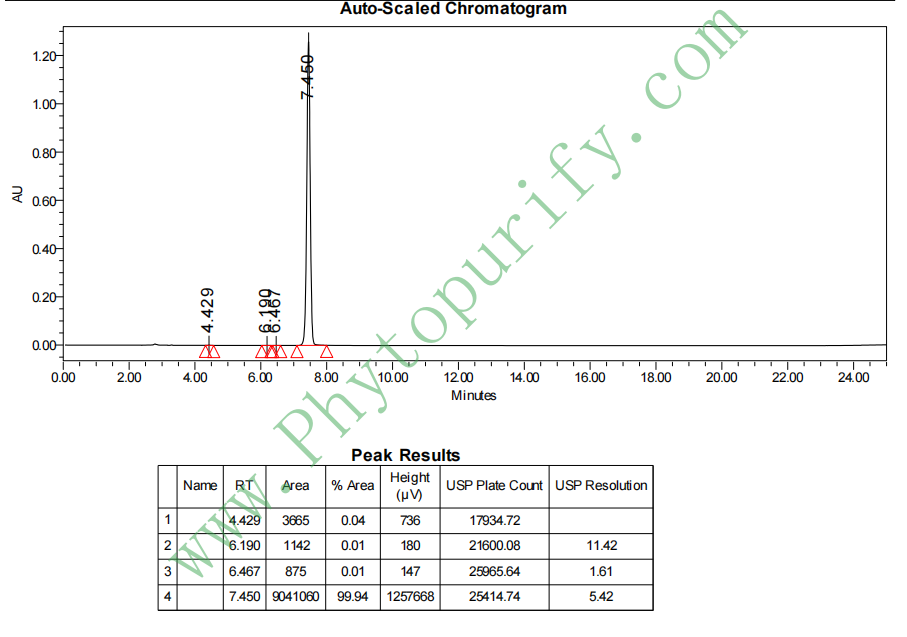
Purity: 95%~99%
Analysis Method: HPLC-DAD or/and HPLC-ELSD
Identification Method: Mass, NMR
Packing: Brown vial or HDPE plastic bottle
Can be supplied from milligrams to grams.
For Reference Standard and R&D, Not for Human Use Directly.
Inquire for bulk scale.
HPLC of L-Sinoacutine
Storage conditions:Short-term storage at 2~8℃, long-term storage at -20 ~ -80℃
L-Sinoacutine (CAS number: 4090-18-0) is a natural alkaloid derived from plants of the Sinoacutine genus, which has attracted much attention in recent years due to its significant analgesic activity. Analgesia, as a common and complex clinical treatment requirement, involves the regulation of multiple molecular targets and signaling pathways. Qingfengteng alkaloid exhibits excellent analgesic effects through a multi-target mechanism of action, and has good pharmacological parameters, making it an important research object in the fields of natural product pharmacology and new drug development. This article will systematically review the chemical structure, plant origin, pharmacological activity, mechanism of action, pharmacological evaluation, and clinical application prospects of Qingfengteng alkaloid, in order to provide theoretical basis and practical guidance for related research.
The molecular formula of Qingfengteng alkaloid is C19H25NO4, with a molecular weight of 327.38. Its structural features include a typical alkaloid skeleton containing multiple chiral centers, giving it a unique spatial configuration and biological activity. Its LogP value is 2.0644, indicating that the compound has moderate lipid solubility and is beneficial for penetrating biological membranes, especially the blood-brain barrier (BBB). The TPSA (topological polar surface area) is 59.0 Å ², further supporting its excellent membrane permeability and central nervous system (CNS) activity. The water solubility is 0.3416 mg/mL, indicating that it has a certain solubility in water, which is convenient for the development of drug formulations. Importantly, Qingfengteng alkaloid does not exhibit hERG channel inhibitory activity, indicating its high cardiac safety, and the Ames test result is negative, indicating no significant genotoxicity risk.
Qingfengteng alkaloid mainly exists in plants of the Stephania spp. genus, especially in species such as Stephania sinica. This genus of plants is widely distributed in southern China and Southeast Asia. Its roots and stems are commonly used in traditional Chinese medicine to promote blood circulation, relieve pain, dispel wind and dampness. The extraction of Qingfengteng alkaloids is usually carried out using organic solvent extraction combined with column chromatography separation technology. The specific steps include: first, crude extraction with ethanol or methanol, followed by alkaline aqueous solution separation through acid-base adjustment to remove impurities; Purification was carried out using methods such as silica gel column chromatography and reverse phase high performance liquid chromatography (RP-HPLC) to obtain high-purity Qingfengteng alkaloid. In recent years, the introduction of ultrasound assisted extraction and microwave-assisted extraction technologies has improved extraction efficiency and purity, laying the foundation for large-scale production.
The pharmacological activity of Qingfengteng alkaloid is most significant in its analgesic effect, covering various pain models including inflammatory pain, neuropathic pain, and acute pain response. In vivo experiments have shown that Qingfengteng alkaloid can significantly reduce the pain response time in mouse hot plate test and acetic acid writhing test, demonstrating its significant central and peripheral analgesic effects. Its analgesic activity is superior to some traditional nonsteroidal anti-inflammatory drugs (NSAIDs) and opioid drugs, and it has fewer side effects.
In addition, Qingfengteng alkaloids also exhibit auxiliary pharmacological effects such as anti-inflammatory, antioxidant, and neuroprotective effects. In vitro experiments have shown that it can inhibit the release of inflammatory mediators such as prostaglandin E2 (PGE2) and tumor necrosis factor - α (TNF - α), and alleviate inflammatory reactions. In the neural cell model, Qingfengteng alkaloid has a protective effect against oxidative stress-induced cell damage, indicating its potential neuroprotective function.
The analgesic mechanism of Qingfengteng alkaloid involves multi-target synergistic regulation, with the main targets including:
TRPV1 (Transient receptor potential vanillic acid subtype 1)As a key ion channel for pain perception, TRPV1 mediates thermal and chemical pain. Qingfengteng alkaloid can regulate the activity of TRPV1 channel, reduce its sensitivity to stimuli, and alleviate pain.
CNR1 (cannabinoid receptor 1)CNR1 regulates pain conduction and emotional response in the central nervous system. Qingfengteng alkaloid has a certain excitatory effect on CNR1, promoting the activation of endogenous analgesic pathways.
OPRD1 (δ - opioid receptor), OPRM1 (μ - opioid receptor), and OPRK1 (κ - opioid receptor)The opioid receptor family is the target of traditional analgesic drugs, and Qingfengteng alkaloid can partially activate these receptors to exert opioid like analgesic effects while avoiding the addiction risk of traditional opioid drugs.
PTGS1 (cyclooxygenase 1) and PTGS2 (cyclooxygenase 2)Qingfengteng alkaloids inhibit these two key inflammatory enzymes, reduce prostaglandin synthesis, and alleviate inflammatory pain.
TRPA1 (Transient receptor potential vanillic acid subtype A1)TRPA1 is involved in the perception of chemical and mechanical pain, and Qingfengteng alkaloid has a regulatory effect on it, reducing related pain.
SLC6A4 (Serotonin Transporter)By regulating serotonin levels, matrine may affect the emotional and cognitive dimensions of pain.
DRD2 (dopamine D2 receptor)The dopamine system plays an important role in pain regulation, and the action of matrine on DRD2 receptors can help alleviate pain related emotional disorders.
In summary, Qingfengteng alkaloids regulate pain signal transduction and inflammatory response through multi-target and multi pathway synergistic effects, achieving their analgesic and adjuvant therapeutic effects.
The pharmacological parameters of Qingfengteng alkaloid show that it has good potential for drug development. The molecular weight of 327.38 conforms to Lipinski's rule, with a LogP of 2.06, indicating moderate lipid solubility and favorable absorption and distribution in vivo. The TPSA is 59 Å ², supporting its ability to penetrate the blood-brain barrier and meeting the requirements for its central analgesic effect. Moderate water solubility, convenient for formulation design. The hERG channel has no inhibitory effect and reduces the potential risk of cardiac toxicity. The Ames test is negative, indicating a low risk of genetic toxicity.
Pharmacokinetic studies have shown that Qingfengteng alkaloids are rapidly absorbed after oral administration, with short peak plasma concentrations and high bioavailability. It is widely distributed in the body, especially at high concentrations in brain tissue, supporting the pharmacological activity of the central nervous system. The metabolic pathway is mainly through liver oxidation and binding reactions, and the metabolites have no significant toxicity. The half-life of Qingfengteng alkaloid is moderate and suitable for daily administration. Excretion is mainly through the kidneys and bile, with a stable excretion rate.
Given the significant analgesic activity and good safety and pharmacological properties of Qingfengteng alkaloid in various pain models, it has broad application prospects in the field of clinical analgesia in the future. Especially in the treatment of chronic pain, neuropathic pain, and inflammatory pain, vincristine is expected to become a powerful supplement to non opioid analgesics, reducing dependence on traditional analgesics and the risk of side effects.
In addition, the multi-target mechanism of action of Qingfengteng alkaloids provides the possibility for personalized precision therapy. Combined with modern drug design techniques, its structure can be further optimized to improve activity and selectivity. Future research should focus on its preclinical safety evaluation, pharmacokinetic optimization, and clinical trial design to promote its translation into clinical applications.
At the same time, by combining modern molecular biology and pharmacological techniques, in-depth analysis of the mechanism of action and signaling pathway of Qingfengteng alkaloid will provide a theoretical basis for the development of new analgesic drugs. Multidisciplinary collaboration will accelerate its clinical application process and meet the urgent demand for efficient and safe analgesic drugs in clinical practice.
Qingfengteng alkaloid, as a natural product with unique structure and significant analgesic activity, exhibits excellent pharmacological activity and good drug properties, and has the potential to become a new generation of analgesic drugs. Its multi-target and multi pathway mechanism of action provides new ideas and strategies for pain treatment. In the future, through systematic pharmacological research and clinical validation, Qingfengteng alkaloids are expected to play an important role in pain management and benefit a wide range of patients. The in-depth development of natural product pharmacology will provide a solid foundation for the pharmacological application of Qingfengteng alkaloids and similar compounds, and promote the innovation of natural product drugs to new heights.
