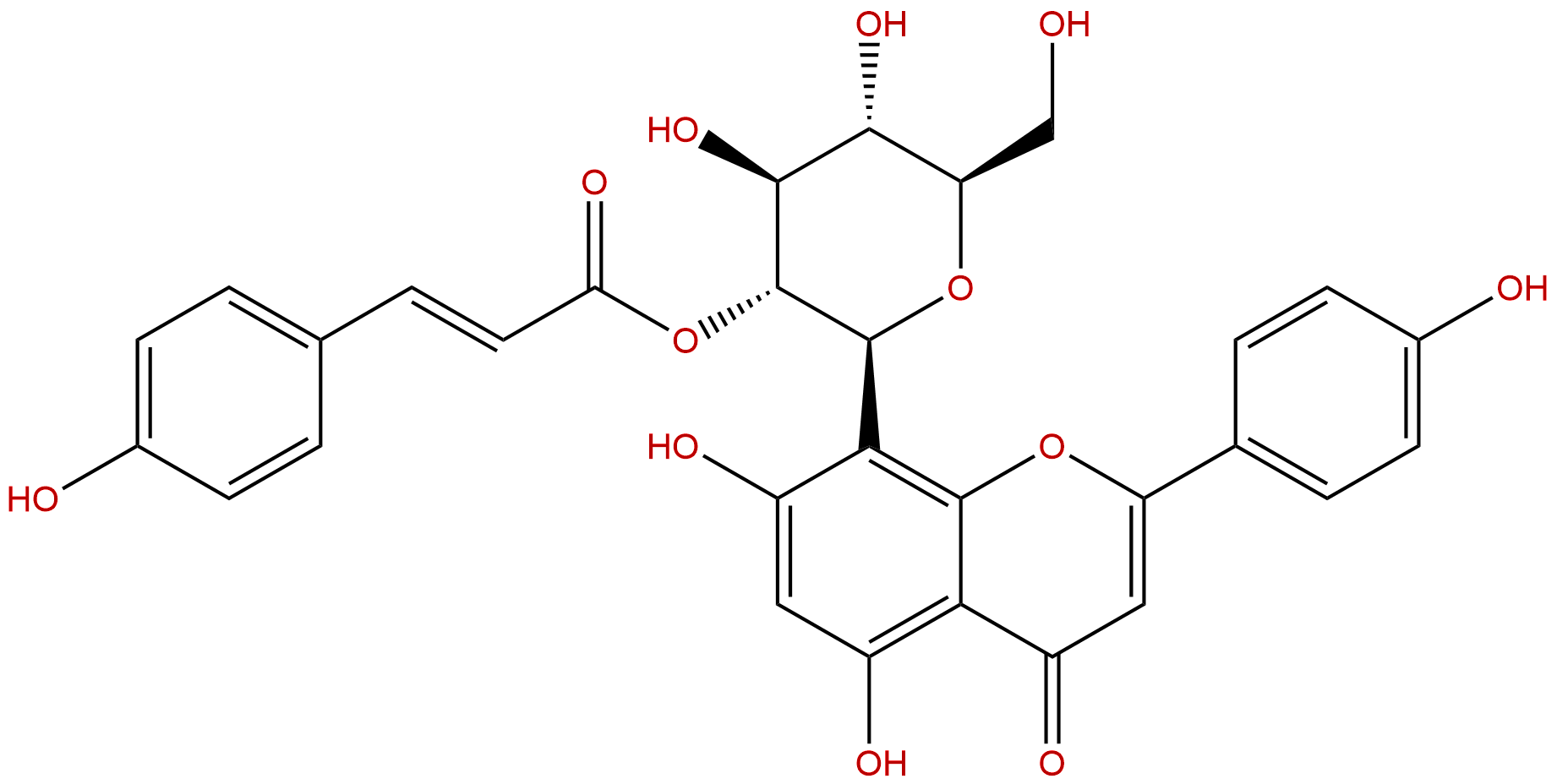


Product name: Vitexin 2''-O-p-coumarate
Synonym name:
Catalogue No.: BP3397
Cas No.: 59282-55-2
Formula: C30H26O12
Mol Weight: 578.526
Botanical Source:
Physical Description: Yellow powder
Type of Compound: Flavonoids
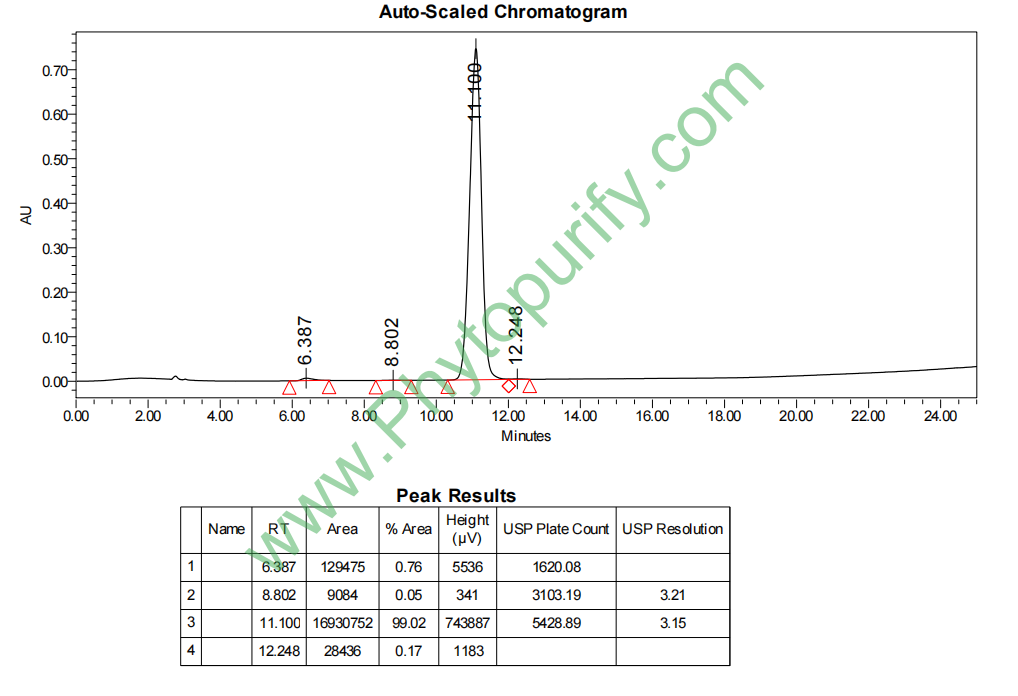
Purity: 95%~99%
Analysis Method: HPLC-DAD or/and HPLC-ELSD
Identification Method: Mass, NMR
Packing: Brown vial or HDPE plastic bottle
The product could be supplied from milligrams to grams. Inquire for bulk scale.
We provide solution to improve the water-solubility of compounds, thereby facilitating the variety of activity tests and clinic uses.
For Reference Standard and R&D, Not for Human Use Directly.
HPLC of Vitexin 2''-O-p-coumarate
Storage conditions:Short-term storage at 2~8℃, long-term storage at -20 ~ -80℃
207.3500
1.8005
1.6184
.2860
.5898
.2256
Low
88.5053
4.2325
Yes
No
No
No
Yes
Yes
0.6
Yes
Yes
Yes
Yes
Flavonoids, as one of the most widely distributed plant secondary metabolites in nature, have long been of great concern due to their diverse chemical structures and extensive biological activities. Among them, C-glycosylated flavonoids are more stable in the gastrointestinal environment compared to common O-glycosides due to their sugar groups being connected to aglycones through stable C-C bonds. They are not easily hydrolyzed by acids or enzymes, and may have better bioavailability and in vivo activity, making them a hot topic in natural product research and new drug development. Vitexin 2 '' - O-p-coumarate (V2C), CAS number 59282-55-2, is an outstanding representative of this class of compounds. It is an acylated derivative formed by further esterification reaction between vitexin at the 2 '' - O - position and p-coumaroyl. This unique structural modification significantly enhances its lipophilicity and biological activity.
V2C is widely present in various traditional medicinal plants such as Trigonella foenum graecum Linn. and Crataegus spp. These plants are commonly used in folk medicine to treat inflammation, pain, metabolic disorders, and related complications. Modern pharmacological research has gradually revealed that V2C not only inherits the antioxidant capacity based on flavonoids, but also exhibits excellent multidimensional pharmacological activities such as anti-cancer, anti-inflammatory, anti hyperalgesia, and neuroprotection. Its function involves multi-target regulation of oxidative stress, cell apoptosis, inflammatory signaling pathways, and key enzyme activities, demonstrating great potential as a lead compound for multi-target therapy. This article aims to systematically review the chemical properties, plant sources, pharmacological activities, mechanisms of action, medicinal properties, and clinical application prospects of V2C, in order to provide comprehensive scientific references for the in-depth research and development of this compound.
2 '' - O-p-coumaroyl vitexin is a structurally unique C-glycosylated flavonoid ester. Its parent nucleus is apigenin, which is 5,7,4 '- trihydroxyflavone. On the C-8 position of the mother nucleus, a glucose group is connected through a C-C bond, forming the basic skeleton of vitexin. The key structural feature of V2C is that its 2 '' - hydroxyl group (2 '' - OH) of the glucose group further undergoes esterification reaction with the carboxyl group of p-coumaric acid, forming ester bonds. Therefore, its chemical name clearly reflects this structure: the 2 '' - O-p-coumaric acid ester of vitexin.
The molecular formula of this compound is C30H26O13, with a molecular weight of 578.5260 g/mol. The introduction of coumarin significantly altered the physicochemical properties of the molecule. The calculated lipid water partition coefficient (LogP) is approximately 1.80, indicating that the molecule has a certain degree of lipophilicity but is not excessively hydrophobic, which is beneficial for its penetration into the cell membrane. Its topological polar surface area (TPSA) is as high as 207.35 Å ², mainly attributed to the numerous polar groups such as hydroxyl, carbonyl, and ether bonds in the molecule, indicating its strong hydrogen bonding ability, but may also affect its transmembrane permeability. The water solubility parameter is 0.286, indicating that its solubility in water is low and it belongs to slightly soluble or poorly soluble substances, which is a key factor to consider in its formulation development.
From the perspective of chemical stability, C-glycosidic bonds endow the core structure with good tolerance to acidic and enzymatic environments. However, the ester bond is relatively easy to hydrolyze under alkaline conditions or specific esterase action, producing vitexin and p-coumaric acid, which is one of the possible metabolic pathways in vivo and also a concern when studying its active forms.
V2C is relatively widely distributed in the plant kingdom, mainly found in the aboveground parts of various medicinal plants, especially in leaves and seeds.
Main plant sources:
1. Trigonella foenum graecum Linn This is one of the most famous and primary sources of V2C. The seeds and leaves of Huluba are rich in various flavonoids, and V2C is an important active ingredient, often used as one of the chemical markers of the plant.
2. Crataegus spp In particular, the leaves and flowers of Crataegus monogyna and Crataegus Pinnatifida contain various derivatives of vitexin, including V2C, which are considered as one of the material bases for the cardiovascular protection of hawthorn.
3. Other plants V2C has also been reported to be isolated from Pennisetum glaucum, certain ferns, and a few leguminous plants.
Extraction and Separation Methods:
Due to V2C being a moderately polar compound, its extraction and separation usually follow the conventional process of natural product chemistry and are optimized based on its characteristics.
1. Extract The most commonly used method is solvent extraction. Due to their solubility, moderately polar organic solvents or mixed solvents have higher efficiency, such as methanol, ethanol, acetone, or their mixtures with water (such as 70-80% ethanol). Technologies such as ultrasound assisted extraction (UAE) and microwave-assisted extraction (MAE) can significantly improve extraction efficiency, shorten time, and reduce solvent usage.
2. Separation and purification After the crude extract is concentrated under reduced pressure, liquid-liquid extraction (such as extraction with ethyl acetate or n-butanol) is usually used for initial enrichment. Further purification is highly dependent on chromatographic techniques. Column chromatography (CC) is a conventional method, often using silica gel, polyamide, or macroporous adsorption resins (such as D101, AB-8) as stationary phases, and gradient elution systems such as chloroform methanol or petroleum ether ethyl acetate for separation. High performance liquid chromatography (HPLC), especially preparative HPLC (Prep HPLC), is the final key step in obtaining high-purity V2C monomers. It is often performed using a reverse phase C18 chromatography column with methanol water or acetonitrile water (pH adjusted with a small amount of formic acid or acetic acid) as the mobile phase for elution. High speed counter current chromatography (HSCCC), as a solid-liquid distribution chromatography technique without solid carriers, has also been used for the separation of V2C due to its high recovery rate and large preparation capacity.
3. appraisal The isolated compounds were structurally confirmed by UV spectroscopy (UV, flavonoid characteristic absorption), mass spectrometry (MS, providing molecular weight and fragment ion information), and nuclear magnetic resonance spectroscopy (NMR, especially 1H NMR and 13C NMR), and compared with literature data or standards.
Numerous in vitro and in vivo studies have confirmed that V2C has broad and significant pharmacological activities, covering multiple therapeutic fields.
1. Antioxidant activity
V2C is a potent natural antioxidant. The phenolic hydroxyl groups in its molecular structure (especially the 4 '- OH in the B ring and the 5,7-dihydroxy in the A ring) are active sites that provide hydrogen atoms or electrons, and can effectively scavenge free radicals (such as DPPH, ABTS ⁺, superoxide anions, hydroxyl radicals). Research has shown that its antioxidant capacity is superior to that of its aglycone apigenin and precursor vitexin, thanks to the introduction of coumarin which increases the conjugation system and enhances the electron delocalization ability, thereby stabilizing phenolic oxygen radicals. In cell models, V2C can significantly alleviate oxidative damage induced by oxidants such as hydrogen peroxide (H ₂ O ₂) and tert butyl hydroperoxide (t-BHP), and improve cell survival rate.
2. Anti inflammatory activity
V2C exhibits strong anti-inflammatory effects. In the lipopolysaccharide (LPS) - induced macrophage (such as RAW 264.7) inflammation model, V2C can dose dependently inhibit the production of nitric oxide (NO), prostaglandin E2 (PGE2), and key pro-inflammatory cytokines such as tumor necrosis factor - α (TNF - α), interleukin-6 (IL-6), and IL-1 β. In animal models, acute or chronic inflammation models such as rat paw swelling induced by carrageenan or Freund's complete adjuvant, and mouse ear swelling induced by xylene, V2C intraperitoneal injection or gavage administration can significantly reduce inflammation and tissue edema.
3. Anti hyperalgesia and analgesic activity
Pain hypersensitivity is closely related to the inflammatory process. Research has shown that V2C has analgesic and anti hyperalgesia effects in various pain models. For example, in formalin tests (evaluating central and peripheral analgesic effects) and acetic acid writhing tests (evaluating visceral pain), V2C can significantly reduce pain behavioral responses. More importantly, in neuropathic pain models such as chronic sciatic nerve compression injury models, V2C can effectively alleviate mechanical and thermal hyperalgesia, and its effect is comparable to first-line drugs such as gabapentin, with possibly fewer side effects, indicating its potential in the treatment of refractory neuropathic pain.
4. Antitumor activity
V2C showed growth inhibitory and pro apoptotic activities on a variety of human cancer cell lines, including breast cancer (MCF-7), liver cancer (HepG2), lung cancer (A549), colon cancer (HT-29) and leukemia (HL-60) cells. Its anti-cancer mechanism involves inducing cell cycle arrest (usually in G2/M or S phase), activating mitochondrial dependent apoptosis pathway (upregulating Bax/Bcl-2 ratio, activating caspase-3/9), increasing intracellular reactive oxygen species (ROS) to toxic levels, and inhibiting cell migration and invasion. It is worth noting that V2C has relatively low toxicity to certain normal cells and exhibits a certain degree of selectivity.
5. Neuroprotective activity
In neurological disease models, V2C exhibits protective potential. In the Alzheimer's disease cell model induced by β - amyloid protein (A β), V2C can alleviate neuronal toxicity and improve cell viability. In animal models of Parkinson's disease induced by ischemia/reperfusion brain injury or MPTP, V2C pretreatment can reduce infarct area, improve neurological function scores, and protect dopaminergic neurons. Its neuroprotective effect is closely related to antioxidant, anti apoptotic, and anti-inflammatory mechanisms.
6. Other potential activities
Preliminary studies also suggest that V2C may have activities such as lowering blood sugar, improving insulin resistance, protecting the cardiovascular system (such as anti myocardial ischemia), and antimicrobial activity, but further research is needed in these areas.
The multiple pharmacological activities of V2C stem from its diverse regulation of cellular signaling pathways, and its targets are widely distributed in key pathways such as antioxidant defense, inflammatory response, cell apoptosis, and survival.
1. Antioxidant and Nrf2/ARE pathway activation
V2C is an effective activator of the Nrf2 (NFE2L2) signaling pathway. In the resting state, Nrf2 binds to its inhibitory protein Keap1 in the cytoplasm and is degraded by ubiquitination. V2C may promote the dissociation of Nrf2 from Keap1 by modifying its cysteine residues, leading to translocation to the nucleus. In the nucleus, Nrf2 binds to antioxidant response elements (ARE) and initiates the transcriptional expression of a series of downstream phase II detoxifying enzymes and antioxidant proteins, including:
- Heme oxygenase-1 (HMOX1)Catalytic degradation of hemoglobin, producing bilirubin and carbon monoxide with antioxidant and anti-inflammatory effects.
- Superoxide dismutase (SOD1, SOD2)Catalytic conversion of superoxide anions into hydrogen peroxide.
- Catalase (CAT) and Glutathione peroxidase 1 (GPX1)Eliminate hydrogen peroxide and prevent the generation of hydroxyl radicals.
- Glutamine cysteine ligase catalytic subunit (GCLC)Promote glutathione (GSH) synthesis.
Through this core pathway, V2C systematically enhances the antioxidant defense ability of cells, which is the fundamental mechanism for combating oxidative stress-related diseases such as neurodegenerative diseases and ischemia-reperfusion injury.
2. Anti inflammation and inhibition of NF - κ B and MAPK pathways
The anti-inflammatory effect of V2C is mainly achieved by inhibiting the NF - κ B and MAPK signaling pathways.
- NF - κ B pathway Under stimulation such as LPS, the I κ B kinase (IKK) complex is activated, phosphorylated, and degraded, releasing NF - κ B (p65/p50 dimer) into the nucleus and initiating pro-inflammatory gene transcription. V2C can inhibit IKK activity, prevent I κ B α degradation and p65 nuclear translocation, thereby downregulating the expression of iNOS (producing NO), COX-2 (producing PGE2), as well as cytokines such as TNF - α and IL-6.
- MAPK pathway V2C can inhibit LPS induced phosphorylation activation of p38 MAPK, JNK, and ERK1/2. The inhibition of these kinases further affects the activity of transcription factors such as AP-1, synergistically inhibiting the production of inflammatory mediators.
3. Mechanisms of anti hyperalgesia
The mechanism of its analgesic effect is complex, involving both peripheral and central levels:
- peripheral Inhibit the production of pro-inflammatory mediators (such as PGE2 and cytokines) at the site of inflammation, and reduce sensitization of nociceptors.
- Center Possible involvement in regulating the activation of spinal dorsal horn microglia and astrocytes, inhibiting the Toll like receptor 4 (TLR4)/NF - κ B pathway, and reducing the release of central sensitization related substances (such as brain-derived neurotrophic factor BDNF). In addition, the potential regulatory effects on the glutamatergic system, opioid receptors, or cannabinoid receptors also need to be explored.
4. Molecular targets for anti-tumor effects
In addition to the classic pathways of inducing apoptosis and cycle arrest, the anticancer mechanism of V2C also involves:
- Matrix metalloproteinases (MMPs)V2C can inhibit the expression and activity of MMP-1, MMP-3, MMP-9, etc., which is the key to its inhibition of tumor cell invasion and metastasis.
- Tyrosinase (TYR)In certain melanoma models, inhibition of TYR activity may interfere with melanin synthesis and tumor progression.
- PI3K/Akt/mTOR pathway This pathway is the core of cell growth, proliferation, and survival. V2C has been reported to inhibit the phosphorylation of Akt, thereby downregulating its downstream pro survival signals.
5. Multi target synergy for neuroprotection
In neuroprotection, the above-mentioned antioxidant (activating Nrf2), anti-inflammatory (inhibiting NF - κ B), and anti apoptotic (regulating Bcl-2 family, inhibiting caspase) mechanisms work together. In addition, it may also protect neurons by regulating the expression of neurotrophic factors, inhibiting glutamate excitotoxicity, and maintaining mitochondrial functional integrity.
Although V2C has excellent pharmacological activity, whether it can become a drug still needs to undergo systematic pharmacological evaluation.
Analysis of drug properties parameters based on calculations and preliminary experiments:
- Molecular weight (578.5)Slightly higher than the 500 Da upper limit recommended by Lipinski's "Five Rules", but many successful drugs also exceed this limit.
- LogP (1.80)Being within the ideal range (1-3) indicates good membrane permeability.
- TPSA (207.4 Ų)Significantly higher than the upper limit commonly believed to be easily permeable (about 140 Å ²), this strongly suggests that its oral absorption may be poor and its ability to cross the blood-brain barrier (BBB) may be weak. This is consistent with the description of "blood-brain barrier: low" and is the main obstacle that needs to be overcome when treating central nervous system diseases.
- Water solubility (0.286)Poor, affecting its formulation development and in vivo dissolution and absorption.
- Preliminary safety indicators HERG inhibition is' no ', indicating a low risk of potential cardiac toxicity (causing QT interval prolongation), which is a favorable safety signal. The Ames test value is 0.6 (usually considered positive if it is greater than 1.5), indicating a low risk of mutagenicity, but further in vitro and in vivo genetic toxicity testing is needed to confirm.
Current status of pharmacokinetics (ADME) research:
At present, pharmacokinetic studies on V2C systems are relatively limited, with information mostly based on speculation of similar compounds and a small amount of preliminary research.
- absorb Due to its large TPSA and low solubility, it is predicted that its oral bioavailability may not be high. The ester bond may be partially hydrolyzed by esterase in the intestine, and the absorbed form may be V2C itself or its metabolites (vitexin, coumaric acid). The use of nano formulations (such as liposomes, nanoparticles), phospholipid complexes, or cyclodextrin inclusion techniques to improve their solubility and permeability is an effective strategy for improving their oral absorption.
- distribution Due to its lipophilic nature, it may be widely distributed in tissues rich in blood vessels, but limited by high TPSA, its entry into the brain and central nervous system may be limited. Targeted delivery systems, such as brain targeted nanocarriers, are key to enhancing their neuroprotective efficacy.
- Metabolism As an ester compound, V2C is likely to be hydrolyzed by carboxylesterases in the liver and blood into its main metabolites, vitexin and p-coumaric acid. In addition, the flavonoid mother nucleus may undergo typical II binding reactions (glucuronidation, sulfation). The C-glycosidic bond makes it more tolerant to hydrolysis by gut microbiota than O-glycosides.
- excretion Metabolites are mainly excreted through urine and bile.
In summary, V2C is a lead compound with strong activity and promising safety, but its poor solubility and permeability are the main bottlenecks for its drug development. Future research needs to focus on improving its pharmacokinetic properties through formulation strategies and conducting comprehensive preclinical ADME and toxicological evaluations.
V2C, as a natural active molecule with multiple targets and functions, has broad development prospects in various disease fields, but also faces many challenges.
Potential clinical application directions:
1. Treatment of neuropathic pain: Its remarkable anti hyperalgesia effect, especially in the nerve injury model, makes it hopeful to develop into a new, non opioid, non gabapentin analgesic drug for the treatment of diabetes neuralgia, post herpetic neuralgia, etc., which may have better tolerance and less central side effects.
2. Adjuvant treatment/prevention of neurodegenerative diseases Based on its powerful antioxidant and anti-inflammatory neuroprotective effects, V2C may be developed as an adjuvant therapy or nutritional supplement for Alzheimer's disease and Parkinson's disease, aimed at delaying disease progression and protecting neurons.
3. Treatment of inflammation related diseases Chronic inflammatory diseases such as rheumatoid arthritis and inflammatory bowel disease can be treated by V2C by inhibiting pathways such as NF - κ B.
4. Adjuvant therapy and chemoprevention of tumors As a natural product, V2C can be used in combination with conventional chemotherapy drugs, which may enhance sensitivity, reduce toxicity, or be used for chemoprevention of certain cancers.
5. Functional food and cosmetic additives Its potent antioxidant activity allows it to be used as an ingredient in advanced functional foods (health foods) or in cosmetics for anti-aging and anti photodamage.
Challenges and future research directions:
1. Pharmacokinetic optimization This is the biggest obstacle for V2C to enter clinical practice. It is necessary to invest in the research and development of advanced drug delivery systems, such as self microemulsions, solid dispersions, nanocrystals, prodrug modifications, etc., to improve their solubility, stability, and bioavailability. It is crucial to develop targeted delivery technologies that can cross the blood-brain barrier for brain diseases.
2. Deep analysis of the mechanism of action Although some targets and pathways are known, the direct interaction mode and precise binding site between V2C and key target proteins such as Keap1 and IKK are still unclear. Further research is required using techniques such as molecular docking, surface plasmon resonance (SPR), and chemical proteomics.
3. Systematic Toxicological Evaluation Comprehensive preclinical toxicology studies are required, including acute toxicity, subchronic toxicity, reproductive toxicity, genetic toxicity, etc., to clarify their safe dose range.
4. Lack of clinical research evidence At present, all activity data come from preclinical studies, and it is urgent to design rigorous clinical trials to verify its effectiveness, safety, and pharmacokinetic characteristics in humans.
5. Sustainable sources and synthesis Extracting content from plants is limited and costly. Exploring the use of synthetic biology techniques (such as heterologous synthesis in microorganisms) or developing efficient chemical/enzymatic routes for total or semi synthesis is of great significance for ensuring its large-scale supply.
2 '' - O-p-coumaroyl vitexin (V2C) is a structurally novel and biologically active C-glycosylated flavonoid ester. It ingeniously combines the advantages of apigenin core, C-glycosylation, and phenolic acyl groups, exhibiting powerful pharmacological effects beyond its precursor compounds, including antioxidant, anti-inflammatory, analgesic, anticancer, and neuroprotective effects. Its multi-target action characteristics, especially its effective regulation of core signaling pathways such as Nrf2/ARE and NF - κ B, provide a solid scientific basis for its treatment of oxidative stress and inflammation related diseases (such as neuropathic pain, neurodegenerative diseases, chronic inflammation).
However, its inherent pharmacological defects, especially low water solubility and membrane permeability, limit its bioavailability and delivery to target tissues, becoming the main bottleneck for its drug conversion. Future research should form a dual wheel drive model of "deep exploration of active mechanisms" and "innovation driven formulation technology". On the one hand, utilizing multi omics and high-throughput screening techniques to further elucidate its system pharmacology network and potential new targets; On the other hand, we will vigorously develop new drug delivery strategies to overcome their ADME shortcomings. At the same time, promote preclinical safety evaluation of the system and ultimately move towards clinical research.
In summary, V2C is a highly valuable natural lead compound for development. With the continuous deepening of interdisciplinary research and the gradual breakthrough of technological bottlenecks, it is expected to transform from an interesting phytochemical into a new type of drug or key functional ingredient for treating major human diseases, playing an important role in the pharmaceutical and health industries.
