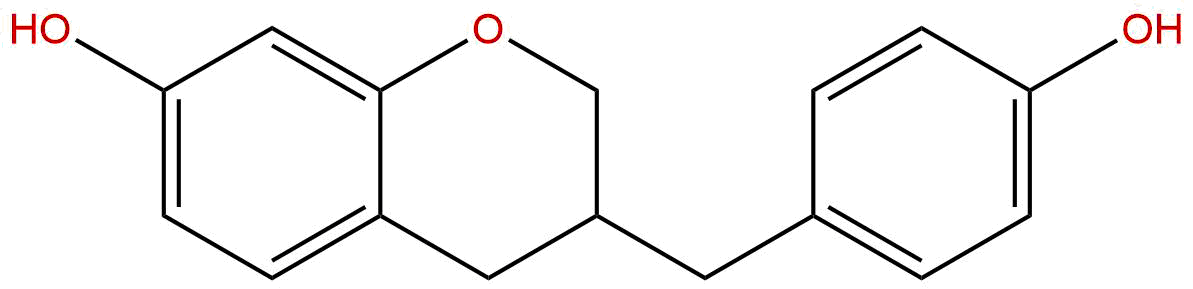


Product name: 7,4'-Dihydroxyhomoisoflavane
Synonym name:
Catalogue No.: BP4785
Cas No.: 148462-00-4
Formula: C16H16O3
Mol Weight: 256.301
Botanical Source:
Type of Compound: Flavonones
Purity: 95%~99%
Analysis Method: HPLC-DAD or/and HPLC-ELSD
Identification Method: Mass, NMR
Packing: Brown vial or HDPE plastic bottle
Storage: Store in a well closed container, protected from air and light. Put into refrigerate or freeze for long term storage.
Whenever possible, you should prepare and use solutions on the same day. However, if you need to make up stock solutions in advance, we recommend that you store the solution as aliquots in tightly sealed vials at -20℃. Generally, these will be useable for up to two weeks.
The product could be supplied from milligrams to grams
Inquire for bulk scale.
For Reference Standard and R&D, Not for Human Use Directly.
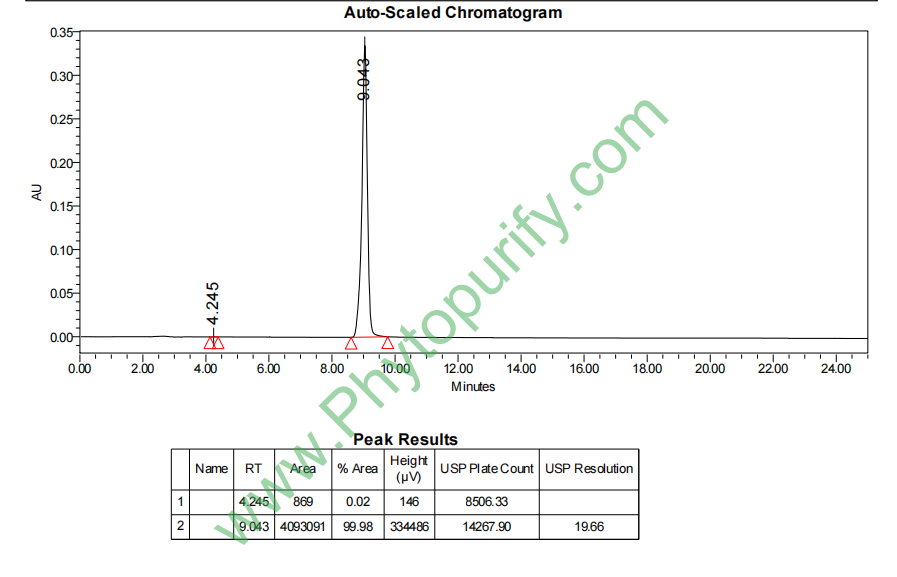
HPLC of 7,4'-Dihydroxyhomoisoflavane
Storage conditions:Short-term storage at 2~8℃, long-term storage at -20 ~ -80℃
49.6900
3.4378
3.4352
.1042
4.8104
9.3926
High
90.3580
2.6511
No
Yes
Yes
No
Yes
No
0.0
Yes
Yes
Yes
Yes
As an important treasure trove for drug discovery and development, natural products continue to provide modern medicine with lead compounds with novel structures and diverse activities. Isoflavones, as an important class of plant secondary metabolites, are widely distributed in plants such as legumes and lilies, and have attracted much attention due to their diverse biological activities. 7,4 '- Dihydroxyhomoisoflurane (CAS: 148462-00-4) is a structurally unique member of the isoflurane family. Compared to classical isoflavones, its core skeleton has an additional carbon atom on the C ring, forming a homoisoflurane structure. This subtle structural difference often leads to a unique spectrum of biological activity.
In recent years, with the in-depth study of endocrine system diseases, especially estrogen related diseases (such as menopausal syndrome, osteoporosis, breast cancer, etc.), finding estrogen receptor modulators with high selectivity and low side effects has become a research hotspot. 7,4 '- dihydroxy high isoflavones have gradually entered the field of pharmacologists due to their multi-target potential in estrogen regulation. Preliminary studies have shown that it not only interacts with classical estrogen receptors (ESR1, ESR2), but may also affect sex hormone binding globulin (SHBG), aromatase (CYP19A1), and hypothalamic pituitary gonadal axis related targets (such as FSHR, LHB), suggesting that it has a complex and intricate regulatory network in regulating hormone balance in the body. This article aims to provide a systematic review of the chemical properties, plant sources, pharmacological activities, mechanisms of action, pharmacological properties, and clinical application prospects of 7,4 '- dihydroxy homoisoflavones, in order to provide comprehensive scientific references for the in-depth research and potential drug development of this compound.
The molecular formula of 7,4 '- dihydroxy high isoflurane is C ₁₆ H ₁₆ O3, with a molecular weight of 256.3010. Its chemical structure belongs to the class of high isoflavones, and its basic skeleton consists of three rings: A, B, and C. Compared with typical isoflavones (such as daidzein), its C ring is a chroman ring (benzodihydropyran ring), and is connected to the B ring through a methylene group (- CH ₂ -) at the 3rd position of the C ring, forming a "high" structure (i.e. one more CH ₂ unit than isoflavones). The characteristic substituents of this compound are two phenolic hydroxyl groups at the 7th position of the A ring and the 4 'position of the B ring, which are key pharmacophores for its antioxidant and estrogen receptor binding effects.
Its physical and chemical properties determine its bioavailability and in vivo distribution. The calculated lipid water partition coefficient (LogP) is 3.4378, indicating that the compound has moderate lipophilicity, which facilitates transmembrane transport and binding to hydrophobic protein targets. The topologically polar surface area (TPSA) is 49.6900 Å ², which is relatively small, consistent with its structure of only two phenolic hydroxyl groups, indicating good membrane permeability. The predicted value of water solubility is relatively low, about 0.1042 mg/mL, indicating that solubilization strategies (such as making cyclodextrin inclusion complexes, nano formulations, or prodrugs) may need to be considered in formulation development to improve their oral bioavailability. It is worth noting that its blood-brain barrier (BBB) penetration is predicted to be "high", which means that the compound may act on the central nervous system, providing a structural basis for the treatment of estrogen related neurodegenerative diseases or emotional disorders. In addition, preliminary pharmacological risk assessment showed that the hERG inhibition and Ames mutagenicity risks were both negative ("no" and "0.0", respectively), providing preliminary positive signals for its safety as a drug candidate.
7,4 '- dihydroxy high isoflavones are not widely distributed compounds and are mainly isolated from specific medicinal plants. According to literature reports, this compound mainly exists in some genera of the Liliaceae family, such as Fritillaria genus(Fritillaria Spp.) and Xia Fengxinzi genus(Galtonia The bulb or aboveground part of a plant. These plants are often used in traditional medicine to treat cough, inflammation, and related diseases. In addition, sporadic discoveries have also been made in individual species of Fabaceae and Orchidaceae.
Its extraction and separation usually follow the conventional process of natural product chemistry. Firstly, the dried plant material is crushed and subjected to cold soaking or heating reflux extraction using polar organic solvents such as methanol, ethanol, or acetone. After vacuum concentration, the crude extract was subjected to liquid-liquid distribution extraction using solvents such as petroleum ether, ethyl acetate, and n-butanol to preliminarily enrich components of different polarities. 7,4 '- dihydroxy high isoflurane is usually enriched in the ethyl acetate extraction site.
Further purification relies on various chromatographic techniques. Silica gel column chromatography is commonly used for preliminary separation, with different ratios of petroleum ether ethyl acetate or chloroform methanol gradient elution. Then, fine purification was carried out by combining reversed-phase silica gel column chromatography (such as C18 packing, eluted with methanol water system), dextran gel column chromatography (Sephadex LH-20, eluted with methanol or methanol chlorine mixed solvent) and high performance liquid chromatography (HPLC, semi prepared or prepared). The structural identification mainly relies on modern spectroscopic techniques, including nuclear magnetic resonance (¹ H NMR, ¹ ³ C NMR, 2D NMR such as HSQC, HMBC), mass spectrometry (ESI-MS, HR-ESI-MS), and ultraviolet spectroscopy (UV). Its unique high isoflurane skeleton and 7,4 '- dihydroxy substitution mode can be confirmed by the characteristic proton and carbon signals in NMR, as well as key correlation peaks in HMBC spectra.
A large number of in vitro and limited in vivo studies have shown that 7,4 '- dihydroxy isoflavones have various pharmacological activities, among which estrogen like activity is the most prominent.
The pharmacological effects of 7,4 '- dihydroxy high isoflavones stem from their interactions with multiple molecular targets, forming a network that regulates estrogen signaling and endocrine balance.
Based on its calculations and preliminary experimental data, a preliminary evaluation was conducted on the pharmacological properties of 7,4 '- dihydroxy high isoflavones.
The multi-target estrogenic regulatory properties of 7,4 '- dihydroxy isoflavones have broad prospects for their application in various disease fields, but they also face many challenges.
Potential clinical application directions:
Future research prospects:
As a structurally unique natural product of high isoflavones, 7,4 '- dihydroxy high isoflavones exhibit broad pharmacological potential in relieving menopausal symptoms, preventing and treating osteoporosis, and assisting in the treatment of hormone dependent tumors and neurodegenerative diseases, thanks to their ability to act on the estrogen regulatory network with multiple targets. Its excellent blood-brain barrier penetration and preliminary safety prediction have added unique development value to it. However, its low water solubility and potential rapid metabolism issues are key obstacles that it must overcome on the path to becoming a drug. Future research should focus on using interdisciplinary approaches to deeply analyze its molecular action profile, and utilizing modern medicinal chemistry and pharmaceutical technology to optimize and transform it. With the continuous deepening of research, 7,4 '- dihydroxy high isoflurane is expected to develop from an interesting natural product molecule into a candidate drug or lead compound with clear clinical application value, providing new options for the treatment of related diseases.
