


Product name: Teprenone
Synonym name: Geranylgeranylacetone [mixture of (5E,9E,13E)- and (5Z,9E,13E)- isomers]
Catalogue No.: BP2100
Cas No.: 6809-52-5
Formula: C23H38O
Mol Weight: 330.556
Botanical Source:
Type of Compound: Aliphatics
Purity: 95%~99%
Analysis Method: HPLC-DAD or/and HPLC-ELSD
Identification Method: Mass, NMR
Packing: Brown vial or HDPE plastic bottle
Storage: Store in a well closed container, protected from air and light. Put into refrigerate or freeze for long term storage.
Whenever possible, you should prepare and use solutions on the same day. However, if you need to make up stock solutions in advance, we recommend that you store the solution as aliquots in tightly sealed vials at -20℃. Generally, these will be useable for up to two weeks.
The product could be supplied from milligrams to grams
Inquire for bulk scale.
For Reference Standard and R&D, Not for Human Use Directly.
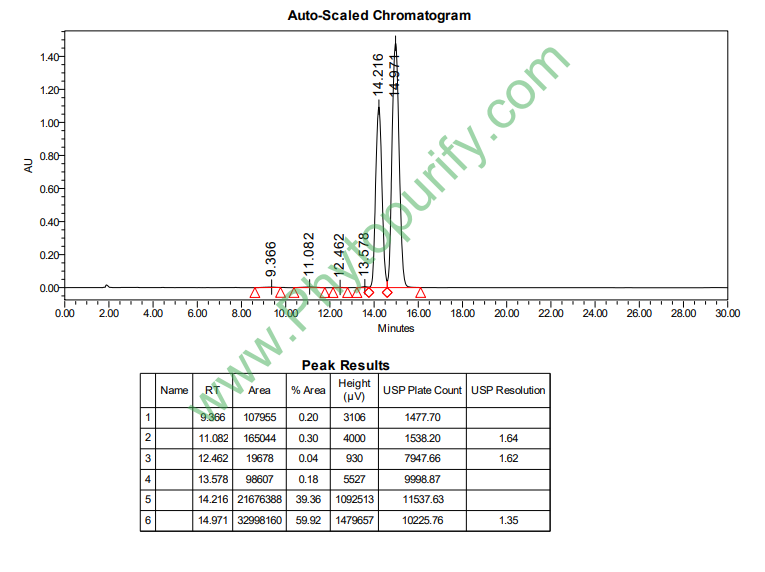
HPLC of Teprenone
Storage conditions:Short-term storage at 2~8℃, long-term storage at -20 ~ -80℃
17.0700
7.6246
7.6263
.0007
7.7734
8.2821
High
92.1707
2.8364
Yes
Yes
No
No
No
No
0.0
No
Yes
Yes
Yes
Teprenone (CAS number: 6809-52-5), as a natural derivative compound with multiple pharmacological activities, has attracted widespread attention in the fields of anti ulcer and multi organ protection in recent years. Its main mechanism of action is to induce the expression of Heat Shock Proteins (HSPs), especially Hsp70, which in turn exerts a cellular protective effect. Teprenone not only shows significant efficacy in gastric mucosal protection and anti ulcer treatment, but also demonstrates protective potential for the liver, nervous system, kidneys, and heart, demonstrating its unique advantages as a multi-target drug. This article will systematically review the chemical structure and physicochemical properties, plant sources and extraction methods, pharmacological activity research, mechanism of action and molecular targets, pharmacological evaluation and pharmacokinetic characteristics of teprenone, and explore its clinical application prospects and future development directions.
Teprenone is a terpene ketone compound with a molecular formula of C2H34O and a molecular weight of 330.5560. Its structural feature is that the (9E, 13E) - geranyl group is bonded to one of the α - methyl groups of acetone, and there are two geometric isomers, 5E and 5Z, mixed in a 3:2 ratio. This compound belongs to terpenes and methyl ketones, containing typical geranyl groups that endow it with high hydrophobicity.
In terms of physicochemical properties, the LogP value of teprenone is as high as 7.6246, indicating its strong lipid solubility and extremely low water solubility (0.0007), which has important implications for its in vivo distribution and pharmacokinetics. The extremely low polar surface area (TPSA of 17.07) and high lipid solubility make it easy to penetrate the blood-brain barrier (BBB), and experimental data confirms its high BBB penetration ability. In addition, teprenone does not exhibit hERG channel inhibitory activity and the Ames mutagenicity test is negative, indicating its high safety and good potential for drug development.
Teprenone was initially isolated from natural plant terpenoids, although its specific plant sources are limited, it is usually prepared through semi synthetic methods. Its parent structure is mainly derived from natural products of terpenes based on aromatic leaves, which are widely present in various aromatic plants such as Citronella oil and Lemongrass oil.
The extraction method mainly relies on the distillation extraction of plant volatile oils, followed by the separation and purification techniques such as column chromatography to obtain the precursor of terpenes from aromatic leaves. The synthesis of teprenone is often achieved through chemical synthesis routes, which involve structural modification of terpenes and introduction of ketone groups. Modern preparation techniques emphasize efficiency, greenness, and controllability to meet the needs of industrial production.
The pharmacological activity research of teprenone covers multiple aspects such as anti ulcer, liver protection, neuroprotection, kidney protection, and heart protection.
As an anti ulcer drug, the main function of teprenone is to promote the repair and protection of gastric mucosa. Numerous in vitro and in vivo experiments have shown that teprenone can enhance the gastric mucosal barrier function, promote mucus secretion, inhibit excessive gastric acid secretion, and alleviate oxidative stress and inflammatory reactions in gastric mucosal cells by inducing Hsp70 expression, thereby effectively preventing and treating gastritis and gastric ulcers.
Teprenone has shown significant protective effects in liver disease models, reducing liver cell damage and promoting liver cell regeneration. Its mechanism mainly includes antioxidant, anti-inflammatory, and regulation of cell apoptosis. By inducing Hsp70, teprenone enhances the tolerance of liver cells to various harmful stimuli and reduces the progression of liver fibrosis.
The neuroprotective effect is an emerging field in the research of teprenone. Research has shown that teprenone can alleviate neuroinflammation and oxidative stress by regulating the expression of heat shock proteins in nerve cells, protecting neurons from damage. It has potential therapeutic value in neurodegenerative diseases and models of cerebral ischemia-reperfusion injury.
Toprenone also exhibits protective effects on the kidneys and heart. In the renal injury model, teprenone reduces tubular cell damage by inhibiting inflammatory factors and oxidative stress. In terms of cardiac protection, it can alleviate myocardial ischemia-reperfusion injury, improve myocardial function, and prevent myocardial cell apoptosis.
The core mechanism of action of teprenone is to induce the expression of heat shock protein Hsp70. As a molecular partner, Hsp70 can stabilize protein structure, promote the repair and degradation of damaged proteins, and enhance cell tolerance to various stresses. In addition, teprenone exerts its multi-target effects by regulating multiple signaling pathways.
The targets of teprenone in gastritis and related diseases include:
Teprenone achieves its multiple protective effects by regulating the aforementioned targets, inhibiting inflammatory responses, reducing oxidative stress, and promoting cell repair.
The action of teprenone involves multiple signaling pathways, especially the regulation of NF - κ B and MAPK signaling pathways. By inhibiting the activation of NF - κ B, teprenone reduces the expression of pro-inflammatory factors and alleviates inflammatory responses; By regulating the MAPK pathway, it promotes cell survival and repair. In addition, teprenone activates the AKT signaling pathway and enhances cell anti apoptotic ability.
The pharmacological evaluation of teprenone shows that it has good safety and pharmacological basis. Although its high lipid solubility (LogP=7.62) may affect oral absorption, it is also beneficial for penetrating biological membranes, especially the blood-brain barrier, supporting the realization of its neuroprotective effect. The low polarity surface area (TPSA=17.07) further enhances its membrane permeability.
The extremely low water solubility (0.0007) suggests that the distribution of teprenone in the body may be biased towards a lipid environment, and appropriate formulation techniques are needed to improve its bioavailability. The high permeability of the blood-brain barrier gives it potential advantages in the treatment of central nervous system diseases.
In terms of safety, teprenone did not exhibit hERG channel inhibition, reducing the risk of cardiac toxicity; A negative Ames test indicates no significant mutagenicity and meets clinical drug safety requirements.
Pharmacokinetic studies have shown that after oral administration, teprenone is absorbed quickly and widely distributed, especially enriched in the liver and gastric mucosa. Its metabolism is mainly carried out through the liver enzyme system, and the activity of metabolites still needs further research. The main excretion pathways are bile and feces, with a moderate half-life, supporting the design of daily dosing regimens.
As a multifunctional natural derivative drug, teprenone has been widely used in clinical anti ulcer treatment, especially in patients with gastritis and gastric ulcers, showing good efficacy and safety. Its unique Hsp70 induction mechanism provides a new therapeutic strategy for traditional anti ulcer drugs, especially suitable for gastric mucosal protection and repair.
In addition, the potential of teprenone in the fields of liver disease, neurodegenerative diseases, kidney and heart protection is gradually being recognized. In the future, with the in-depth analysis of its mechanism of action and pharmacokinetic optimization, teprenone is expected to expand to more indications, especially for the comprehensive treatment of neurological diseases and multi organ protection.
The improvement of formulation technology, such as nanocarriers and liposome encapsulation, is expected to overcome their poor water solubility and enhance their bioavailability and targeting. The combination therapy strategy is also a future research focus, which enhances the therapeutic effect by synergizing with anti-inflammatory and antioxidant drugs.
The clinical trial design needs to be further improved, especially for the clinical validation of neuroprotection and liver protection, in order to promote the expansion of indications and deepening of clinical application of teprenone.
As a unique natural derivative of terpenoids, teprenone exhibits a wide range of pharmacological activities and good safety due to its mechanism of inducing heat shock protein expression. Its successful application in the treatment of ulcers has laid the foundation, and its potential in the fields of liver, nerve, kidney, and heart protection is worth further exploration in the future. Through chemical modification, formulation optimization, and multi-target mechanism research, teprenone is expected to become an important drug in the field of multi organ protection, providing new ideas and solutions for the treatment of related diseases. Continued basic and clinical research will drive further expansion of its clinical applications, benefiting more patients.
