


Name: Songorine
Synonym name: Zongorine; Napellonine; Shimoburo base I; Bullatine G
Catalogue No.: BP0293
Cas No.: 509-24-0
Formula: C22H31NO3
Mol Weight: 357.494
Botanical Source: Alkaloid from Root of Aconitum soongoricum and Aconitum monticola, the above-ground parts of Aconitum karakolicum, and from the Chinese drug ``Fuzi" (Aconitum carmichaeli) (Ranunculaceae)
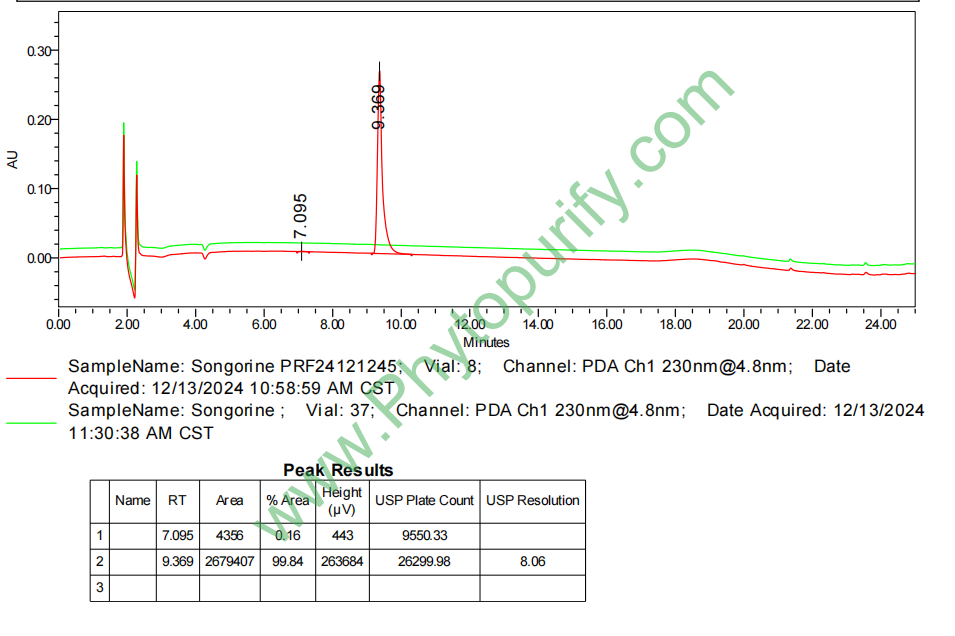
Purity: 95%~99%
Analysis Method: HPLC-DAD or/and HPLC-ELSD
Identification Method: Mass, NMR
Packing: Brown vial or HDPE plastic bottle
Can be supplied from milligrams to grams.
For Reference Standard and R&D, Not for Human Use Directly.
Inquire for bulk scale.
HPLC of Songorine
Storage conditions:Short-term storage at 2~8℃, long-term storage at -20 ~ -80℃
60.7700
1.7414
1.2621
.3501
3.4566
25.1082
High
48.3988
7.3394
No
No
No
No
Yes
No
0.0
Yes
No
Yes
No
Natural products have always been an important source of innovative drug discovery, among which diterpenoid alkaloids have attracted much attention due to their complex and diverse chemical structures and extensive biological activities. Songorine, also known as Artemisia annua G, is a C20 diterpenoid alkaloid isolated from plants of the Aconitum genus in the Ranunculaceae family. Since its discovery, this compound has become a hot topic in pharmacological research due to its unique pharmacological activity spectrum. Traditionally, Aconitum plants have been commonly used in folk medicine for pain relief and anti-inflammatory purposes, but their strong toxicity and narrow therapeutic window limit their direct application. As one of the active ingredients, Song Guoling's research provides a key entry point for understanding the pharmacological substance basis of Aconitum plants and developing new therapeutic drugs.
Modern pharmacological research has shown that Songguoling has multiple biological activities, including significant analgesic, anti-inflammatory, antiarrhythmic, and potential anti-tumor effects. What is particularly noteworthy is that it can efficiently penetrate the blood-brain barrier and directly act on the central nervous system, which provides the possibility for its use in the treatment of central nervous system related diseases. As an antagonist of gamma aminobutyric acid type A (GABAA) receptors in the rat brain, Song Guoling has a regulatory effect on the neurotransmitter system. In addition, the study also revealed that it exerts complex pharmacological effects by acting on multiple targets such as transient receptor potential vanillic acid subtype 1 (TRPV1) and cyclooxygenase (COX/PTGS). In recent years, its potential in the study of malignant tumors such as epithelial ovarian cancer has expanded its application prospects. This article aims to systematically review the chemical properties, plant sources, pharmacological activities, mechanisms of action, medicinal properties, and clinical application prospects of Song Guoling, in order to provide comprehensive scientific references for the in-depth research and development of this compound.
The chemical name of Song Guoling is (1 α, 14 α, 16 β) -20-Ethyl-1,14,16-trimethoxy-4- (methoxymethyl) aconitane-7,8-diol, and its CAS number is 509-24-0. From a chemical structure perspective, it belongs to the typical C20 diterpenoid alkaloid (hetisine type), with a complex polycyclic skeleton structure containing multiple chiral centers, which determines its specific stereoconfiguration and biological activity. Its molecular formula is C22H33NO4 and its molecular weight is 357.4940.
In terms of physical and chemical properties, Song Guoling exhibits a certain degree of lipophilicity, with a calculated lipid water partition coefficient (LogP) of 1.7414, indicating moderate lipid solubility, which is consistent with its ability to penetrate cell membranes and the blood-brain barrier. Its topological polar surface area (TPSA) is 60.7700 Å ², which is relatively small and further supports its good membrane permeability. The water solubility data shows that its solubility is about 0.3501 mg/mL, which belongs to the category of slightly soluble to poorly soluble. This suggests that solubilization strategies may need to be considered in formulation development. The key pharmacological parameters show that Songguoling has high blood-brain barrier permeability, which is crucial for its central nervous system activity. At the same time, preliminary toxicity screening showed no significant hERG channel inhibitory activity (low risk of arrhythmia) and Ames test mutagenicity (result 0.0), providing early data support for its relative safety. These basic physicochemical and pharmacological parameters constitute the physical and chemical basis for the subsequent pharmacological research and drug development of Songguoling.
Song Guoling mainly comes from various plants in the Aconitum genus of the Ranunculaceae family. This genus of plants is widely distributed in the northern temperate zone, with many species in Asia, especially in China, having a long history of medicinal use. Among them, 'Xueshang Yizhihao' often refers to certain species in the Aconitum genus that have specific toxicity and medicinal effects, such as Aconitum brachypodum. Song Guoling is one of the characteristic diterpenoid alkaloids isolated from these plants.
Extracting and isolating Song Guoling from plant materials usually follows the conventional process of natural product chemistry. Firstly, the dried plant rhizomes and other parts are crushed, and suitable solvents (such as methanol, ethanol, or acidic water) are used for leaching or reflux extraction to dissolve the alkaloid components. Due to the fact that alkaloids often exist in the form of salts, the acid water extraction method is more commonly used. After obtaining the crude extract, utilizing the characteristics of alkaloids, acid precipitation and alkaline precipitation can be carried out by adjusting the pH value to preliminarily enrich the total alkaloid fraction.
Further purification relies on various chromatographic techniques. Silica gel column chromatography is commonly used for preliminary separation, with gradient elution using organic solvents of different polarities (such as chloroform methanol system). Subsequently, by combining methods such as reverse phase chromatography (such as C18 column), preparative thin-layer chromatography, or high-performance liquid chromatography (HPLC) for fine separation, high-purity Song Guoling monomer compounds were finally obtained. Structural identification is accomplished through modern spectroscopic techniques such as nuclear magnetic resonance (NMR, including 1H-NMR, 13C-NMR, and 2D-NMR), mass spectrometry (MS), infrared spectroscopy (IR), and X-ray single crystal diffraction. With the advancement of extraction and separation technology, especially the application of high-speed countercurrent chromatography and other technologies, the separation efficiency and purity of Song Guoling have been significantly improved, providing material guarantees for its pharmacological activity research.
The pharmacological activity research of Song Guoling reveals its multifaceted therapeutic potential, mainly covering the fields of nervous system, cardiovascular system, anti-inflammatory and anti-tumor.
1. Analgesic activity:
Analgesia is one of the earliest core activities of Song Guoling that received attention. Research has shown that it exhibits significant analgesic effects in various pain models, such as acetic acid writhing test, hot plate test, and formalin test. Its analgesic effect is different from classical opioid drugs and may involve multi-target regulation. Preliminary studies suggest that its addictive risk is low, which provides the possibility for its development as a new type of non addictive analgesic.
2. Anti inflammatory activity:
Song Guoling has shown anti-inflammatory effects in both acute and chronic inflammation models. For example, in the rat paw swelling model induced by carrageenan and the mouse ear swelling model induced by xylene, Song Guoling can effectively inhibit the inflammatory response. Its anti-inflammatory mechanism is related to the inhibition of pro-inflammatory factors (such as TNF - α, IL-1 β, IL-6) production and the release of inflammatory mediators.
3. Antiarrhythmic activity:
Aconitine compounds usually have cardiac toxicity and can cause arrhythmia, but Song Guoling, as its structural analogue, exhibits unique anti arrhythmic properties. Research has shown that it can counteract arrhythmia models induced by barium chloride, aconitine, or coronary artery ligation, and its mechanism may involve regulating ion channels (such as sodium, potassium, and calcium channels) in myocardial cells to stabilize myocardial electrophysiological activity.
4. Neuroprotection and GABAA receptor regulation:
Song Guoling can efficiently penetrate the blood-brain barrier and directly act on the central nervous system. It has been identified as a non competitive antagonist of GABAA receptors, which may affect anxiety, seizures, and cognitive function by regulating GABAergic neurotransmission. Some studies suggest that under specific conditions, it may also exhibit neuroprotective effects, but its impact on the nervous system is dose-dependent and model dependent.
5. Antitumor activity:
In recent years, the anti-cancer potential of Song Guoling has received attention. Research has confirmed that it has proliferative inhibitory and pro apoptotic effects on various tumor cell lines, particularly demonstrating research value in epithelial ovarian cancer (EOC). It can induce cell cycle arrest, activate apoptotic signaling pathways (such as caspase cascade), and inhibit the migration and invasion of tumor cells.
6. Other activities:
In addition, there are research reports that Song Guoling has potential activities such as anti fibrosis and improving learning and memory, but its mechanism still needs further exploration.
The multiple pharmacological activities of Song Guoling stem from its interactions with multiple molecular targets in the body, forming a complex network.
1. Pain related targets:
This is an area where research on its mechanism of action is relatively concentrated. It is known that Song Guoling involves multiple targets related to pain perception and regulation:
* TRP channel family: Research has shown that Song Guoling is an agonist/modulator of TRPV1 (capsaicin receptor), which triggers calcium influx by activating TRPV1. It may initially produce pain sensation, but in the long term or through desensitization mechanisms, it produces analgesic effects. Meanwhile, it may also affect the TRPA1 channel.
* Endogenous cannabinoids and opioid system: Song Guoling may interact with the cannabinoid CB1 receptor (CNR1) to regulate the endogenous cannabinoid system. In addition, it has a certain affinity for opioid receptors (OPRM1, OPRD1, OPRK1), which may partially mediate its analgesic effect, but whether it has an excitatory or antagonistic effect is still controversial and may have subtype selectivity.
* Cyclooxygenase (COX): Song Guoling can inhibit the activity of COX-1 (PTGS1) and COX-2 (PTGS2), thereby reducing the synthesis of pain and inflammatory mediators such as prostaglandins, which is an important pathway for its anti-inflammatory and analgesic effects.
* Monoamine transporters and dopamine receptors: By affecting the serotonin transporter (SLC6A4) and dopamine D2 receptor (DRD2), Song Guoling may indirectly regulate the descending inhibitory pain pathway and emotion related pain modulation.
2. GABAA receptor:
As the main inhibitory receptor of the central nervous system, GABAA receptor is a key target of action for Song Guoling. Song Guoling antagonizes GABA induced chloride ion currents in a non competitive manner, which may be located in the transmembrane domain of the receptor, different from the binding sites of benzodiazepines or barbiturates. This explains its complex effects on anxiety, seizures, and sedative hypnotic activities.
3. Target of anti-tumor effect:
In terms of anti-cancer, the mechanism of action of Song Guoling involves inducing endoplasmic reticulum stress, mitochondrial dysfunction, regulating the Bcl-2/Bax ratio, activating caspase-3/-9, and ultimately triggering tumor cell apoptosis. In addition, it can also inhibit signaling pathways closely related to cell survival and proliferation, such as PI3K/Akt and MAPK. In epithelial ovarian cancer, these pathways have been proven to be key to their effectiveness.
4. Ion channels (cardiovascular system):
Its antiarrhythmic effect is related to the regulation of voltage-gated sodium channels (Nav), potassium channels (such as hERG, but not inhibited by Song Guoling itself), and calcium channels on the myocardial cell membrane. By affecting the duration and conduction of action potentials, it restores normal heart rhythm.
In summary, Song Guoling has integrated its unique pharmacological activity spectrum through the synergistic or antagonistic effects of "multi-target, multi pathway", which also provides an example for the design of multi-target drugs based on natural products.
Although Song Guoling has rich pharmacological activity, its development into a drug depends on the systematic pharmacological evaluation and pharmacokinetic characteristics.
1. Analysis of pharmacological parameters:
As mentioned earlier, the molecular weight of Songguoling is moderate (357.5), and its LogP value (1.74) shows good lipid solubility and membrane permeability. Its TPSA value (60.8) is relatively low, which meets the basic requirements of the "Five Rules" for generic drugs, indicating that it has good oral absorption potential. Its high blood-brain barrier permeability is a significant advantage in the development of central nervous system drugs. The absence of hERG inhibition and Ames mutagenicity negative results provides a positive signal for its early safety. However, its poor water solubility is the main obstacle that needs to be overcome in the development of formulations, which may require improvement through techniques such as salt formation, formation of inclusion complexes, or nano formulations.
2. Pharmacokinetic studies:
At present, there is relatively limited pharmacokinetic research on the Songguoling system, but there are some animal experimental data available. Research has shown that after oral or intravenous administration in different animal models, Song Guoling is absorbed quickly, widely distributed, and can quickly enter brain tissue, which is consistent with its high lipid solubility and BBB permeability. Its metabolism in the body may mainly be mediated by the liver cytochrome P450 enzyme system for oxidation, demethylation, and other reactions, generating various metabolites. The excretion pathway may involve the kidneys and bile. However, key information such as absolute bioavailability, major metabolic enzyme subtypes, active metabolites, and potential drug drug interactions still require further research.
3. Safety evaluation:
As alkaloids derived from the Aconitum genus, safety is a core concern in the development of Song Guoling. Although its toxicity may be lower than that of highly toxic components such as aconitine, the dose-dependent toxic side effects still need to be comprehensively evaluated. Acute toxicity experiments need to determine its LD50, while long-term toxicity experiments need to investigate its effects on major organs (heart, liver, kidney, nervous system). Its GABAA receptor antagonistic activity may trigger central excitatory effects such as anxiety and seizures at high doses, and cardiovascular activity also needs to be carefully evaluated within a wider therapeutic window. Therefore, systematic preclinical toxicology research is crucial.
The multi-target pharmacological properties of Song Guoling have brought broad clinical application prospects in multiple therapeutic fields, but also face many challenges.
1. Potential clinical application directions:
* Chronic pain management: Given its multi-target analgesic mechanism and low potential addiction, Songguoling is expected to be developed as a novel analgesic for the treatment of neuropathic pain and inflammatory pain, especially for patients with poor efficacy or tolerance to existing opioid drugs.
* Neurological disorders: Its GABAA receptor regulatory properties make it of exploratory value in the treatment of anxiety disorders, epilepsy and other diseases. Its impact on learning and memory is also worth further investigation in cognitive impairment models such as Alzheimer's disease.
* Cardiovascular disease: As a potential antiarrhythmic drug, it can be used to treat certain ventricular arrhythmias, but extreme caution is needed to balance its efficacy with potential cardiac toxicity risks.
* Tumor adjuvant therapy: In malignant tumors such as epithelial ovarian cancer, liver cancer, and lung cancer, Song Guoling can be developed as a chemotherapy sensitizer or an independent anti-cancer drug, especially for patients who are resistant to traditional chemotherapy.
* Inflammatory diseases: Can be used for the treatment of chronic inflammatory diseases such as rheumatoid arthritis and colitis.
2. Challenges faced:
* Treatment window and safety: The primary challenge is to clarify the range of effective and toxic doses. It is necessary to accurately elucidate the mechanisms of its cardiac toxicity and neurotoxicity, and improve its safety through structural modification or formulation techniques.
* Water solubility and formulation development: Improving its water solubility is the key to advancing its clinical administration. New delivery systems such as nanocrystals, liposomes, and cyclodextrin inclusion may become solutions.
* Complexity of mechanism of action: The multi-target characteristic is a double-edged sword, which may bring therapeutic advantages but also lead to unpredictable side effects. It is necessary to use methods such as systems pharmacology and network pharmacology to more clearly depict its "component target pathway disease" network.
* Lack of clinical research data: At present, the vast majority of research is still in the preclinical stage, and there is an urgent need for standardized clinical trials to verify its effectiveness, safety, and pharmacokinetic characteristics in humans.
3. Future prospects:
Future research should focus on: ① conducting systematic preclinical pharmacological, pharmacokinetic, and toxicological studies to provide solid data for new drug clinical trial applications (IND); ② Using computer-aided drug design, structural biology, and other methods to optimize the structure of Song Guoling, aiming to improve its activity, reduce toxicity, enhance pharmacokinetic properties, and obtain derivatives with greater development potential; ③ Thoroughly explore the precise molecular mechanisms underlying its novel anti-tumor and neuroprotective effects; ④ Explore its synergistic effects in combination with other drugs. As an active ingredient in traditional Chinese medicine, the modern research on Song Guoling is a microcosm of the modernization and internationalization of Chinese medicine. Its successful development will not only provide new treatment options for patients, but also valuable experience for discovering multi-target drugs from complex natural products.
As a diterpenoid alkaloid derived from the traditional medicinal plant Aconitum, Song Guoling has become an important molecule in natural product pharmacology research due to its unique chemical structure and extensive pharmacological activity. From pain relief, anti-inflammatory, anti arrhythmic, to potential anti-tumor applications, its multi-target mode of action demonstrates the advantages of natural products in regulating complex biological networks. Although it has shown good blood-brain barrier permeability and preliminary safety signals in terms of drug development, challenges such as poor water solubility and the need to clarify treatment windows still exist. Future research needs to optimize and modify it based on a deep understanding of its complex mechanism of action, combined with modern pharmaceutical chemistry and formulation techniques, and actively promote standardized clinical evaluation. The research process of Song Guoling fully reflects the transformation path from traditional medical knowledge to modern innovative drug discovery, and its subsequent development deserves continuous attention, which is expected to bring new hope for the treatment of related diseases.
