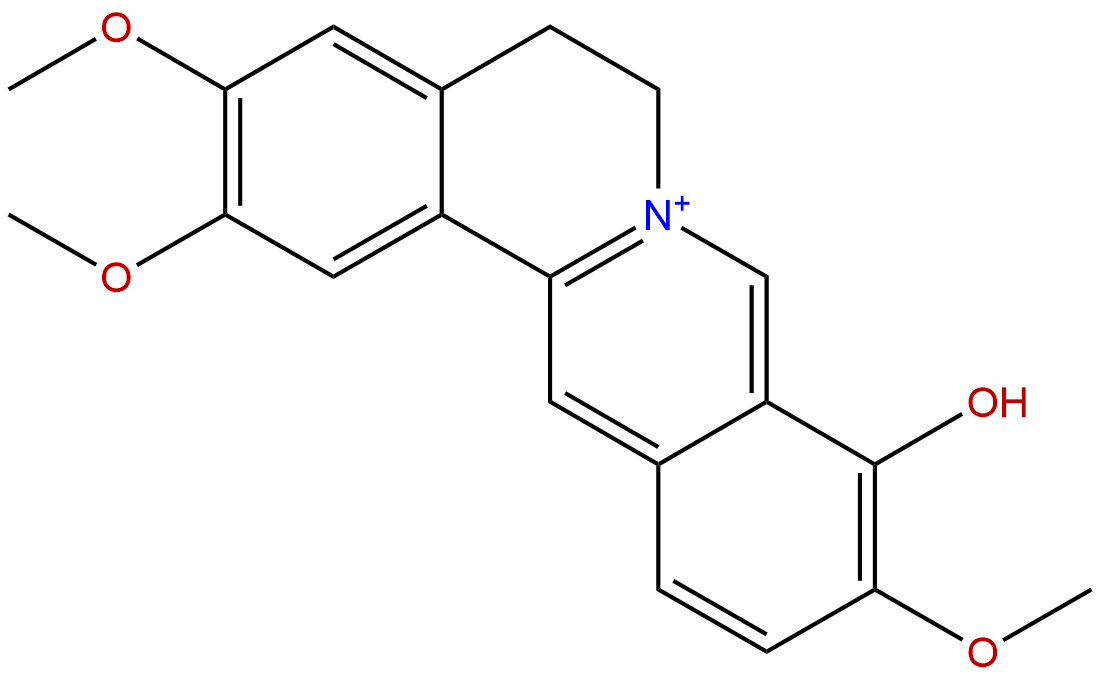


Product name: Palmatrubine
Synonym name:
Catalogue No.: BP1619
Cas No.: 16176-68-4
Formula: C20H20NO4+
Mol Weight: 338.382
Botanical Source: Alkaloid from Fibraurea chloroleuca and Stephania glabra tubers (Menispermaceae)
Physical Description: Powder
Type of Compound: Alkaloids
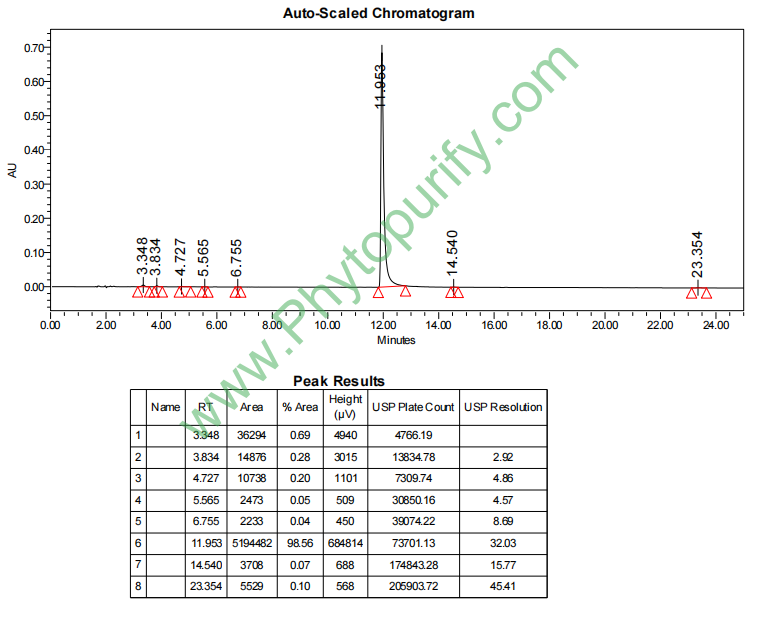
Purity: 95%~99%
Analysis Method: HPLC-DAD or/and HPLC-ELSD
Identification Method: Mass, NMR
Packing: Brown vial or HDPE plastic bottle
The product could be supplied from milligrams to grams. Inquire for bulk scale.
We provide solution to improve the water-solubility of compounds, thereby facilitating the variety of activity tests and clinic uses.
For Reference Standard and R&D, Not for Human Use Directly.
Description:
Palmatrubine binds to double-stranded DNA most probably via an intercalating mode.
References:
Chem Biodivers. 2007 Feb;4(2):145-53.
DNA-binding affinities and sequence specificities of protoberberine alkaloids and their demethylated derivatives: a comparative study.
METHODS AND RESULTS:
Berberrubine (1a), jatrorubine (2a), and Palmatrubine (3a) have been chemically prepared by partial demethylation of berberine (1), jatrorrhizine (2), and palmatine (3), respectively. Their interactions with calf thymus (CT) DNA, poly(dA-dT)poly(dA-dT), poly(dG-dC)poly(dG-dC), and eight AT-rich 12-mer double-stranded DNAs have been investigated by means of competitive ethidium bromide (EB) displacement experiments. The results showed that DNA-binding affinities of these protoberberine alkaloids have been significantly improved by partial demethylation, and that all of these alkaloids have the preferable binding affinities with AT-rich DNA. Especially, the sequence specificities of DNA-binding of demethylated derivatives 1a, 2a, and Palmatrubine had changed to a certain extent when compared with the parent alkaloids 1, 2, and 3, respectively. The binding mode of these alkaloids was further confirmed by UV spectroscopic titration experiments.
CONCLUSIONS:
All the compounds bind to double-stranded DNA most probably via an intercalating mode.
HPLC of Palmatrubine
Storage conditions:Short-term storage at 2~8℃, long-term storage at -20 ~ -80℃
Palmatrubine is a typical isoquinoline alkaloid that has attracted much attention due to its unique chemical structure and diverse biological activities. As a derivative of the Palmatine family, Palmatine alkaloids are widely present in traditional Chinese medicinal materials, especially abundant in Chinese medicinal plants such as Coptis chinensis and Corydalis yanhusuo. In recent years, with the development of natural product pharmacology, palmatine alkaloids have become a research hotspot due to their potential role in anti-tumor, especially leukemia treatment.
Leukemia, as a type of malignant tumor originating from the hematopoietic system, has a complex pathogenesis and diverse treatment options, but still faces issues of drug resistance and recurrence. Bamatin alkaloids exhibit inhibitory effects on various leukemia cell lines by regulating multiple key molecular pathways, demonstrating promising potential for drug development. This article provides a systematic review of the chemical structure and physicochemical properties, plant sources and extraction methods, pharmacological activity, mechanism of action, evaluation of drug properties, and clinical application prospects of palmatine alkaloids. The aim is to provide a theoretical basis and guiding ideas for subsequent research.
Palmatrubine, molecular formula C20H20NO5, molecular weight 338.3830, CAS number 16176-68-4, is a natural alkaloid with an isoquinoline skeleton. Its structural features include a tetracyclic isoquinoline core with multiple methoxy substituents, endowing it with strong lipophilicity and stability. The LogP value is 0.4695, indicating that it has moderate lipid solubility, which is beneficial for membrane penetration and in vivo distribution.
The polar surface area (TPSA) is 51.8 Å ², indicating moderate polarity and a certain degree of water solubility (0.5494), which provides a good physical and chemical basis for its absorption and distribution in vivo. Bamatin alkaloids have high blood-brain barrier permeability, suggesting their potential role in central nervous system diseases. The negative result of hERG channel inhibition experiment indicates a low risk of cardiac toxicity. The Ames mutagenicity test value is 1.8, indicating a low risk of genotoxicity and a good safety foundation.
Bamatin alkaloids are mainly found in various traditional Chinese medicinal herbs, especially in the rhizomes of plants such as Coptis chinensis, Corydalis yanhusuo, and Phellodendron amurense. In traditional Chinese medicine, these plants are widely used for clearing heat, detoxifying, promoting blood circulation, and relieving pain. Bamantine, as one of the active ingredients, plays a partial pharmacological role.
The common methods for extracting palmatine alkaloids include solvent extraction, acid-base extraction, and chromatographic separation. Taking Huanglian as an example, ethanol or methanol is often used as solvents for reflux extraction, followed by alkaline aqueous phase extraction through acid-base adjustment to remove impurities. The purification of Bamatine alkaloids was ultimately achieved using techniques such as silica gel column chromatography and reverse phase high performance liquid chromatography (RP-HPLC). In recent years, the application of new technologies such as ultrasound assisted extraction and microwave-assisted extraction has improved extraction efficiency and purity, laying the foundation for industrial production.
Bamatin alkaloids have shown significant pharmacological activity in various in vitro and in vivo models, particularly demonstrating unique advantages in the field of anti leukemia. Its main pharmacological activities include:
Anti leukemia effect
Multiple studies have shown that palmatine alkaloids can inhibit the proliferation of leukemia cells and induce cell apoptosis. It exhibits inhibitory effects on various leukemia cell lines such as acute myeloid leukemia (AML) and chronic lymphocytic leukemia (CLL). The inhibitory effect is closely related to the dose and duration of action, showing a clear dose-dependent relationship.
Anti inflammatory and immune regulation
Bamatin alkaloids can downregulate the expression of pro-inflammatory cytokines, regulate immune cell function, and alleviate inflammatory reactions. It indirectly enhances anti-tumor immune effects by inhibiting the STAT3 signaling pathway, reducing the release of inflammatory mediators.
Antioxidant effect
As a natural alkaloid, palmatine alkaloids have the ability to scavenge free radicals and alleviate oxidative stress, which helps protect cells from oxidative damage and maintain cellular homeostasis.
Neuroprotective effect
Due to its excellent blood-brain barrier permeability, palmatine alkaloids also have potential in neuroprotection. Some studies have shown that they can alleviate neuroinflammation and promote the survival of nerve cells.
The anti leukemia mechanism of Bamatin alkaloids is complex, involving the regulation of multiple signaling pathways and key molecular targets. The current research mainly focuses on the following targets:
AMPK(PRKAA1)
As a core regulatory factor of cellular energy metabolism, the activation of AMPK can inhibit the metabolic adaptability of tumor cells. Bamatin alkaloids activate AMPK, induce energy metabolism disorders in leukemia cells, and promote cell apoptosis.
MCL1 and BCL2
These two anti apoptotic proteins play a crucial role in the survival of leukemia cells. Bamatin alkaloids downregulate the expression of MCL1 and BCL2, disrupt the intracellular anti apoptotic barrier, and promote mitochondrial dependent apoptosis.
NOTCH1
The NOTCH1 signaling pathway plays an important role in the pathogenesis of leukemia. Bamantine inhibits NOTCH1 signaling, blocks abnormal cell proliferation and differentiation, and suppresses tumor progression.
STAT3
STAT3, as a transcription factor that promotes tumor growth, regulates the expression of various genes. Bamatin alkaloids inhibit the phosphorylation and nuclear translocation of STAT3, reduce its transcriptional activity, inhibit tumor cell proliferation and immune escape.
MAPT、IDH1、NFE2L2、TOP1、SIRT1
These targets involve cell cytoskeleton stability, metabolic regulation, oxidative stress response, DNA topoisomerase activity, and deacetylase function. The regulation of Bamantine further reveals its multi-target and multi pathway synergistic anti-tumor effect.
In summary, Bamatin alkaloids exhibit broad-spectrum anti leukemia potential by regulating the proliferation, apoptosis, and metabolism of leukemia cells through the synergistic action of multiple targets and pathways.
The pharmacological evaluation of Bamatin alkaloids shows that they have good potential for drug development:
Molecular weight and lipid solubility
The molecular weight of 338.38 conforms to Lipinski's rule, and the LogP value of 0.4695 indicates a balance between its hydrophilic and hydrophobic properties, which is beneficial for oral absorption and in vivo distribution.
Polarized surface area (TPSA)
The TPSA value of 51.8 Å ² indicates moderate polarity, which facilitates membrane penetration and blood-brain barrier permeability.
Water solubility and bioavailability
Although the water solubility of 0.5494 is not high, it is sufficient to support certain oral absorption. Combined with its high blood-brain barrier permeability, it indicates that it has good distribution ability in both the central and peripheral nervous systems.
safety
The hERG channel has no inhibitory effect and reduces the risk of cardiac toxicity. The Ames test results indicate that its genotoxicity is low and its safety is good.
Pharmacokinetic characteristics
Although there are currently few studies on the systematic pharmacokinetics of palmatine alkaloids, their structure is stable and their metabolic pathways may involve the liver CYP450 enzyme system. Further research is needed on their metabolic kinetic parameters, half-life, and in vivo distribution.
Bamatin alkaloids, as a natural isoquinoline alkaloid, have great clinical development potential due to their multi-target anti leukemia effects and good drug properties. Future research directions can focus on:
In depth mechanism research
Further elucidate the interaction mechanism between Bamantine and various molecular targets, reveal its signal network regulation in leukemia cells, optimize its structure to enhance selectivity and efficacy.
Pharmacokinetic and Toxicological Evaluation
The system conducts pharmacokinetic studies in vivo, clarifies its absorption, distribution, metabolism, and excretion characteristics, and evaluates the safety and toxicological risks of long-term medication.
Combination therapy strategy
Explore the combination application of Bamatin alkaloids with existing leukemia treatment drugs (such as targeted drugs and chemotherapy drugs), evaluate their synergistic effects and potential for reducing drug resistance.
Preclinical and clinical trials
Promote efficacy validation and safety evaluation in animal models, gradually conduct clinical trials, and verify its therapeutic effect and tolerability in leukemia patients.
Expand indications
Exploring its potential application in neurological tumors and neurodegenerative diseases by utilizing its high blood-brain barrier permeability.
Bamatin alkaloids, as a natural isoquinoline alkaloid with a multi-target mechanism of action, have demonstrated unique pharmacological advantages in the field of anti leukemia. Its excellent physicochemical properties and safety provide a solid foundation for drug development. In the future, by combining modern pharmacology, molecular biology, and medicinal chemistry methods, we will deeply explore the mechanism of action of palmatine alkaloids and optimize their drug properties, which is expected to promote them as important candidates for new anti leukemia drugs. The continuous development of pharmacology of natural products will provide broader space and possibilities for the clinical translation of palmatine alkaloids.
