
| Catalog No | Package | Original Price | Price | Inventory | Quantity | Operating |
|---|---|---|---|---|---|---|
| BP1389-100mg | 100mg | $30.00 | Sign in |
|


Product name: Theobromine
Synonym name: 3,7-Dimethylxanthine; Diurobromine; Santheose;
Catalogue No.: BP1389
Cas No.: 83-67-0
Formula: C7H8N4O2
Mol Weight: 180.167
Botanical Source: Theobroma cacao L.
Physical Description:
Type of Compound: Alkaloids
Purity: 95%~99%
Analysis Method: HPLC-DAD or/and HPLC-ELSD
Identification Method: Mass, NMR
Packing: Brown vial or HDPE plastic bottle
Storage: Store in a well closed container, protected from air and light. Put into refrigerate or freeze for long term storage.
Whenever possible, you should prepare and use solutions on the same day. However, if you need to make up stock solutions in advance, we recommend that you store the solution as aliquots in tightly sealed vials at -20℃. Generally, these will be useable for up to two weeks.
The product could be supplied from milligrams to grams
Inquire for bulk scale.
Chengdu Biopurify Phytochemicals Ltd. is a leading company in the research, development, manufacture and marketing of High Quality Phytochemicals and Extracts(especially Active Ingredients from Traditional Chinese Medicine,TCM), Natural Active Pharmaceutical Ingredients worldwide.
The main services:
A. Supply active ingredients and reference standards of TCM, from mgs to kgs scale
B. Custom extraction and purification, target Herb Active Ingredients
C. Custom synthesis and semi-synthesis for Natural Active Ingredients
D. CR(contract research), CM(contract manufacture) and PD(process development) services from lab scale, pilot scale to commercial scale(GMP is also available)
E. TCM compounds library for drug screen,more than 3000 compounds available, many of them are rare and unique.
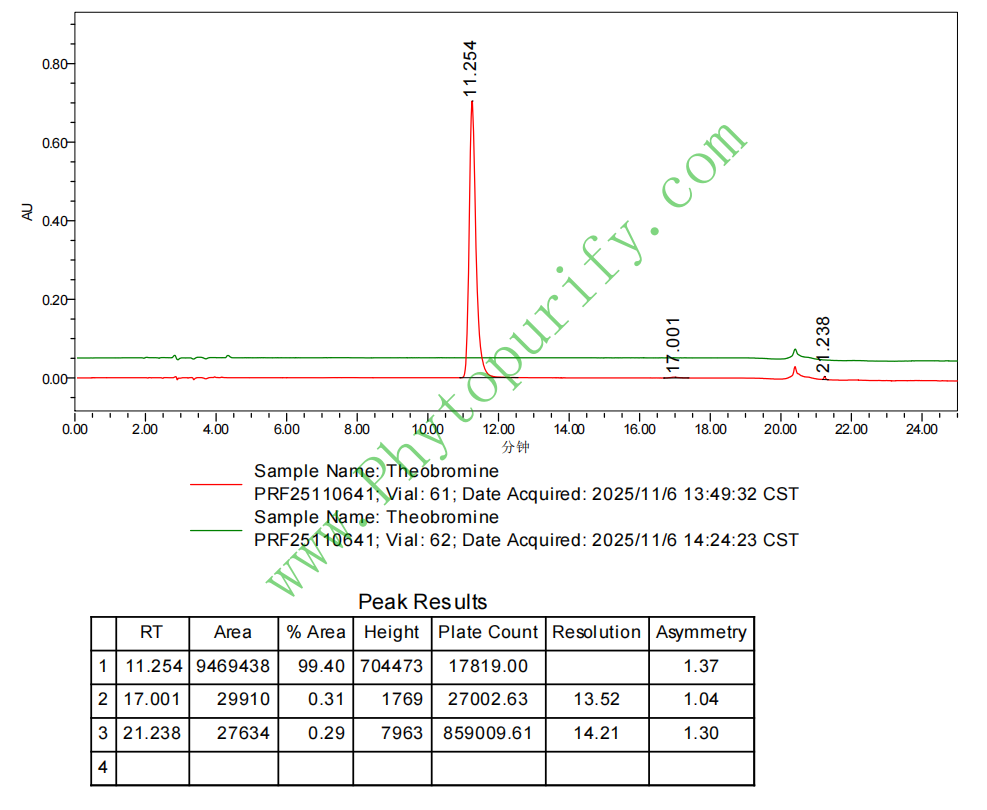
HPLC of Theobromine
Storage conditions:Short-term storage at 2~8℃, long-term storage at -20 ~ -80℃
Theobromamine (CAS number: 83-67-0) is a naturally occurring methylxanthine alkaloid found in cocoa beans. It belongs to the class of purine derivatives called dimethylxanthine and has methyl substituents at positions 3 and 7 in its molecular structure. As one of the main active ingredients in cocoa plants (Theobroma cacao), theobromine not only endows chocolate with unique physiological activities, but also receives widespread attention due to its diverse pharmacological effects. Its main pharmacological functions include vasodilation, diuresis, cardiac stimulation, and bronchiectasis. In addition, theobromine also exhibits significant adenosine receptor antagonism, especially inhibition of adenosine receptor A1 (AR1), thereby regulating the functions of the central nervous system and cardiovascular system.
In recent years, with the deepening development of natural product pharmacology and molecular pharmacology, the potential role of theobromine in antidepressant, neuroprotective, and metabolic regulation fields has gradually been revealed. The molecular targets involved include monoamine oxidase A/B (MAOA/MAOB), glycogen synthase kinase 3 β (GSK3B), serotonin transporter (SLC6A4), serotonin receptor 1A (HTR1A), gamma aminobutyric acid receptor (GABRA1), cAMP response element binding protein (CREB1), brain-derived neurotrophic factor (BDNF), and catechol-O-methyltransferase (COMT), demonstrating its multi-target regulatory potential in neurological and psychiatric disorders.
This article provides a systematic review of the chemical structure and physicochemical properties, plant sources and extraction methods, pharmacological activity and mechanism of action, pharmacological evaluation and pharmacokinetic characteristics of theobromine. It also looks forward to its potential and future research directions in clinical applications, aiming to provide theoretical basis and practical guidance for the study of natural product pharmacology and related fields.
The chemical name of theobromine is 3,7-dimethylxanthine, with a molecular formula of C7H8N4O2 and a molecular weight of 180.1670. Its structure belongs to purine alkaloids, with a core of xanthine skeleton. A methyl group is attached to the nitrogen atom at positions 3 and 7, forming a dimethyl substitution structure. This structure endows theobromine with a good balance of fat solubility and water solubility, with a LogP value of approximately -0.1653, indicating its moderate hydrophilicity, which is conducive to absorption and distribution in the body.
The polar surface area (TPSA) is 72.68 Å ², indicating a certain polarity limitation when crossing biofilms, but combined with its high blood-brain barrier permeability, it shows that theobromine can effectively enter the central nervous system. The water solubility is 2.4007 mg/mL, suitable for oral administration. It is worth noting that theobromine does not exhibit hERG channel inhibitory activity, indicating a low risk of cardiac toxicity; The Ames test result is 0.9, indicating that its genotoxicity risk is extremely low and has a good safety basis.
The chemical structure has high stability, is not easily degraded at room temperature and pressure, and has good thermal stability, suitable for food processing and pharmaceutical formulation needs. Its UV absorption peak is mainly concentrated in the range of 270-280 nm, which is convenient for analysis, detection, and purity identification.
Cocoa alkaloids mainly exist in the cocoa beans of Theobroma cacao seeds, and their content is significantly affected by variety, origin, maturity, and processing technology. In addition to cocoa beans, tea, Paulinia cupana, and a few other plants also contain small amounts of theobromine, but the content is much lower than cocoa beans.
Traditional extraction methods mainly include solvent extraction, liquid-liquid extraction, and supercritical fluid extraction. Solvent extraction usually uses ethanol, water, or their mixed solvents, and the extraction efficiency is optimized by adjusting the pH value and temperature. Liquid liquid extraction utilizes the polarity of theobromine and often uses organic solvents such as chloroform and ethyl acetate for separation and purification. In recent years, ultrasound assisted extraction and supercritical CO2 extraction technologies have gradually become research hotspots due to their advantages of high efficiency, environmental friendliness, and low-temperature protection of active ingredients.
The purification steps after extraction usually use column chromatography (silica gel, C18 reverse phase column) and high performance liquid chromatography (HPLC) techniques to ensure the high purity and activity stability of theobromine. Modern technology also combines membrane separation technology and crystallization purification to improve yield and purity, meeting the needs of the pharmaceutical and food industries.
Cocoa alkaloids, as an effective vasodilator, reduce the contractility of vascular smooth muscle cells, promote vasodilation, and improve local blood flow perfusion by antagonizing adenosine receptors, especially A1 subtype. Animal experiments have shown that theobromine can significantly reduce arterial blood pressure and improve microcirculation function. In addition, its mild cardiac stimulating effect mainly manifests as an increase in heart rate and myocardial contractility, similar to caffeine but with a milder effect, suitable for regulating cardiovascular function.
Cocoa alkaloids have a significant diuretic effect, which involves inhibiting the reabsorption of sodium ions by renal tubules, promoting urine production and excretion. This effect helps regulate fluid balance and blood pressure, and has auxiliary therapeutic significance for patients with mild edema and hypertension in clinical practice.
As a bronchodilator, theobromine reduces bronchial smooth muscle contraction and alleviates airway spasms by blocking adenosine receptors. Experimental studies have shown that theobromine can be used as an adjuvant therapy for asthma and chronic obstructive pulmonary disease (COPD), improving respiratory function.
Cocoa alkaloids can cross the blood-brain barrier, exert adenosine receptor antagonist effects, and enhance neural excitability and cognitive function. Its regulatory effects on the neurotransmitter system include inhibiting MAOA and MAOB activity, increasing the concentration of neurotransmitters such as dopamine and serotonin in the brain, regulating GABA receptor function, enhancing the expression of CREB1 and BDNF, demonstrating antidepressant and neuroprotective potential.
Multiple in vitro and animal model studies have confirmed that theobromine regulates neurotransmitter metabolism and neuroplasticity through multi-target action, exhibiting antidepressant activity. Its targets include MAOA, MAOB, GSK3B, SLC6A4, HTR1A, GABRA1, CREB1, BDNF, and COMT, which comprehensively regulate neural signal transduction and neuronal survival, and have potential value for the development of antidepressant drugs.
Cocoa alkaloids, as non selective antagonists of adenosine receptors, have a high affinity for A1 receptors in particular. Adenosine receptors are widely distributed in the central nervous system and cardiovascular system, regulating neurotransmission, heart rate, vascular tone, and metabolism. By blocking the A1 receptor, theobromine relieves adenosine mediated inhibitory signals, enhances neural excitability and myocardial contractility, and promotes vasodilation.
MAOA and MAOB are the main monoamine oxidases in the brain, involved in the metabolism of neurotransmitters such as dopamine, serotonin, and norepinephrine. The inhibitory effect of theobromine on MAOA/MAOB increases neurotransmitter levels in the brain, improves emotional states, and alleviates depressive symptoms.
GSK3B plays a crucial role in neuronal development, cell apoptosis, and inflammatory response. Cocoa alkaloids promote neuronal survival and functional recovery, enhance neural plasticity, and contribute to antidepressant and neuroprotection by regulating GSK3B activity.
SLC6A4 encodes the serotonin transporter protein, which regulates the reuptake of serotonin. HTR1A is a subtype of serotonin receptors involved in regulating emotions and anxiety. Cocoa alkaloids exert antidepressant and anti anxiety effects by affecting these two targets, regulating the serotonin signaling pathway.
GABRA1 is a GABA_A receptor subunit that mediates inhibitory signaling in the central nervous system. Cocoa alkaloids regulate GABRA1 function, balance excitation and inhibition, and alleviate symptoms of anxiety and depression.
CREB1, as a transcription factor, regulates the expression of neurotrophic factors such as BDNF. BDNF is crucial for neuronal growth, differentiation, and synaptic plasticity. Cocoa alkaloids promote CREB1 phosphorylation and BDNF expression, enhancing nerve repair and functional recovery.
COMT is involved in the metabolism of catecholamine neurotransmitters. The regulation of COMT by theobromine helps maintain neurotransmitter balance and assists in improving neurological and psychiatric disorders.
The molecular weight of theobromine is moderate (180.1670), in accordance with Lipinski's rule, with a LogP value of -0.1653, indicating its moderate hydrophilicity, which is beneficial for oral absorption. The TPSA value is 72.68 Å ², which supports its good biofilm permeability, especially high blood-brain barrier permeability, making it suitable for central nervous system drug development.
In terms of safety, theobromine does not inhibit hERG channels and reduces the risk of arrhythmia; The Ames test result is 0.9, indicating that its genotoxicity is extremely low and has a good safety basis.
After oral administration, theobromine is rapidly absorbed and has a high bioavailability. It is widely distributed and can effectively cross the blood-brain barrier to reach the central nervous system. Metabolism is mainly carried out through the CYP450 enzyme system in the liver, generating various metabolites, some of which are active in mice. Excretion is mainly completed through the kidneys, with a moderate half-life, supporting multiple dosing regimens.
Pharmacokinetic studies have shown that theobromine has good in vivo stability and controllable metabolic rate, making it suitable for development as an oral formulation.
Cocoa alkaloids, as a natural product, have shown broad prospects in clinical applications due to their multi-target and multifunctional pharmacological properties. Its vasodilation and diuretic effects make it potential for adjuvant therapy in cardiovascular diseases, especially in patients with hypertension and mild heart failure. Bronchiectasis provides a new treatment option for patients with asthma and chronic obstructive pulmonary disease.
In the field of neurological and psychiatric disorders, the antidepressant, anti anxiety, and neuroprotective effects of theobromine deserve further clinical verification. It may become a natural substitute or adjuvant for psychotropic drugs by regulating multiple neurotransmitter pathways and promoting the expression of neurotrophic factors. Meanwhile, due to its good safety and blood-brain barrier penetration ability, theobromine is expected to be developed as a therapeutic drug for central nervous system diseases.
Future research should focus on optimizing the drug formulation of theobromine, enhancing its bioavailability and targeting; Conduct systematic clinical trials to verify its efficacy and safety; Explore its potential for combined use with other drugs. In addition, in-depth mechanism research based on molecular targets will provide theoretical basis for the design of new derivatives and promote the innovative development of theobromine related drugs.
Cocoa alkaloids, as a widely sourced and structurally clear natural methylxanthine compound, have become a hot topic in natural product pharmacology research due to their diverse pharmacological activities and good medicinal properties. Its potential applications in cardiovascular, respiratory, and neuropsychiatric diseases demonstrate the significant value of natural products in modern drug development. In the future, with the advancement of molecular pharmacology and medicinal chemistry technology, theobromine and its derivatives are expected to become new drugs for clinical treatment, contributing more to human health.
