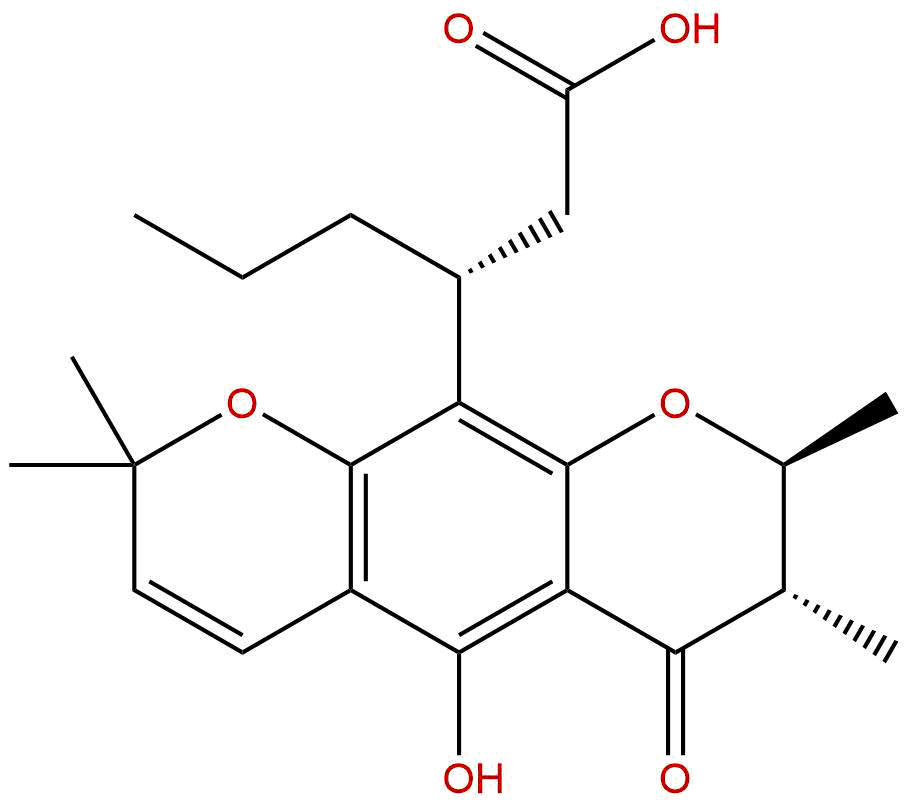


Product name: Isoapetalic acid
Synonym name: Calofolic acid E
Catalogue No.: SBP01602
Cas No.: 34366-34-2
Formula: C22H28O6
Mol Weight: 388.46
Botanical Source:
Type of Compound: Chromones
Purity: 95%~99%
Analysis Method: HPLC-DAD or/and HPLC-ELSD
Identification Method: Mass, NMR
Packing: Brown vial or HDPE plastic bottle
Storage: Store in a well closed container, protected from air and light. Put into refrigerate or freeze for long term storage.
Whenever possible, you should prepare and use solutions on the same day. However, if you need to make up stock solutions in advance, we recommend that you store the solution as aliquots in tightly sealed vials at -20℃. Generally, these will be useable for up to two weeks.
The product could be supplied from milligrams to grams
Inquire for bulk scale.
For Reference Standard and R&D, Not for Human Use Directly.
Storage conditions:Short-term storage at 2~8℃, long-term storage at -20 ~ -80℃
Isoapetalic acid (CAS number: 34366-34-2), as a type of natural product, has received widespread attention in recent years due to its significant anti HIV activity. HIV infection is still a major challenge in the field of global public health. Although the existing antiretroviral therapy (ART) has made significant progress, its long-term efficacy is limited by virus resistance and drug side effects. Therefore, the development of new, efficient, and safe anti HIV drugs has become a research hotspot. Natural products have become important resources for drug development due to their structural diversity and rich biological activity. As a natural product with a unique structure, isoapetalic acid exhibits excellent anti HIV potential. This article will systematically review its chemical structure, plant origin, pharmacological activity, mechanism of action, and drug efficacy evaluation, aiming to provide theoretical basis and research direction for subsequent drug development and clinical applications.
The molecular formula of isoapetalic acid is C22H28O5, with a molecular weight of 372.4500, belonging to terpenoid organic acid derivatives. Its structural features include multiple hydroxyl and carboxyl functional groups, with a TPSA (topological polar surface area) of 111.96 Å ² and 6 hydrogen bond acceptors, indicating moderate molecular polarity, certain water solubility, and good biofilm permeability. The structure of isoapetalic acid contains a typical terpenoid skeleton, combined with carboxylic acid groups, giving it strong biological activity. Its physicochemical properties such as melting point, solubility, and stability have a significant impact on its extraction, purification, and drug formulation development. Isopentaric acid exhibits good solubility in organic solvents and is suitable for various extraction and separation techniques.
Isopentaric acid is mainly present in the roots, stems, or leaves of certain specific plants, especially in traditional medicinal plants with antiviral activity. Common source plants include Isoapetalum plants, which are used in traditional medicine to treat infectious diseases. The common methods for extracting isoapetalic acid include solvent extraction, liquid-liquid distribution, column chromatography, and high-performance liquid chromatography (HPLC) purification. Generally, ethanol or methanol is used for crude extraction, followed by separation by silica gel column chromatography and further purification by HPLC to obtain high-purity isoapetalic acid. In recent years, supercritical CO2 extraction and microwave-assisted extraction techniques have also been applied to improve extraction efficiency and purity, reduce the use of organic solvents, and comply with green chemistry principles.
As an effective anti HIV agent, the pharmacological activity of isoapetalic acid mainly manifests in the inhibition of HIV virus replication and infection process. In vitro cell experiments have shown that isoapetalic acid can significantly reduce HIV reverse transcriptase activity, block the reverse transcription process of the viral genome, and inhibit the key step of viral RNA transcription into DNA. In addition, isoapetalic acid also exhibits inhibitory effects on HIV integrase, preventing the integration of viral DNA into the host genome and thus inhibiting viral replication. Multiple studies have shown that isoapetalic acid can achieve significant antiviral effects at low concentrations and has low cytotoxicity, demonstrating a good selectivity index (SI). In addition, isoapetalic acid also has certain immune regulatory functions, which can enhance the antiviral ability of host immune cells and further enhance their anti HIV activity.
The anti HIV mechanism of isoapetalic acid mainly involves the inhibition of key viral enzymes. Firstly, isoapetalic acid binds to the active site of HIV reverse transcriptase (RT), blocking the reverse transcription process of viral RNA and inhibiting the synthesis of viral DNA. Molecular docking and dynamic simulations have shown that isoapetalic acid can stably bind to the non nucleotide inhibitor binding pocket of RT, exerting a non competitive inhibitory effect. Secondly, isoapetalic acid also has an inhibitory effect on HIV integrase (IN), preventing the integration of viral DNA into host cell chromosomes and blocking key steps in the virus lifecycle. In addition, isoapetalic acid may affect the viral replication environment by regulating host cytokine expression, such as modulating the NF - κ B signaling pathway and reducing viral transcriptional activity. Overall, isoapetalic acid achieves effective inhibition of HIV and reduces the risk of viral drug resistance through multi-target and multi mechanism synergistic effects.
From the perspective of drug development, the molecular weight of isoapetalic acid is 372.45, which meets the basic requirements of Lipinski's rule. Its TPSA is 111.96, indicating that it has moderate polarity and is beneficial for oral absorption. Its hydrogen bond receptor number is 6, which is moderate and facilitates the binding of molecules to biological targets. Preliminary in vitro ADME (absorption, distribution, metabolism, excretion) studies have shown that isoapetalic acid has good cell membrane permeability and stable metabolic characteristics. The liver microsomal metabolism experiment showed that isoapetalic acid is mainly metabolized through the CYP450 enzyme system, and the activity of metabolites still needs further research. Animal pharmacokinetic studies have shown that the oral bioavailability of isoapetalic acid is moderate, with a long half-life and good in vivo exposure levels and duration of action. Preliminary toxicological evaluations indicate that isoapetalic acid has no significant acute or subchronic toxicity, a large safety window, and good potential for drug development.
Given the significant activity and good pharmacological properties of isoapetalic acid in the field of HIV resistance, its clinical application prospects are broad. Future research should focus on optimizing its drug formulation and administration regimen, improving bioavailability and targeting. Combining modern drug design techniques such as structural modification and nanocarrier delivery is expected to further enhance its antiviral efficacy and safety. In addition, isoapetalic acid can be used as a candidate drug for multi drug combination therapy against HIV, synergizing with existing ART drugs to reduce the incidence of drug resistance. Preclinical research requires in-depth exploration of its pharmacokinetics, toxicology, and long-term safety to provide sufficient basis for clinical trials. With the development of natural product pharmacology and molecular biology technology, isopetalic acid is expected to become an important part of the new generation of anti HIV drugs, and promote the treatment of AIDS into a new stage.
As a natural product with unique structure and significant anti HIV activity, isoapetalic acid exhibits excellent pharmacological activity and potential for drug development. Its multi-target mechanism of action provides new ideas for the development of anti HIV drugs. Through systematic chemical, pharmacological, and pharmacokinetic studies, isoapetalic acid is expected to become an important candidate molecule in the field of anti HIV therapy. Future research should continue to deepen its mechanism of action, optimize drug properties, and conduct preclinical and clinical studies to promote its translation into clinical applications. The unique advantages of natural products in the development of antiviral drugs make isoapetalic acid have broad application prospects and deserve continuous attention and investment from scientific research and the pharmaceutical industry.
