| Catalog No | Package | Original Price | Price | Inventory | Quantity | Operating |
|---|---|---|---|---|---|---|
| BP3005-100mg | 100mg | $30.00 | Sign in |
|


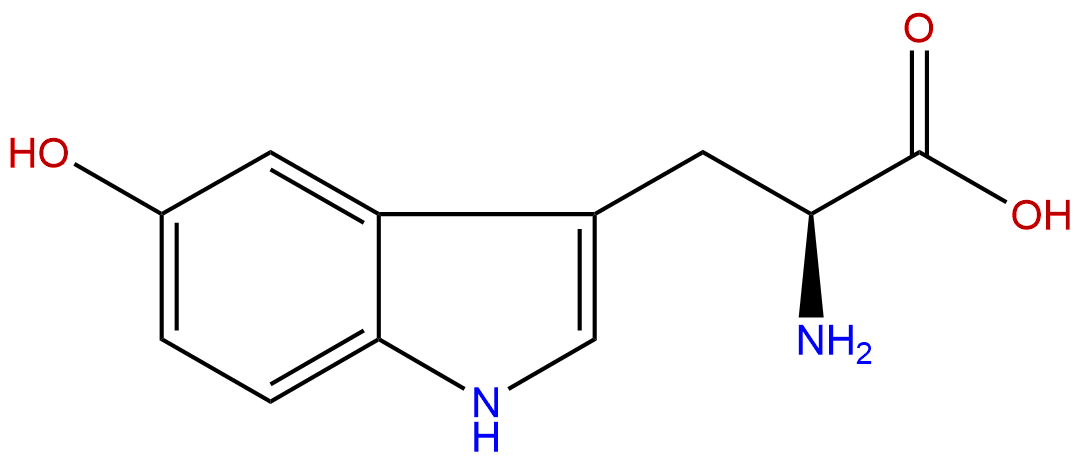
Product name: :5-Hydroxy-DL-tryptophan
Synonym name:
Catalogue No.: BP3005
Cas No.: 56-69-9
Formula: C11H12N2O3
Mol Weight: 220.228
Botanical Source:
Physical Description: White powder
Type of Compound: Alkaloids
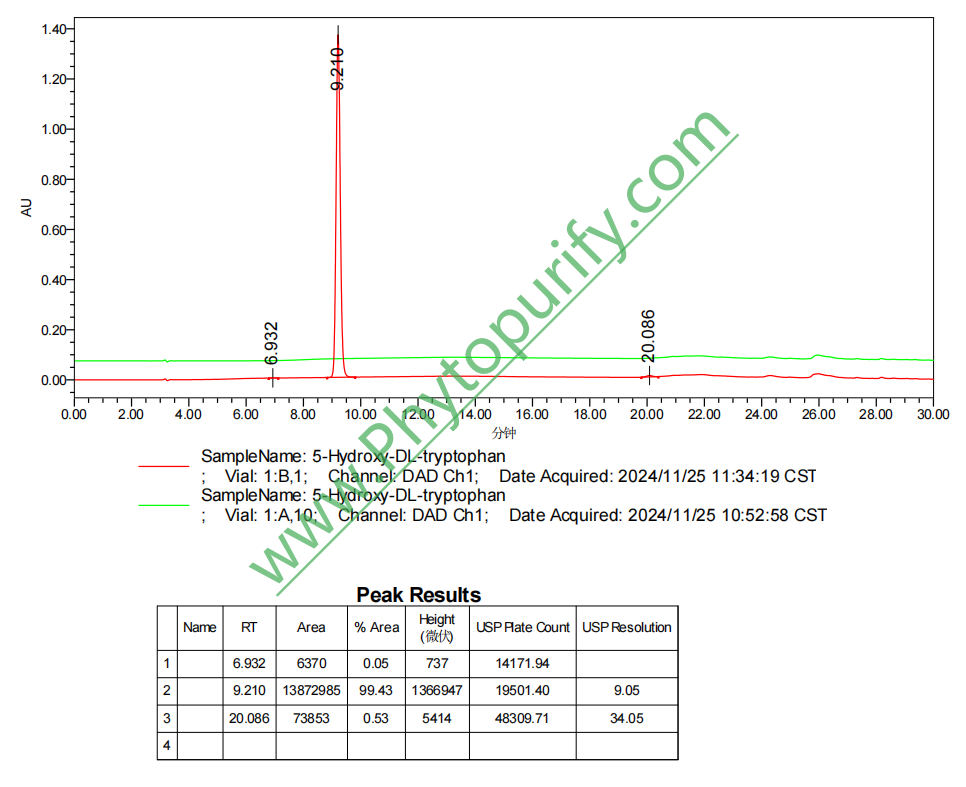
Purity: 95%~99%
Analysis Method: HPLC-DAD or/and HPLC-ELSD
Identification Method: Mass, NMR
Packing: Brown vial or HDPE plastic bottle
The product could be supplied from milligrams to grams. Inquire for bulk scale.
We provide solution to improve the water-solubility of compounds, thereby facilitating the variety of activity tests and clinic uses.
For Reference Standard and R&D, Not for Human Use Directly.
HPLC of 5-Hydroxy-DL-tryptophan
Storage conditions:Short-term storage at 2~8℃, long-term storage at -20 ~ -80℃
99.3400
-1.1564
-1.1668
.4005
.4055
1.5322
Low
29.8850
2.5872
Yes
No
No
No
No
No
0.0
Yes
No
No
No
5-hydroxy-DL-tryptophan (5-HTP), with Chemical Abstracts Service registration number (CAS number) 56-69-9, is a naturally occurring tryptophan derivative characterized by the substitution of a hydroxyl group at the 5th position of the tryptophan indole ring. In living organisms, 5-HTP is a direct precursor substance for the synthesis of the key neurotransmitter serotonin (5-HT, also known as serotonin). This biochemical pathway bypasses the rate limiting step catalyzed by tryptophan hydroxylase (TPH), thus playing a crucial role in regulating central and peripheral 5-HT levels. The 5-HT system is widely involved in regulating emotions, sleep, appetite, pain perception, and cognitive function. Its dysfunction is closely related to various psychiatric and neurological disorders, especially depression. Therefore, as a key intermediate in 5-HT biosynthesis, 5-HTP has long received widespread attention in the fields of pharmacology, neuroscience, and psychiatry, and is considered a natural product with potential therapeutic value. This article aims to systematically review the chemical properties, plant sources, pharmacological activities, molecular mechanisms of action, pharmacological characteristics, and clinical application prospects of 5-HTP, in order to provide comprehensive academic references for related research and development.
The molecular formula of 5-HTP is C ₁₁ H ₁₂ N ₂ O3, with a molecular weight of 220.2280. Its chemical structure consists of three main parts: an indole ring (benzopyrrole), an amino propionic acid side chain attached to the 3rd position of the indole ring, and a hydroxyl group located at the 5th position of the indole ring. The introduction of this hydroxyl group significantly changes the polarity and chemical reactivity of the parent tryptophan. 5-HTP exists in two optical isomers, D-type and L-type. L-5-HTP is a naturally occurring and biologically active form, while commonly referred to as 5-HTP refers to L-type or racemic mixtures.
Its key physicochemical properties determine its bioavailability and distribution characteristics. The calculated lipid water partition coefficient (LogP) is approximately -1.1564, indicating that the compound has a high degree of hydrophilicity. The topologically polar surface area (TPSA) is as high as 99.3400 Å ², mainly attributed to polar functional groups such as amino, carboxyl, and hydroxyl groups in the molecule, further confirming its hydrophilic properties. The water solubility measured in the experiment is about 0.4005 mg/mL, which belongs to moderate to low water solubility, which may to some extent limit the formulation design for high-dose administration. These physical and chemical properties work together, leading to a predicted "low" blood-brain barrier (BBB) permeability, meaning that only a small amount of exogenous 5-HTP can enter the central nervous system from the bloodstream, posing a challenge to its direct central role, but also partially explaining its relatively mild effects and safety characteristics.
5-HTP is not synthesized by the human body itself, but exists in various plants, among which the most famous and commercially widely used source is African plants Ghana seeds The seeds of Griffonia simplicifolia. The content of L-5-HTP in Ghanaian seeds is abundant, up to 3% -8% of dry weight, and it is currently the main natural source of dietary supplements and raw materials. In addition, some other plants such as red bean The seeds of Mucuna pruriens also contain a certain amount of 5-HTP, but usually at lower levels.
The extraction of 5-HTP from plant materials mainly depends on the properties of its acid-base electrolytes. A typical extraction process includes the following steps: first, plant seeds are crushed and extracted using water or acidic aqueous solution (such as dilute hydrochloric acid) to dissolve 5-HTP in salt form. Subsequently, preliminary purification was carried out by adjusting the pH of the solution to near the isoelectric point of 5-HTP (approximately pH 5.5) to minimize its solubility and precipitate it. Further purification can be achieved by ion exchange chromatography, utilizing the exchange interaction between the amino and carboxyl groups of 5-HTP and the resin for separation. Crystallization is a key step in obtaining high-purity products, by controlling the solvent (such as a water ethanol mixture system) and temperature conditions to precipitate 5-HTP crystals. Modern production processes also incorporate steps such as membrane filtration and activated carbon decolorization to improve purity and yield. It should be noted that temperature, pH, and light exposure must be strictly controlled during the extraction process to prevent oxidation or degradation of 5-HTP.
A large number of preclinical and clinical studies have revealed the broad pharmacological activities of 5-HTP, which revolve around enhancing central and peripheral 5-HT levels.
The core mechanism of action of 5-HTP is to act as a substrate and rapidly decarboxylate into the neurotransmitter 5-hydroxytryptamine (5-HT) under the action of aromatic L-amino acid decarboxylase (AADC). The elevated 5-HT levels exert downstream effects by activating widely distributed 5-HT receptors (currently 14 or more subtypes in 7 major categories have been identified). However, modern research has revealed that the pharmacological effects of 5-HTP are far from being summarized by simple "precursor substitution" models. It involves a complex molecular network with direct or indirect interactions with multiple targets related to the pathophysiology of depression
In summary, 5-HTP provides substrates for 5-HT synthesis and interacts extensively with key molecular targets related to metabolism, inflammation, oxidative stress, and neuroplasticity, forming a multi-target network that contributes to its antidepressant and other pharmacological effects.
From the perspective of drug development, 5-HTP exhibits typical characteristics of a natural precursor drug.
pharmacokinetics After oral administration, 5-HTP is rapidly absorbed in the upper small intestine through an active transport mechanism. Its absorption is not significantly inhibited by competition from other amino acids in food, unlike tryptophan. After absorption, most 5-HTP is rapidly decarboxylated and converted to 5-HT by AADC in the liver and peripheral tissues, resulting in low oral bioavailability (estimated to fluctuate between 30% -70%). The generated 5-HT is mainly metabolized by peripheral MAO, so if peripheral AADC inhibitors (such as carbidopa) are not used simultaneously, a large amount of 5-HT will exist in the periphery, which may cause side effects such as nausea and gastrointestinal discomfort, and the amount entering the central nervous system is limited. A small amount of original 5-HTP can enter the central nervous system through the blood-brain barrier and be converted into 5-HT to exert its effects in the central nervous system. Its elimination half-life is relatively short, about 2-4 hours.
Analysis of drug properties parameters:
* Advantages Small molecular weight and simple structure; No risk of hERG inhibition, indicating low risk of cardiac toxicity; The Ames test result is 0.0, indicating that there is no mutagenicity in this testing system and the risk of genetic toxicity is low; As an intermediate of endogenous metabolic pathways in the human body, theoretically it has low immunogenicity and good tolerance.
* challenge The low permeability of the blood-brain barrier limits the efficiency of its direct action; Moderate water solubility, may affect high-dose formulations; Metabolism is extremely fast in the body, with a short half-life, requiring multiple doses per day to maintain stable blood drug concentrations; The main limitation of its clinical application is the side effects caused by peripheral decarboxylation.
Formulation strategy Common strategies to improve efficacy and reduce side effects include: 1) working with Combination therapy of peripheral AADC inhibitors (such as carbidopa)Reducing peripheral 5-HT production and increasing the proportion of 5-HTP entering the central nervous system are the most effective strategies; 2) Development sustained-release preparation To stabilize blood drug concentration, reduce peak valley fluctuations in blood drug concentration, lower the incidence of side effects, and prolong the duration of action; 3) Explore New administration routes(such as nasal administration) to bypass first pass effects and improve brain targeting.
Currently, 5-HTP is sold as a dietary supplement or health supplement in many regions worldwide for emotional support, sleep improvement, and weight management. Its official drug status in the medical field varies depending on national and regional regulations.
Current Applications and Challenges:
* Adjuvant treatment for depression 5-HTP provides a potential alternative or adjuvant option for patients who are unwilling or unable to tolerate the side effects of traditional antidepressants. However, the stability of its efficacy, optimal dosage, and safety when used in combination with prescription drugs still require further validation through large-scale, high-quality randomized controlled trials (RCTs).
* Fibromyalgia and chronic pain management As part of a multimodal analgesia regimen, it has shown certain potential.
* Main challenges Due to insufficient standardization of product purity and dosage (as a supplement regulation); There is a potential risk of developing 5-HT syndrome when used in combination with 5-HTergic drugs such as SSRI, SNRI, triptans, and dexmedetomidine, and extreme caution is required; The security data for long-term use is still incomplete.
Future Prospects:
1. Exploration of Precision Medicine Future research needs to identify the subpopulations of biomarkers that best respond to 5-HTP therapy, such as patients with low TPH activity, high IDO1 activity (inflammatory depression), or insufficient 5-HT synthesis precursors.
2. New drug delivery system Develop brain targeted delivery systems based on nanotechnology or liposomes, or design 5-HTP prodrugs to improve their blood-brain barrier permeability and pharmacokinetic properties.
3. Deep exploration of mechanisms Beyond the role of 5-HT precursors, we will delve into the significance of their anti-inflammatory, antioxidant, and metabolic regulatory effects through targets such as AMPK, Nrf2, IDO1 in neurological and psychiatric disorders.
4. Expand indication research Conduct more rigorous clinical research in areas such as Parkinson's disease (improving motor symptoms and mood), migraine prevention, and anxiety disorders.
5. Regulations and Quality Improvement Promote strict clinical trials as therapeutic products and establish high-quality production and quality control standards.
The pharmacological value of 5-hydroxytryptamine (5-HTP) as a key endogenous molecule connecting nutrition, metabolism, and neuropsychiatric function stems from its fundamental property as a direct precursor of 5-HT. Modern research gradually reveals that its mechanism of action is a complex network involving multiple targets and pathways, including neurotransmitter synthesis, inflammation and immune regulation, cellular energy sensing, and oxidative stress defense. Despite facing challenges such as low blood-brain barrier permeability and fast peripheral metabolism in terms of drug efficacy, its therapeutic potential is expected to be safer and more effective through rational combination therapy (such as peripheral decarboxylase inhibitors) and formulation improvement. In the future, with the deepening of precision medicine concepts and the development of new delivery technologies, 5-HTP is expected to evolve from a well-known dietary supplement to a prescription drug option with clear targets and therapeutic value for certain specific types of depression and other related diseases. Continuous basic and clinical research is crucial for fully tapping into the modern medical value of this ancient natural molecule.
