


Synonym name: Methylisochondodendrine; 7,7'-O,O-Dimethylisochondodendrine
Catalogue No.: BP0433
Cas No.: 518-94-5
Formula: C38H42N2O6
Mol Weight: 622.762
Botanical Source: Alkaloid from Chondodendron tomentosum, Cissampelos insularis, Cissampelos pareira, Cleistopholis staudtii, Cyclea tonkinensis, Epinetrum cordifolium, (preferred genus name Albertisia), Epinetrum mangenotii, Epinetrum villosum, Heracleum wallichi, Limaci
Purity: 95%~99%
Analysis Method: HPLC-DAD or/and HPLC-ELSD
Identification Method: Mass, NMR
Packing: Brown vial or HDPE plastic bottle
Can be supplied from milligrams to grams.
For Reference Standard and R&D, Not for Human Use Directly.
Inquire for bulk scale.
HPLC of Cycleanine
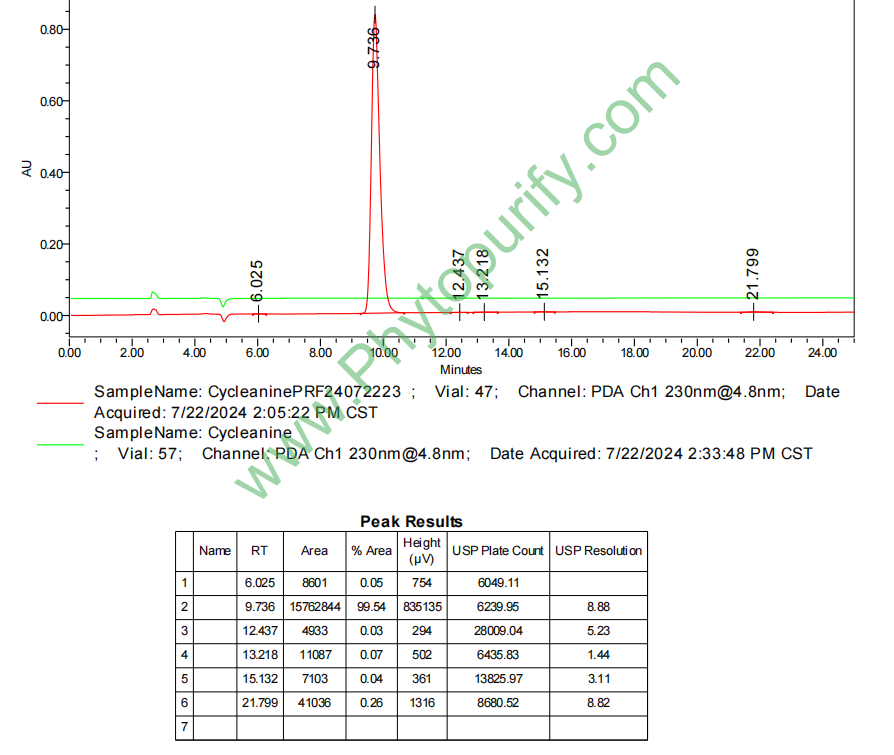
Storage conditions:Short-term storage at 2~8℃, long-term storage at -20 ~ -80℃
Cycleanine (CAS number: 518-94-5) is a natural plant derived alkaloid compound that has attracted attention for its significant vascular selective calcium channel antagonistic activity. As an efficient Ca ² ⁺ antagonist, cyclosporine not only exhibits good pharmacological activity in the field of cardiovascular disease, but also has been widely studied for its pain relief, muscle relaxation, and anti-inflammatory effects. In addition, recent studies have shown that matrine has the potential to exert its effects in the field of tumor therapy, especially in the anti-tumor activity of ovarian cancer, by regulating the apoptotic pathway. Lung cancer is a malignant tumor with high incidence rate and mortality in the world. Relevant studies have revealed that rotundine may mediate anti-cancer effects through a variety of molecular targets, expanding the possibility of its clinical application.
This article aims to provide a systematic review of the chemical structure and physicochemical properties, plant sources and extraction methods, pharmacological activities, and mechanisms of action of iridoid alkaloids. The focus is on exploring their molecular targets and pathways of action in tumor therapy, evaluating their pharmacological and pharmacokinetic characteristics, and looking forward to their future clinical application prospects, providing theoretical basis and research direction for natural product pharmacology and new drug development.
Lunhuanteng alkaloid is a complex alkaloid compound with the molecular formula C ∝₆ H ₄₀ N ₂ O ₈ and a molecular weight of 634.78. Its structural features include multiple cyclic skeletons, containing multiple oxidative functional groups and nitrogen atoms, endowing it with unique chemical properties and biological activity. The LogP value of matrine is 4.57, indicating its high lipid solubility, which is beneficial for penetrating cell membranes, but may also affect its water solubility and bioavailability. Its topological polar surface area (TPSA) is 69.17 Å ², indicating that the molecule has moderate polarity, which may affect its binding ability with biomolecules and its distribution in vivo.
Lunhuanteng alkaloid contains six hydrogen bond receptors, which are of great significance for its binding to protein targets. Although there is currently no clear data on its blood-brain barrier penetration, hepatotoxicity, cardiotoxicity, and hERG channel inhibition, its structural characteristics suggest the need for further systematic evaluation of its safety and pharmacokinetic properties.
Cyclidine mainly exists in plants of the Cycliaceae family, especially in the roots, stems, and leaves of the Cycliaceae genus (Cyclea spp.). In traditional Chinese medicine, the Round Vine plant is used as a medicinal herb for promoting blood circulation, removing blood stasis, relieving pain, and anti-inflammatory effects. Modern extraction techniques often use organic solvent extraction combined with column chromatography separation and purification to obtain high-purity iridium alkaloids.
Common extraction processes include:
In recent years, the application of ultrasound assisted extraction and microwave-assisted extraction technologies has improved the extraction efficiency and purity of Polygonatum sibiricum, laying the foundation for its industrial production.
As an efficient vascular selective Ca ² ⁺ antagonist, cyclosporine can block voltage dependent calcium channels, inhibit calcium ion influx, relax vascular smooth muscle, reduce vascular resistance, and exert the effects of lowering blood pressure and improving microcirculation. Both in vitro and in vivo experiments have confirmed its significant inhibitory effect on vascular smooth muscle cells, with minimal impact on myocardial cells, demonstrating good selectivity.
Lunhuanteng alkaloid exhibits significant analgesic and muscle relaxation effects by regulating nerve conduction and muscle excitability. Animal model studies have shown that matrine can alleviate inflammatory and neuropathic pain, and its muscle relaxation effect helps alleviate symptoms of spastic diseases.
Lunhuanteng alkaloid exhibits anti-inflammatory activity by inhibiting the release of inflammatory mediators and activating inflammatory signaling pathways. It can downregulate the expression of pro-inflammatory cytokines such as TNF - α, IL-1 β, and IL-6, alleviate inflammatory reactions, and demonstrate potential therapeutic value for inflammatory diseases.
In recent years, there has been an increasing amount of research on the use of cyclosporine in tumor treatment, especially in ovarian cancer and lung cancer models where it has shown significant anti-cancer potential. It exhibits multi-target and multi mechanism anti-tumor activity by inducing tumor cell apoptosis, inhibiting cell proliferation and migration. Related studies suggest that matrine can exert its effects by regulating various signaling pathways and molecular targets.
The mechanism of action of matrine involves multiple signaling pathways and key molecular targets, especially its regulatory role in tumor cells, which has attracted much attention.
Lunhuanteng alkaloids bind to voltage dependent L-type calcium channels, block Ca ² ⁺ influx, reduce intracellular calcium concentration, cause vascular smooth muscle relaxation, alleviate vascular spasm and hypertension.
In lung cancer and other tumor models, the key targets of action of cyclosporine include:
Lunhuanteng alkaloid activates the mitochondrial dependent apoptosis pathway, induces cytochrome C release, activates CASP9 and downstream effector enzymes, ultimately leading to tumor cell apoptosis. In addition, its anti-inflammatory and antioxidant effects also help regulate the tumor microenvironment and inhibit tumor progression.
The pharmacological evaluation of Lonicera japonica alkaloids is currently in its preliminary stage. Its high molecular weight (634.78 Da) and high lipid solubility (LogP=4.57) suggest that oral bioavailability may be limited, but a moderate polar surface area (TPSA=69.17 Å ²) facilitates membrane penetration. The number of hydrogen bond receptors is 6, which meets the basic requirement for drug molecules to bind to the target.
At present, there is a lack of systematic experimental data on blood-brain barrier penetration, hepatotoxicity, cardiotoxicity, and hERG channel inhibition, and further safety evaluation is needed in the future. In terms of pharmacokinetics, the absorption, distribution, metabolism, and excretion characteristics of celastrol are not yet clear, and further research is needed on its half-life, bioavailability, and metabolic pathways through in vivo and in vitro models.
Based on its structural characteristics, the drug design of cyclosporine can improve its water solubility and pharmacokinetic properties through structural modification, enhancing its clinical application potential.
As a natural product, matrine has multiple pharmacological activities and potential clinical application value. Its vascular selective calcium antagonism in cardiovascular diseases provides a new treatment approach for hypertension and vascular spasm related diseases. The ability to relieve pain and muscle relaxation makes it potentially applicable in neuromuscular diseases.
More importantly, the multi-target mechanism of action of matrine in the field of tumor therapy, especially its anti-tumor activity in ovarian cancer and lung cancer, provides a new direction for the development of natural anti-cancer drugs. Future research should focus on in-depth analysis of its anti-tumor mechanism, optimizing dosage forms and administration regimens, and conducting preclinical safety and efficacy evaluations.
In addition, by combining modern drug design technologies such as computer-aided drug design (CADD) and nanocarrier delivery systems, it is expected to enhance the efficacy and bioavailability of cyclosporine and promote its clinical translation.
As a natural alkaloid with multiple biological activities, iridoid alkaloids have shown broad application prospects in cardiovascular disease, pain management, and tumor treatment. Its unique chemical structure endows it with efficient vascular selective calcium channel blocking ability and multi-target anti-tumor effects, especially showing significant potential in regulating cell apoptosis pathways.
Although its pharmacological properties and pharmacokinetic characteristics are not yet fully understood, with the advancement of extraction and purification techniques and molecular biology research, cyclosporine is expected to become an important candidate molecule in the fields of natural product pharmacology and anti-cancer drug development. Future research should focus on safety evaluation, deepening the mechanism of action, and preclinical studies to promote the clinical application and transformation of cyclosporine, providing new strategies and drug choices for the treatment of related diseases.
