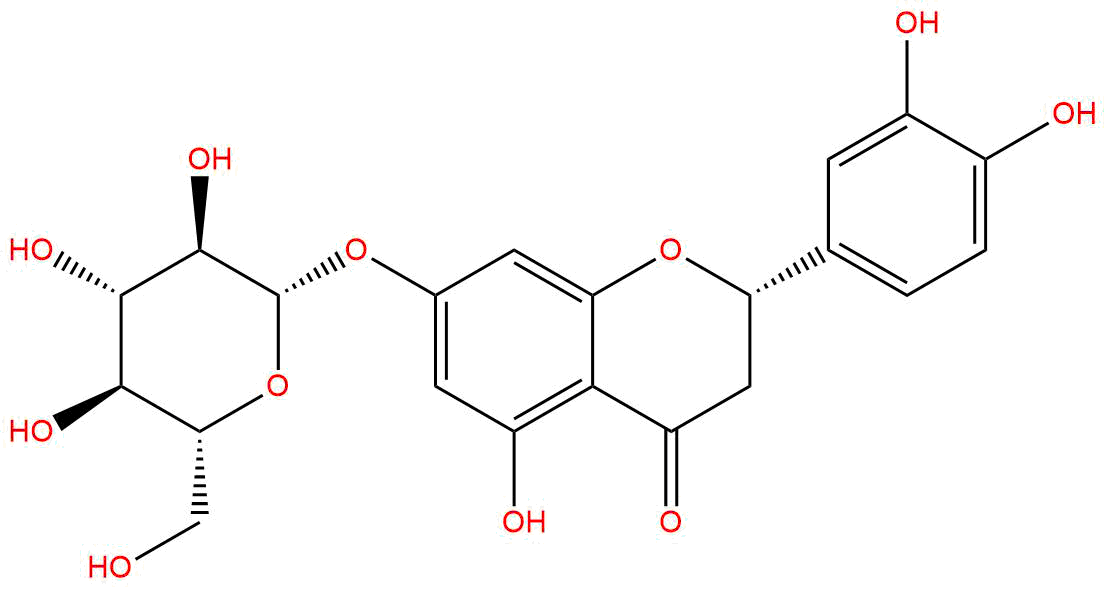


Product name: Eriodictyol 7-O-glucoside
Synonym name:
Catalogue No.: BP2164
Cas No.: 38965-51-4
Formula: C21H22O11
Mol Weight: 450.396
Botanical Source:
Type of Compound:
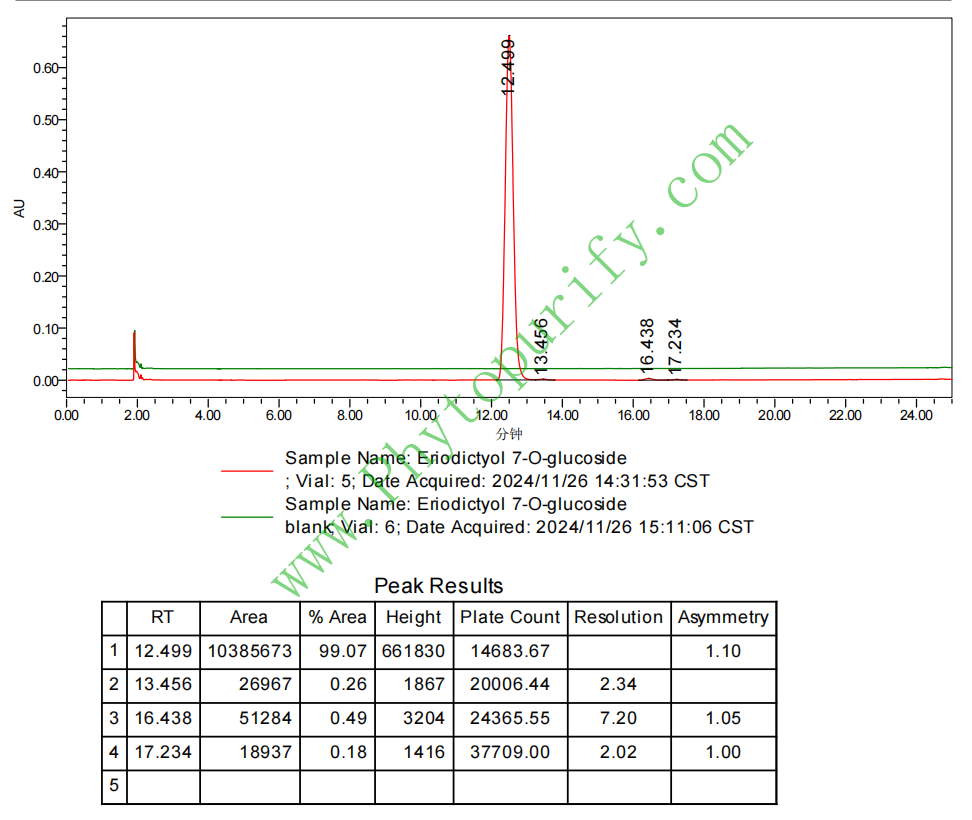
Purity: 95%~99%
Analysis Method: HPLC-DAD or/and HPLC-ELSD
Identification Method: Mass, NMR
Packing: Brown vial or HDPE plastic bottle
Storage: Store in a well closed container, protected from air and light. Put into refrigerate or freeze for long term storage.
Whenever possible, you should prepare and use solutions on the same day. However, if you need to make up stock solutions in advance, we recommend that you store the solution as aliquots in tightly sealed vials at -20℃. Generally, these will be useable for up to two weeks.
The product could be supplied from milligrams to grams
Inquire for bulk scale.
For Reference Standard and R&D, Not for Human Use Directly.
HPLC of Eriodictyol 7-O-glucoside
Storage conditions:Short-term storage at 2~8℃, long-term storage at -20 ~ -80℃
219.0900
-1.5000
-2.0000
Low
No
No
No
No
No
No
Eriodictyol 7-O - β - D-glucoside (hereinafter referred to as "Eriodictyol 7-O - β - D-glucoside") is a natural flavonoid compound that has attracted much attention due to its significant antioxidant and neuroprotective effects. As an activator of the Nrf2 (nuclear factor erythroid 2-related factor 2) pathway, resveratrol 7-O-glucoside can regulate intracellular redox balance, induce the expression of antioxidant enzymes, and provide potential therapeutic strategies for various oxidative stress-related diseases. In recent years, with a deeper understanding of the role of oxidative stress in the occurrence and development of diseases, research on the use of salvianolic acid-7-O-glucoside in ischemic stroke, neurodegenerative diseases, and immune related diseases has gradually increased, demonstrating good pharmacological activity and safety characteristics. This article will provide a systematic review of the chemical structure, sources, pharmacological activity, mechanism of action, pharmacological evaluation, and clinical application prospects of Shengcao phenol-7-O-glucoside, aiming to provide scientific basis for its further development and application.
Shengcao phenol-7-O-glucoside belongs to the flavanone glycoside class of flavonoids, with a molecular formula of C21H22O11 and a molecular weight of 466.39. Its structure is composed of Eriodictyol, a flavonoid skeleton, and a β - D-glucoside bond formed by a hydroxyl group at the 7th position of a glucose molecule. This structure endows it with good water solubility (LogP of approximately -1.5) and high polarity (TPSA of 219.09 Å ²), with a hydrogen bond acceptor number of 11, exhibiting strong hydrophilic characteristics.
From the perspective of physical and chemical properties, the water solubility of Shengcao phenol-7-O-glucoside is good, which is conducive to absorption and distribution in the body. However, its blood-brain barrier permeability is low, indicating that its direct action in the central nervous system may be limited, and specific drug delivery systems or metabolic transformations are needed to achieve neuroprotective functions. In addition, in vitro and in vivo safety evaluations showed that it has no hepatotoxicity, cardiotoxicity, or hERG channel inhibition effect, and the Ames mutagenicity test was negative, indicating that it has a good safety basis.
Shengcao phenol-7-O-glucoside is mainly found in various traditional medicinal plants, especially those belonging to the Lamiaceae and Rutaceae families, such as Eriodictyon spp. and citrus plants. Its content is greatly affected by plant species, growth environment, and harvesting period.
The extraction method usually uses water or methanol as solvents, and obtains crude extracts through ultrasound assisted extraction or reflux extraction. Subsequently, purification was carried out using techniques such as silica gel column chromatography and reverse phase high performance liquid chromatography (RP-HPLC), resulting in the production of high-purity sage phenol-7-O-glucoside. In recent years, the application of supercritical fluid extraction and membrane separation technology has also improved extraction efficiency and purity, reduced solvent residue and environmental pollution.
Shengcao phenol-7-O-glucoside exhibits significant free radical scavenging ability, especially strong scavenging effects on hydroxyl radicals and superoxide anions, with IC50 values of 0.28 mM and 0.30 mM, respectively. This antioxidant activity is mainly attributed to the multi hydroxyl structure of its flavonoid skeleton and the stabilizing effect of glucosides, which can effectively capture free radicals and alleviate oxidative stress damage to cells.
In the oxidative damage model induced by oxygen glucose deprivation (OGD) in vitro, salvianolic acid-7-O-glucoside significantly reduced cell apoptosis rate, restored cell viability, and alleviated cell damage caused by oxidative stress. In the rat model of focal cerebral ischemia (MCAO), salvianolic acid-7-O-glucoside significantly improves neurological dysfunction by reducing oxidative damage to brain tissue and alleviating neuroinflammatory reactions, demonstrating good neuroprotective efficacy.
Shengcao phenol-7-O-glucoside exerts anti-inflammatory effects by regulating the expression of various inflammatory factors. It has a certain regulatory effect on allergic rhinitis related targets such as HRH1, IL4, IL5, IL13, and FCER1A, which can alleviate allergic reactions and alleviate inflammatory symptoms. In addition, in the chronic inflammatory state such as diabetes nephropathy, St. Cao phenol-7-O-glucoside alleviates the process of renal inflammation and fibrosis by inhibiting TNF, NF - κ B and other signal pathways.
Research has shown that resveratrol 7-O-glucoside has potential neuroprotective and disease modifying effects in Parkinson's and Alzheimer's disease models by activating the Nrf2 pathway, regulating the expression of oxidative stress-related enzymes such as GPX1 and SOD1/2, reducing neuronal damage, and inhibiting abnormal accumulation of alpha synuclein (SNCA) and beta amyloid (APP).
The main mechanism of action of Shengcao phenol-7-O-glucoside is focused on the activation of the Nrf2/ARE signaling pathway. Nrf2, as a key intracellular antioxidant transcription factor, can induce the expression of various antioxidant and detoxifying enzyme genes, such as superoxide dismutase (SOD1/2), glutathione peroxidase (GPX1), vascular endothelial growth factor (VEGFA), etc., after enhanced nuclear localization, thereby enhancing the cell's resistance to oxidative damage.
In addition, resveratrol 7-O-glucoside can regulate inflammation related signaling pathways, including NF - κ B and TNF - α, inhibit the release of inflammatory mediators, and alleviate inflammatory responses. Its regulation of angiogenic factors such as VEGFA and platelet-derived growth factor (PDGFB) helps promote the repair and regeneration of ischemic tissues.
In neurodegenerative diseases, resveratrol 7-O-glucoside slows down neuronal degeneration and dysfunction by regulating targets such as mitochondrial function (NDUFS1 complex I), ubiquitin proteasome system (UBC), and dopamine receptor (DRD2).
Shengcao phenol-7-O-glucoside has a moderate molecular weight, high polarity, and good water solubility, but its LogP value is low, indicating weak lipid solubility, which may affect oral absorption and blood-brain barrier penetration. Its blood-brain barrier permeability has been evaluated as low, limiting its direct effects in the central nervous system and requiring improvement through drug carrier systems or structural modifications.
In terms of safety, Shengcao phenol-7-O-glucoside showed no hepatotoxicity, cardiotoxicity, or hERG channel inhibition, and the Ames test was negative, indicating good safety potential. Its high TPSA and hydrogen bond receptor count indicate that it may have strong protein binding and metabolic stability in vivo.
At present, there is relatively little systematic research on its pharmacokinetics. Preliminary data shows that its oral bioavailability is limited, and its metabolic pathway is mainly through the liver enzyme system. Metabolites still need further identification. In the future, it is necessary to strengthen the research on its in vivo metabolism kinetics, optimize the administration route and dosage form design.
Shengcao phenol-7-O-glucoside, as a natural Nrf2 activator, has shown broad application prospects in various oxidative stress-related diseases. Its neuroprotective effect in ischemic stroke models provides new ideas for stroke treatment, especially in the regulation of oxidative damage and inflammatory response in the late stage of acute ischemia.
In neurodegenerative diseases such as Parkinson's disease and Alzheimer's disease, salvianolic acid-7-O-glucoside regulates oxidative stress, protein misfolding, and inflammatory response through multiple targets, which may delay disease progression and improve neurological function, and is worthy of further preclinical and clinical research.
In addition, its immunomodulatory and anti-inflammatory activities make it a potential therapeutic candidate for chronic inflammatory diseases such as allergic rhinitis and diabetes nephropathy.
Future research should focus on the following aspects: (1) in-depth analysis of its molecular mechanism of action and interaction with other signaling pathways; (2) Optimize its pharmacokinetic properties, enhance bioavailability and brain distribution; (3) Conduct systematic toxicological evaluation and preclinical safety studies; (4) Explore combination therapy strategies and leverage synergistic effects; (5) Promote clinical trials to verify its efficacy and safety.
Shengcao phenol-7-O-glucoside, as a natural flavonoid glycoside with significant antioxidant and neuroprotective effects, has shown broad application potential in ischemic stroke, neurodegenerative diseases, and immune inflammatory diseases due to its ability to activate the Nrf2/ARE signaling pathway. Its excellent safety and multi-target regulatory properties provide a solid foundation for its drug development. However, current research on its pharmacokinetics and clinical applications is still in its infancy, and there is an urgent need for systematic and in-depth research and clinical validation. In the future, with the application of new technologies and the advancement of research, Shengcao phenol-7-O-glucoside is expected to become an important drug candidate molecule in the field of natural product pharmacology, bringing new breakthroughs to the treatment of related diseases.
