Introduction/Overview
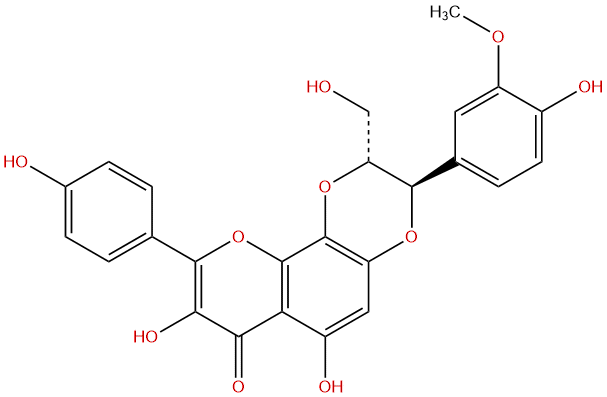
Rhodiolin (CAS number 86831-53-0) is a flavonoid compound isolated from plants of the Rhodiola genus, which has attracted much attention in recent years due to its unique biological activity. As an orally effective inhibitor of glucose 6-phosphate isomerase (GPI), Hongjing Tianling has shown broad research and application potential in the fields of glucose metabolism regulation, tumor inhibition, and antiviral therapy. It targets the key glycolytic enzyme GPI, regulates the PI3K/AKT/mTOR signaling pathway, induces apoptosis in papillary thyroid carcinoma (PTC) cells, and exhibits significant anti-tumor activity. In addition, Hongjing Tianling can also target the viral protein NS2B-NS3, inhibit dengue virus replication, and has potential antiviral value. In recent years, Hongjing Tianling, as a candidate molecule for inhibiting CK1 ε kinase, has also provided new ideas for the development of anticancer drugs.
This article aims to systematically review the chemical structure and physicochemical properties, plant sources and extraction methods, pharmacological activity and mechanism of action of Hongjingtianling, and explore its clinical application prospects and future research directions based on drug evaluation and pharmacokinetic data, providing reference and inspiration for the field of natural product pharmacology.
Chemical structure and physicochemical properties
Hongjing Tianling is a typical flavonoid compound with a molecular weight of 480.4250 and a LogP value of 2.1234, exhibiting moderate lipid solubility. Its topological polar surface area (TPSA) is 159.05 Å ², indicating that the molecule has strong polarity and hydrogen bond donor acceptor ability, which may affect its cell membrane permeability and bioavailability. The low water solubility (0.0745 mg/mL) suggests that the solubility of Hongjing Tianling in aqueous phase is limited, and it may be necessary to optimize the formulation to improve its in vivo absorption efficiency.
Structurally, Hongjing Tianling contains multiple hydroxyl and phenolic hydroxyl groups, which endow it with excellent antioxidant activity and may also affect its binding ability with target proteins. It does not possess hERG channel inhibitory activity, indicating a low risk of cardiac toxicity. The Ames test result is 0.6, indicating a low risk of genotoxicity and meeting safety requirements.
Plant sources and extraction methods
Hongjing Tianling mainly comes from Rhodiola spp., which are widely distributed in high-altitude and cold regions. They are traditionally used to enhance physical strength, resist fatigue, and resist altitude sickness. As one of the important active ingredients in Rhodiola rosea, Hongjingtianling is usually extracted and purified through the following steps:
-
Plant material collection and pretreatment
Select the rhizomes or whole plants of Rhodiola rosea, dry them and grind them into fine powder for solvent extraction.
-
Solvent extraction
Ethanol or methanol aqueous solution (usually 50% -70%) is used for reflux or ultrasound assisted extraction to ensure effective dissolution of flavonoids.
-
Concentration and Separation of Crude Extract
After the extraction solution is concentrated under reduced pressure, liquid-liquid extraction is used to remove lipid soluble impurities.
-
Chromatographic purification
Separation and purification of Hongjingtianling were carried out using methods such as silica gel column chromatography and reverse phase high-performance liquid chromatography (RP-HPLC), resulting in the acquisition of high-purity compounds.
-
Structural Identification
Confirm the structure of the compound using techniques such as nuclear magnetic resonance (NMR), mass spectrometry (MS), and infrared spectroscopy (IR).
In recent years, supercritical CO ₂ extraction and membrane separation technologies have also been attempted to be applied to the extraction of Hongjing Tianling, aiming to improve extraction efficiency and purity, reduce the use of organic solvents, and comply with the concept of green chemistry.
Pharmacological activity research
The pharmacological activities of Hongjing Tianling mainly focus on three directions: anti-tumor, antiviral, and antioxidant.
Antitumor activity
Hongjing Tianling inhibits glucose 6-phosphate isomerase (GPI), blocks glycolytic metabolic pathways, reduces energy supply to tumor cells, and thus suppresses the proliferation of papillary thyroid cancer (PTC) cells. Related in vitro experiments have shown that Hongjing Tianling can significantly inhibit the growth of PTC cell lines and induce cell apoptosis. Its mechanism of action involves inhibiting the phosphorylation of the PI3K/AKT/mTOR signaling pathway, blocking cell survival signaling, and promoting the expression of cell cycle arrest and apoptosis related proteins.
In addition, the potential of Hongjing Tianling as a CK1 ε kinase inhibitor has also been reported. CK1 ε is abnormally activated in various tumor cells and participates in cell cycle regulation and signal transduction. Hongjing Tianling exhibits broad anti-cancer potential by inhibiting CK1 ε and interfering with tumor cell proliferation signals.
Antiviral activity
Hongjing Tianling targets the NS2B-NS3 protein complex of dengue virus and inhibits virus replication. NS2B-NS3 is a key protease of dengue virus, involved in the cleavage and maturation of viral peptides. Hongjing Tianling significantly reduces virus replication efficiency by binding to the protein complex and blocking its enzyme activity. Both in vitro cell models and viral infection experiments have confirmed its antiviral effect, indicating its potential as a drug for the development of anti dengue fever virus.
antioxidant activity
Hongjing Tianling contains abundant phenolic hydroxyl structures and has good free radical scavenging ability. Its antioxidant activity involves multiple targets, including tyrosinase (TYR), matrix metalloproteinases (MMP1, MMP3), nuclear factor E2 related factor 2 (NFE2L2/NRF2), superoxide dismutase (SOD1, SOD2), catalase (CAT), glutathione peroxidase (GPX1), and heme oxygenase (HMOX1). These targets collectively regulate intracellular redox balance, alleviate oxidative stress damage, and protect cellular function.
Mechanism of action and molecular targets
The multi-target mechanism of action of Hongjing Tianling provides a basis for its diverse pharmacological activities.
1. Targeting glucose 6-phosphate isomerase (GPI)
GPI is a key enzyme in the glycolysis pathway, catalyzing the reversible conversion between glucose-6-phosphate and fructose-6-phosphate. Tumor cells rely on glycolysis to obtain energy and metabolic intermediates, and inhibition of GPI can effectively cut off the energy supply to tumor cells. As a GPI inhibitor, Hongjing Tianling reduces the rate of glycolysis, induces energy metabolism disorders in tumor cells, and promotes cell apoptosis.
2. Inhibit the PI3K/AKT/mTOR signaling pathway
The PI3K/AKT/mTOR pathway is a core signaling pathway that regulates cell growth, proliferation, and survival. Hongjing Tianling inhibits the phosphorylation of this pathway, blocks signal transduction, suppresses tumor cell proliferation, and induces apoptosis. This mechanism has been confirmed in a cell model of papillary thyroid cancer.
3. Targeting NS2B-NS3 protein complex
The NS2B-NS3 protein complex of dengue virus is an essential protease for virus replication. Hongjing Tianling binds to this complex, inhibits its enzyme activity, blocks the viral peptide cleavage process, and suppresses viral replication. The target mechanism provides a molecular basis for the antiviral effect of Hongjing Tianling.
4. Inhibit CK1 ε kinase
CK1 ε kinase is involved in cell cycle regulation and signal transduction abnormalities, and is a potential therapeutic target for various tumors. Hongjing Tianling, as a CK1 ε inhibitor, interferes with the proliferation signal of tumor cells and exhibits anti-cancer potential.
5. Antioxidant related targets
Hongjing Tianling regulates various antioxidant enzymes and transcription factors, including NRF2, SOD, CAT, GPX1, etc., enhancing cellular antioxidant defense ability, reducing oxidative stress damage, and protecting cells from free radical invasion.
Evaluation of drug properties and pharmacokinetics
The pharmacological parameters of Hongjing Tianling indicate that it has certain potential for drug development:
- Molecular weight (480.4250)Moderate, in line with the molecular weight range of most oral small molecule drugs.
- LogP(2.1234)Indicating moderate lipid solubility, which is beneficial for membrane permeability and oral absorption.
- TPSA(159.05 Ų)High, indicating strong molecular polarity, may affect its ability to penetrate cell membranes and blood-brain barriers, with limited brain function in clinical applications.
- Water solubility (0.0745 mg/mL)Low, may limit its bioavailability, and solubility needs to be improved through formulation optimization.
- Low permeability of blood-brain barrier Reduce the risk of central nervous system side effects.
- HERG inhibition negative The risk of cardiac toxicity is low.
- Ames test result 0.6 The risk of genotoxicity is low and the safety is good.
At present, there is limited research on the pharmacokinetics of Hongjing Tianling. Preliminary data shows that it is well absorbed orally, but the metabolic pathways and half-life in vivo still need to be further studied. In the future, the combination of in vivo and in vitro metabolic enzymes should be used to optimize the dosing regimen, improve in vivo stability and bioavailability.
Clinical application prospects and prospects
As a natural flavonoid compound with multiple targets and functions, Hongjing Tianling has broad clinical application potential
-
Development of anti-tumor drugs
It induces tumor cell apoptosis by inhibiting the key glycolytic enzymes GPI and PI3K/AKT/mTOR pathways, especially showing good inhibitory effects in solid tumors such as papillary thyroid carcinoma. In the future, synergistic anti-cancer strategies can be explored by combining chemotherapy drugs.
-
Potential of antiviral drugs
Targeting the inhibitory effect of NS2B-NS3 protein on dengue virus, providing a new target for the development of anti dengue virus drugs. Given the global trend of dengue virus infection, the antiviral activity of Hongjing Tianling has significant public health implications.
-
Antioxidant and anti-inflammatory applications
Hongjing Tianling regulates various antioxidant enzymes, reduces oxidative stress, and may play a protective role in chronic inflammation, neurodegenerative diseases, and metabolic syndrome.
-
Development of CK1 ε kinase inhibitors
As a potential inhibitor of CK1 ε kinase, Hongjing Tianling provides new ideas for anti-cancer strategies targeting this enzyme, which can be expanded to the treatment research of various types of tumors in the future.
However, the clinical translation of Hongjing Tianling still faces many challenges, including poor water solubility, limited bioavailability, and unclear pharmacokinetic characteristics. In the future, it is necessary to strengthen in vivo pharmacokinetics, toxicology, and preclinical safety evaluation, combined with new drug delivery systems such as nanocarriers, to enhance their clinical application value.
Conclusion
Hongjing Tianling, as a natural flavonoid derived from the Sedum genus, has shown broad application prospects in the fields of anti-tumor, antiviral, and antioxidant effects due to its unique GPI inhibitory activity and multi-target mechanism of action. It exerts significant pharmacological effects by regulating glycolysis metabolism, inhibiting key signaling pathways, and viral protease activity. The pharmacological evaluation shows that Hongjingtianling has good safety and potential oral activity, but its water solubility and pharmacokinetic properties still need to be optimized.
Future research should focus on in-depth analysis of its molecular mechanism of action, improving pharmacokinetic and toxicological data, exploring efficient formulation technologies, and promoting its translation into clinical applications. As a model of natural product pharmacology, Hongjing Tianling will undoubtedly play an important role in new drug development and disease treatment.