

Storage conditions:Short-term storage at 2~8℃, long-term storage at -20 ~ -80℃
45.5900
2.5581
1.9173
.4703
2.3477
43.3579
High
73.8019
4.5155
No
Yes
No
Yes
Yes
Yes
0.0
No
No
No
No
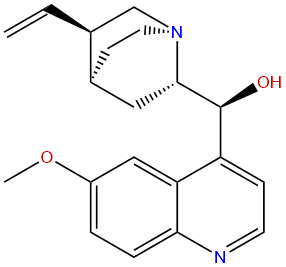
Quinidine, CAS number 56-54-2, is a natural antiarrhythmic drug with a long history and wide clinical application. As a stereoisomer of quinine, quinidine was initially isolated from the bark of Cinchona spp. and has been used for the treatment of arrhythmia and malaria for a long time. With the development of molecular pharmacology and medicinal chemistry, the pharmacological mechanism of quinidine has gradually become clear, especially its role in cardiac electrophysiological regulation. In recent years, quinidine has not only been proven to be an effective cytochrome P450db inhibitor and potassium channel blocker, but also demonstrated the potential to induce cell apoptosis, expanding its research and application fields.
This article provides a systematic review of the chemical structure and physicochemical properties, plant sources and extraction methods, pharmacological activity and mechanism of action of quinidine. It delves into its molecular targets and pharmacological characteristics, and, combined with pharmacokinetic data, looks forward to its clinical application prospects and future development directions, providing detailed reference materials for researchers in the field of natural product pharmacology.
The chemical name of quinidine is (R) - α - ethyl-6-methoxy-4-quinolone methanol, with a molecular formula of C20H24N2O2 and a molecular weight of 324.4240. Its structure belongs to the quinine alkaloid class, with a typical quinoline ring system and side chain alcohol groups. The molecular structure of quinidine contains multiple chiral centers, endowing it with specific stereochemical properties closely related to its biological activity.
In terms of physical and chemical properties, the LogP value of quinidine is 2.5581, indicating its moderate lipid solubility, which is beneficial for transmembrane absorption and distribution. Its topological polar surface area (TPSA) is 45.59 Å ², indicating moderate polarity and favorable oral bioavailability. The water solubility is 0.4703 mg/mL, belonging to low to moderate solubility compounds. Quinidine can effectively penetrate the blood-brain barrier (BBB), which is related to its high lipid solubility and low polarity. It is worth noting that quinidine is a hERG (human cardiac potassium channel) inhibitor, which is closely related to its antiarrhythmic activity and potential cardiac toxicity. In addition, quinidine tested negative in the Ames test, indicating a low risk of genotoxicity.
Quinidine mainly comes from the bark of the Cinchona spp., especially from species such as Cinchona officinalis and Cinchona ledger. The cinchona tree is native to the Andes mountains of South America and is a natural source of traditional antimalarial drugs quinine and quinidine. Bark contains various alkaloids, among which quinidine is one of the most important active ingredients.
The extraction process usually uses acid-base extraction method. Fresh or dry cinchona bark is first soaked in a dilute acid (such as dilute hydrochloric acid) aqueous solution to form quinidine salts, increasing its water solubility. Subsequently, quinidine is precipitated as a free base through alkalization treatment (such as sodium hydroxide solution), and liquid-liquid extraction is performed using organic solvents (such as ether, chloroform). The extraction solution undergoes concentration, recrystallization, and other steps to obtain high-purity quinidine. In modern technology, supercritical fluid extraction and high-performance liquid chromatography (HPLC) purification techniques have also been applied to the extraction and purification of quinidine, improving the purity and yield of the product.
Quinidine, as a classic antiarrhythmic drug, is mainly used to treat ventricular and supraventricular arrhythmias. Its pharmacological activity covers the regulation of various ion channels, especially the blocking effect of potassium ion channels (K+channels) and sodium ion channels (Na+channels).
Antiarrhythmic activity
Quinidine restores normal heart rhythm by blocking various ion channels on the myocardial cell membrane, prolonging the duration of action potentials, inhibiting abnormal electrical activity. Its main targets include KCNH2 (hERG), KCNQ1, SCN5A (cardiac sodium channel Nav1.5), CACNA1C (L-type calcium channel), KCNE1, KCNE2, and RYR2 (cardiac sarcoplasmic reticulum calcium release channel). Among them, quinidine blocks the hERG channel particularly significantly, with an IC50 of approximately 19.9 μ M, prolonging the cardiac repolarization process and preventing the occurrence of arrhythmia.
Inhibition of cytochrome P450db
Quinidine is a selective cytochrome P450db inhibitor that affects the drug metabolism enzyme system and may lead to drug interactions. This characteristic needs to be noted in clinical medication, especially when used in combination with other drugs that rely on P450 metabolism.
Inducing cell apoptosis
In recent years, studies have found that quinidine can induce apoptosis in multiple cell types, indicating its potential application value in the fields of oncology and cell biology. The mechanism of inducing apoptosis may involve pathways such as ion channel regulation, mitochondrial dysfunction, and oxidative stress.
Application of Malaria Research
Although quinidine is now rarely used alone for the treatment of malaria, its antimalarial activity is still widely studied, especially in the mechanisms of drug resistance and the development of new antimalarial drugs. Quinidine as a model compound is of great significance.
The mechanism of action of quinidine is complex, involving the regulation of multiple ion channels and enzyme systems:
KCNH2 (hERG) channel blockade
The hERG channel mediates rapid delayed reduction of potassium current (IKr) in the heart, which is crucial for cardiac repolarization. Quinidine inhibits IKr current, prolongs action potential duration, and prevents arrhythmia by binding to hERG channels. Although this effect is effective, it may also lead to prolonged QT interval and increased risk of arrhythmia.
KCNQ1/KCNE1 channel regulation
The slow delayed potassium current (IKs) channel composed of KCNQ1 and the auxiliary subunit KCNE1 is also a target of quinidine, regulating the repolarization process of myocardial cells.
SCN5A (Nav1.5) sodium channel blockade
Quinidine blocks myocardial sodium channels, reduces sodium ion influx, lowers myocardial cell excitability, and inhibits abnormal conduction.
CACNA1C (L-type calcium channel) inhibition
By inhibiting L-type calcium channels, quinidine reduces calcium ion influx, affecting myocardial contraction and electrical activity.
RYR2 regulation
Quinidine regulates the sarcoplasmic reticulum calcium release channel RYR2, affects intracellular calcium homeostasis in cardiomyocytes, and participates in antiarrhythmic effects.
Inhibition of cytochrome P450db
Quinidine selectively inhibits P450db enzyme, interferes with drug metabolism, and affects pharmacokinetics.
Inducing apoptosis mechanism
Quinidine induced apoptosis may be achieved by regulating ion channel mediated intracellular calcium homeostasis imbalance, activating mitochondrial pathways, and oxidative stress response.
Quinidine has good oral bioavailability, moderate LogP value, low TPSA, and is conducive to membrane permeation and systemic distribution. Its molecular weight of 324.4240 conforms to the principle of "drug similarity" in drug design. Low water solubility, but sufficient to meet the dissolution requirements of oral formulations.
Quinidine can effectively penetrate the blood-brain barrier, indicating that it may also have certain activity or side effects in the central nervous system. As a hERG channel inhibitor, although it enhances the anti arrhythmic effect, it also brings potential risks of cardiac toxicity, which need to be strictly controlled in clinical dosage and administration regimen.
Pharmacokinetic studies have shown that quinidine is rapidly absorbed after oral administration, with a high plasma protein binding rate. It is mainly metabolized and excreted through the liver, and the metabolic pathway involves the cytochrome P450 enzyme system, especially the P450 db subtype. Its half-life is moderate and suitable for clinical treatment.
The Ames test result is negative, indicating that quinidine has a low risk of genetic toxicity and good safety.
Quinidine, as a first-line antiarrhythmic drug, is particularly suitable for treating ventricular arrhythmias and paroxysmal supraventricular tachycardia. Its multi-target mechanism of action gives it unique advantages in the treatment of complex arrhythmias. In the future, with a deeper understanding of its molecular targets and mechanisms of action, quinidine is expected to reduce cardiac toxicity and improve treatment selectivity through structural modification and dosage form optimization.
In addition, the cytochrome P450db inhibitory effect of quinidine provides an important model for drug interaction research, guiding rational clinical drug use. Its potential to induce cell apoptosis also suggests the potential application of quinidine in the field of anti-tumor, which is worth further exploration.
In the field of malaria research, although quinidine is no longer the preferred drug, the study of its anti malaria mechanism and molecular mechanisms related to drug resistance is still of great significance, which will contribute to the development of new anti malaria drugs.
Future research should focus on optimizing the structure of quinidine, reducing the cardiac toxicity associated with hERG channel inhibition, expanding its indications, and combining modern drug delivery technologies to improve its clinical efficacy and safety.
Quinidine, as a classic natural antiarrhythmic drug, plays an important role in clinical arrhythmia treatment due to its multi-target regulatory ability and good oral activity. Its complex pharmacological mechanism includes the blockade of potassium channels, sodium channels, and calcium channels, as well as the inhibition of cytochrome P450db, reflecting the multidimensional characteristics of natural product pharmacology.
Despite the risk of cardiac toxicity, quinidine remains one of the irreplaceable drugs in the treatment of arrhythmia. In the future, through in-depth molecular mechanism research and rational structural modification, it is expected to further enhance its safety and efficacy, and expand its clinical application fields. As a model of natural product pharmacology research, the research results of quinidine not only enrich the knowledge system of cardiovascular pharmacology, but also provide valuable theoretical and practical basis for new drug development.
