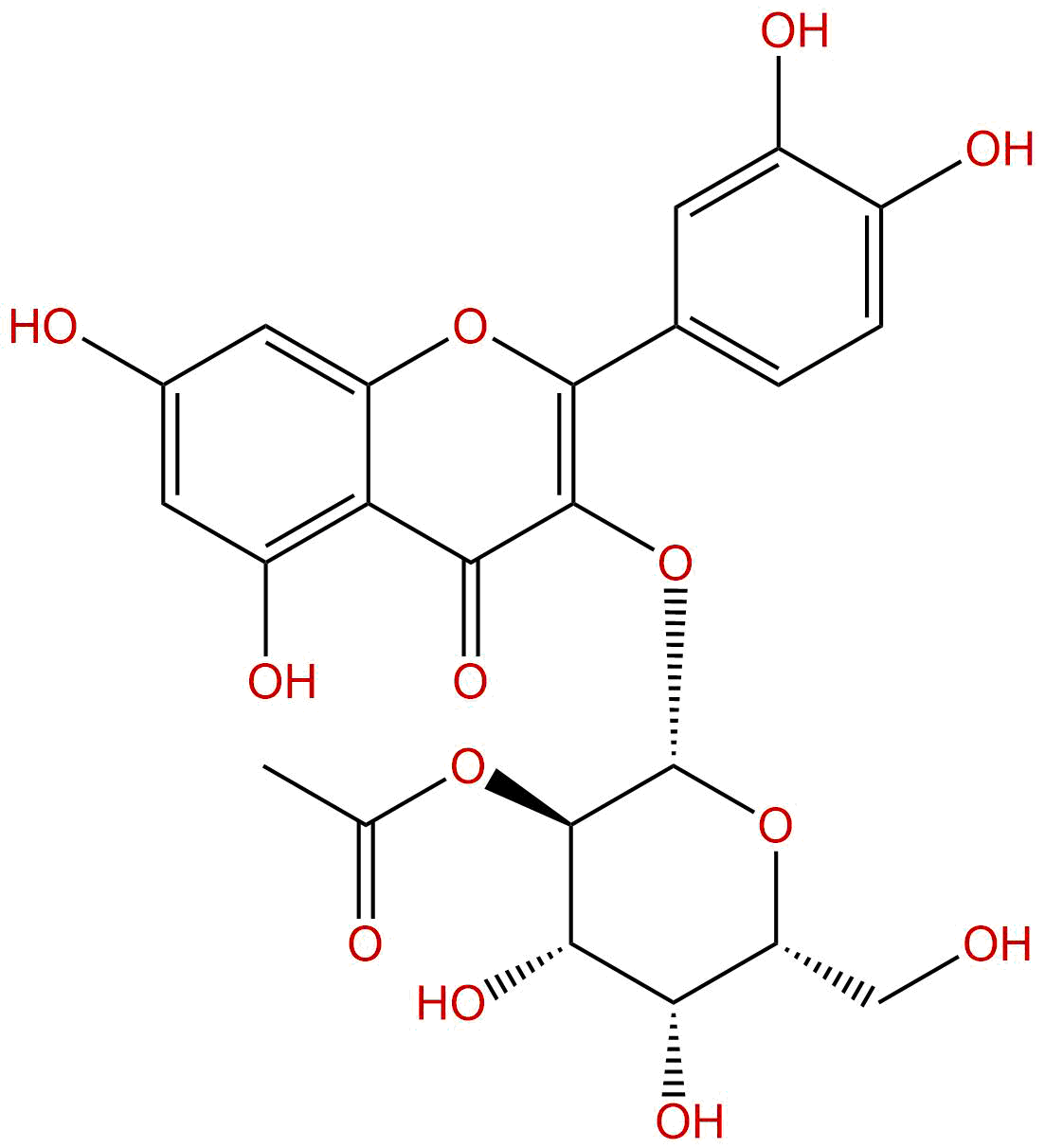


Product name: 2""-Acetylhyperin
Synonym name: Quercetin 3-O-β-D-(2-O-acetyl)galactopyranoside
Catalogue No.: BP2233
Cas No.: 439266-62-3
Formula: C23H22O13
Mol Weight: 506.416
Botanical Source:
Type of Compound:
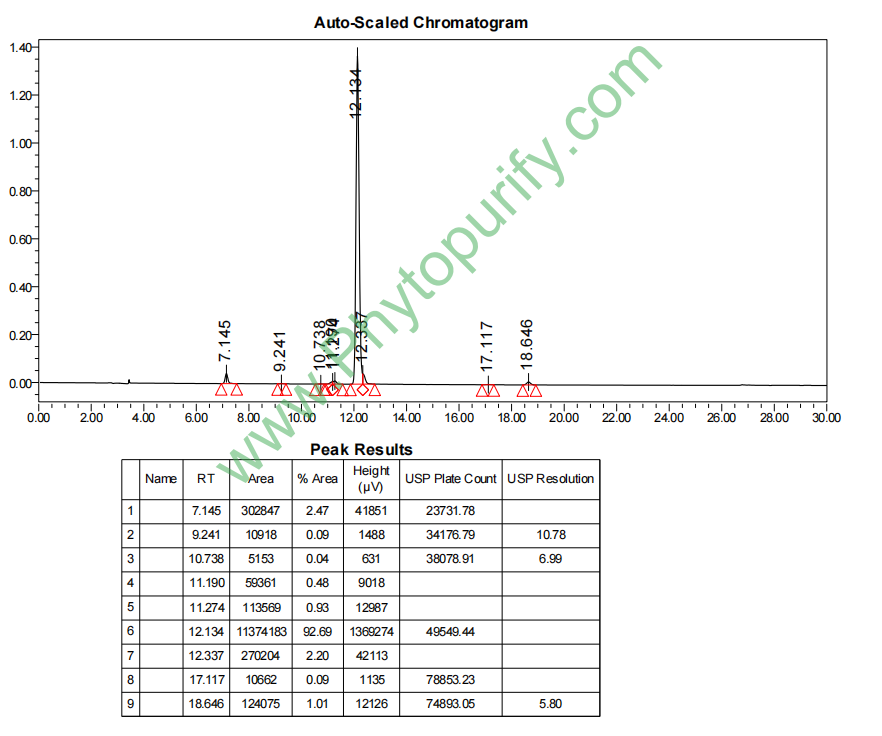
Purity: 95%~99%
Analysis Method: HPLC-DAD or/and HPLC-ELSD
Identification Method: Mass, NMR
Packing: Brown vial or HDPE plastic bottle
Storage: Store in a well closed container, protected from air and light. Put into refrigerate or freeze for long term storage.
Whenever possible, you should prepare and use solutions on the same day. However, if you need to make up stock solutions in advance, we recommend that you store the solution as aliquots in tightly sealed vials at -20℃. Generally, these will be useable for up to two weeks.
The product could be supplied from milligrams to grams
Inquire for bulk scale.
For Reference Standard and R&D, Not for Human Use Directly.
HPLC of 2""-Acetylhyperin
Storage conditions:Short-term storage at 2~8℃, long-term storage at -20 ~ -80℃
216.5800
.2216
-.0251
1.9053
.5898
.2242
Low
78.4787
4.1076
Yes
No
Yes
No
Yes
No
0.6
Yes
No
Yes
Yes
Natural products, as an important source of drug discovery and development, play an irreplaceable role in the history of human disease prevention and treatment. Flavonoids have always been a hot topic in natural product pharmacology research due to their broad biological activity and low toxicity. 2 "- Acetyl hyperoside (CAS: 439266-62-3) is an acetylated derivative of Hyperin, a flavonol glycoside with a unique structure. In recent years, it has gradually emerged from numerous natural flavonoids and demonstrated multifaceted pharmacological potential. Hypericin itself has been widely studied for its anti-inflammatory, antioxidant, neuroprotective, and other activities. Acetylation modification may alter its physicochemical properties, bioavailability, and interactions with targets, thereby endowing its parent compound with biological characteristics that are not present or superior. At present, there is still a lack of systematic review on 2 "- acetyl hyperoside. This article aims to comprehensively review the chemical properties, plant sources, pharmacological activities, mechanisms of action, and medicinal properties of this compound, in order to provide a systematic scientific reference for further research and future development of this compound.
The chemical name of 2 "- acetyl hyperoside is quercetin-3-O - β - D-galactopyranoside-2" - acetate. Its molecular formula is C23H22O13 and its molecular weight is 506.4160. Structurally, it takes Quercetin as the aglycone and undergoes acetylation modification on the hydroxyl group at position 2 of the galactose moiety, which is its key structural feature that distinguishes it from hyperoside (where the galactose moiety is not acetylated).
This structural change significantly affects its physicochemical properties. The calculated lipid water partition coefficient (LogP) is 0.2216, indicating that the compound has relatively balanced hydrophilicity and oleophilicity, but slightly leans towards hydrophilicity. Its topological polar surface area (TPSA) is as high as 216.58 Å ², mainly attributed to the numerous hydroxyl, sugar, and ester bond oxygen atoms in the molecule, indicating its high polarity. The theoretically calculated water solubility value is 1.9053, which belongs to the solubility range and is consistent with the high TPSA value. These properties collectively determine its initial behavior such as absorption and distribution within the organism. The introduction of acetyl groups may theoretically increase the lipophilicity of the molecule to some extent, helping it penetrate the cell membrane, but the large polar sugar groups and remaining multiple phenolic hydroxyl groups still make it appear as a moderately polar compound as a whole.
2 "- Acetyl hyperoside is not widely present in the plant kingdom, and it is currently reported that it mainly comes from a few plants. The most classic source is from the genus Violaceae in the Rosaceae family Potentilla discolor(Potentilla discolor Bunge's dried whole grass. Forsythia suspensa is commonly used in traditional medicine for hemostasis, heat clearing, and detoxification. Modern research has shown that it is rich in various flavonoids, with 2 "- acetyl hyperoside being one of its characteristic active ingredients. In addition, in some cases Hypericum genus(Hypericum A small amount was also detected in plants, which is consistent with their identity as derivatives of hyperoside.
The extraction and separation method follows the conventional process of plant chemistry, but has been optimized for its polarity characteristics:
1. Extract Methanol, ethanol, or aqueous ethanol are commonly used for reflux extraction or ultrasound assisted extraction of dried and crushed plant materials. Considering the polarity and thermal stability of the target compound, 70% -80% ethanol aqueous solution is a commonly used extraction solvent, which can reduce the dissolution of lipid soluble impurities while ensuring extraction efficiency.
2. Enrichment and Separation After the crude extract is concentrated under reduced pressure, macroporous adsorption resins (such as D101, AB-8) are often used for preliminary enrichment, followed by gradient elution with water and different concentrations of ethanol. The target compound is usually eluted in the elution site of low to medium concentration ethanol (such as 30% -50%). Further purification relies on various chromatographic techniques:
* Silica gel column chromatography Gradient elution using chloroform methanol water system.
* Reverse phase column chromatography For example, ODS (C18) column is used to elute with methanol water or acetonitrile water system, which is currently the most commonly used and efficient purification method.
* Preparation type high-performance liquid chromatography Using a reverse phase C18 column, methanol water or acetonitrile water (often containing a small amount of formic acid or acetic acid to adjust pH) is used as the mobile phase for final monomer purification to obtain high-purity samples for activity studies.
Structural identification involves the comprehensive use of techniques such as ultraviolet spectroscopy (UV), mass spectrometry (MS), nuclear magnetic resonance hydrogen spectroscopy, and carbon spectroscopy (¹ H-NMR, ¹ ³ C-NMR). In particular, the chemical shift and coupling constant of characteristic protons on the sugar group in NMR can be used to determine the position of acetyl substitution (2 "position).
Existing studies (mainly based on in vitro cell models and some in vivo animal models) have revealed that 2 "- acetyl hyperoside has multiple pharmacological activities, and its activity spectrum overlaps with the glycoside quercetin and hyperoside, and also has its own characteristics.
Anti inflammatory and immune regulatory activity This is one of the most extensively studied activities of the compound. In the lipopolysaccharide (LPS) - induced macrophage (such as RAW264.7) inflammation model, 2 "- acetyl hyperoside can significantly inhibit the production of nitric oxide (NO), prostaglandin E2 (PGE2), and key pro-inflammatory cytokines such as tumor necrosis factor - α (TNF - α), interleukin-6 (IL-6), and IL-1 β. Its strength of action has been shown to be superior to non acetylated hyperoside in some studies. In acute inflammation models induced by carrageenan or acetic acid in mice, it also exhibits good anti-inflammatory effects.
Antioxidant and anti apoptotic activity This compound can effectively scavenge free radicals such as DPPH and ABTS, and exhibits iron ion reduction ability. In hydrogen peroxide (H ₂ O ₂) or other oxidative stress-induced cell damage models (such as neurons, cardiomyocytes, endothelial cells), it can increase the activity of superoxide dismutase (SOD) and glutathione peroxidase (GSH Px), reduce malondialdehyde (MDA) levels, thereby reducing oxidative damage and inhibiting cell apoptosis. This has potential significance for the prevention and treatment of cardiovascular and neurodegenerative diseases.
Neuroprotective activity In addition to antioxidant pathways, studies have also found that 2 "- acetyl hyperoside has a protective effect on glutamate induced damage to PC12 cells or primary cortical neurons, which may involve regulating calcium overload and apoptosis related proteins. In Alzheimer's disease model cells, it exhibits the potential to inhibit the toxicity induced by β - amyloid protein (A β).
Antitumor activity Preliminary studies have shown that 2 "- acetyl hyperoside has inhibitory effects on the proliferation of certain tumor cell lines, such as human liver cancer HepG2 cells and human lung cancer A549 cells, and can induce cell cycle arrest and apoptosis. Its mechanism of action may be related to regulating the Bcl-2/Bax protein ratio and activating the Caspase cascade reaction.
Other activities: It has also been reported that it has anti diabetes potential (by inhibiting α - glucosidase and protecting pancreatic β cells), anti-virus (such as anti influenza virus), liver protection and other activities. These activities are mostly closely related to their anti-inflammatory and antioxidant core functions.
The pharmacological effects of 2 "- acetyl hyperoside are the result of multi-target and multi pathway synergy, and its core mechanism revolves around regulating key inflammatory and oxidative stress signaling pathways.
Inhibition of NF - κ B signaling pathway This is the core mechanism that mediates its anti-inflammatory effect. In the resting state, NF - κ B binds to the inhibitory protein I κ B and exists in the cytoplasm. When stimulated by LPS and other factors, the I κ B kinase complex is activated, leading to phosphorylation and degradation of I κ B. NF - κ B (mainly p65/p50 dimer) is released and transferred into the nucleus, initiating transcription of numerous inflammatory cytokine genes. Research has shown that 2 "- acetyl hyperoside can inhibit the phosphorylation and degradation of I κ B α, thereby preventing the nuclear translocation of NF - κ B p65 subunit, downregulating the expression of inflammatory mediators such as iNOS, COX-2, TNF - α, IL-6, etc.
Regulating the MAPK signaling pathway The mitogen activated protein kinase pathway, particularly p38, JNK, and ERK, is crucial in inflammation and stress responses. This compound has been shown to inhibit the phosphorylation activation of p38 and JNK in LPS induced macrophages, but its effect on the ERK pathway varies in different studies. By inhibiting p38/JNK, it can further regulate the activity of downstream transcription factors such as AP-1, synergistically inhibiting inflammatory responses.
Activate Nrf2/ARE antioxidant pathway Nuclear factor E2 related factor 2 is the overall switch for cellular antioxidant defense. Under oxidative stress, Nrf2 dissociates from Keap1, enters the nucleus, binds to antioxidant response elements, and initiates the transcription of a series of phase II detoxifying enzymes and antioxidant enzymes such as heme oxygenase-1, quinone oxidoreductase 1, SOD, etc. Research has shown that 2 "- acetyl hyperoside can promote nuclear translocation of Nrf2, enhance the activity of ARE reporter genes, and systematically improve the antioxidant capacity of cells.
Regulating the PI3K/Akt signaling pathway This pathway is closely related to cell survival, proliferation, and metabolism. In some protective models, 2 "- acetyl hyperoside has been observed to activate PI3K/Akt signaling, thereby inhibiting downstream pro apoptotic factors such as Bad and GSK-3 β, exerting anti apoptotic and cell protective effects.
Direct molecular target In addition to regulating the aforementioned pathways, research also attempts to explore their direct targets of action. Molecular docking simulations suggest that it may exert inhibitory effects by binding to the active pockets of iNOS and COX-2, or directly interacting with kinases such as IKK and p38. In addition, as flavonoids, their phenolic hydroxyl structure enables them to directly chelate metal ions, scavenge free radicals, and may affect the function of certain receptors such as estrogen receptors. These direct targets still require further biochemical experiments (such as surface plasmon resonance and thermal displacement analysis) to confirm.
Based on calculations and preliminary experimental data, a preliminary evaluation of the pharmacological properties of 2 "- acetyl hyperoside is conducted
The multi-target and multi pathway action characteristics of 2 "- acetyl hyperoside make it potentially advantageous in the treatment of complex diseases, especially chronic inflammation related diseases.
Potential indications:
Development Challenges and Strategies:
2 "- Acetyl hyperoside, as a natural flavonoid glycoside with a unique acetylation structure, has shown great potential for drug development due to its significant multiple pharmacological activities such as anti-inflammatory, antioxidant, and neuroprotective effects, as well as multi-target properties acting on key signaling pathways such as NF - κ B, MAPK, and Nrf2. Although current research has revealed its rich biological functions, there are still significant gaps in areas such as systematic pharmacokinetics, precise molecular target identification, and drug efficacy optimization. Future research should focus on overcoming the bottleneck of low bioavailability and exploring its essence through modern pharmaceutical technology and molecular biology methods. With the continuous deepening of research, 2 "- acetyl hyperoside is expected to develop from a potential natural active molecule into an innovative drug or lead compound for treating inflammation related chronic diseases, providing another example for the modern development of natural products.
