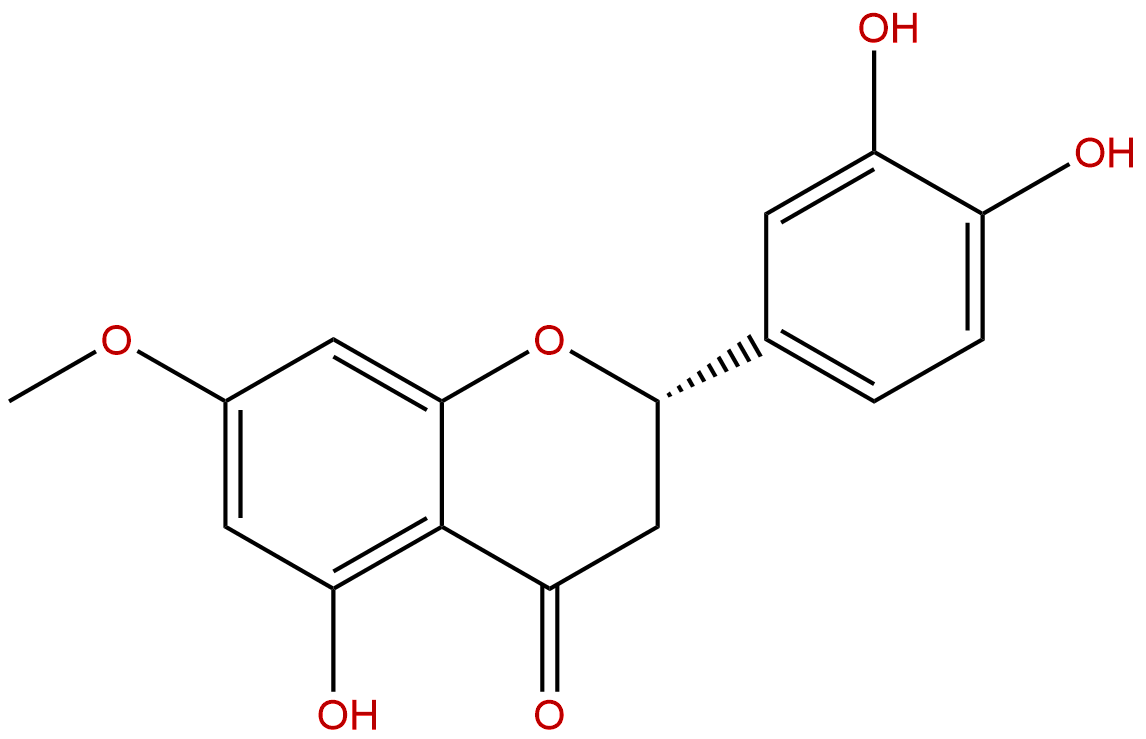


Product name: 7-O-Methyleriodictyol
Synonym name: Sterubin; Eriodictyol 7-methyl ether; 7-Methoxy-3',4',5-trihydroxyflavanone
Catalogue No.: SBP02141
Cas No.: 51857-11-5
Formula: C16H14O6
Mol Weight: 302.282
Botanical Source:
Physical Description: Powder
Type of Compound: Flavonoids
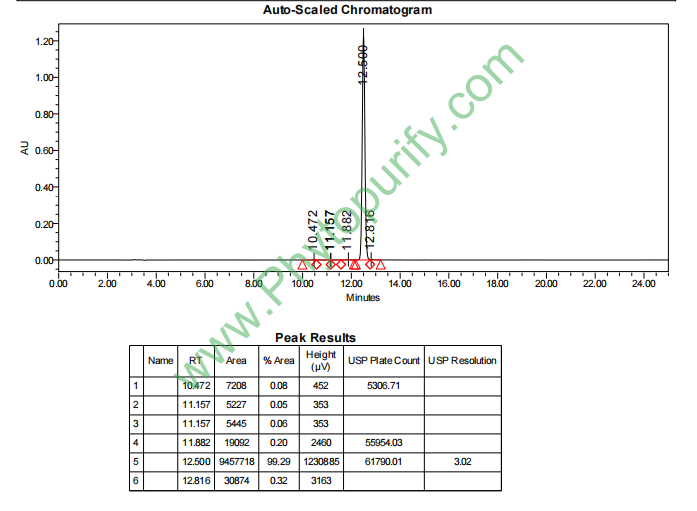
Purity: 95%~99%
Analysis Method: HPLC-DAD or/and HPLC-ELSD
Identification Method: Mass, NMR
Packing: Brown vial or HDPE plastic bottle
The product could be supplied from milligrams to grams. Inquire for bulk scale.
We provide solution to improve the water-solubility of compounds, thereby facilitating the variety of activity tests and clinic uses.
For Reference Standard and R&D, Not for Human Use Directly.
HPLC of 7-O-Methyleriodictyol
Storage conditions:Short-term storage at 2~8℃, long-term storage at -20 ~ -80℃
96.2200
2.2986
2.1889
.2227
4.8735
4.7704
Low
84.7932
2.9025
No
No
Yes
No
Yes
No
0.6
Yes
No
No
No
Natural products, as an important source of drug lead compounds, play an irreplaceable role in the long history of human struggle against diseases. Among them, flavonoids have always been a hot topic in medicinal chemistry and pharmacology research due to their extensive biological activity and relatively low adverse reactions. Eriodictyol, as a natural dihydroflavonoid compound, mainly exists in plants such as lemon and rosemary, and has been proven to have various pharmacological activities such as antioxidant, anti-inflammatory, and neuroprotective effects. However, natural flavonoids generally suffer from poor metabolic stability and low bioavailability, which limits their clinical translation. Structural modification, especially methylation, is one of the effective strategies to improve its drug properties, enhance or endow new biological activities.
7-O-Methyliodictyol (CAS number: 51857-11-5) is a derivative of resveratrol whose 7-hydroxyl group has been methylated. This small structural change not only significantly affects the physicochemical properties of the molecule, such as lipid solubility and metabolic stability, but may also profoundly alter its interaction mode with biological targets. Although 7-O-methyl coumarin is less well-known among the public and some research fields compared to its parent compound coumarin, in recent years, with the deepening of research on natural methylated flavonoids, its unique pharmacological activity, especially its potential value in antioxidant stress-related diseases, is gradually being revealed. This article aims to provide a systematic review of the chemical properties, plant sources, pharmacological activities, mechanisms of action, and potential medicinal properties of 7-O-methylcatechol, in order to provide comprehensive academic references for the in-depth research and development of this compound.
The chemical essence of 7-O-methyl coumarin is the product of replacing the hydroxyl group at position 7 of coumarin (5,7,3 ', 4' - tetrahydroxydihydroflavone) with a methoxy group (- OCH ∝). Its system is named (S) -2- (3,4-dihydroxyphenyl) -5-hydroxy-7-methoxy-2,3-dihydrochrom-4-one. Structurally, it retains the C6-C3-C6 basic skeleton of dihydroflavones, where the C-5 position of the A ring is a hydroxyl group and the C-7 position is a methoxy group; The C-3 'and C-4' positions of the B ring are adjacent dihydroxy structures; The C-ring is a saturated pyranone ring, and the C-2 position is the chiral center.
The molecular formula of this compound is C ₁₆ H ₁₄ O ₆, with a molecular weight of 302.2820. The key physicochemical parameters are as follows: the lipid water partition coefficient (LogP) is 2.2986, indicating that it has a certain lipophilicity, which is conducive to its penetration of the cell membrane; The polar surface area (TPSA) is 96.2200 Å ², which is at a moderate level, indicating that it may have good oral absorption potential, but may also be affected by intestinal efflux transporters. The water solubility (LogS) of the compound is 0.2227, indicating poor water solubility, which may be a potential limiting factor for its low bioavailability in vivo. In addition, the predictive model shows that its blood-brain barrier (BBB) penetration ability is low, suggesting that it may be limited in exerting its central nervous system function, but at the same time, it may also imply a lower risk of central adverse reactions. The prediction result of hERG inhibition is' no ', indicating a low risk of inducing QT interval prolongation and arrhythmia in the heart. The Ames test predicted a value of 0.6, indicating a certain risk of mutagenicity, but further experimental verification is needed.
Compared with the parent compound, the methylation of the 7-hydroxyl group blocks a key phenolic hydroxyl group. This modification usually brings about the following changes: firstly, an increase in the lipophilicity of the molecule (LogP), which helps to improve its affinity with biofilms and transmembrane transport ability; Secondly, it shields the 7-hydroxyl group, avoiding its binding reaction with glucuronic acid or sulfuric acid, which may improve metabolic stability and prolong the half-life in vivo; Finally, the hydrogen bond donor/acceptor mode between the molecule and target proteins (such as enzymes or receptors) has been altered, which may affect the strength and selectivity of their biological activity.
7-O-methylcatechol is not a widely distributed common flavonoid, and its natural sources are relatively limited, mainly found in certain specific plant families and genera. The plants currently reported to contain this compound mainly include:
Given its typically low content in plants, efficient modern chromatographic techniques are required for the extraction, separation, and purification of 7-O-methylcatechol. The typical extraction process is as follows:
Finally, the isolated compound was structurally identified using techniques such as nuclear magnetic resonance spectroscopy (NMR) and mass spectrometry (MS), confirming its identity as 7-O-methylcatechol.
At present, research on the pharmacological activity of 7-O-methylprednisolone mainly focuses on the antioxidant field similar to its parent compound, but also shows some unique advantages.
Antioxidant activity is the most core and extensively studied pharmacological activity of 7-O-methylcatechol. Oxidative stress is the common pathological basis for the occurrence and development of many chronic diseases (such as cardiovascular disease, neurodegenerative disease, diabetes, cancer). The antioxidant effect of 7-O-methyl coumarin is reflected in multiple aspects:
By upregulating the expression of these key antioxidant enzymes, 7-O-methylcatechol can significantly enhance the overall antioxidant capacity of cells, thereby resisting oxidative damage more persistently and effectively.
Based on its antioxidant and anti-inflammatory potential, 7-O-methylprednisolone has also shown preliminary activity in other fields:
The pharmacological effects of 7-O-methylcatechol are the result of multi-target and multi pathway synergistic effects. The core mechanism revolves around regulating redox balance and inflammatory response.
This is the most critical mechanism by which 7-O-methylcatechol exerts antioxidant and cell protective effects. The specific process is as follows:
1. Perceived oxidative stress Under normal physiological conditions, NRF2 binds to its negative regulatory factor Kelch like ECH related protein 1 (KEAP1) and is degraded by ubiquitination.
2. Decorate KEAP1 7-O-methylthymol or its metabolites act as electrophilic molecules that can covalently modify key cysteine residues (such as Cys151, Cys273, Cys288) on KEAP1 protein. This modification changes the conformation of KEAP1, causing it to dissociate from NRF2.
3. NRF2 stability and nuclear translocation After dissociation, NRF2 is no longer degraded and can stabilize and accumulate. Subsequently, NRF2 translocates into the nucleus.
4. Initiate transcription In the nucleus, NRF2 forms heterodimers with small Maf proteins, recognizes and binds to the ARE sequence of the target gene promoter region, and initiates the transcription of a series of downstream protective genes, including SOD1, SOD2, CAT, GPX1, HMOX1, etc.
From the provided target list (TYR, MMP1, NFE2L2, NRF2, SOD1, CAT, GPX1, HMOX1, MMP3, SOD2), it can be seen that the target network of 7-O-methylcatechol is highly concentrated in Antioxidant defense and Extracellular matrix remodeling Two functional modules. NFE2L2 (NRF2) is the core hub, and its downstream SOD1, SOD2, CAT, GPX1, and HMOX1 form a powerful antioxidant enzyme system. MMP1 and MMP3 represent their roles in tissue protection. TYR points to its potential applications in pigment metabolism. This multi-target synergistic mode of action may give it an advantage over single target drugs in dealing with complex diseases such as chronic inflammation and fibrosis driven by oxidative stress.
The conversion of natural products into clinical drugs must undergo strict pharmacological evaluation. Based on the aforementioned physicochemical parameters and preliminary pharmacological data, a preliminary evaluation of the pharmacological properties of 7-O-methylthymol can be conducted.
Based on its physicochemical properties and studies of similar compounds, it can be inferred that the pharmacokinetic characteristics of 7-O-methylthymol are as follows:
* absorb Oral absorption may be poor due to its low water solubility and potential intestinal efflux (such as P-glycoprotein). After absorption, it may exist in the form of prototype and bound metabolites.
* distribution Due to its lipophilicity, it may be widely distributed in tissues, especially in organs with abundant blood flow such as the liver and kidneys. The plasma protein binding rate may be high.
* Metabolism The main metabolic pathways include: ① II combined reaction The 3 ', 4' - dihydroxy group of ring B and the 5-hydroxy group of ring A combine with glucuronic acid or sulfuric acid to form corresponding single or double complexes. ② Phase I oxidation reaction The C ring may be oxidized by CYP450 enzyme to open the ring, generating smaller phenolic acid metabolites. ③ O-demethylation The 7-methoxy group may be demethylated to regenerate coumarin.
* excretion Metabolites are mainly excreted through bile and urine.
The unique pharmacological activity and relatively clear mechanism of 7-O-methylprednisolone provide possibilities for its application in multiple disease fields.
In order to promote the clinical translation of 7-O-methylthymol, future research should focus on the following aspects:
As a natural methylated derivative of coumarin, 7-O-methyl coumarin has shown remarkable research value in the field of antioxidant stress-related diseases due to its unique chemical structure and multi-target pharmacological activity, especially its strong antioxidant effect through activating the NRF2-ARE pathway. Although its poor water solubility, metabolic instability, and potential genetic toxicity risks pose major challenges on its pharmaceutical path, its clear mechanism, good drug like basis, and broad application prospects make it a natural product lead compound worthy of further exploration. Future research requires collaborative efforts in multiple areas such as medicinal chemistry, pharmacokinetics, toxicology, and new formulation technologies, with the potential to develop active molecules from this ancient plant into novel drugs for treating modern chronic diseases. The in-depth study of 7-O-methylcatechol not only helps to reveal the structure-activity relationship of naturally methylated flavonoids, but also provides a valuable example for discovering innovative drugs from traditional natural products.
