Introduction/Overview
Natural products, as an important source of drug discovery, play an irreplaceable role in the history of human disease treatment. Among them, glycoside indole monoterpene alkaloids are a class of plant secondary metabolites with complex structures and diverse biological activities, widely distributed in plants such as Rubiaceae and Malvaceae, and have attracted much attention for their significant pharmacological activities such as anti malaria, analgesic, and anti-inflammatory. Strictosidinic acid (CAS number: 150148-81-5) is a member of this class of compounds, and it is a compound derived from the nine jointed plants of the Rubiaceae family Psychotria myriantha Glycoside indole monoterpene alkaloids isolated from leaves. Preliminary studies have shown that this compound not only exhibits peripheral analgesic and antipyretic activities, but its unique chemical structure also suggests its potential application value in the field of combating major infectious diseases such as malaria. Its mechanism of action involves intervention in the biosynthesis pathway of 5-hydroxytryptamine (5-HT) and may act on multiple malaria parasite targets. This article aims to systematically review the chemical structure, plant origin, pharmacological activity, mechanism of action, medicinal properties, and clinical application prospects of Strictosidinic acid, in order to provide comprehensive scientific references for the in-depth research and development of this natural product.
Chemical structure and physicochemical properties
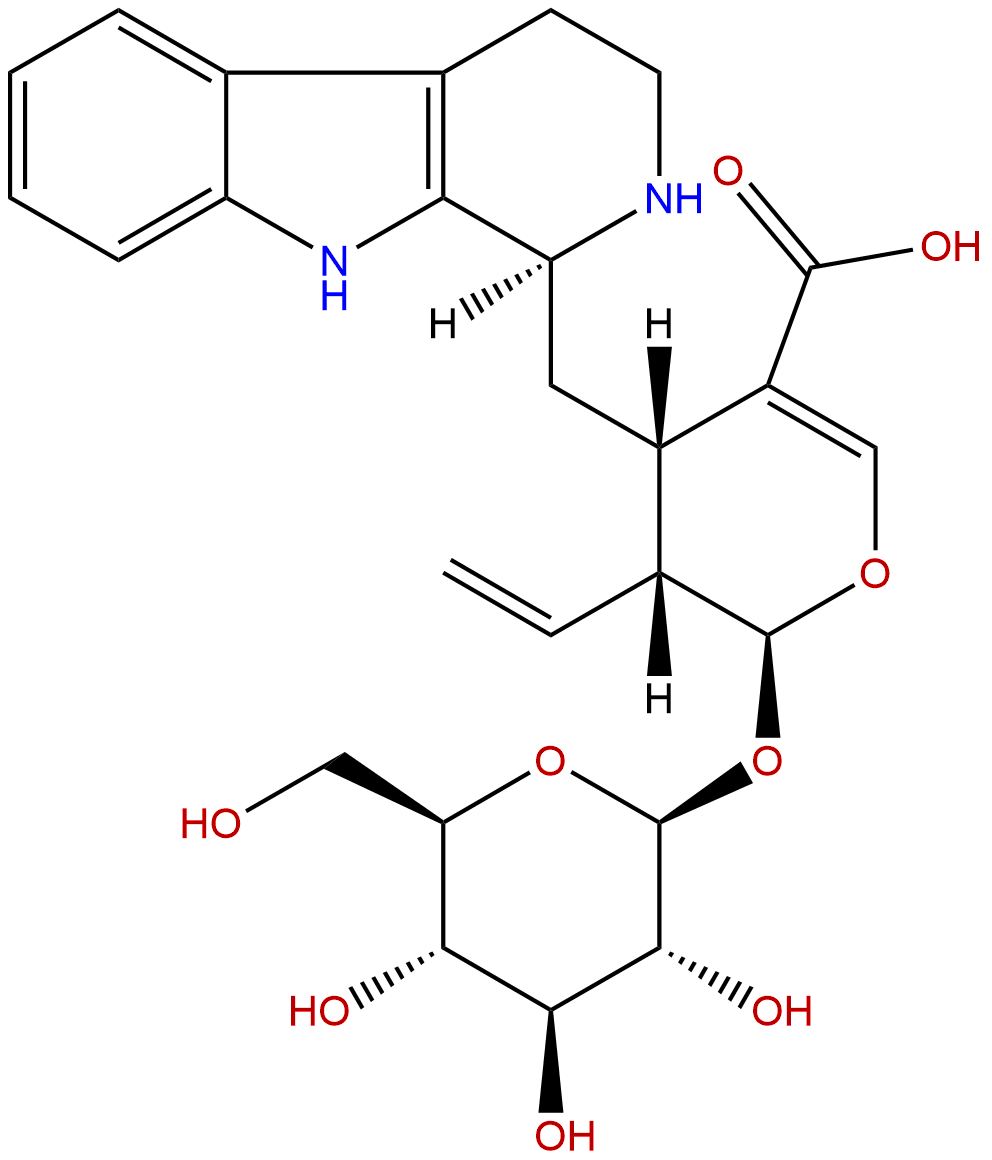
The molecular formula of Strictosidinic acid is C26H32N2O10, with a molecular weight of 516.5470 Da. Its core structure belongs to the glycoside indole monoterpene alkaloid, which is composed of an indole or dihydroindole unit connected to a monoterpene skeleton through C-C bonds, and further connected to the glycoside (usually glucose) part, forming a complex polycyclic system. This structural feature gives it both hydrophilicity and a certain lipophilic region.
From the analysis of physicochemical parameters related to drug properties, Strictosidinic acid exhibits typical polar molecular characteristics. The calculated lipid water partition coefficient (LogP) is -0.8444, indicating that the compound has strong hydrophilicity and tends to be distributed in the aqueous phase. The topologically polar surface area (TPSA) is as high as 173.73 Å ², mainly attributed to the presence of multiple hydroxyl, carboxyl, and glycosidic oxygen atoms in the molecule, which are potential hydrogen bond donors and acceptors. The high TPSA and negative LogP values together explain its good water solubility (predicted value of approximately 1.9727 mg/mL). These properties suggest that oral absorption may face challenges and are not conducive to penetrating the blood-brain barrier (predicted as low permeability), which is consistent with the pharmacological properties reported to exert peripheral analgesic effects rather than central effects. In terms of preliminary safety prediction, the compound showed no risk of hERG potassium channel inhibition (predicted as' no '), and the Ames test predicted a value of 0.0, suggesting that it may not be mutagenic and providing a favorable safety starting point for subsequent development.
Plant sources and extraction methods
The main plant source of Strictosidinic acid is the nine node genus of plants in the Rubiaceae family Psychotria myriantha This genus of plants is widely distributed in tropical and subtropical regions around the world, and is often used in traditional medicine to treat fever, pain, and various inflammatory diseases, providing ethnic pharmacological clues for searching for active ingredients from this plant.
The extraction and separation of Strictosidinic acid from plant materials typically follow the conventional process of natural product chemistry. Firstly, collect Psychotria myriantha The leaves are dried and crushed. Subsequently, solvent extraction method is used, commonly using methanol or ethanol water mixed solvents for cold soaking or heating reflux extraction to maximize the extraction of polar alkaloid components. After vacuum concentration, the crude extract obtained was subjected to preliminary fractionation using liquid-liquid partitioning (such as extraction with petroleum ether, ethyl acetate, and n-butanol in sequence). Strictosidinic acid, due to its strong polarity, was mainly enriched in n-butanol or aqueous layers. Further purification relies on various chromatographic techniques. Silica gel column chromatography is commonly used for preliminary separation using a chloroform methanol gradient elution system. Subsequently, modern separation methods such as reversed-phase silica gel (such as C18) column chromatography, Sephadex LH-20 column chromatography and high performance liquid chromatography (HPLC) were combined to finally obtain high-purity Strictosidinic acid monomer compounds. Structural identification is accomplished through the comprehensive use of spectroscopic techniques such as nuclear magnetic resonance (NMR, including 1H, 13C, and 2D NMR), mass spectrometry (MS), infrared spectroscopy (IR), and ultraviolet spectroscopy (UV).
Pharmacological activity research
Existing research has revealed multiple pharmacological activities of Strictosidinic acid, mainly focusing on analgesic, antipyretic, and potential antimalarial effects.
-
Analgesic and antipyretic activity Research has shown that Strictosidinic acid exhibits clear peripheral pain relieving activity in mouse models. In the second phase (inflammatory pain phase) of acetic acid-induced writhing test and formalin test, this compound can significantly reduce pain response, but its effect does not depend on the central opioid system, suggesting that its analgesic mechanism may be related to anti-inflammatory or affecting peripheral pain signal transduction. Meanwhile, Strictosidinic acid has antipyretic effects on yeast induced fever model mice, which can reduce elevated body temperature. It is worth noting that its antipyretic effect may be related to inhibiting prostaglandin synthesis or affecting certain mediators of the hypothalamic thermoregulatory center, but the specific pathway remains to be elucidated.
-
Malaria resistance potential Although the direct anti malarial activity of Strictosidinic acid has not been fully reported, as a member of the glycoside indole monoterpene alkaloid family, its structural analogues (such as quinine and artemisinin derivatives) are well-known anti malarial drugs. Bioinformatics and preliminary molecular docking studies suggest that Strictosidinic acid may exert anti malarial effects by acting on multiple key targets of malaria parasites, providing a strong theoretical basis for its anti malarial activity research. Its potential anti malarial activity is worthy of experimental verification in vitro and in vivo malaria models.
-
The impact on the 5-hydroxytryptamine system A key study found that Strictosidinic acid can inhibit precursor enzymes involved in 5-HT biosynthesis, such as tryptophan hydroxylase, and reduce 5-HT levels in tissues or cells. 5-HT is not only an important neurotransmitter, but also involved in pain perception, temperature regulation, and inflammatory processes. Therefore, inhibition of 5-HT synthesis may be one of the core mechanisms by which it exerts peripheral analgesic and antipyretic effects.
Mechanism of action and molecular targets
The pharmacological effects of Strictosidinic acid stem from its interactions with multiple molecular targets.
-
Targeting the 5-hydroxytryptamine synthesis pathway As mentioned earlier, Strictosidinic acid has been confirmed to be an inhibitor of 5-HT biosynthesis precursor enzymes. Tryptophan hydroxylase (TPH) is the rate limiting enzyme for 5-HT synthesis. Strictosidinic acid may inhibit TPH activity through competitive or other means, reduce de novo synthesis of 5-HT, and thus lower peripheral and/or central 5-HT levels. 5-HT has a dual role in pain modulation and is typically used as a pain mediator in the periphery, so reducing its levels may help alleviate certain types of inflammatory pain.
-
Potential anti malaria molecular target network Based on computational simulations and studies of similar compounds, Strictosidinic acid may act on multiple key proteins of Plasmodium falciparum, constituting its potential anti malarial mechanism
- Drug transporter protein Such as chloroquine resistance transporter protein (PfCRT) and multidrug resistance protein 1 (PfMDR1). Disrupting the function of these transporters may reverse or prevent malaria parasites from developing resistance to traditional drugs.
- metabolic enzyme For example, dihydrofolate reductase (PfDHFR) is a key enzyme in the pyrimidine synthesis pathway and a target for drugs such as ethambutol.
- Cytochrome system The cytochrome bc1 complex (PfCYTb/PfCYTBC) is a key component of the mitochondrial respiratory chain and a target of atorvastatin.
- Kinase and autophagy related proteins PfPK (protein kinase) and PfATG8 (autophagy related protein) are involved in the proliferation, differentiation, and survival of malaria parasites.
- Other key proteins Such as PfATP6 (sarcoplasmic/endoplasmic reticulum calcium ATPase, a potential target of artemisinin) and PfK13 (Kelch13 protein, associated with artemisinin resistance).
This multi-target action characteristic may suggest that Strictosidinic acid has the potential to overcome or delay drug resistance in malaria parasites, but all of the aforementioned interactions need to be confirmed through biochemical and cellular experiments.
Evaluation of drug properties and pharmacokinetics
Based on the prediction of its physicochemical properties and limited pharmacological research, a preliminary evaluation of the pharmacological properties of Strictosidinic acid can be conducted.
- Absorption, distribution, metabolism, excretion (ADME) prediction:
- absorb High polarity (low LogP, high TPSA) may limit its passive diffusion through intestinal epithelial cells, and oral bioavailability may be low. Structural modifications or the use of absorption enhancers may be necessary to improve.
- distribution The predicted blood-brain barrier permeability is low, which is consistent with reports of insignificant central nervous system effects, and is beneficial for reducing the risk of central nervous system side effects. Its distribution may be mainly limited to blood and peripheral tissues.
- Metabolism As a compound containing glycosidic bonds and multiple hydroxyl groups, it may be a substrate for β - glucosidase in gut microbiota, undergoing hydrolysis and deglycosylation. In the liver, it may undergo II binding reactions such as glucuronidation and sulfation.
- excretion Polar metabolites may be mainly excreted through the kidneys and urine.
- Advantages and challenges of pharmaceutical properties:
- Advantage Natural source, novel structure; Preliminary safety prediction is good (no hERG inhibition or mutagenic risk); Has clear peripheral analgesic and antipyretic activities, with a unique mechanism of action (inhibition of 5-HT synthesis); Potential multi-target anti malaria mode of action.
- challenge High molecular weight (>500) and strong polarity may lead to poor oral absorption; The complex chemical structure may pose difficulties for total synthesis or large-scale semi synthesis, affecting the supply of raw materials; The complete pharmacokinetic parameters (such as half-life, absolute bioavailability) and detailed in vivo metabolic profiles are still blank; The in vitro and in vivo efficacy data for its core pharmacological activities, especially anti malaria, still need to be enriched.
Clinical application prospects and prospects
Strictosidinic acid, as a natural product with a unique mechanism of action, has the following clinical application prospects:
-
Development of new peripheral analgesics Given that it exerts peripheral analgesic effects by inhibiting 5-HT synthesis and has no central opioid activity, Strictosidinic acid or its structurally optimized derivatives are expected to be developed as a novel non addictive analgesic drug for the treatment of inflammatory pain and neuropathic pain (peripheral components), especially for patients who need to avoid central side effects or opioid abuse risks.
-
Supplement or alternative options for antipyretic agents Its antipyretic activity provides a candidate molecule for the development of new antipyretic drugs, especially when the mechanism of action is different from that of traditional nonsteroidal anti-inflammatory drugs, it may be suitable for cases where existing antipyretic drugs are intolerant or have poor reactions.
-
Lead compounds of antimalarial drugs Its potential multi-target antimalarial properties are highly attractive. In today's increasingly severe problem of drug resistance in malaria parasites, structural modification and optimization using Strictosidinic acid as a lead compound aim to improve its anti malarial efficacy, pharmacokinetic properties, and validate its effectiveness against drug-resistant malaria strains. This is a new drug development path worth exploring.
-
Components of combination therapy Considering its impact on the 5-HT system, it may be possible to explore the combination of analgesics or antimalarials with other mechanisms of action in order to produce synergistic effects and reduce their respective dosages and side effects.
Future research should focus on: ① solving the problem of raw material sources through total synthesis or biosynthetic technologies; ② Conduct pharmacokinetic studies on the system to clarify its ADME characteristics; ③ Conduct in-depth in vitro and in vivo pharmacological evaluations, especially for the validation of antimalarial activity; ④ Based on the structure-activity relationship (SAR) study, its molecules are reasonably modified to optimize physicochemical properties (such as balancing lipid solubility to improve membrane permeability), enhance activity, and reduce potential toxicity; ⑤ Thoroughly elucidate the exact signaling pathways of its analgesic and antipyretic effects, and verify its direct interaction with predicted antimalarial targets using chemical biology methods.
Conclusion
Strictosidinic acid is derived from traditional medicinal plants Psychotria myriantha A glycoside indole monoterpene alkaloid with important biological activity discovered in the middle. It not only demonstrates clear peripheral analgesic and antipyretic effects, but also its unique mechanism of inhibiting 5-HT synthesis and potential broad-spectrum antimalarial targeting, making it an attractive lead compound in the field of drug discovery. Despite facing challenges such as poor oral absorption in drug development, its good preliminary safety prediction and diverse biological activities have laid a solid foundation for subsequent development. Through interdisciplinary research in modern medicinal chemistry, pharmacology, and formulation, a systematic optimization and evaluation of Strictosidinic acid is expected to develop it into a novel drug for treating pain, fever, or malaria, further highlighting the eternal value of natural products in innovative drug development.