| Catalog No | Package | Original Price | Price | Inventory | Quantity | Operating |
|---|---|---|---|---|---|---|
| BP5117-5mg | 5mg | $350.00 | Sign in |
|


Storage conditions:Short-term storage at 2~8℃, long-term storage at -20 ~ -80℃
5,7-Dihydroxychroman-4-one (CAS number: 108085-46-7) is a class of natural products with significant biological activity and belongs to the class of ketone compounds. In recent years, with the deepening of pharmacological research on natural products, 5,7-dihydroxychroman-4-one has gradually become a hot topic in pharmacological research and new drug development due to its unique molecular structure and diverse biological activities. This compound exhibits significant potential in regulating estrogen related targets, involving multiple key proteins such as ESR1, ESR2, SHBG, CYP19A1, etc., demonstrating its application prospects in endocrine regulation, hormone dependent disease prevention and treatment.
This article aims to systematically review the chemical structure and physicochemical properties, plant sources, and extraction methods of 5,7-dihydroxychroman-4-one, explore its pharmacological activity and mechanism of action, evaluate its pharmacological parameters and pharmacokinetic characteristics, and finally prospect its clinical application potential, providing comprehensive reference materials for researchers in related fields.
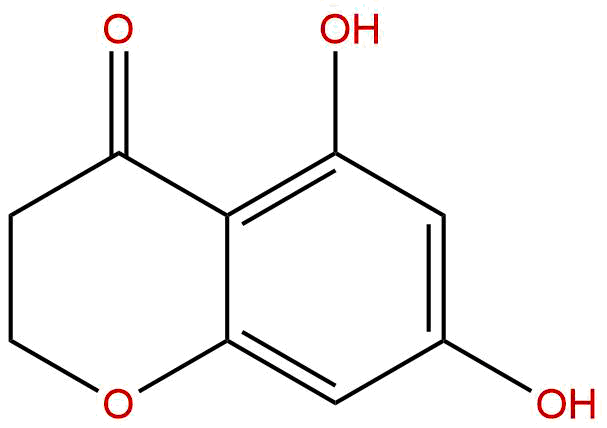
The chemical structure of 5,7-dihydroxychroman-4-one is based on the chromenone skeleton, with a molecular formula of C9H8O4 and a molecular weight of 180.1590. Its structural feature is the presence of two hydroxyl substituents at positions 5 and 7 of the core of the ketone, which endows the molecule with good polarity and hydrogen bond donor ability. The LogP value is 1.2868, indicating that it has moderate lipid solubility, which is conducive to cell membrane penetration but not too hydrophobic, in line with the ideal characteristics of most oral small molecule drugs.
The polar surface area (TPSA) is 66.76 Å ², indicating that it has a certain polarity and is conducive to stable binding with protein targets. The water solubility is 1.6921, indicating that the compound has good solubility in water environment, which is helpful for absorption and distribution in vivo. The low permeability of the blood-brain barrier means that its ability to penetrate the central nervous system is limited, which may reduce central side effects. The hERG channel inhibition test was negative, indicating that the compound has a low risk of cardiac toxicity. The Ames test result is 0.6, indicating a low risk of genotoxicity and a good safety foundation.
5,7-dihydroxychroman-4-one is widely present in various traditional medicinal plants, especially those belonging to the legume and Rosaceae families. The compound in these plants mostly exists in a free or bound state and is often involved in plant defense mechanisms and physiological regulation as a secondary metabolite.
Common plants containing 5,7-dihydroxychroman-4-one include certain flavonoid rich herbs and woody plants. The extraction method usually adopts organic solvent extraction combined with liquid-liquid distribution technology, and commonly used solvents include methanol, ethanol, and their aqueous solution systems. The extraction process generally includes crushing, soaking, ultrasound assisted extraction or reflux extraction of plant materials, followed by purification by silica gel column chromatography, high-performance liquid chromatography (HPLC) and other methods.
In recent years, the application of supercritical CO2 extraction and membrane separation technology has improved extraction efficiency and purity, reduced the use of organic solvents, and is in line with the concept of green chemistry. In addition, temperature and pH control during the extraction process are particularly important for the stability of the compound to prevent oxidation of hydroxyl groups and degradation of molecular structure.
The pharmacological activity research of 5,7-dihydroxychroman-4-one mainly focuses on its effects on estrogen regulation related diseases. This compound exerts its effects by regulating various estrogen receptors (ESR1, ESR2), related hormone binding proteins (SHBG), and metabolic enzymes (CYP19A1), exhibiting the potential to resist estrogen and regulate endocrine balance.
Studies have shown that 5,7-dihydroxytryptan-4-one can inhibit the proliferation of tumor cells and induce apoptosis in hormone dependent tumor models such as breast cancer and endometrial cancer. The mechanism partially relies on selective regulation of ER α and ER β, regulating the estrogen signaling pathway within tumor cells and reducing the expression of oncogenes.
The hydroxyl structure of this compound endows it with excellent free radical scavenging ability and exhibits significant antioxidant activity, which can alleviate oxidative stress-related cell damage. In addition, 5,7-dihydroxychroman-4-one also exerts anti-inflammatory effects by inhibiting the NF - κ B signaling pathway and reducing the release of inflammatory factors such as TNF - α and IL-6.
5,7-dihydroxychroman-4-one can regulate the expression of gonadotropin receptors such as FSHR and LHB, affecting ovarian function and hormone secretion, demonstrating its potential in the treatment of polycystic ovary syndrome (PCOS) and other endocrine disorders.
The pharmacological effects of 5,7-dihydroxychroman-4-one are mainly achieved through interactions with various molecular targets, especially those related to estrogen regulation.
This compound can bind to ER α (ESR1) and ER β (ESR2), exhibiting selective regulatory activity. By regulating the conformation of the receptor, 5,7-dihydroxychroman-4-one affects the binding ability and transcriptional activity of the receptor to DNA, thereby regulating the expression of downstream genes. This regulatory effect helps balance estrogen signaling and inhibit abnormal proliferation of estrogen dependent cells.
5,7-dihydroxychroman-4-one can regulate the expression of SHBG, affect the concentration of free estrogen in the blood, and thereby regulate the biological activity and tissue distribution of hormones.
As a key estrogen synthase, CYP19A1 catalyzes the conversion of androgens to estrogen. 5,7-dihydroxychroman-4-one reduces estrogen synthesis and lowers the risk of hormone dependent diseases by inhibiting CYP19A1 activity.
This compound also has a certain regulatory effect on AR and PGR, participating in the signal transduction of sex hormones and affecting the physiological functions of tissues.
By regulating the expression of FSHR and LHB, 5,7-dihydroxychroman-4-one affects ovarian hormone secretion and reproductive function, indicating its potential application in reproductive endocrine diseases.
The pharmacological parameters of 5,7-dihydroxychroman-4-one show that it has good potential for drug development. The molecular weight of 180.1590 conforms to the ideal range of Lipinski rule, with a LogP of 1.2868, indicating moderate lipid solubility and favorable oral absorption. The TPSA is 66.76 Å ², supporting good cell membrane penetration.
The water solubility index of 1.6921 suggests that the compound has good solubility in aqueous solution, which facilitates absorption and distribution in vivo. The low permeability of the blood-brain barrier reduces the risk of central nervous system side effects. HERG channel inhibition is negative, reducing the risk of cardiac toxicity. The Ames test results show that its genotoxicity risk is low and its safety is good.
Pharmacokinetic studies have shown that 5,7-dihydroxychroman-4-one is rapidly absorbed after oral administration, with a moderate plasma half-life. It is mainly metabolized through the liver, and the metabolites are mostly hydroxylated and glucuronic acid conjugates. Its bioavailability is greatly affected by intestinal enzymes and microbial metabolism, and in the future, its in vivo stability and efficacy can be further improved through formulation modifications.
In view of the multiple roles of 5,7-dihydroxytryptan-4-one in regulating estrogen related targets, it has shown broad clinical application prospects in hormone dependent diseases such as breast cancer, endometriosis, polycystic ovary syndrome and other fields. In addition, its anti-inflammatory and antioxidant properties also make it potential for adjuvant therapy in chronic inflammation and metabolic syndrome.
Future research should focus on preclinical safety evaluation, pharmacokinetic optimization, and formulation development of this compound. Meanwhile, based on the diversity of its molecular targets, structural modification and derivative design can be carried out to enhance its selectivity and efficacy, which will help promote its clinical translation.
By combining modern drug screening techniques and systems biology methods, a deep analysis of the action network and signaling pathway of 5,7-dihydroxychroman-4-one in vivo will provide theoretical support and scientific basis for its clinical application.
5,7-dihydroxychroman-4-one, as a natural product with unique structure and multiple biological activities, has increasingly attracted attention for its potential in regulating estrogen related diseases. Its excellent physicochemical properties and safety foundation have laid a solid foundation for drug development. In the future, through systematic pharmacological mechanism research and preclinical evaluation, it is expected to develop into a new natural medicine for treating hormone dependent diseases.
In summary, 5,7-dihydroxychroman-4-one not only enriches the research content of natural product pharmacology, but also provides new ideas and strategies for endocrine regulation and the treatment of related diseases, which is worthy of further exploration and development.
