Introduction/Overview
Natural products, as an important source of drug discovery, play an irreplaceable role in the history of human disease treatment. Among them, Euphorbia plants have attracted much attention due to their rich secondary metabolites and extensive pharmacological activities. Deoxy Euphorbia factor L1 (CAS number: 247099-01-0) is a diterpenoid compound with significant biological activity isolated from Euphorbia plants. In recent years, with the continuous increase of the incidence rate of tumors and the limitations of existing treatment methods, the search for new antitumor drugs with high efficiency and low toxicity has become a research hotspot. Deoxyquercetin L1 has rapidly become a research frontier in the field of natural product pharmacology due to its strong anti-tumor potential demonstrated in various in vitro and in vivo models. Its anti-tumor activity involves multiple key links such as inducing cell apoptosis, inhibiting cell proliferation, invasion and metastasis, and preliminary studies suggest that it has regulatory effects on multiple key tumor related targets, such as MCL1, BCL2, STAT3, etc. This article aims to systematically review the chemical properties, plant sources, pharmacological activities, mechanisms of action, pharmacological evaluation, and clinical application prospects of deoxyquercetin L1, in order to provide comprehensive scientific references for the in-depth research and future drug development of this compound.
Chemical structure and physicochemical properties
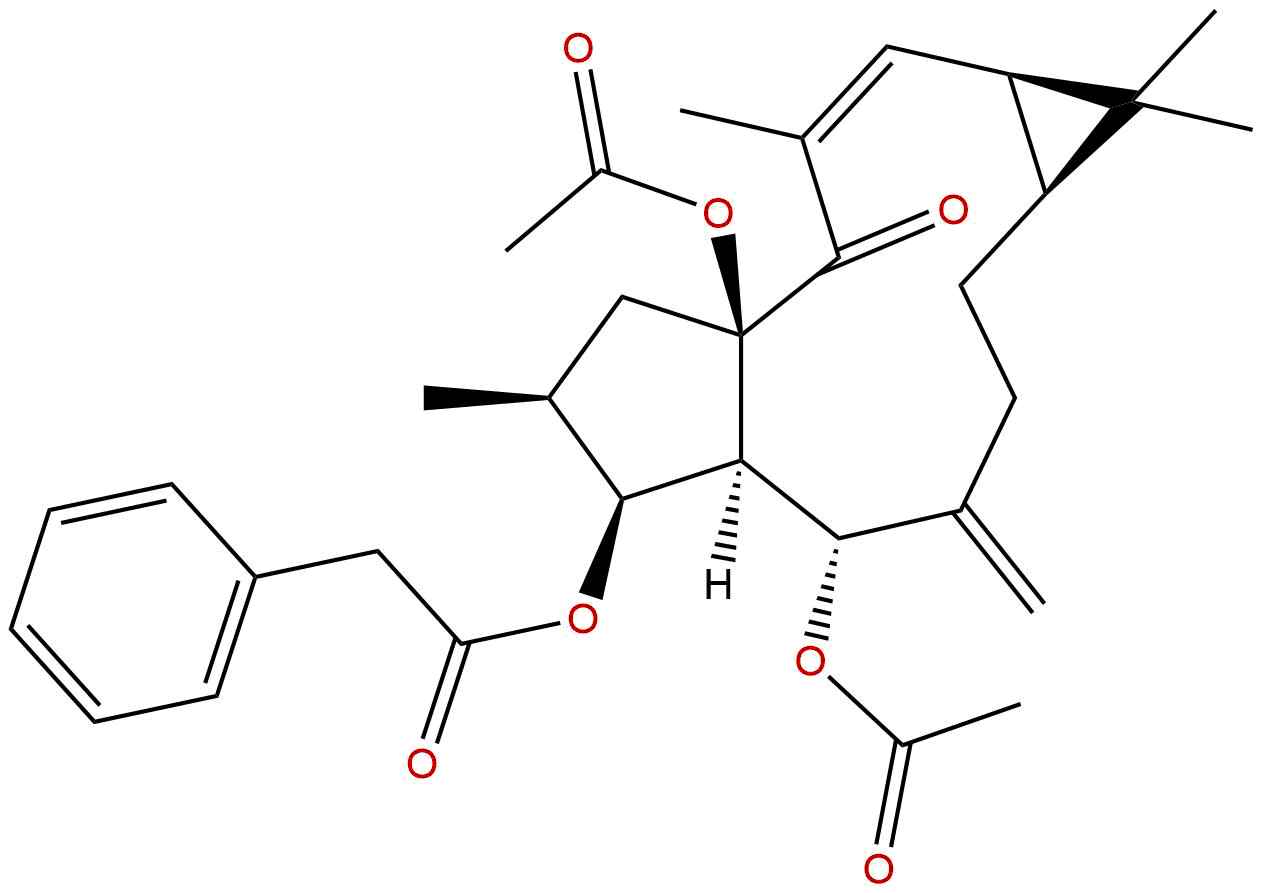
Deoxychalcone L1 is a diterpenoid compound of the latan type. Its molecular formula is C32H40O7 and its molecular weight is 536.6650. Structurally speaking, it possesses the core four ring skeleton of latantane compounds and is connected to multiple oxygen-containing functional groups (such as hydroxyl and ester groups) as well as aromatic side chains. These structural features are the material basis for its biological activity.
Its physicochemical properties have a decisive impact on its bioavailability and medicinal properties. The lipid water partition coefficient (LogP) of this compound is 4.4392, indicating its strong lipophilicity, which facilitates its penetration into cell membranes but may also lead to poor water solubility. The calculated topological polar surface area (TPSA) is 95.9700 Å ², which is relatively moderate. The predicted value of its water solubility is relatively low, about 0.0022 mg/mL, which suggests that in the process of formulation development, it may be necessary to improve its solubility through salt formation, formation of inclusion complexes, or the use of special delivery systems such as nanoparticles and liposomes. Preliminary pharmacological risk assessment shows that the compound has a high potential for blood-brain barrier penetration, which provides a possibility for its treatment of central nervous system related tumors. In addition, the key toxicity risk screening results are optimistic: it is predicted that there is no significant hERG potassium channel inhibitory activity (low risk of arrhythmia), and the Ames test prediction value is 0.0, suggesting that it may not have direct genetic toxicity. These preliminary in vitro toxicity prediction data have laid a certain foundation for its subsequent development.
Plant sources and extraction methods
Deoxychalcone L1 is mainly derived from various plants in the Euphorbiaceae family, Euphorbia genus, with the most representative source being Euphorbia lathyris L., also known as chalcone. As a traditional Chinese medicine, Xusuizi's seed (Qianzizi) has the effects of promoting diuresis, reducing swelling, breaking blood and eliminating symptoms. Modern research has confirmed that it contains abundant diterpenoid components, and deoxyqianzizi L1 is one of the important active ingredients.
Its extraction and separation usually follow the conventional process of natural product chemistry. Firstly, the dried seeds or other plant parts are crushed and subjected to cold soaking or heating reflux extraction using organic solvents such as methanol, ethanol, or acetone to obtain the crude extract. Subsequently, the crude extract was preliminarily separated using solvent partitioning methods (such as partitioning between different polar solvent systems, such as petroleum ether, ethyl acetate, n-butanol, and water) to enrich the fraction containing the target component (usually the ethyl acetate fraction). Further purification depends on various chromatographic techniques, including normal phase silica gel column chromatography, reverse phase silica gel column chromatography (such as ODS), gel column chromatography (such as Sephadex LH-20) and high performance liquid chromatography (HPLC). By comparing thin layer chromatography (TLC) spots or HPLC peaks with standard samples, and combining spectroscopic techniques such as nuclear magnetic resonance (NMR) and mass spectrometry (MS) for structural identification, high-purity deoxyquercetin L1 can be obtained. Optimizing the extraction solvent, temperature, and chromatographic separation conditions is the key to improving its yield and purity.
Pharmacological activity research
Numerous pharmacological studies have shown that the core biological activity of deoxyquercetin L1 is concentrated in the field of anti-tumor, exhibiting broad-spectrum and efficient inhibitory activity in various human tumor cell lines.
1. Antitumor activity
* Cell proliferation inhibition: Deoxygenin L1 can significantly inhibit the proliferation of a variety of cancer cells, including breast cancer (such as MCF-7, MDA-MB-231), liver cancer (such as HepG2, SMMC-7721), lung cancer (such as A549), colon cancer (such as HCT-116, SW480) and gastric cancer cells. Its inhibitory effect is concentration - and time-dependent, with a half maximal inhibitory concentration (IC50) typically at the micromolar or even nanomolar level, exhibiting strong cytotoxicity.
* Inducing cell apoptosis This compound is an effective inducer of cell apoptosis. Research has found that it can cause characteristic morphological changes in tumor cells, such as cell shrinkage and nuclear fragmentation, and activate key biochemical events of apoptosis, including mitochondrial membrane potential decline, cytochrome c release, activation of caspase-3 and caspase-9, and cleavage of poly (ADP ribose polymerase) (PARP).
* Inhibit cell migration and invasion In addition to its direct killing effect, deoxyquercetin L1 can also inhibit the migration and invasion ability of tumor cells, which is an important manifestation of its anti-tumor metastasis potential. In scratch healing and Transwell invasion experiments, the compound significantly reduced the motility of cancer cells and their ability to penetrate the matrix gel.
* In vivo anti-tumor effect In a nude mouse transplant tumor model, intraperitoneal injection or oral administration of deoxyquercetin L1 can significantly inhibit tumor growth, and no significant weight loss or organ toxicity was observed within a certain dose range, indicating that it has a certain therapeutic window.
2. Other potential activities
Although the research focus is on anti-tumor effects, based on its structural analogues and traditional uses in Euphorbia plants, deoxyquercetin L1 may still have potential anti-inflammatory and analgesic activities. However, relevant research is not yet sufficient and further exploration is needed.
Mechanism of action and molecular targets
The anti-tumor effect of deoxyquercetin L1 is the result of multi-target and multi pathway synergy. Existing research has preliminarily revealed its effects on multiple key tumor related signaling pathways and molecular targets:
-
Regulating apoptosis related proteins (MCL1, BCL2)Deoxyquercetin L1 can downregulate the expression of anti apoptotic proteins B cell lymphoma 2 (BCL2) and myeloid leukemia 1 (MCL1), while possibly upregulating the expression of pro apoptotic proteins such as BAX, thereby disrupting mitochondrial outer membrane permeability and triggering intrinsic apoptotic pathways.
-
Inhibition of STAT3 signaling pathway Signal transduction and transcription activator 3 (STAT3) is an important oncogenic transcription factor. This compound can inhibit the phosphorylation (activated form) of STAT3, prevent its nuclear translocation and binding to DNA, thereby downregulating the expression of downstream target genes (such as Cyclin D1, Bcl-2, MMP-2, etc.), achieving multiple effects of inhibiting proliferation, inducing apoptosis, and resisting invasion.
-
Inhibition of Matrix Metalloproteinase 2 (MMP2)Matrix metalloproteinase-2 (MMP2) is a key enzyme that degrades extracellular matrix and promotes tumor invasion and metastasis. Deoxyquercetin L1 can significantly reduce the gene expression and protein activity of MMP2, which is one of the important mechanisms for its inhibition of tumor cell invasion.
-
Affects DNA topoisomerases (TOP1, TOP2A)Preliminary studies suggest that this compound may interfere with the functions of DNA topoisomerases I (TOP1) and II α (TOP2A), affecting DNA replication, transcription, and repair, leading to DNA damage and genomic instability, thereby inhibiting tumor cell growth.
-
Regulating hypoxia inducible factor 1A (HIF1A)In the hypoxic microenvironment of tumors, deoxyquercetin L1 may inhibit the stability and transcriptional activity of hypoxia inducible factor-1 α (HIF1A), thereby interfering with tumor angiogenesis and metabolic reprogramming, which are adaptive processes to hypoxia.
-
Intervention in MAPK/ERK signaling pathway This compound may regulate cell proliferation and survival signals by affecting the phosphorylation level of mitogen activated protein kinase 1 (MAPK1, ERK2).
-
Affects the estrogen signaling pathway (ESR1, CYP19A1)For hormone dependent tumors (such as some breast cancer), deoxygenazin L1 may interfere with estrogen synthesis or signal transduction by acting on estrogen receptor α (ESR1) or aromatase (CYP19A1).
These targets do not exist in isolation, but form a complex network of interactions. Deoxyquercetin L1 may exert a synergistic anti-tumor effect by simultaneously acting on multiple nodes in the network, and may help overcome the problem of resistance to single target drugs.
Evaluation of drug properties and pharmacokinetics
Although deoxyquercetin L1 has significant in vitro activity, its potential as a drug depends on the systematic drug efficacy evaluation and pharmacokinetic properties.
Drugability assessment:
As mentioned earlier, its advantages lie in moderate molecular weight, unpredictable hERG inhibition and genetic toxicity risk, and the possibility of penetrating the blood-brain barrier. The main challenge lies in its lower Water solubility And higher LogP value This may lead to poor oral absorption and low bioavailability. In addition, as a natural product, ester bonds and other functional groups in its chemical structure may be easily metabolized and hydrolyzed in vivo, affecting stability. Therefore, it is necessary to conduct systematic in vitro ADMET (absorption, distribution, metabolism, excretion, toxicity) experiments, including studies on liver microsomal metabolic stability, cytochrome P450 enzyme inhibition/induction, plasma protein binding rate, Caco-2 cell permeability, etc.
pharmacokinetics:
At present, there are few reports on the pharmacokinetic studies of the deoxyquercetin L1 system, which remains a weak link in its development chain. Based on its physical and chemical properties, it can be inferred that:
* absorb Oral administration may have limited bioavailability due to solubility and first pass effects.
* distribution Prediction of high lipid solubility and blood-brain barrier permeability suggests its possible distribution in adipose tissue, liver, and central nervous system.
* Metabolism The liver may be its main metabolic site, and the CYP450 enzyme system may be involved in its biotransformation. It is necessary to clarify its main metabolites and activities.
* excretion Metabolites may be mainly excreted through bile and kidneys.
Future research needs to establish sensitive in vivo analytical methods (such as LC-MS/MS) to conduct comprehensive pharmacokinetic studies in animal models such as mice and rats, obtaining key parameters such as absolute bioavailability, half-life, distribution volume, and clearance rate, providing a basis for formulation design and optimization of dosing regimens.
Clinical application prospects and prospects
Deoxyquercetin L1, as a natural compound with multi-target anti-tumor activity, has shown broad clinical application prospects, but also faces many challenges.
prospect:
1. New anti-tumor candidate drugs Its multi-target mechanism of action may be effective for various solid tumors and hematological tumors, especially for tumors resistant to existing chemotherapy drugs, which may provide new treatment options.
2. Combination therapy sensitizer Given its action on key signaling nodes such as apoptosis pathway and STAT3, when combined with conventional chemotherapy drugs or targeted drugs, it may produce synergistic effects, reduce drug resistance, and improve therapeutic efficacy.
3. Anti tumor metastasis drugs Its activity in inhibiting MMP2 and cell invasion makes it uniquely valuable in preventing or treating tumor metastasis.
4. Potential for the treatment of central nervous system tumors The high blood-brain barrier permeability prediction makes it promising for the treatment of brain tumors such as glioma.
Challenges and Prospects:
1. Optimization of drug properties The primary task is to address its water solubility and bioavailability issues. Through Structural modification(Preparation of prodrugs, synthesis of water-soluble derivatives) or development New delivery system Nanocrystals, liposomes, and polymer micelles are key directions for enhancing their drug properties.
2. In depth mechanism research It is necessary to more accurately elucidate its direct interaction mode with the above-mentioned targets (such as MCL1, TOP1/2A) (such as whether it directly binds, binding sites), and use omics techniques (proteomics, transcriptomics) to comprehensively reveal its action network.
3. System preclinical evaluation Standardized preclinical pharmacodynamic (more in vivo models), pharmacokinetic, and toxicological studies must be completed to clarify the effective dose range and safety profile, providing solid data for clinical trial applications.
4. Exploring biosynthetic pathways Analyzing its biosynthetic pathway in Euphorbia plants is expected to achieve sustainable and efficient green production through synthetic biology methods, solving the problem of limited plant extraction sources.
Conclusion
Deoxyquercetin L1 is a highly promising anti-tumor natural compound discovered from traditional Chinese medicine Xusuizi. It exhibits various pharmacological activities in inhibiting proliferation, inducing apoptosis, and resisting invasion and metastasis by regulating multiple key tumor related targets such as MCL1, BCL2, STAT3, and MMP2. Despite facing challenges such as poor water solubility in drug development, its unique structure, clear multi-target mechanism, and preliminary good toxicity prediction have laid a solid foundation for its subsequent development. Future research should focus on improving its physicochemical properties through chemical and pharmaceutical methods, revealing the details of its molecular action, and completing systematic preclinical development studies. With the advancement of these works, deoxyquercetin L1 is expected to gradually develop from an active natural molecule into a clinically valuable anti-tumor candidate drug or lead compound, providing new weapons for tumor treatment and successful examples for innovative drug development based on traditional Chinese medicine resources.