Introduction/Overview
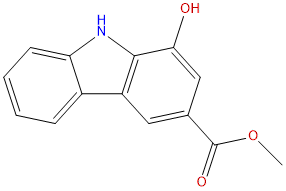
Natural products, as an important source of drug discovery, play an irreplaceable role in the history of human disease treatment. Among them, alkaloid compounds have always been a hot topic in medicinal chemistry and pharmacology research due to their structural diversity and wide range of biological activities. Clausine E, A carbazole alkaloid isolated from the traditional medicinal plant Pseudochromia has attracted much attention since its discovery due to its unique chemical structure and multifaceted pharmacological activities. Its CAS number is 182261-83-2. Preliminary studies have shown that it is not only a potential demethylase inhibitor for fat mass and obesity related proteins, but also exhibits significant activity in anti-inflammatory and anti-tumor fields. With the deepening development of modern molecular biology and pharmacology techniques, research on Clausine E has gradually progressed from initial activity screening to its molecular targets, mechanisms of action, and drug evaluation. This article aims to provide a systematic review of the chemical properties, plant sources, pharmacological activities, mechanisms of action, and potential medicinal properties of Clasine E, in order to provide comprehensive scientific references for the deep development and clinical application of this natural product.
Chemical structure and physicochemical properties
Clasine E belongs to the class of carbazole alkaloids, with a molecular formula of C ₁₅ H ₁₅ NO ₂ and a molecular weight of 241.2460. Its core structure is the tricyclic carbazole nucleus, which is connected with substituents such as methoxy at specific positions. This structural feature is an important material basis for its biological activity. The carbazole ring system itself has a rigid planar structure and a large conjugated system, which usually facilitates π - π stacking or hydrophobic interactions with the active pockets of biomolecules such as enzymes and receptors.
From the analysis of physicochemical parameters related to drug formation, the lipid water partition coefficient (LogP) of Clasine E is 2.9066, indicating its moderate lipophilicity, which is beneficial for its penetration of cell membranes but may also affect its water solubility. Its topological polar surface area (TPSA) is 62.3200 Å ², which is relatively low, further indicating its good membrane permeability. However, its water solubility data is 0.0164 (usually measured in mg/mL or mol/L, indicating low solubility), which is a potential challenge in its pharmaceutical properties and may require optimization in formulation to improve its bioavailability. It is worth noting that the predictive model shows that Clasine E has a high blood-brain barrier permeability, which provides the possibility for its potential central nervous system related applications, such as neuroinflammation. In addition, key early safety indicators showed that it had no significant inhibitory effect on hERG potassium channels (hERG inhibition: No), and the Ames test result was 0.9 (usually less than 1.5, indicating no significant mutagenicity), suggesting a low risk of cardiac and genetic toxicity, laying a preliminary safety foundation for its subsequent development.
Plant sources and extraction methods
Clausine E mainly comes from the genus Pseudochromia in the Rutaceae family. As a traditional medicinal plant, fake yellow bark is commonly used in folk medicine to treat colds, coughs, rheumatism, and inflammatory diseases, providing a traditional basis for the biological activity of its chemical components.
The separation and purification of Clasine E from plant materials usually use classical natural product chemistry methods. Firstly, the dried roots, stems, or leaves of fake yellow bark are crushed and subjected to cold soaking or heating reflux extraction using methanol, ethanol, or a methanol water mixed solvent. After concentration, the crude extract is obtained. Subsequently, the crude extract was preliminarily separated using solvent partitioning methods (such as extraction with petroleum ether, ethyl acetate, and n-butanol in sequence), and Clasine E was often enriched in the ethyl acetate extraction site due to its equipolarity. Further purification relies on column chromatography technology, often using silica gel column chromatography with different ratios of petroleum ether ethyl acetate or chloroform methanol gradient elution. Depending on the polarity and characteristics of the target compound, it may also be necessary to use reversed-phase silica gel column chromatography (such as C18 packing, eluted with methanol water system) or gel column chromatography (such as Sephadex LH-20) in combination to obtain high-purity Clausine E monomer. Modern separation techniques such as high-performance liquid chromatography, especially preparative HPLC, have become key means of final purification and identification. Structural identification is accomplished through the comprehensive use of spectroscopic methods such as mass spectrometry, nuclear magnetic resonance hydrogen spectroscopy, and carbon spectroscopy.
Pharmacological activity research
A large number of in vitro and partially in vivo studies have revealed various pharmacological activities of Clausine E, mainly focusing on anti-inflammatory and anti proliferative aspects.
1. Anti inflammatory activity:
Clausine E exhibits significant anti-inflammatory potential. In various inflammatory cell models, such as lipopolysaccharide induced macrophages, it can effectively inhibit the production of pro-inflammatory mediators such as nitric oxide and prostaglandin E2. More importantly, it can dose dependently inhibit the expression and release of various key pro-inflammatory cytokines, such as TNF - α and IL-6. In animal inflammation models, such as carrageenan induced paw swelling in rats or cotton ball induced granuloma models, Clausine E also exhibits good anti-inflammatory effects, reducing tissue edema and inflammatory infiltration.
2. Anti tumor and anti proliferative activity:
In addition to anti-inflammatory effects, Clausine E has inhibitory effects on the proliferation of various tumor cell lines and abnormally proliferating synovial cells. Research has shown that it can induce tumor cell cycle arrest (such as G2/M phase arrest) and promote cell apoptosis. In the research background of rheumatoid arthritis, its inhibitory activity on the proliferation of synovial fibroblasts suggests its potential value in the treatment of synovial dysplasia.
3. Other potential activities:
As an inhibitor of FTO demethylase, Clasine E may affect gene expression networks associated with obesity, metabolism, and related diseases by regulating RNA epigenetic modifications, opening up new directions for its application in the field of metabolic diseases.
Mechanism of action and molecular targets
The multiple pharmacological activities of Clausine E stem from its regulation of multiple key signaling pathways and molecular targets within cells. Its anti-inflammatory mechanism is particularly complex, involving a wide network of targets:
- Regulating key inflammatory signaling pathways: Clausine E can effectively inhibit the nuclear factor kappa B signaling pathway. It inhibits the nuclear translocation of transcription factor RELA by affecting the activity of IKBKB and preventing the degradation of I κ B protein, ultimately downregulating the expression of a series of NF - κ B-dependent pro-inflammatory genes (such as TNF, IL-6, NOS2). At the same time, it can also inhibit the JAK-STAT pathway, especially the phosphorylation and activation of STAT3, blocking its mediated inflammation and cell survival signals.
- Inhibition of inflammatory mediator synthase: Clausine E can downregulate the protein expression of inducible nitric oxide synthase and cyclooxygenase, thereby reducing the production of potent inflammatory mediators such as NO and PGE2.
- Affects inflammasome and cell pyroptosis: By inhibiting the activation of CASP1, Clausine E may interfere with the function of NLRP3 inflammasome, reduce the maturation and release of cytokines such as IL-1 β, and may regulate the process of cell pyroptosis.
- Adjusting ion channels and pain perception: Its potential inhibitory effect on TRPV1 and TRPA1 channels is not only related to anti-inflammatory effects, but may also directly participate in analgesia, as these channels are key sensors mediating inflammatory pain.
In terms of anti-tumor effects, its mechanism may be related to its induction of cyclin dependent kinase inhibition, activation of mitochondrial apoptosis pathways (such as regulating Bcl-2 family proteins), and inhibition of survival promoting pathways such as STAT3. As an FTO inhibitor, its mechanism is directly related to the inhibition of the enzyme's demethylation activity on RNA m6A modification, thereby affecting the stability and translation efficiency of downstream genes.
Evaluation of drug properties and pharmacokinetics
Based on its physicochemical properties, Clasine E exhibits certain drug like characteristics, but there are also areas that need to be optimized.
Advantage:
1. Moderate molecular weight(~241) conforms to the general rules of small molecule drugs.
2. Suitable lipid solubility(LogP ~2.9), Beneficial for oral absorption and cell infiltration.
3. High potential for central infiltration This provides the possibility for treating central nervous system inflammation or related diseases.
4. Good early security warning There was no significant hERG inhibition or mutagenic risk (Ames test negative), reducing the critical risk of early development.
Challenge:
1. Poor water solubility This is its main bottleneck in drug development, which may lead to low oral bioavailability, limited in vivo distribution, and difficulty in formulation. The solution strategy may include preparing salts, using solubilizing carriers (such as cyclodextrin inclusion complexes, nanocrystals, liposomes), or developing prodrugs.
2. Metabolic stability unknown Its carbazole structure may be susceptible to metabolism by the liver cytochrome P450 enzyme system, and systematic in vitro metabolic stability studies (liver microsomes, liver cell models) are needed to evaluate its half-life and potential metabolites.
3. Lack of pharmacokinetic data Currently, there are few reports on the systematic pharmacokinetic studies of Clasine E, including absorption, distribution, metabolism, and excretion. Future research needs to clarify its oral bioavailability, plasma protein binding rate, tissue distribution characteristics, main metabolic pathways, and elimination half-life through animal experiments (rats, mice).
Clinical application prospects and prospects
The multi-target nature of Clausine E brings unique prospects for its application in the treatment of complex diseases.
Potential application directions:
1. Chronic inflammatory diseases Such as rheumatoid arthritis, osteoarthritis, inflammatory bowel disease, etc. It can inhibit synovial cell proliferation and block inflammatory pathways with multiple targets, demonstrating dual therapeutic potential.
2. neoadjuvant therapy Especially suitable for tumors closely related to chronic inflammation, such as liver cancer and colon cancer. Its dual anti-inflammatory and anti proliferative effects may produce synergistic effects or enhance the efficacy of existing chemotherapy drugs.
3. Metabolic diseases Based on its FTO inhibitory activity, it may have exploratory value in the prevention and treatment of obesity, diabetes and their complications.
4. Neuroinflammatory related diseases Thanks to its high blood-brain barrier permeability, it is worth further research in the regulation of neuroinflammation in diseases such as Alzheimer's disease, Parkinson's disease, and multiple sclerosis.
Future research directions and challenges:
1. structural optimization Using Clasine E as the lead compound, structural modification was carried out through medicinal chemical methods to improve water solubility, metabolic stability, and target selectivity, while reducing potential toxicity.
2. Deep analysis of mechanism Using chemical biology methods such as probe molecules and proteomics to identify their direct targets and elucidate the synergistic relationships among their multiple targets.
3. Preclinical systematic review Conduct standardized pharmacological, pharmacokinetic, and toxicological studies, establish reliable animal disease model data, and provide a basis for clinical trial applications.
4. Combination therapy strategy Explore its combination application with existing anti-inflammatory or anti-tumor drugs in order to improve efficacy, reduce dosage, and minimize side effects.
Conclusion
Clausine E, as a carbazole alkaloid derived from traditional medicinal plants, has become a valuable candidate molecule in the field of natural product drug development due to its unique chemical structure and multi-target pharmacological activity. Its significant anti-inflammatory and anti proliferative effects, as well as its inhibitory effect on emerging targets such as FTO, reveal its broad therapeutic potential. Although there are still challenges in drug formulation, especially in terms of water solubility and systemic pharmacokinetics, these obstacles are expected to be overcome through the comprehensive application of modern medicinal chemistry, pharmacy, and pharmacology techniques. In the future, with a more detailed analysis of its mechanism of action and continuous preclinical research, Clasine E and its structurally optimized derivatives are expected to develop into new drugs for the treatment of chronic inflammation, tumors, and metabolic diseases, thereby demonstrating the sustained vitality of natural products in innovative drug discovery.