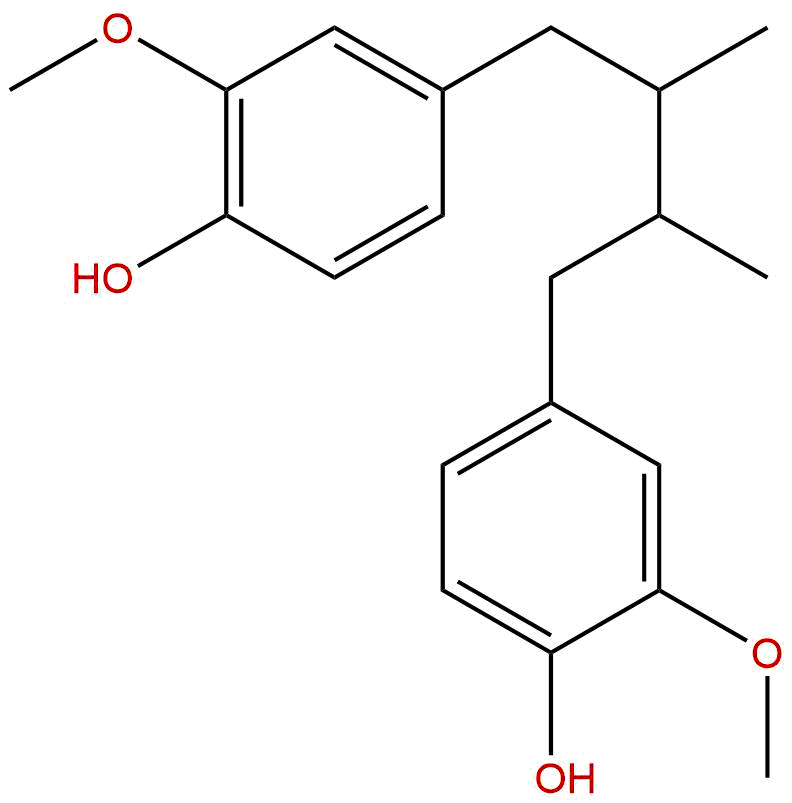


Product name: meso-dihydroguaiaretic acid
Synonym name: dihydroguaiaretic acid
Catalogue No.: BP1643
Cas No.: 66322-34-7
Formula: C20H26O4
Mol Weight: 330.424
Botanical Source: Sargentodoxa cuneata
Physical Description: Powder
Type of Compound: Lignans
Purity: 95%~99%
Analysis Method: HPLC-DAD or/and HPLC-ELSD
Identification Method: Mass, NMR
Packing: Brown vial or HDPE plastic bottle
The product could be supplied from milligrams to grams. Inquire for bulk scale.
We provide solution to improve the water-solubility of compounds, thereby facilitating the variety of activity tests and clinic uses.
For Reference Standard and R&D, Not for Human Use Directly.
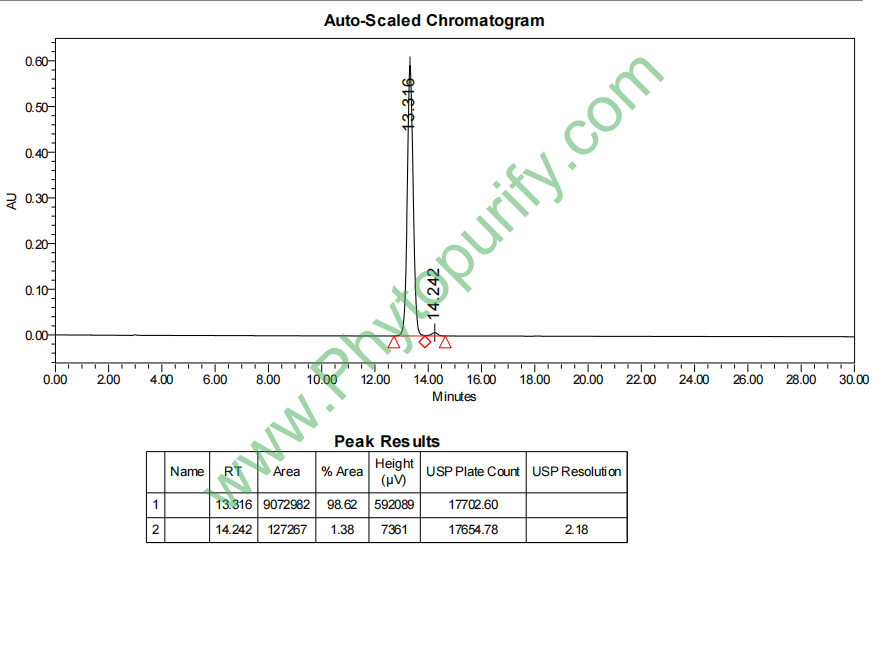
HPLC of meso-dihydroguaiaretic acid
Storage conditions:Short-term storage at 2~8℃, long-term storage at -20 ~ -80℃
58.9200
4.3821
4.3786
.0077
10.9094
13.3911
High
94.5566
2.8643
Yes
Yes
Yes
No
No
No
0.0
No
No
No
No
Natural products, as an important source of drug discovery, play an irreplaceable role in the history of human disease treatment. Lignin compounds are a class of phenylpropanoid dimers widely present in the plant kingdom, which have attracted much attention due to their structural diversity and wide range of biological activities. Meso dihydroguaiaretic acid (MDGA), as a typical lignan, has gradually become one of the hotspots in natural product pharmacology research due to its potential pharmacological value, especially in the fields of anti-inflammatory and anti-tumor, since its identification. This compound was initially isolated from the fruit of Saururus chinensis and later found in the bark of Machilus plants. Early studies have revealed its anti-cancer activity, but as research deepens, its role in regulating complex inflammatory networks becomes increasingly prominent, especially in autoimmune disease models such as rheumatoid arthritis, demonstrating the potential for multi-target intervention. Rheumatoid arthritis is an autoimmune disease characterized by chronic synovitis, joint destruction, and systemic complications. Its pathogenesis involves abnormal activation of multiple immune cells, inflammatory factors, and signaling pathways. Although current clinical drugs can alleviate symptoms, long-term use often accompanies side effects or insufficient efficacy. Therefore, finding new, efficient, and multi-target therapeutic molecules is an urgent issue that needs to be addressed. This article aims to systematically review the chemical properties, plant sources, pharmacological activities, molecular mechanisms of action, pharmacological characteristics, and clinical application prospects of racemic dihydroguaiacetinic acid, in order to provide comprehensive academic references for the in-depth research and development of this compound.
Meso dihydroguaiacetinic acid (CAS number: 66322-34-7) is a lignan compound. Its systematic chemical name can be described as 1,4-bis (2-methoxy-4-methylphenyl) -2,3-dimethylbutane, or more precisely defined as 2,3-dimethylbutane substituted with 2-methoxy-4-methylphenol groups at positions 1 and 4, respectively. Its molecular formula is C20H26O4 and its molecular weight is 330.4240 g/mol.
Structurally, the core of MDGA is a 2,3-dimethylbutane skeleton (C6 unit), with two guaiacol groups (i.e. 2-methoxyphenol) connected at each end. The "meso -" prefix indicates that although the molecule contains a chiral center, it lacks optical activity as a whole due to the presence of symmetry planes inside, making it a racemic molecule. This symmetrical diarylbutane structure is an important basis for its biological activity, and the methoxy and phenolic hydroxyl groups on the two aromatic rings are key pharmacophores involved in hydrogen bonding formation and interaction with target proteins.
In terms of physicochemical properties, based on the provided pharmacological parameters, MDGA exhibits typical hydrophobic characteristics. Its lipid water partition coefficient (LogP) is 4.3821, indicating strong lipophilicity. The topologically polar surface area (TPSA) is 58.92 Å ², which is relatively small, consistent with its presence of only two phenolic hydroxyl groups and two methoxy groups as polar groups. The water solubility is extremely low, only 0.0077 mg/mL, which suggests that in the development of formulations, it may be necessary to improve its solubility through techniques such as salt formation, cyclodextrin inclusion, or nanoformulation. It is worth noting that this compound has a high prediction of blood-brain barrier permeability, suggesting its potential application value in central nervous system related diseases. On early safety indicators, its hERG inhibition is' no ', indicating a low potential risk of arrhythmia; The Ames test result is 0.0, indicating no significant genetic toxicity risk, which provides a favorable safety starting point for its further development.
The distribution of racemic dihydroguaiacylic acid in nature is relatively limited, mainly concentrated in a few plants, which poses certain challenges for its resource development and also indicates specific biological sources.
Main plant sources:
Extraction and Separation Methods:
The extraction and separation of active ingredients in natural products usually follow the strategy of system solvent extraction combined with multiple chromatographic techniques. For MDGA, the standard procedure is as follows:
The racemic dihydroguaiacetinic acid exhibits various pharmacological activities, among which anti-cancer and anti-inflammatory effects are the most studied areas.
Antitumor activity The initial focus of MDGA activity was its anti-cancer potential. Research has shown that it has growth inhibitory and apoptosis inducing effects on various human cancer cell lines. For example, in liver cancer, breast cancer, colon cancer and other cell models, MDGA can inhibit cell proliferation in a dose-dependent manner, and trigger typical morphological changes of apoptosis and the emergence of biochemical markers (such as caspase-3 activation). Its anti-cancer mechanism may involve cell cycle arrest (such as G1 phase arrest), activation of mitochondrial pathway apoptosis, and inhibition of tumor cell invasion and metastasis ability.
Anti inflammatory and immune regulatory activity This is a highly promising direction in the pharmacological research of MDGA, especially in models related to rheumatoid arthritis. In the lipopolysaccharide (LPS) - induced macrophage (such as RAW264.7 cells) inflammation model, MDGA can significantly inhibit the production of nitric oxide (NO), prostaglandin E2 (PGE2), and key pro-inflammatory cytokines such as tumor necrosis factor - α (TNF - α), interleukin-6 (IL-6), and interleukin-1 β (IL-1 β). In animal models such as rat paw swelling induced by carrageenan or Freund's complete adjuvant, and collagen induced arthritis (CIA) mouse models, administration of MDGA can effectively reduce joint swelling, inflammatory cell infiltration, and cartilage destruction, demonstrating good in vivo anti arthritis effects.
antioxidant activity As a lignan containing phenolic hydroxyl groups, MDGA itself has the ability to scavenge free radicals. It can effectively scavenge DPPH radicals and ABTS radicals, and exhibits reducing power. Its antioxidant effect not only helps to directly alleviate oxidative stress damage, but may also indirectly exert protective effects by activating the intracellular antioxidant defense system (such as the Nrf2 pathway).
Other potential activities There are sporadic studies suggesting that MDGA may also have antibacterial, antiviral, and neuroprotective activities, but research in these areas is not yet systematic and requires further in-depth exploration.
The multifaceted therapeutic effects of racemic dihydroguaiacol on inflammatory diseases such as rheumatoid arthritis stem from its diverse regulation of complex cellular signaling networks. Existing research has revealed that it acts on multiple key targets and pathways, forming a mechanism network of multi-target synergistic effects.
Regulating the AMPK signaling pathway AMP activated protein kinase (AMPK) is a core regulator of cellular energy metabolism and an important anti-inflammatory and anticancer target. MDGA has been shown to activate AMPK through its catalytic subunit PRKAA1. The activation of AMPK can inhibit the mammalian target protein of rapamycin (mTOR) signaling and suppress abnormal cell proliferation; On the other hand, it can negatively regulate the activity of pro-inflammatory transcription factors such as nuclear factor kappa B (NF - κ B), thereby reducing the expression of inflammatory mediators.
Inhibition of TLR4/NF - κ B and STAT3 inflammatory axis Toll like receptor 4 (TLR4) is a key receptor that recognizes endogenous/exogenous danger signals and initiates innate immune responses. MDGA can inhibit TLR4 signaling, thereby blocking the excessive activation of downstream NF - κ B and mitogen activated protein kinase (MAPKs) pathways, which is one of the core mechanisms for reducing cytokine production such as IL-6 and TNF - α. Meanwhile, MDGA can also inhibit the phosphorylation and activation of signal transduction and transcription activator 3 (STAT3). Cytokines such as IL-6 activate the JAK-STAT3 pathway through their receptors, forming a positive feedback loop that continuously drives inflammation and cell survival. The inhibition of STAT3 by MDGA breaks this vicious cycle.
Regulating arachidonic acid metabolism and substrate degradation MDGA has inhibitory effects on 5-lipoxygenase (ALOX5) and matrix metalloproteinase-1 (MMP1). ALOX5 is a key enzyme that catalyzes the production of leukotrienes from arachidonic acid, which is a potent pro-inflammatory and chemotactic mediator. MMP1 can degrade collagen in the extracellular matrix and plays an important role in the destruction of articular cartilage in arthritis. Inhibiting these two targets exerts a protective effect on both the production of inflammatory mediators and tissue destruction.
Activate Nrf2 antioxidant pathway Nuclear factor E2 related factor 2 (NFE2L2/Nrf2) is the main switch regulating gene expression driven by antioxidant response elements (ARE). MDGA can promote Nrf2 nuclear translocation, upregulate the expression of phase II detoxifying enzymes and antioxidant proteins such as heme oxygenase-1 (HO-1) and quinone oxidoreductase 1 (NQO1), and enhance the cell's resistance to oxidative and inflammatory damage.
Affects other related targets MDGA can also inhibit the activity of indoleamine 2,3-dioxygenase 1 (IDO1). IDO1 participates in immune tolerance and suppresses T cell function by degrading tryptophan, and its inhibition may help restore normal immune surveillance. In addition, its regulatory effects on protein kinase C alpha (PRKCA) and phosphatidylinositol 3-kinase gamma (PIK3CG) are also involved in its complex regulation of cell proliferation, survival, and inflammatory response.
In summary, MDGA does not act on a single target, but rather forms a synergistic networked mode of action by simultaneously regulating multiple key signaling nodes such as AMPK, TLR4/NF - κ B, STAT3, Nrf2, etc. This may be the molecular basis for its excellent therapeutic effects in complex diseases such as rheumatoid arthritis models.
Based on the parameters provided in the previous text and existing research, a preliminary evaluation of the pharmacological properties of racemic dihydroguaiacetin acid is conducted.
Preliminary analysis of drug properties Roughly evaluated based on the variant of Lipinski's "Rule of Five": molecular weight (330.4)<500, number of hydrogen bond donors (2 phenolic hydroxyl groups)<5, number of hydrogen bond acceptors (4)<10, LogP (4.38) slightly above the threshold of 5. Overall, MDGA generally conforms to the common physicochemical characteristics of small molecule oral drugs, but its high LogP value suggests strong lipid solubility, which may lead to variability in oral absorption and challenges in formulation.
Prediction and Challenges of Absorption, Distribution, Metabolism, and Excretion (ADME):
Preliminary Safety Assessment The negative hERG inhibition and Ames test results provided are important early positive signals, reducing their primary concerns of cardiac toxicity and genotoxicity. However, comprehensive preclinical safety evaluations are still needed, including acute toxicity, long-term toxicity, reproductive toxicity, and broader screening for off target effects.
Current status of pharmacokinetic research Currently, there are very limited research reports on the pharmacokinetics of the MDGA system. Most of its key pharmacokinetic parameters, such as absolute bioavailability, half-life, tissue distribution characteristics, and major metabolic pathways, are unknown. This is a research gap that must be filled before the compound can move towards development and application.
As a natural lignan with multi-target activity, racemic dihydroguaiacetin has broad clinical application prospects, but also faces many challenges.
Potential therapeutic areas:
Development Strategy and Challenges:
Meso dihydroguaiacetinic acid is a lignin compound with significant biological activity isolated from traditional medicinal plants. It not only inherits the traditional advantages of multi-target and multi pathway synergistic effects of natural products, but also demonstrates the potential for precise regulation of key pathological links in complex diseases such as rheumatoid arthritis in modern pharmacological research - from inhibiting classic pro-inflammatory signals such as TLR4/NF - κ B and STAT3, to activating endogenous protective pathways such as AMPK and Nrf2. Its mechanism of action network is clear and logical. Although there are still challenges in drug formulation, especially in terms of water solubility and systemic pharmacokinetics, its good early safety and clear multi effect pharmacological activity have laid a solid foundation for its further development. In the future, through interdisciplinary collaboration, combined with the latest advances in medicinal chemistry, pharmacy, systems biology, and clinical medicine, the optimization and evaluation of racemic dihydroguaiacetin acid are expected to transform it from a potential natural active molecule into a new type of drug that can be used for clinical treatment, providing new options for the treatment of major diseases such as autoimmune diseases and tumors.
